Announced 13 Oct 2026 · Sources checked
What happened at OpenAI?
On 13 October 2026 the OpenAI Newsroom account posted on X that the company had “discovered a sophisticated recording device that was hidden inside one of our offices.” OpenAI said it “used our models to understand the device and where it had come from,” identified a specific employee who had planted it a few days earlier, and referred the matter to the FBI.
The company thanked “the agents and prosecutors who moved quickly to make an arrest” and said the FBI’s investigation is ongoing. It also said the employee had been fired.
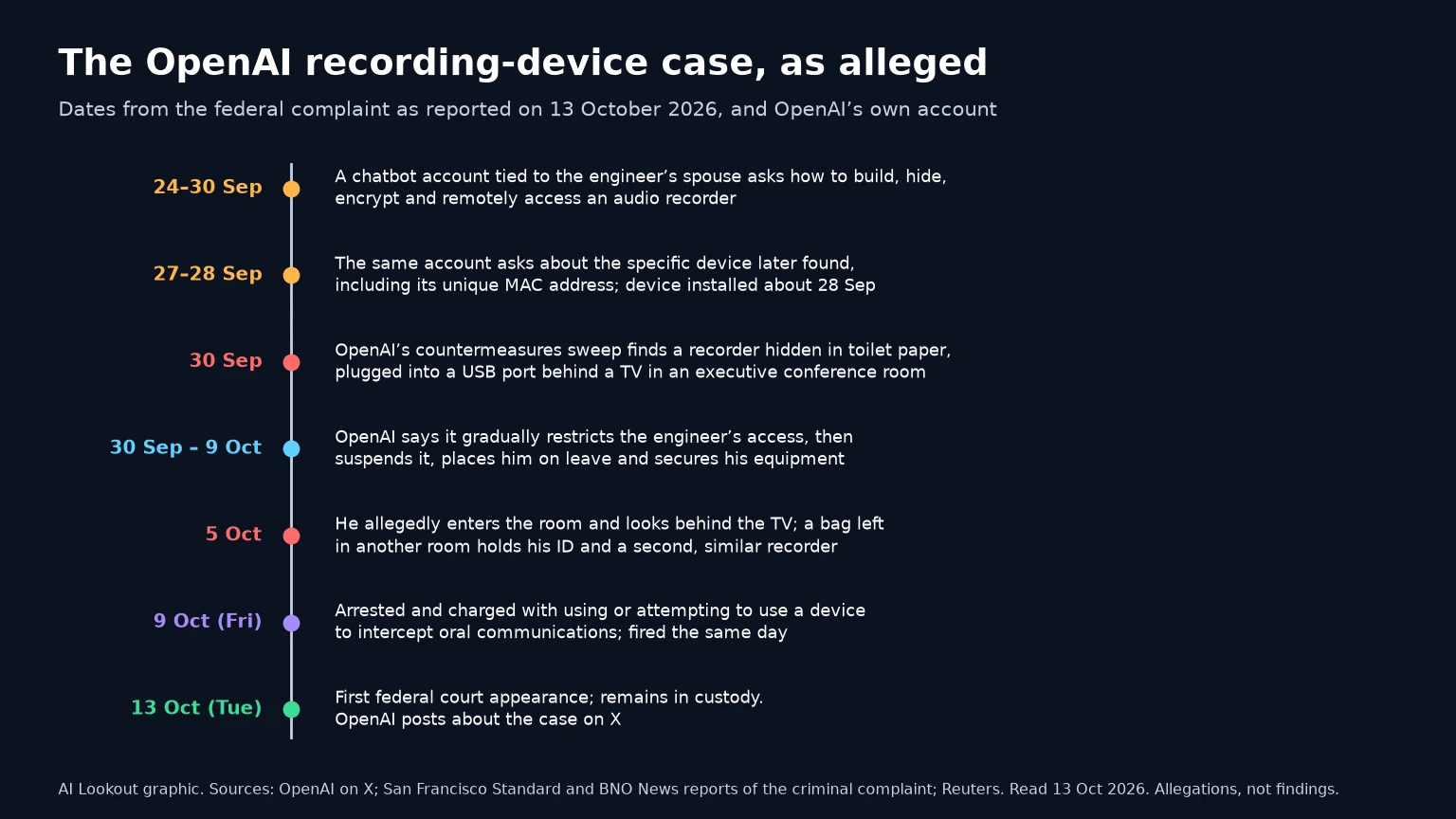
The same day, the US Attorney’s Office for the Northern District of California announced the charge, according to the San Francisco Standard and BNO News. Prosecutors named the engineer as Abdulrahman Alfozan, 35, a Saudi national who has worked at OpenAI since July 2025. He was arrested on Friday 9 October, made his first appearance in federal court on Tuesday 13 October, and remains in custody. AI Lookout could not find a public response from him or a lawyer.
What does the criminal complaint allege?
Both outlets describe the criminal complaint in similar terms. OpenAI staff found the device on 30 September, plugged into a USB port on the back of a television in an executive conference room at the company’s San Francisco offices. It had been wrapped in toilet paper, its contents were encrypted, and OpenAI determined it had been installed around 28 September.
Prosecutors say meetings in that room often involved confidential research, product plans, business strategy, government engagements and commercial relationships. Surveillance footage allegedly showed the engineer near the room several times before the discovery, although he was not authorised to enter it or attend meetings there.
The complaint also leans on digital records. Before the device was installed, it alleges, he used an internal productivity tool to ask about OpenAI’s building addresses, meeting rooms, room capacities and calendars, and where leadership and outside-partner meetings took place. Between 24 and 30 September, a chatbot account linked to his spouse, which shared identifiers with his own account, allegedly asked how to build a continuous audio recorder, add Wi-Fi, listen remotely and encrypt its SD card. On 27 and 28 September the account allegedly asked about the specific device later found, including its unique MAC address.
On 5 October, prosecutors say, he entered the conference room and appeared to look behind the television. That day security staff opened a bag he had left unattended in another room and found his wallet, ID and a second recording device similar to the first.
How did OpenAI use its own models in the investigation?
OpenAI’s public account is short, but the SF Standard reports more of what the company said. Its technical surveillance countermeasures team found the device during a sweep of the room. OpenAI described the recorder as built to evade detection, with strong encryption, audio monitoring and a way of moving data that was meant to avoid monitoring.
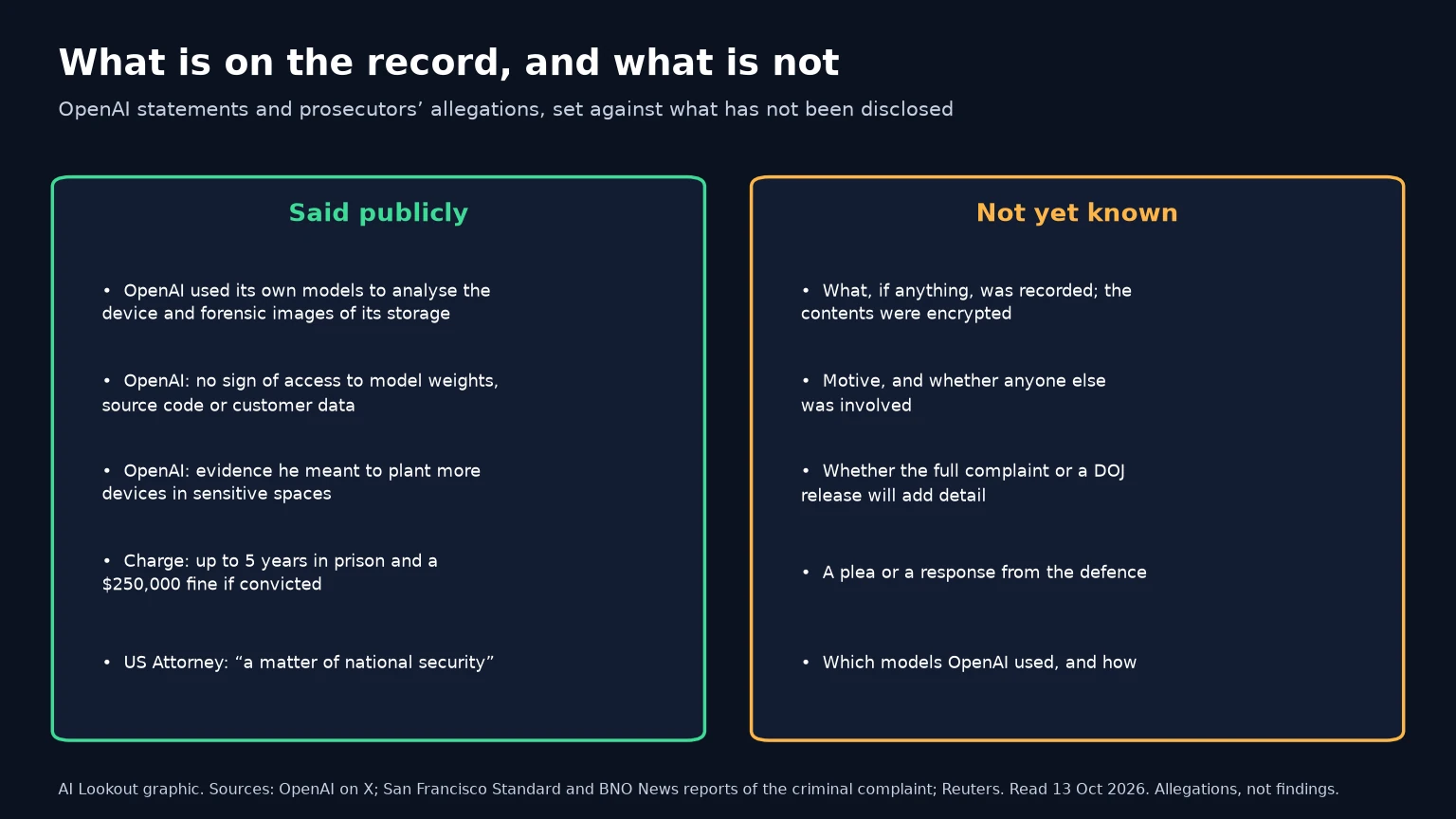
The company says investigators used its models to analyse forensic images of the device’s storage and to assess changes in the underlying data. It has not said which models it used, how they were set up, or how much of the attribution came from models rather than from footage, access logs and the bag found on 5 October.
That detail is still notable. AI labs regularly say their models can help defenders, and OpenAI publishes reports on how it uses them to find and disrupt misuse, such as its recent takedown of Russia- and Iran-linked “false front” operations. This case applies the same idea to physical security inside OpenAI’s own building.
The case also shows the reverse. Much of the evidence described in the complaint comes from what someone allegedly typed into an internal tool and a chatbot. Logs of AI conversations are becoming ordinary evidence, and anyone who uses these tools at work should assume their questions can be read and correlated.
What does OpenAI say was not taken?
OpenAI said that, at this point, it has no indication that the person inappropriately accessed or exfiltrated model weights, source code or customer data. Those are the assets AI labs and governments worry about most, because stolen weights would hand over a finished model.
According to the SF Standard, OpenAI says it gradually restricted the engineer’s access to systems and spaces from 30 September, then suspended his physical and network access, put him on leave and secured his company equipment. It timed the firing with the FBI so as not to disrupt the investigation; he was fired on 9 October, the day of the arrest.
OpenAI also says it has evidence he intended to place other recording devices in sensitive spaces. It has not said what that evidence is. Because the recorder’s contents were encrypted, nobody has said publicly whether any conversations were captured.
What is the charge, and what happens next?
He faces one count of using or attempting to use a device to intercept oral communications. If convicted, he could face up to five years in prison, a $250,000 fine and three years of supervised release. The case is handled by the office’s National Security, Cyber and Special Prosecutions Section.
Officials framed it in security terms. “For us it is a matter of national security,” US Attorney Craig Missakian said, according to the SF Standard. FBI Director Kash Patel said protecting American AI innovation is among the bureau’s highest counterintelligence priorities.
Neither the charge nor the reported statements accuse him of spying for a foreign government, and no motive has been given. A complaint is an accusation, and he is presumed innocent unless proven guilty. The next steps are a detention decision and, usually, an indictment or preliminary hearing.
Why does this matter for AI labs?
Frontier labs hold trade secrets that are worth billions and that governments treat as strategic, and their meeting rooms carry talks with partners and officials. That makes insiders, not only outside hackers, part of the threat model.
Microsoft chief executive Satya Nadella recently argued that frontier models themselves should be treated like insider risks. The OpenAI case is a reminder that the human version of that risk has not gone away, and that labs now run counter-surveillance sweeps of their own offices.
It is also the second security-related staff matter OpenAI has made public in under two weeks. Earlier in October it said it had parted ways with three safety researchers over the handling of sensitive information, which the researchers dispute in an open letter. Nothing in OpenAI’s statement or the reporting on the complaint links the two cases, and they involve very different allegations.
Governments are moving in the same direction. The UK’s new AI risk package, for example, weighs incident reporting for frontier AI, and US officials now describe AI lab security as counterintelligence work.
What is still unknown?
Several basics are still missing: what, if anything, the recorder captured; who the information was meant for; whether anyone else was involved; and what OpenAI’s models actually did in the investigation. AI Lookout has not read the complaint itself, and the details above come from OpenAI and from news reports describing the filing. We will update this article if court records or the Justice Department add material detail.
Common questions
What was found in OpenAI’s office?
According to the complaint as reported, an encrypted audio recorder wrapped in toilet paper and plugged into a USB port behind a television in an executive conference room in San Francisco. OpenAI found it on 30 September 2026, and a second, similar device was later found in a bag.
Did the employee steal OpenAI’s model weights or code?
OpenAI says that, at this time, it has no indication the person inappropriately accessed or exfiltrated model weights, source code or customer data. The FBI investigation is ongoing.
What charge does the OpenAI engineer face?
One count of using or attempting to use a device to intercept oral communications. It carries up to five years in prison and a $250,000 fine if he is convicted. He has not been convicted and is presumed innocent.
What to remember
Prosecutors have charged an OpenAI engineer with bugging an executive conference room, and OpenAI says its own models helped trace the device. The company reports no sign that weights, code or customer data were taken, but what was recorded, and why, is still unknown.
Sources & further reading
How this story was made
Written by Kristian Kostov with AI assistance and checked against the linked sources. Company performance claims are attributed to the company. Analysis reflects AiLookout’s interpretation; we have not independently tested the products discussed. Cover photography is illustrative and does not depict the specific announcement or product.
Our editorial standards