Announced 21 Oct 2026 · Sources checked
What NVIDIA released
NVIDIA has added five open models to its Nemotron Retriever collection, aimed at the search and document steps that sit underneath AI agents. In a Hugging Face blog post published on 21 October 2026, the company introduced Nemotron 3.5 Embed in 8B BF16, 1B BF16 and 1B NVFP4 versions, Nemotron 3.5 Rerank 8B BF16, and Nemotron 3.5 Parse, a 631-million-parameter document parser. The same day NVIDIA listed them in its GTC Berlin roundup of open models for Europe, alongside Nemotron 3.5 Super VL, Kumo, Cosmos 3.5 and Alpamayo 2 Edge.
NVIDIA's pitch is about agent efficiency rather than search for its own sake. The blog argues that when an agent retrieves incomplete or irrelevant evidence, it repeats searches and reads more documents, burning inference tokens. In NVIDIA's agentic tests on ViDoRe v3, BRIGHT and BrowseComp-Plus, with the agent model, tools and tasks held fixed, adding Nemotron 3.5 Rerank cut total agent tokens per query by about 14 percent with the 8B embedder and 13 percent with the 1B embedder, while improving retrieval accuracy. With the 8B embedder, the reranker scored about 0.9 points higher nDCG@10 than Qwen3-VL-Reranker-8B at a similar token cost. Those are NVIDIA's measurements.
Embed: searching pages as images and text
The headline change in Nemotron 3.5 Embed is that it can retrieve document pages from images as well as text, so tables, charts, infographics, datasheets and schematics become searchable without first being converted to text. According to the Embed 8B model card, queries are text only, while documents can be an image, text or both. Token-level states are mean-pooled into a 4,096-dimensional vector, which can be truncated to smaller sizes such as 1,024 or 512 dimensions, and the maximum sequence length is 32,768 tokens including image tokens.
The 8B model builds on Mistral's Ministral-3-8B-Instruct for its vision encoder, with the language component initialised from the earlier Nemotron 3 Embed 8B and kept frozen during training. NVIDIA says that means text-only embeddings should match the corresponding Nemotron 3 Embed models, so teams with existing text indexes can add image retrieval without re-embedding everything. The 1B models are distilled from the 8B teacher, and the NVFP4 variant quantises both the text and image encoders.
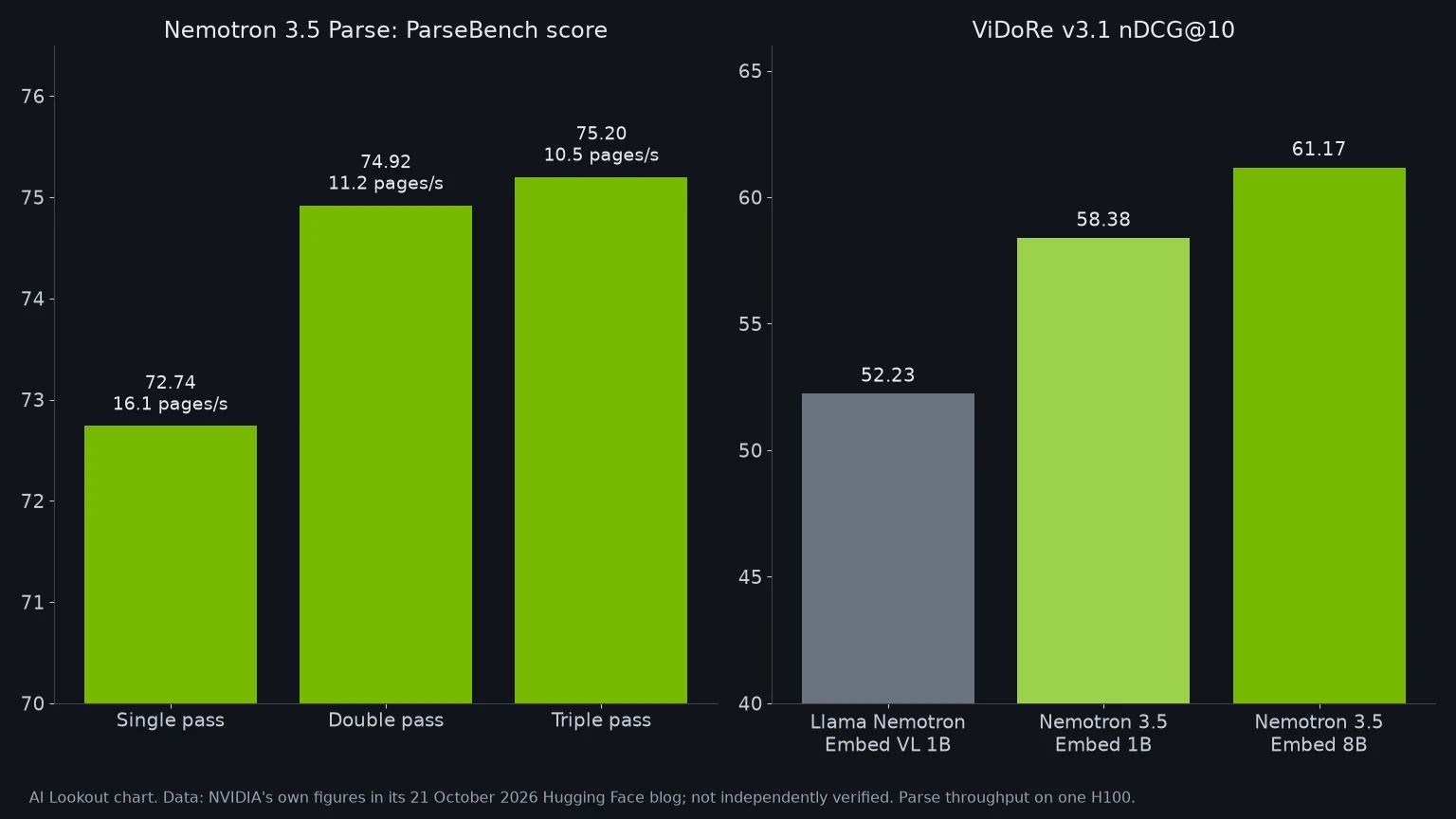
On NVIDIA's numbers, Embed 8B scores 61.17 nDCG@10 on ViDoRe v3.1, first among dense retrieval models on that leaderboard as of 20 October, and 8.94 points above the older Llama Nemotron Embed VL 1B. The 1B version keeps 95.4 percent of the teacher's score at 58.38. On the multilingual MIRACL Vision set the 8B model reaches 72.6, which NVIDIA says is 4.3 points above Qwen3-VL-Embedding-8B. NVIDIA also compares against Google's EmbeddingGemma 2, which targets on-device multimodal search at a much smaller size. The NVFP4 1B model, NVIDIA says, processes 128.8 documents per second on GB200 against 101.3 for BF16, a 27.1 percent gain, while keeping 99.85 percent of accuracy on ViDoRe v3.
Rerank: sorting evidence for agents
Nemotron 3.5 Rerank 8B is a cross-encoder: instead of comparing two separately computed vectors, it reads each query and candidate document together and outputs one relevance score. Its model card describes a Pixtral-based vision encoder and a bidirectional Ministral 3 language tower, with an MLP head producing the score. Candidates can be text, images or both, and the context limit is 32,768 tokens.
NVIDIA and the MTEB team launched a ViDoRe v3.1 reranking leaderboard alongside the release. On combined image and text inputs, Rerank 8B scored 60.49 nDCG@10 against 59.17 for Qwen3-VL-Reranker-8B, with both models reranking the top 50 candidates from the Embed 1B model. A reranker adds latency and compute to every query, so the trade-off is whether better ordering saves more downstream agent tokens than it costs. NVIDIA's agent experiments suggest it does in their setup.
Fine-tuning is part of the package. NVIDIA published recipes that combine synthetic query generation, hard-negative mining and training with NeMo AutoModel. On a test set of 8,202 chart and infographic images, one epoch of fine-tuning raised Embed 1B from 37.34 to 44.12 nDCG@10, an 18 percent relative gain, but only lifted Embed 8B from 41.44 to 42.75. Perplexity, which recently open-sourced its pplx-decider models, reported that Rerank 8B achieved the highest average on its private 72-task reranking benchmark.
Parse: turning document pixels into structure
Nemotron 3.5 Parse handles the step before search: turning scanned pages and image-based PDFs into structured text. It identifies document elements, their positions and reading order, and outputs Markdown, HTML tables and structured blocks for tables and charts. The Parse model card lists 630.8 million trainable parameters including a multi-token prediction head, a recommended maximum input of 1,664 by 2,048 pixels, and a Hugging Face release date of 17 October.
NVIDIA says Parse ranks first on ParseBench among models under one billion parameters, scoring 75.20 at 10.5 pages per second on a single H100 in triple-pass mode. Developers can trade accuracy for speed with the same weights: a single pass scores 72.74 at 16.1 pages per second, and a double pass, which revisits tables and charts, scores 74.92 at 11.2. Training used enterprise documents, scientific papers, forms and synthetic multilingual data, and NVIDIA reports OCR evaluations across 163 language and script combinations.
NVIDIA credits LightOn's open models and technical write-ups as pivotal to Parse. That puts it in direct conversation with LightOnOCR-3, which shipped Apache-2.0 OCR weights with layout boxes earlier this month. Post-training used GRPO with custom rewards to reduce repetitive loops and unclosed blocks and to keep tables and chart schemas consistent, problems that have plagued generative OCR.
Licence, access and partners
The weights are on Hugging Face under the OpenMDW License Agreement 1.1, which NVIDIA describes as open and commercially usable; the Embed card notes that the Ministral base model is under Apache 2.0. NVIDIA also offers the models as NIM microservices on build.nvidia.com, and in its own test on an RTX PRO 6000 Blackwell Server Edition the Embed NIM served 6,031 query requests per second, about 2.9 times a comparable vLLM configuration.
Hosted access is spread across several inference providers. Baseten carries Embed, Rerank and Parse, while DeepInfra, FriendliAI and OpenRouter list the two Embed sizes and Rerank 8B. Elastic customers can reach Nemotron Retriever embedding and reranking models through Elasticsearch's Inference API, Turbopuffer has added Embed 8B as a native embedding option, and Vectorize reported that Embed ranked first on two long-conversation memory benchmarks in its Hindsight evaluation.
The release extends the open Nemotron 3.5 family NVIDIA began rolling out last week with Nemotron 3.5 Super VL and Bolt. Together they let a team build a retrieval pipeline end to end on NVIDIA-published models: Parse to extract, Embed to index and search, Rerank to order the evidence, and a Nemotron language model to reason over it.
What to check before adopting
Nearly every number in the launch comes from NVIDIA or its partners. The leaderboard positions are dated 20 October and retrieval leaderboards move quickly. The agent-token savings come from NVIDIA's own pipeline, with one agent model and fixed tasks, and may look different with other agents, corpora or chunking choices. Partner results from Perplexity and Turbopuffer use private or in-house benchmarks that outsiders cannot rerun.
There are practical costs too. The 8B embedder produces 4,096-dimensional vectors by default, which is large for big indexes unless teams truncate them, and image-based retrieval means storing and embedding page images. NVFP4 throughput gains depend on Blackwell-class hardware. The frozen language tower is helpful for re-use, but it also means text-only quality should be about the same as Nemotron 3 Embed, so the main reason to upgrade is visual retrieval. As always, the OpenMDW terms and the base model licences should be read before production use.
Common questions
Are the Nemotron 3.5 retrieval models free for commercial use?
NVIDIA describes them as open and commercially available under the OpenMDW License Agreement 1.1. Read those terms and the Apache 2.0 licence of the Ministral base model before deploying.
Do I need to re-embed my existing text index?
NVIDIA says the language component was frozen during training, so text-only embeddings should match the matching Nemotron 3 Embed models. Images are the new capability.
Where can I run them?
On Hugging Face, as NVIDIA NIM microservices, and through providers including Baseten, DeepInfra, FriendliAI and OpenRouter, with Elastic and Turbopuffer integrations.
Sources & further reading
How this story was made
Written by Kristian Kostov with AI assistance and checked against the linked sources. Company performance claims are attributed to the company. Analysis reflects AiLookout’s interpretation; we have not independently tested the products discussed. The cover places the companies’ own logos, taken from public-domain or openly licensed files credited in the caption, on a plain background. It is not a product photograph, a screenshot, or an endorsement.
Our editorial standards