Announced 22 Oct 2026 · Sources checked
What NVIDIA announced for Cosmos
NVIDIA published a round of updates to Cosmos, its family of open world models and tools for physical AI, on 22 October 2026 during its GTC conference in Berlin. The NVIDIA blog post groups the changes into three parts: Cosmos Data Factory, a set of cloud-native blueprints for building training data; Cosmos Framework, a training and optimisation toolkit now extended to other open models; and new Cosmos 3 Nano model variants for testing autonomous driving and robot policies in simulation, alongside updated Cosmos 3 NIM inference microservices.
World models are AI systems that learn how scenes change over time, so they can predict, generate or simulate video of the physical world. Robot and autonomous-vehicle teams use them to create training footage of situations that are rare, dangerous or expensive to film, and to test driving or manipulation software before it reaches a real machine. NVIDIA's pitch is that its stack now covers the whole loop, from curating data through training and evaluation to deployment, with each piece usable on its own.
NVIDIA also says the Cosmos platform ranks in the top five on six open-model leaderboards. The post does not name the leaderboards, so that claim cannot be checked from the announcement.
Cosmos Data Factory and its five blueprints
Cosmos Data Factory is the largest piece. NVIDIA describes it as tools and agent skills for labelling, curating, augmenting and evaluating training data at scale. Its GitHub repository calls it "a set of agent-driven blueprints and composable skills that turn real data into a large, labeled training dataset for physical AI," running on a customer's own GPUs on premises or in a cloud. NVIDIA says the blueprints are available through GitHub, Microsoft Azure, Nebius and CoreWeave.
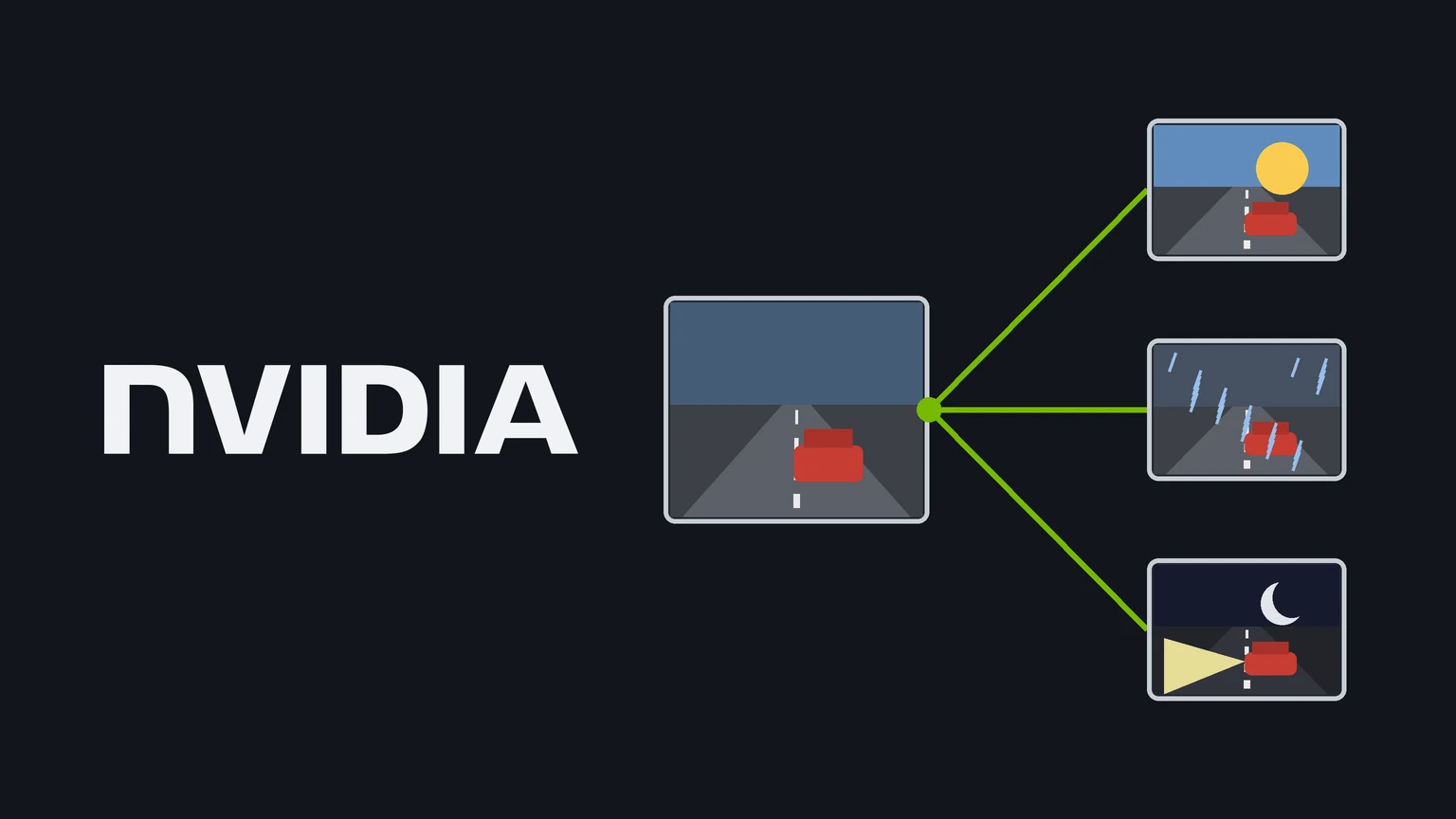
There are five reference blueprints. Autonomous Vehicle Dataset Generation finds driving clips similar to an example video and can generate Cosmos 3 variants of them, so a team short of, say, unprotected left turns in heavy rain can multiply the examples it has. Defect Image Generation turns reference images of printed circuit boards, metal and glass parts into simulated components and adds generated defects for inspection models. Event Video Generation turns a single still image into short annotated videos of events such as fires, falls, shoplifting or fights. Image Attribute Augmentation varies clothing, colour and footwear on crops of people to improve person search. Video Data Augmentation changes the weather, lighting and environment of existing footage while keeping the scene's structure, and labels the result.
Cosmos Curator, NVIDIA's GPU-accelerated tool for curating video datasets, now also handles multimodal, multisensor inputs, according to the blog. That matters for vehicles and robots, which record lidar, radar and several cameras at once rather than a single video stream.
How the blueprints run
The repository is more concrete than the blog about what it takes to run all this. Every blueprint runs as an Apache Airflow workflow through a component called CDF Orchestration and is supported on Kubernetes; Event Video Generation and Video Data Augmentation can also run on NVIDIA's OSMO backend. Prerequisites include a Kubernetes cluster, object storage, a container registry, an NGC API key and a Hugging Face read token, and GPU requirements vary by blueprint.
The blueprints are assembled from core skills that can also be used alone: AnomalyGen for defect images with masks, augmentation with Cosmos models, auto-labelling for detection, tracking and captions, curation and retrieval with Cosmos Curator and Cosmos Dataset Search, orchestration, and simulation that renders labelled images from 3D scenes with Isaac Sim and Omniverse Replicator.
Two details stand out. First, the generated output is checked by Cosmos Evaluator, which the repository says measures physical accuracy and object fidelity, with checks for hallucination, object consistency, attribute verification and physical plausibility. Synthetic video that breaks physics can teach a model the wrong lessons, so an automated filter is a sensible step, though NVIDIA does not publish how often it rejects clips. Second, setup is designed to be driven by a coding agent: the README suggests asking an agent to clone the orchestration repository and run a preflight check that audits the environment without changing anything before setup proceeds.
Cosmos Framework: training other open models
The second part is Cosmos Framework, which the repository describes as an end-to-end framework for training and serving world models, including the Cosmos 3 family. It bundles a distributed trainer, import and export of Hugging Face safetensors checkpoints, adapters for JSONL, WebDataset and LeRobot datasets, inference through Diffusers, Transformers and vLLM, a server for deploying Cosmos 3 policies, and post-training methods including supervised fine-tuning, preference training, reinforcement learning and distillation.
What is new, according to NVIDIA, is that these training, optimisation and deployment recipes are now packaged as agent skills and extended beyond Cosmos to other open models, naming GR00T, Alpamayo, Qwen and Pi0.5 and other compatible Hugging Face models. In practice that means a team could fine-tune a robot policy or a driving model with the same tooling NVIDIA uses for Cosmos, then shrink it with distillation and quantisation for deployment.
The repository describes Cosmos 3 as a suite of "omnimodal" world models that process and generate language, images, video, audio and action sequences in one Mixture-of-Transformers architecture. We covered one specialised member of that family, NVIDIA's Cosmos3-H-Dreams surgical simulator, earlier this week. The shipped training recipes are 8-GPU configurations tested on eight H100 80GB cards, which gives a sense of the hardware involved even for fine-tuning.
NVIDIA cites one example: the robotics research lab MicroAGI post-trained Cosmos 3 on videos of humans manipulating objects and distilled its 32-billion-parameter reasoner into an 8-billion-parameter Nano model "with no loss in accuracy." NVIDIA does not say which benchmark was used. Roboflow is also offering labelling and Cosmos 3 post-training on its platform, with deployment to Roboflow's hosted service or to on-premises NVIDIA GPUs.
Cosmos 3 Nano for closed-loop simulation and faster NIMs
The third part is new Cosmos 3 Nano variants for simulation. NVIDIA says they let developers test autonomous policies in repeatable, hard-to-capture scenarios with multiple camera views and sensors, and that accompanying code lets teams adapt the models to train and evaluate their own policies for autonomous vehicles and two-armed robots in interactive, closed-loop simulation before real-world testing. Closed loop means the simulated world reacts to what the policy does, rather than replaying a fixed recording, which is what makes it useful for testing decisions rather than perception alone.
For deployment, NVIDIA says updated Cosmos 3 NIM microservices deliver up to twice as fast inference with no quality loss in validated configurations, and that continuous video analysis can raise alerts in under a second. A new version 3.3 of the Metropolis blueprint for video search and summarisation, built on those microservices, is said to monitor 40 percent more video streams on the same GPU. Both figures are NVIDIA's, and the qualifier "validated configurations" means the speedup will not necessarily hold on every setup.
Early users and their numbers
The most striking numbers come from customers. NVIDIA says Porsche is leading a shared autonomous-vehicle data flywheel across Volkswagen Group brands, using Cosmos Data Factory through the data platform Voxel51 on Microsoft Azure. A Microsoft blog post dated 21 October says the work, with Volkswagen Group brands and the software unit CARIAD, is expected to cut repeated physical test drives by up to 90 percent and shorten AI regression test cycles by up to 85 percent. NVIDIA's blog phrases the second figure as development cycle times. Either way, these are expectations, not measured results. Voxel51 recently added a data agent to its platform, which is the layer Porsche's engineers work in.
Inspection-robot maker ANYbotics offers the most detailed evidence. In a write-up by the data platform Encord, published 21 October, Encord says the Event Video Generation skill produced more than 1,500 clips from 410 reference images across nine kinds of change. ANYbotics used frames from those clips to calibrate the change-detection model its ANYmal robots run on repeat patrols. Across 25 inspection points, anomaly recall rose 24 percent; for liquid spills, detection accuracy rose 10 percent. ANYbotics estimates the spill gain alone is worth over $22,000 per site a year, more than 400 times the cost of generating the data. That is a single customer's own evaluation, dated 25 September, not an independent study.
NVIDIA also says Ultralytics retrained its YOLO detection model with real images plus synthetic defects and improved defect localisation and recall, without giving figures, and that the energy company ADNOC uses Fogsphere's MistIQ platform, built on Cosmos and the Metropolis blueprint, to detect safety hazards across 65 sites.
What to watch and what is unproven
The announcement fits NVIDIA's push to make Europe a physical-AI market this week, alongside its Alpamayo driving software, which Bolt picked for its Lucid robotaxis, and reference humanoids such as Agile Robots' Agile ONE SN built on Isaac GR00T. Cosmos Data Factory is the plumbing that would feed such systems with data.
Several things remain unclear. NVIDIA does not give pricing for the blueprints beyond their availability on GitHub and partner clouds, and running them assumes a Kubernetes cluster and GPUs. The leaderboard ranking, the twofold NIM speedup and the MicroAGI distillation result have no published method in the announcement. And synthetic data has known risks: if generated clips share subtle artefacts, a model can learn the generator's habits instead of the world's. Cosmos Evaluator is meant to catch that, but independent tests of how well it does are still to come.
For teams already working on robots, inspection or driving software, the practical news is that the repositories are public now and the customer figures give a rough sense of the payoff. The claims that matter most, about safety and real-world transfer, will need results outside NVIDIA's own posts.
Common questions
What is NVIDIA Cosmos Data Factory?
A set of open, agent-driven blueprints and skills that curate, label, augment and generate training data for physical AI, running as Airflow workflows on Kubernetes on your own GPUs or partner clouds.
Is Cosmos Data Factory free to use?
The repositories are public on GitHub, and NVIDIA did not announce separate pricing. You still need a Kubernetes cluster, GPUs, an NGC API key and a Hugging Face token, plus any cloud costs.
What are Cosmos 3 Nano simulation models?
Smaller Cosmos 3 variants NVIDIA says can generate repeatable multiview, multisensor scenarios for testing autonomous-vehicle and two-armed robot policies in closed-loop simulation before real-world trials.
Sources & further reading
- NVIDIA Cosmos Opens New Tools to Train, Evaluate and Deploy World Models ↗
- NVIDIA/cosmos-data-factory: Synthetic Data Generation Workflows for Physical AI ↗
- NVIDIA/cosmos-framework ↗
- Advancing autonomous vehicle development with Microsoft, NVIDIA, Porsche, and Voxel51 ↗
- NVIDIA Cosmos Data Factory and Encord: synthetic anomaly data for ANYbotics ↗
How this story was made
Written by Kristian Kostov with AI assistance and checked against the linked sources. Company performance claims are attributed to the company. Analysis reflects AiLookout’s interpretation; we have not independently tested the products discussed. The cover places the companies’ own logos, taken from public-domain or openly licensed files credited in the caption, on a plain background. It is not a product photograph, a screenshot, or an endorsement.
Our editorial standards