Announced 20 Oct 2026 · Sources checked
What NVIDIA and the Baker Lab released
NVIDIA and the University of Washington's Institute for Protein Design (IPD) released RFD4-Proteina, an open model for designing proteins and other biomolecules, as part of a batch of healthcare announcements at NVIDIA's GTC Berlin conference on 20 October 2026. The model's weights are on Hugging Face, its code is on GitHub under a BSD 3-Clause licence, and NVIDIA is also serving it as a hosted BioNeMo endpoint. A project page with the full results went up alongside the release, with a preprint listed as forthcoming.
The lab behind it is run by David Baker, who shared the 2024 Nobel Prize in Chemistry for computational protein design. “We are moving from an era of discovering the proteins nature has made to one in which we can design entirely new ones,” Baker said in NVIDIA's announcement, pointing to uses from drug discovery to enzymes that break down pesticides. The model is a collaboration between the IPD and NVIDIA's generative-AI research group, with contributors from more than twenty institutions.
Where tools such as AlphaFold predict the structure of a protein from its sequence, design models work in the other direction: you specify what you want a molecule to do, and the model proposes a sequence and structure that should do it. RFD4-Proteina is the latest in the Baker lab's RFdiffusion line, and its pitch is breadth: one model that handles many design jobs that previously needed separate specialist tools.
How RFD4-Proteina works
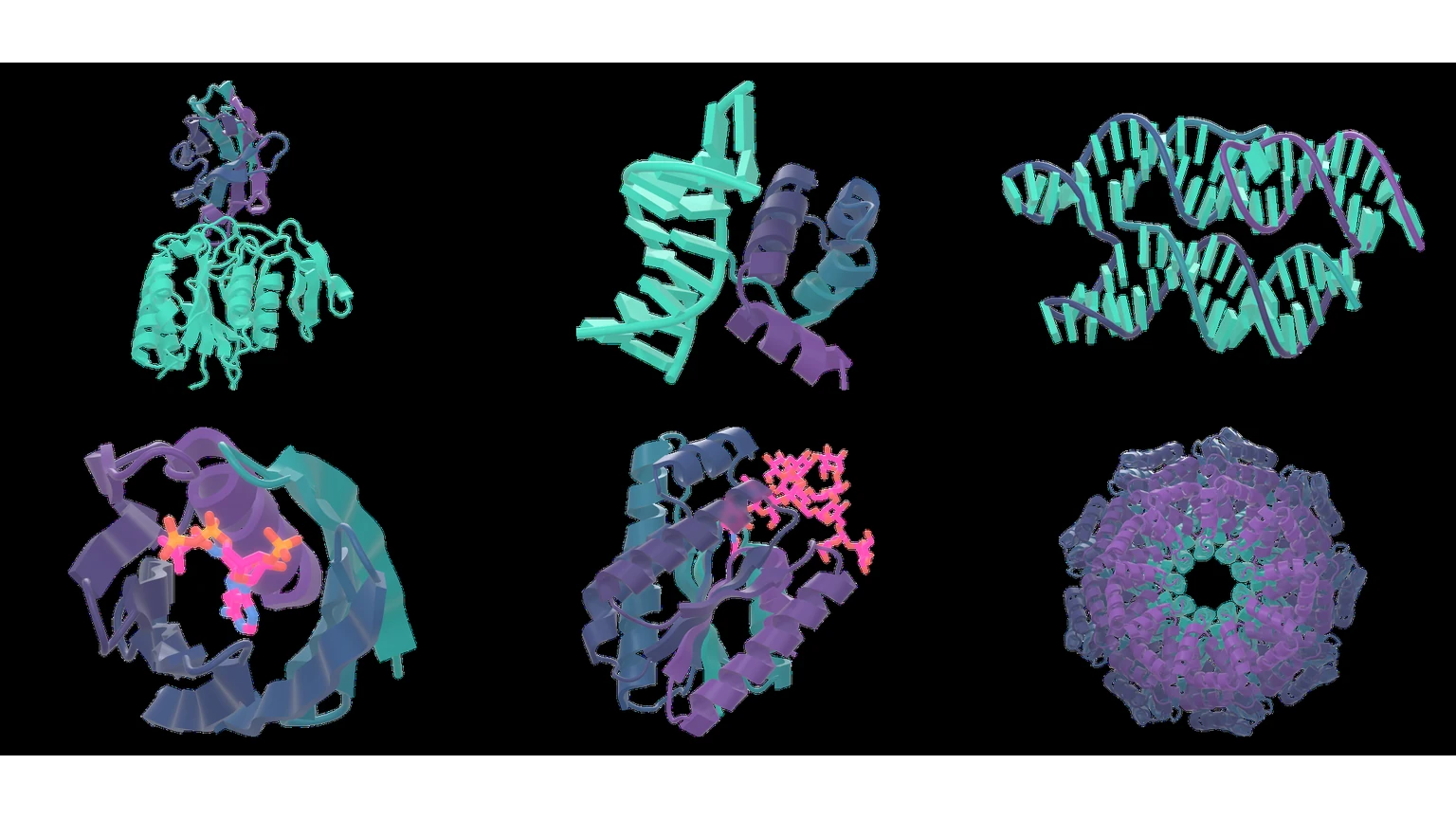
RFD4-Proteina is a flow-matching generative model, a close relative of diffusion models. Its key design choice is a single shared latent space that covers standard and modified amino acids, sugars, DNA and RNA, trained against force-field energies so that the structures it generates are physically plausible. Because every kind of building block lives in the same space, the model can design a protein, a protein that binds DNA, an enzyme wrapped around a small molecule, or a glycosylated complex without switching models. It generates sequence and all-atom structure together rather than designing a backbone first and filling in the amino acids afterwards.
The authors describe two kinds of reasoning. “Intrinsic” reasoning uses recurrent refinement: the model can loop over its own internal representation more times for harder parts of a design, spending more computation where it is needed. The release ships three presets, named low, medium and high thinking, that run 120, 180 or 300 trunk evaluations across 60 denoising steps. “Extrinsic” reasoning is a reward-guided beam search over the generation path, scoring partial designs against metrics such as predicted structure quality or geometric constraints and keeping the most promising branches. This is a different route to quality than the per-design hallucination used by tools like BindCraft.
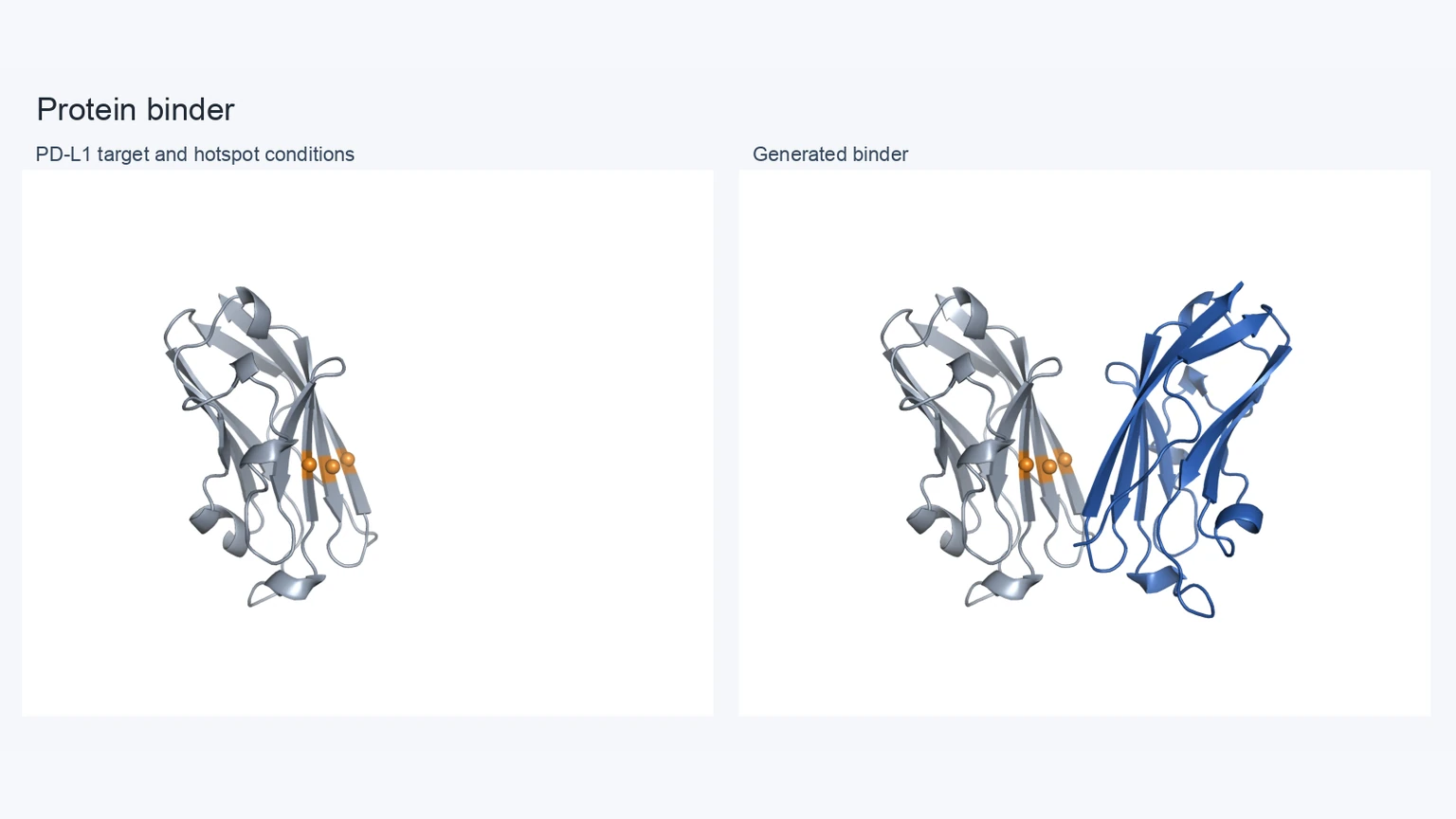
Conditioning is handled through annotated structure files or text-based YAML specifications that pin down fixed motifs, hotspots, burial or hydrogen bonds. The model covers monomer generation, protein and DNA binders, antibodies and nanobodies, enzyme and motif scaffolding, small-molecule pockets, partial diffusion to refine an existing structure, and inverse folding. The released checkpoint is a matched pair of a flow model and an autoencoder, about 436 million parameters and a 1.74 GB download, and it runs on NVIDIA GPUs from the Ampere generation onward. It sits in the same fast-moving area as other recent open design work such as Prompteina's text-conditioned structure generation.
What the in silico benchmarks claim
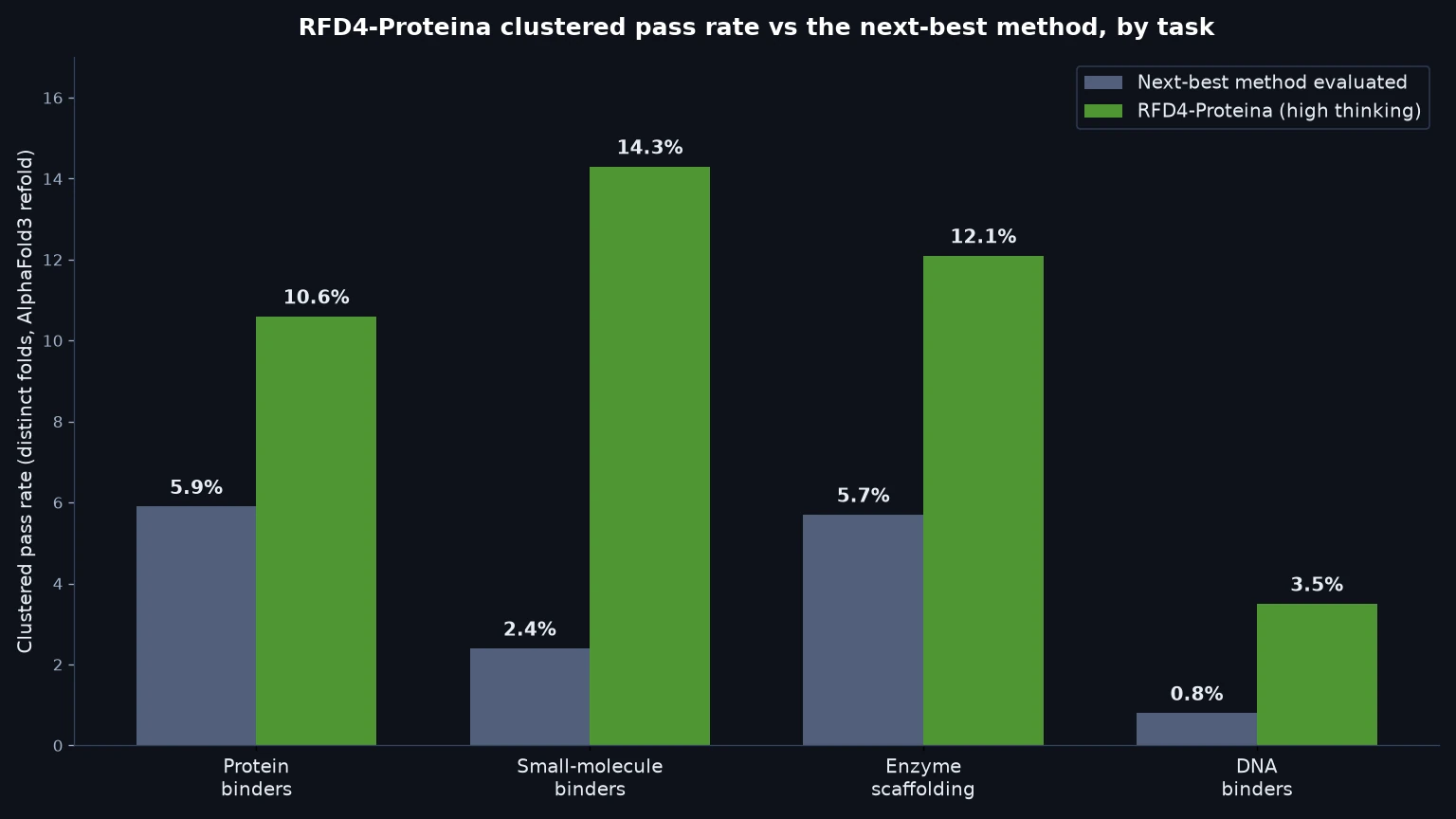
The headline numbers are computational. The developers refold each designed sequence with AlphaFold3 and check it against the intended structure and task-specific criteria, then report a “clustered” pass rate that counts only distinct folds, so repeating one success earns nothing. On this measure, at its high-thinking setting, RFD4-Proteina reports a 10.6% clustered pass rate on protein binding against 5.9% for the next-best method evaluated (BindCraft), 14.3% versus 2.4% on small-molecule binding, 12.1% versus 5.7% on enzyme scaffolding, and 3.5% versus 0.8% on DNA binding. The project page frames these as higher success rates at higher throughput than every other method it tested.
The breadth claim is that the model solves more targets, not just a higher rate on easy ones: passing designs for 22 of 24 protein targets, all 77 small-molecule targets, 35 of 37 enzyme tasks and all three DNA targets. More thinking trades speed for quality in the expected way; on protein binding the clustered pass rate rises from 7.7% at low thinking to 10.6% at high, while throughput falls from about 2,388 to 986 designs per GPU-hour.
These are the developers' own figures, run on only a few dozen targets per task and not independently reproduced, and they measure computational pass rates rather than molecules that work in a tube. One of the baselines RFD4-Proteina compares itself against, Google DeepMind's AlphaProtein-novo, is itself a recent release, which is a reminder of how quickly the frontier here is moving and how hard apples-to-apples comparison is.
What the lab tests showed
A design model is only as good as the molecules it makes in the lab, and this release leans harder on wet-lab validation than most. The team reports calcium-dependent calmodulin binders, with 12 of 18 designs binding below one micromolar and showing no binding without calcium; binders to peptide-MHC complexes with more than a hundredfold preference for the intended peptide, including off-targets that differ by just one or two residues; and what it says are the first de novo binders to the YAP1 and Tau disordered peptides, with measured affinities of 112 and 527 picomolar.
On enzymes, the team scaffolded an expanded eight-residue active site for phosphotriesterases that break down the organophosphate pesticide paraoxon; the best design reached a catalytic efficiency about ten million times faster than the uncatalyzed reaction and 10- to 1,000-fold better than the lab's earlier six-residue designs. It also reports what it calls the first proof of concept of a de novo enzyme for a step in making an active pharmaceutical ingredient: an enantioselective ligase for a bond in the synthesis of lenacapavir, an HIV-prevention drug whose manufacturing cost limits access, where the best design converted 79% of the desired amine against 8.8% of the mirror-image form.
Wet-lab hits like these are the part that computational benchmarks cannot capture, and they echo a wider trend of AI systems being pointed at concrete biology, from Claude designing binders against scorpion neurotoxins to the enzyme-discovery work we covered earlier. They remain early-stage results reported by the designers rather than independent replications.
How to get it and what it costs
RFD4-Proteina is open in the senses that matter for researchers: the weights are downloadable from Hugging Face, the inference, search, training and evaluation code is on GitHub under BSD 3-Clause, and there is a Diffusers port that was merged into the Hugging Face Diffusers library on 20 October. The BSD licence covers the model, weights and code; some optional add-ons, such as the AlphaFold2 and OpenFold3 refolding images used for scoring, keep their own upstream terms, and the training data has separate source terms.
For teams that do not want to run it themselves, NVIDIA hosts the model as a BioNeMo NIM endpoint, which its model card marks as free and ready for commercial or non-commercial use. NVIDIA also lists the model as available through partners including Amazon Bio Discovery, Anthropic's Claude Science, Benchling, Databricks, Google Cloud, Hugging Face, Nebius, OpenAI and Tamarind Bio, so it can be wired into agent and cloud workflows rather than only a local GPU.
Running it locally needs an NVIDIA GPU with a recent CUDA driver, Linux and Python 3.12; the authors list tested cards from the Ampere, Ada, Hopper and Blackwell generations. The hosted Studio spaces screen every input and output through a biosecurity filter and refuse flagged requests, a nod to the dual-use worry that shadows any tool that can design new proteins on demand.
Why an open design model matters
The significance is less any single number than the packaging: a capable, broadly scoped protein-design model released under a permissive licence, with weights, code and a hosted endpoint, from a Nobel laureate's lab and the largest AI-hardware company. That lowers the barrier for academic and smaller industrial groups that cannot train such a model themselves, in the same way open-weight language models did for text.
It also fits NVIDIA's strategy of seeding open models that run best on its own hardware, part of the same GTC Berlin push that included its DSX AI-factory designs. For drug discovery specifically, the appeal is shortening the loop between designing a candidate and testing it; NVIDIA says partners such as Genedata and Danaher will fold the model into autonomous-lab workflows. That ambition rhymes with deals like OpenAI's acquisition of Orchestra Bio to add drug-program agents, as AI companies move from chatbots toward the bench.
Whether it changes day-to-day practice depends on reproducibility. Open weights mean outside groups can run the benchmarks themselves and test designs in their own labs, which is the only way the computational pass rates turn into trust.
Limitations and open questions
The caveats are the usual ones for this field, and the developers are fairly direct about them. Computational passers are predictions, not proof: a design that satisfies AlphaFold3 and the geometric filters may still fail to fold, bind or catalyze in the lab. The benchmark suites are small, a few dozen targets each and only three for DNA, and the comparisons are not perfectly matched because different methods use different conditioning. The efficiency figures in the repository's own table were measured on a previous checkpoint pair and have not been re-measured on the current release, so throughput claims should be read with care.
There is also the preprint gap. The full method and results are described on the project page and in a research draft, but the peer-reviewed paper is listed as forthcoming, so the numbers have not been through external review. And because the model can design functional proteins from a specification, its biosecurity controls, input screening and the dual-use judgement of the people using it will matter as much as its accuracy.
For now, the honest summary is that RFD4-Proteina is a broad, openly licensed design model with unusually extensive developer-run lab validation and benchmark claims that outside groups now get to check for themselves.
Common questions
Is RFD4-Proteina free to use?
The weights and code are released under a BSD 3-Clause licence, and NVIDIA's hosted BioNeMo endpoint is marked free for commercial or non-commercial use. Some optional refolding tools used for scoring, and the training data, carry their own separate terms.
How is it different from AlphaFold?
AlphaFold predicts a structure from a known sequence. RFD4-Proteina works in reverse: you specify a function or constraint and it designs a new sequence and all-atom structure to match, across proteins, enzymes, binders, antibodies and DNA-binding molecules.
Have the results been independently verified?
Not yet. The benchmark numbers and lab results are the developers' own, reported on the project page and a draft, with the peer-reviewed paper listed as forthcoming. Because the model is open, outside groups can now run the benchmarks and test designs themselves.
Sources & further reading
How this story was made
Written by Kristian Kostov with AI assistance and checked against the linked sources. Company performance claims are attributed to the company. Analysis reflects AiLookout’s interpretation; we have not independently tested the products discussed. The cover is a cropped example output published by the developer in its openly licensed repository, credited in the caption. It is not an AiLookout test or screenshot.
Our editorial standards