Announced 9 Oct 2026 · Sources checked
What did the Prompteina team release on 9 October?
Protein design models usually ask for a special input for each property you care about: a fold label here, a secondary-structure string there, a hotspot mask for binders. Prompteina’s pitch is that one free-form English prompt should cover that range the way a text-to-image model covers style and subject.
The release landed on 9 October 2026 across four surfaces we inspected: the arXiv abstract for 2610.13917, the jleechung/prompteina GitHub repository created that morning, Hugging Face model weights at jleechung/prompteina, and the Prompteina-Data dataset. The README lists Joseph Lee, Yanjing Li, Bo Qiang, Gregory Lau, Allyson Ettinger, Noah A. Smith, Rory Donovan-Maiye, David Baker, Hanna Hajishirzi and Pang Wei Koh, spanning UW, NUS, Ai2 and HHMI.
The authors position Prompteina against sequence-from-text models that still need a separate fold step, and against structure models that need engineered inputs. They also say the same language interface lets an LLM agent research a target and write binder specifications without translating every design choice into a proprietary control schema. That agentic angle is where the paper spends much of its experimental budget.
How does text-conditioned protein structure generation work?
Prompteina extends Complexa, NVIDIA’s all-atom binder-capable structure generator derived from the Proteina line. Frozen Qwen3-Embedding-8B supplies a pooled caption embedding broadcast through adaptive layer normalization for global properties. Frozen Qwen3-8B token states feed cross-attention so individual residues can lock onto phrases that name disulfide bonds, catalytic sites or binder–target contacts.
Training starts from a Complexa checkpoint. The team first warms newly added text projectors with the denoiser frozen, then jointly continues pretraining on Prompteina-Data with a flow-matching loss, then fine-tunes an alignment head that supervises which caption tokens map to which residues. At inference the model takes a prompt, a length, and for binders a target structure plus optional contact residues, then samples backbone coordinates and side-chain latents that a frozen VAE decodes into an all-atom structure and sequence.
Prompteina-Data is the other half of the claim. The authors assemble about 1.8 million chain entries from the PDB, AlphaFold DB and Teddymer dimers, extract up to 59 annotation types per entry, and ask Qwen3-235B-A22B to write multiple captions per structure. They report 52.4 million captions in total and an LLM-judge audit on 80 captions with 97.8% recall and 89.8% precision against source annotations. The dataset README on Hugging Face is short; the paper’s appendix carries the construction detail.
What happened in the GM2A wet-lab campaign?
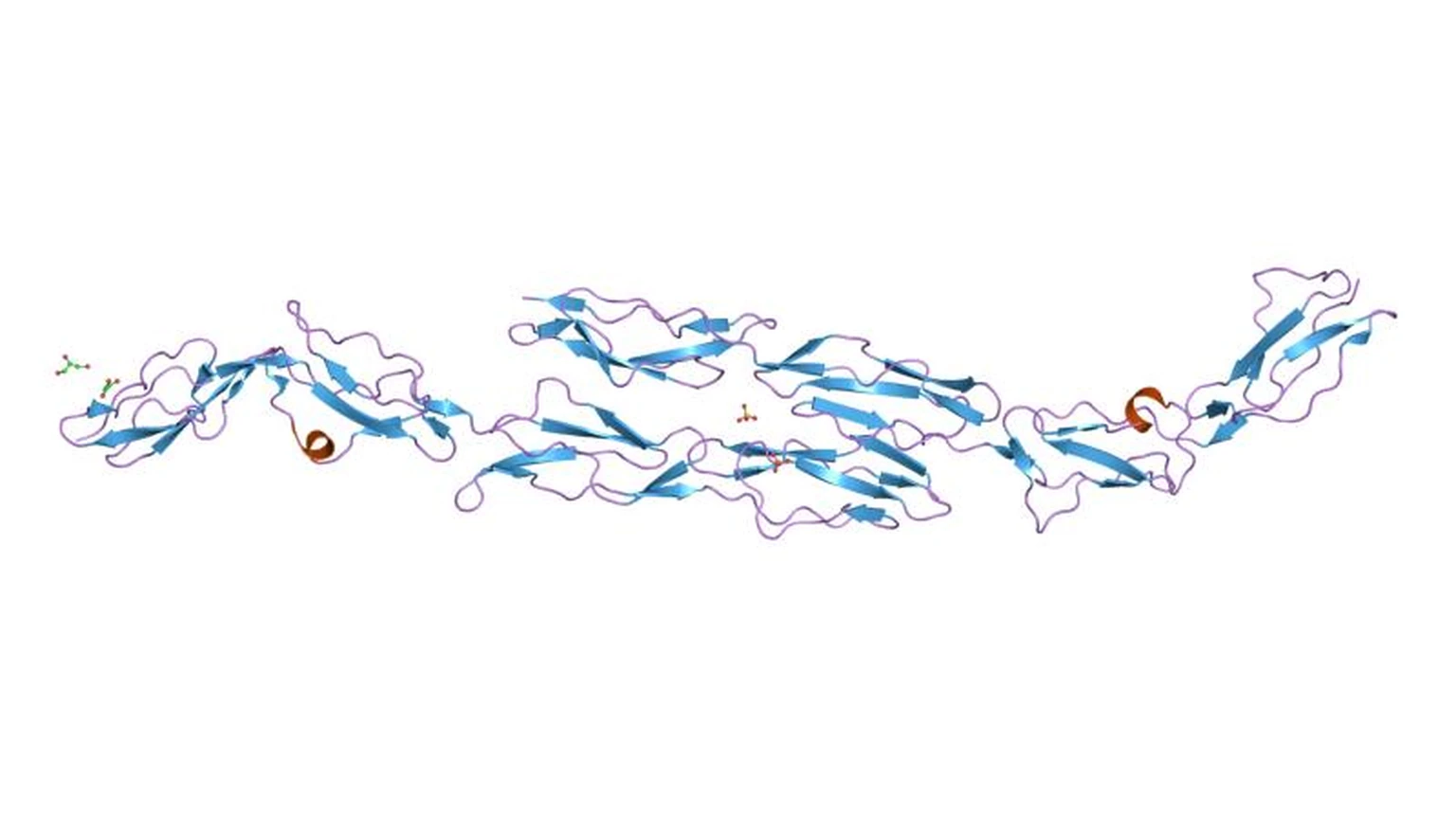
The wet-lab section is the part most readers will cite. The team ran an iterative agent-guided campaign against GM2 ganglioside activator protein (GM2A), implicated in GM2 gangliosidosis and previously without reported de novo binders. A prior BoltzGen campaign of 30 designs had also found none. Prompteina’s campaign used a 1,000-design in-silico budget, then sent 90 designs to Adaptyv Bio for expression and surface plasmon resonance.
Eighty-nine designs expressed. Adaptyv classified nine as binders; eight received fitted apparent KD values. Six were sub-micromolar. The strongest binder’s overall apparent KD across three replicates is reported as 107 nM in the abstract and main text (a figure caption in the HTML version also mentions a 68.8 nM replicate). The paper shows the agent requesting a two-layer alpha/beta architecture around GM2A residue W94 with about 22 interface residues; the realised design landed near that brief.
That is a credible proof of concept for one hard target, not a general claim that text prompts invent therapeutics. Expression, SPR classification and KD fits are still wet-lab work with their own false-positive modes, and the paper does not claim in-cell or animal efficacy.
How can labs actually run Prompteina?
The README’s install path is concrete: clone github.com/jleechung/prompteina, use Python 3.12 and CUDA 12.6, and run ./env/build_uv_env.sh. Hugging Face hosts prompteina-monomer.ckpt and prompteina-binder.ckpt plus SHA256SUMS. The NOTICE file states code is Apache License 2.0, weights are under the NVIDIA Open Model License as derivatives of Proteina-Complexa, and data assets are Creative Commons Attribution 4.0.
That license split matters for product teams. Apache-2.0 code is familiar. The NVIDIA Open Model License is commercially usable and allows derivative models, but it is revocable under its own terms and points at NVIDIA’s Trustworthy AI conditions. Anyone redistributing checkpoints should read licenses/license_weights.txt rather than assume Apache covers the weights.
For biology groups already tracking transcript and splicing models such as Illumina’s SpliceAI-2 transcript prediction update, Prompteina is a different layer: it proposes structures from text, it does not annotate genomes. The practical early use is likely agent-assisted binder brainstorming with heavy in-silico filters before any wet-lab spend, not one-click drug design.
What are the limits, licenses and open questions?
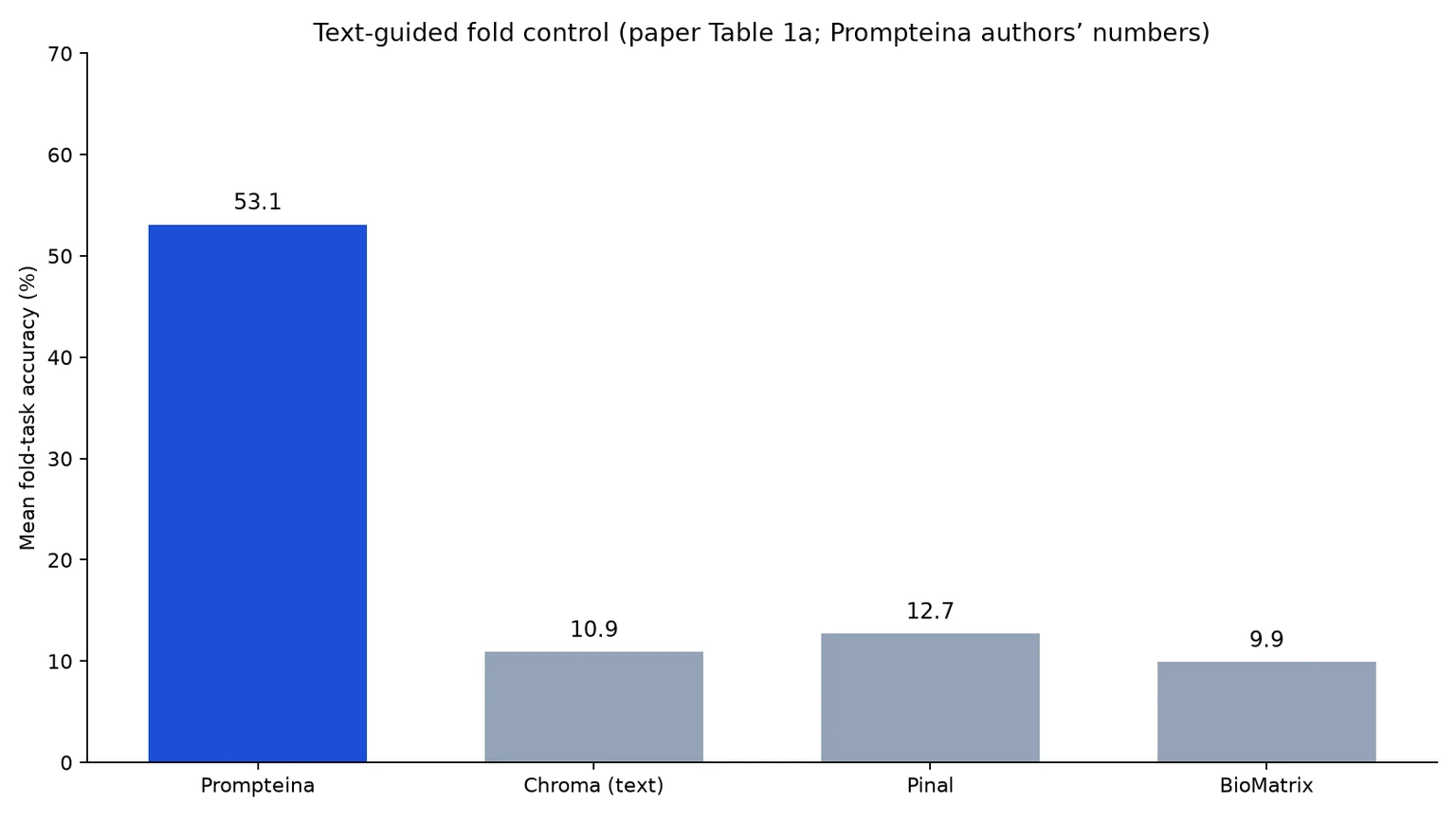
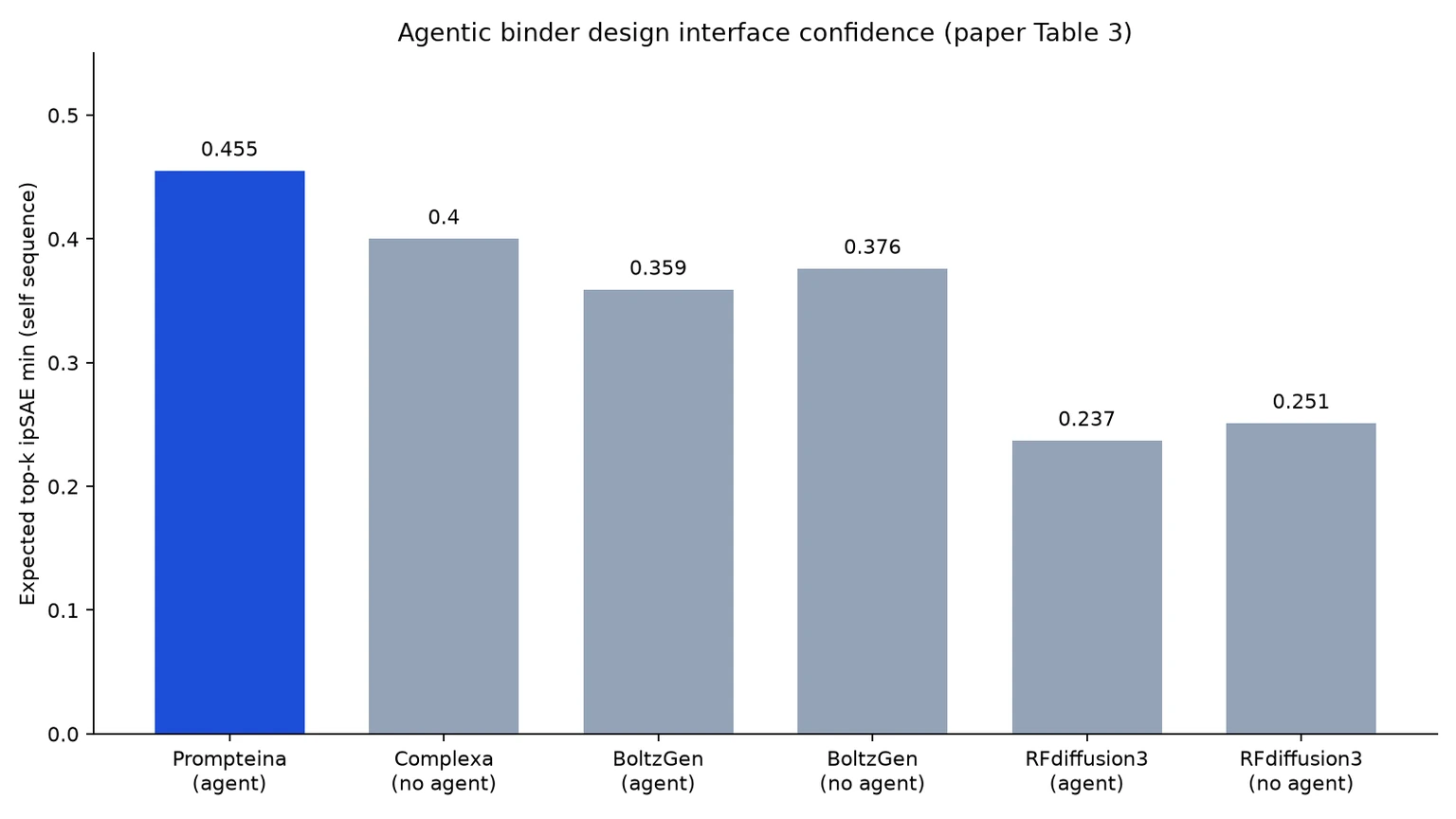
Several limits are explicit in the paper. Caption generation used an LLM, so caption fidelity depends on that pipeline; the authors’ own audit found unsupported numerical specificity as a common precision failure. Benchmarks lean on the authors’ chosen metrics (including ipSAE min) and on Claude Opus 4.6 as the agent, so changing the agent or the scorer could move rankings. Complexa without extra controls was not run with the agent because its released checkpoint lacked the needed property inputs.
Independent reproduction will need serious GPU time and careful matching of sampling settings. We did not download the multi-gigabyte checkpoints or run generation. Until outside labs publish matched tables, treat Table 1 and Table 3 as author claims with open artifacts, not as settled leaderboard truth.
Still, as a dated event the package is unusually complete for a methods paper: code, weights, dataset, HTML paper and a wet-lab result on a target others had failed. For AI Lookout readers the news is less “AI designs a protein” and more “natural language became a first-class control surface for an all-atom generator, and the authors showed it in the lab once.”
Common questions
Is Prompteina open source?
The code is Apache License 2.0. Model weights are under the NVIDIA Open Model License as Complexa derivatives. Prompteina-Data is listed as Creative Commons Attribution 4.0. Read the NOTICE and licenses/ files before commercial redistribution.
Did Prompteina invent a drug for GM2 gangliosidosis?
No. The paper reports nine SPR-classified binders against the GM2A protein in a prospective design campaign, with a strongest overall apparent KD of 107 nM across replicates. That is an in-vitro binding result, not a clinical candidate.
How is Prompteina different from RFdiffusion or BoltzGen?
Those models use property-specific input formats for folds, hotspots and secondary structure. Prompteina conditions an all-atom generator on free-form text so one prompt can mix global and residue-level requests, which the authors argue helps LLM agents express richer binder specs.
What to remember
Prompteina makes natural language a usable control interface for all-atom protein structure generation, ships open artifacts under a mixed license stack, and backs the claim with author benchmarks plus nine experimental GM2A binders—strong news if you track protein AI, still a single-lab scorecard until others reproduce it.
Sources & further reading
How this story was made
Written by Kristian Kostov with AI assistance and checked against the linked sources. Company performance claims are attributed to the company. Analysis reflects AiLookout’s interpretation; we have not independently tested the products discussed. Cover photography is illustrative and does not depict the specific announcement or product.
Our editorial standards