

Announced 7 Oct 2026 · Sources checked
What did Biohub and NIH publish on 7 October?
Biohub’s newsroom posted that it, the Department of Energy, the National Institutes of Health “and new funding partners” are investing $1.8 billion in funding, data, computation and new measurement technology — “the largest coordinated commitment to generating AI-ready biological data to date.” The intended result is “an open resource for the research community.” The dated line is Redwood City, 7 October 2026.
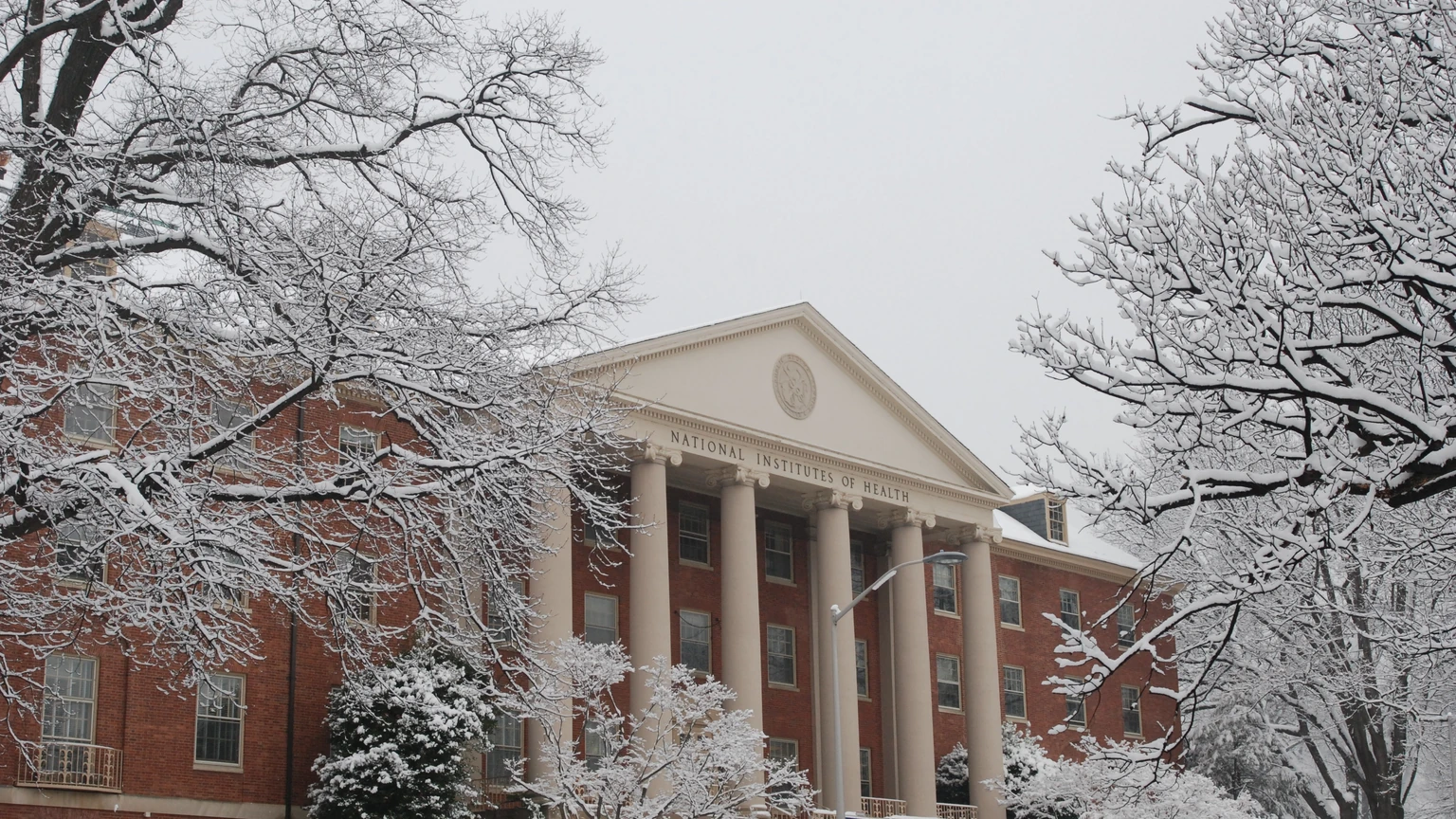
The same day, NIH issued “NIH joins effort to build SI-ready data for predictive models of human biology.” NIH says it is coordinating with DOE, Biohub and other partners through its Bio Genesis Mission, and that it will help standardize “appropriate datasets” with Biohub. NIH’s page does not state the $1.8 billion total or the $300 million company figure. “SI” is NIH’s current federal wording for the systems Biohub still calls AI.
A partnership post and a dollar stack are different claims. For how to keep a newsroom total separate from a confirmed budget line, see our note on reading AI company announcements.
How does the $1.8 billion add up?
Biohub’s arithmetic is four blocks that are not the same kind of money. The April Virtual Biology Initiative already committed $500 million: $400 million inside Biohub for measurement technology and $100 million for research outside the institute. October restates that pledge. It does not present it as a second $500 million.
DOE, Biohub says, will invest more than $500 million over five years through the Genesis Mission in lab measurement, modeling and computation, drawing on National Laboratory supercomputing, scattering facilities, cryo-electron microscopy and autonomous laboratories. The post quotes Darío Gil, DOE’s Under Secretary for Science. We reviewed energy.gov’s existing Genesis Mission pages and did not find a matching 7 October DOE news release.
NIH, in Biohub’s telling, will coordinate datasets “developed through more than $500 million in prior federal investment.” That is existing spend being aligned, not a newly appropriated $500 million. NIH’s own release describes NLM and NCBI repositories and Common Fund atlases; it does not repeat the $500 million number. Google DeepMind, Isomorphic Labs and Meta “are collectively investing $300 million,” with no split, years or cash-versus-compute detail. Isomorphic president Max Jaderberg and DeepMind’s Pushmeet Kohli are quoted. We did not find matching 7 October DeepMind or Meta newsroom posts.
| Block | What Biohub posted | Confirmed on 7 October? |
|---|---|---|
| Biohub $500 million | April pledge restated | April Biohub page; not new cash today |
| DOE >$500 million / 5 years | Genesis Mission measurement and compute; Gil quoted | No standalone energy.gov release found |
| NIH >$500 million prior | Coordinate existing datasets | NIH confirms coordination; omits the dollar figure |
| DeepMind, Isomorphic, Meta $300 million | Collective; no split published | No matching lab or Meta newsroom post found |
How is the work supposed to work?
Biohub says the datasets should let researchers “ask, predict, and answer biological questions digitally.” The first measurement job is expanding cell-response data “across far more cell types and conditions than have yet been studied,” plus instruments that can study cells at greater scale and speed. Those are design goals, not a released assay panel.
Alex Rives, Biohub’s head of science, calls a virtual cell “one of the most important challenges for the next era of science” and says accurate models could let scientists “perform experiments digitally.” NIH’s Nicole Kleinstreuer, deputy director of DPCPSI, says the aim is “universal cell models” that predict how any cell responds to an intervention, possibly on faster medical timelines than laboratory experiments alone. Both quotes describe hoped-for capability.
NVIDIA “will support” accelerated computing and software; Renaissance Philanthropy “is helping to expand funding.” Neither sentence includes a dollar amount. Named scientific groups on the October page are the Allen Institute, Broad Institute, Gladstone Institutes, the Human Cell Atlas, the Human Protein Atlas and the Wellcome Sanger Institute. The April page already named Allen, Arc Institute, Broad, Sanger, HCA and HPA; Gladstone is new in the October list, and Arc is not in that October sentence.
Who can use the data, and when?
Biohub says the result “will be an open resource.” Kohli’s quote is about an “open, standardized data commons.” The operational layer is still prospective: shared standards, common identifiers, “a single point of access,” “as the initiative takes shape.” Neither post published a portal URL, data-use license, embargo or date.
The October post cites Tabula Sapiens, OpenCell, Zebrahub, CELLxGENE and the CryoET Data Portal as precedent, not as the new stack. A reader looking for a 7 October download of a universal virtual cell will not find one. Neighbouring DeepMind biology artifacts this month are inspectable, including the AlphaProtein Novo enzyme preprint and SynthID Bio protein watermarks.
NIH’s release is more cautious: it will bring together existing biomedical datasets and help make them more useful to people building predictive models of living systems. That is curation of what already exists, plus a request for more intervention-response measurements.
How does this sit next to other AI-biology releases?
This is a data-and-instrumentation pledge, not a model drop. DeepMind’s recent public biology artifacts are different objects: AlphaProtein Novo is a preprint and GitHub repository; SynthID Bio watermarks designed proteins; the AlphaGenome Atlas is a genomic atlas. Those can be opened. Today’s announcement cannot, yet.
The same distinction applies to Claude’s enzyme-discovery campaign, which left a paper trail of claimed findings. Treating a stacked funding total as if it already produced a working virtual cell would collapse a commitment into a result.
What should readers not assume from the headline?
The $1.8 billion figure mixes new multi-year DOE money, an unsplit $300 million from three companies, a six-month-old Biohub pledge, and prior NIH investment. Biohub’s own sentence includes “funding, data, computation, and new measurement technology,” so it is not limited to cash landing this week.
Claims about faster cures are forward-looking. No independent audit, shared evaluation set or released multimodal corpus accompanied the posts. NIH confirmed the partnership and did not confirm Biohub’s arithmetic. A later material update would be a public access point, a data-use license, a DOE or company budget line, or the first released multimodal dataset.
Common questions
Is the $1.8 billion all new money announced today?
No. Biohub restates its April $500 million pledge and more than $500 million of prior NIH investment. The newly stated cash is DOE’s more-than-$500 million over five years and $300 million collectively from DeepMind, Isomorphic Labs and Meta.
Can researchers download a virtual-cell dataset today?
Not from this announcement. Biohub describes shared standards and a single access point as the initiative takes shape. NIH says it will coordinate existing repositories. Neither post published a portal, license or release date.
Did NIH confirm DeepMind’s and Meta’s $300 million?
No. NIH confirmed that it is coordinating with DOE, Biohub and other partners. The $300 million figure and the $1.8 billion total appear on Biohub’s page, not on NIH’s.
What to remember
Treat 7 October as a documented expansion of Biohub’s April initiative: NIH is in, DOE is quoted for multi-year measurement money, and three labs are named for a collective $300 million. Do not treat the $1.8 billion headline as new cash in a single week, and do not expect a virtual-cell download until an access point exists.
Sources & further reading
How this story was made
Written by Kristian Kostov with AI assistance and checked against the linked sources. Company performance claims are attributed to the company. Analysis reflects AiLookout’s interpretation; we have not independently tested the products discussed. Cover photography is illustrative and does not depict the specific announcement or product.
Our editorial standards