Announced 20 Oct 2026 · Sources checked
What Mistral released
Mistral AI has released Voxtral 3, a new family of speech-to-text and text-to-speech models, together with a software kit for building voice agents that can listen, think, call tools and talk back in real time. The Paris company announced it in a post on 20 October 2026 and made the models available the same day through its API.
The release has three parts. There are new transcription models that turn speech into text and work out who said what. There is a new speech model that turns text into expressive audio. And there is a voice agent software development kit, or SDK, that wires those pieces to a language model so a company can put an automated agent on a phone line or a website.
Mistral is pitching the package at contact centres, service desks, virtual assistants and hands-free copilots, and it leans on its usual selling point: organisations can run the stack on Mistral's EU-hosted API or on their own infrastructure, and control whether any audio is kept.
The transcription models
The flagship transcription model is Voxtral Small Transcribe 3. Mistral says it now covers 50 languages, including all 24 official languages of the European Union and a number of low-resource Asian and Indian languages. It handles diarization, the job of labelling which speaker said each line, and context biasing, where a developer supplies key terms such as product names or speaker names so the model is more likely to spell them correctly without any fine-tuning.
Mistral claims state-of-the-art results. Its announcement says the Small model beats Whisper, ElevenLabs' Scribe v2 and Gemini 3.5 Transcribe on multilingual transcription and diarization, and the model page in Mistral's documentation adds Microsoft AI Transcribe 2 and GPT-Transcribe to the list. The charts behind those claims use public test sets such as FLEURS for word error rate across 45 languages and AMI, Switchboard and AISHELL-4 for diarization, plus the Earnings-22 benchmark for how well the model recalls supplied keyphrases.
A smaller sibling, Voxtral Mini Transcribe 3, has 4 billion parameters and is aimed at cheap batch work. A third model, Voxtral Mini Transcribe Realtime 3, is built for live agents: Mistral says it transcribes with under 500 milliseconds of latency, keeps diarization and context biasing, and natively predicts when a speaker has finished talking, using both the sound and the meaning of what was said. Mistral's announcement gives its language count as over 35, while the pricing card lists 40-plus.
The new text-to-speech model
On the output side, Voxtral Mini TTS 3, sold through the API as Voxtral Speech 3, generates speech in more than 35 languages and over 50 dialects, in both batch and real-time modes. Mistral's main claim is expressiveness: the model reads the meaning of the text it is given and picks emotion, pace and emphasis to match, so an apology sounds different from a congratulation without extra instructions.
Developers can also steer it explicitly. Mistral lists instruction following for emotion, pacing and emphasis, contextual speech that takes the conversation so far into account, a vocabulary library, and phoneme hints for words a model would otherwise mispronounce, such as invented brand names. The announcement's audio samples show earlier Voxtral versions misreading dates, prices and email addresses and the new one reading them correctly.
A feature called Pro Voice adapts the model to a specific speaker, aiming to reproduce their character, emotional range and speaking style across languages from about 30 minutes of recorded audio. Mistral positions this for professional use where quick voice cloning falls short. Preset voices are available in 18 languages, from Emirati and Modern Standard Arabic to Vietnamese.
Mistral backs its quality claims with charts of quality per dollar on several tests, including Voice Code Bench from BeSimple AI, which focuses on customer-support failures with numbers and unusual names. The fine print matters here: the scores come from another AI model acting as judge, several charts are labelled internal evaluations, and the prompt sets were selected by Mistral for release.
How the voice agent SDK works
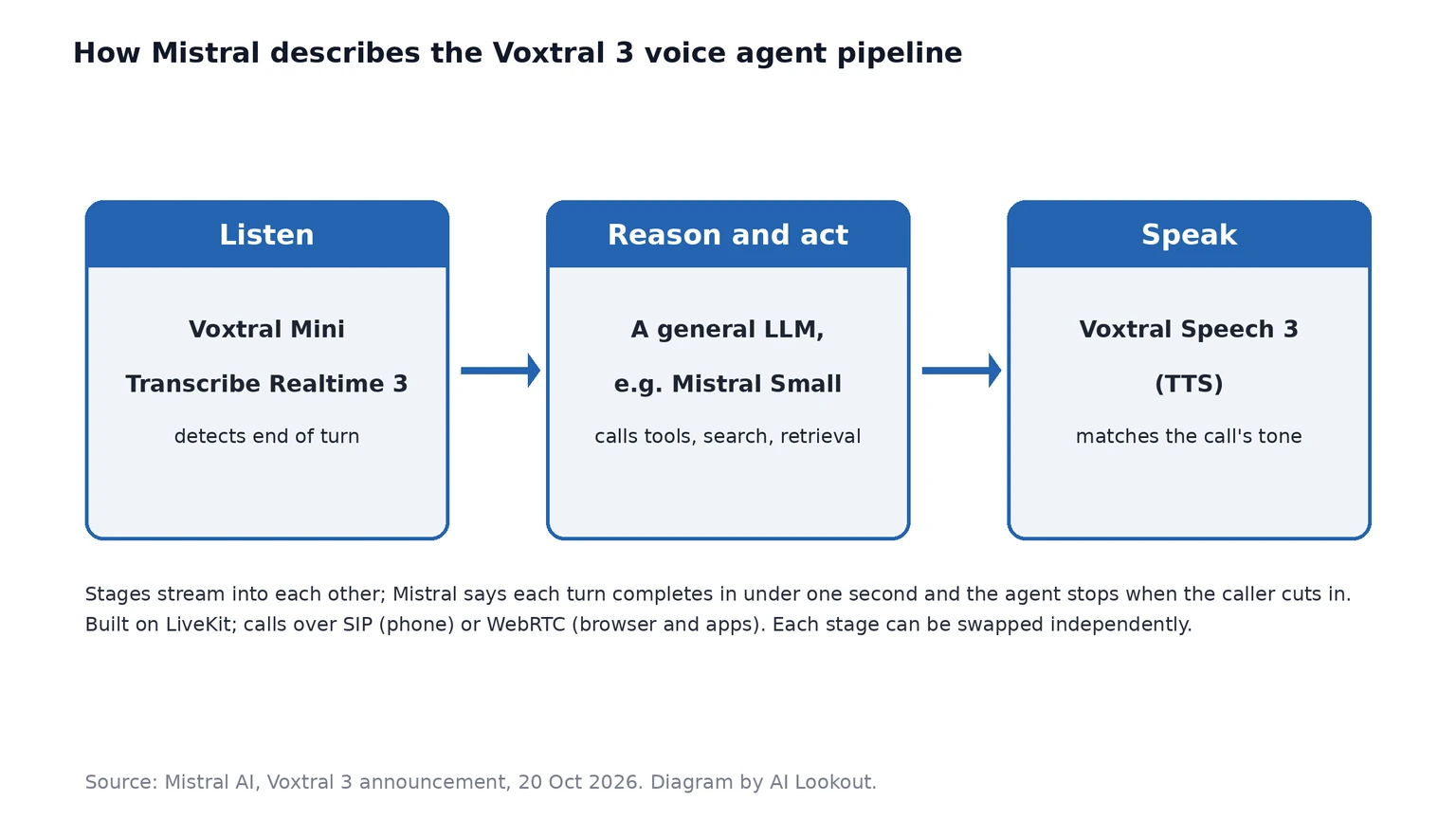
The voice agent SDK is the most practical piece for builders. Mistral says it is built on LiveKit, the open-source real-time audio and video framework, and runs speech in, reasoning and speech out as a single streaming pipeline. The realtime transcription model listens and decides when the caller is done, a general language model such as Mistral Small reasons about the request and calls tools, and Voxtral Speech 3 answers in a tone that fits the conversation.
Because no stage waits for the previous one to finish completely, Mistral says each turn completes in under one second, and the agent stops talking when the caller interrupts. During a call an agent can verify a caller's identity, check a bill or book an appointment using function calling, web search and retrieval over a company's own systems. It can answer and place phone calls over SIP, run in browsers and apps over WebRTC, and connect to existing telephony and contact-centre software.
Each stage is a separate model, so a team can swap the language model, the voice or the language without rewriting the agent. That modular design is a different bet from end-to-end speech-to-speech models, which handle listening and talking inside one network and can sound more fluid but are harder to inspect and to connect to existing business logic.
Prices and how to get it
Voxtral 3 is available now through the Mistral API on European, US and global endpoints, and developers can try voice agents, transcription, speech generation and voice cloning in Mistral's Studio playgrounds. Mistral lists these prices: Voxtral Mini Transcribe 3 in batch at $0.0035 per minute, Voxtral Small Transcribe 3 at $0.004 per minute, Voxtral Mini Transcribe Realtime 3 at $0.008 per minute, and Voxtral Speech 3 at $13 per million characters for both batch and real-time use.
Mistral says that speech price undercuts comparable models from OpenAI, Deepgram, ElevenLabs and Google, based on those companies' own pricing pages. Running the whole stack on-premises or in a private cloud is possible, but the announcement says to contact Mistral's sales team for that. When AI Lookout checked Mistral's Hugging Face organisation on 20 October, no Voxtral 3 model weights had been published there, so unlike some earlier Voxtral releases this one is not an open-weight download today.
Where it sits in the voice AI race
Voxtral 3 lands in a crowded month for voice AI. Mistral itself shipped an open Arabic realtime transcription model a week earlier, xAI has pushed Grok Voice 3.0 as a speech-to-speech API, and OpenAI has been updating its own live voice models. On the open side, Ant Group released Ming 3.0 speech models under the MIT licence the same day.
Mistral's angle is less about a single model than about the full loop a business needs, sold at low per-minute prices with a European hosting option. For contact centres in regulated industries, the promise that audio can stay on their own servers may matter as much as a few points of word error rate.
What to keep in mind
All of the benchmark comparisons come from Mistral, and several are explicitly internal tests judged by another AI model, so independent results will be the real test. The sub-second turn time is a vendor figure and will depend on the language model chosen and on network conditions.
Voice cloning raises familiar risks. Pro Voice needs about half an hour of a person's speech, and Mistral's documentation has a section on cloning and consent, but any tool that can reproduce a real voice convincingly can also be misused for fraud, so how the consent checks work in practice is worth watching. Finally, the self-hosted option goes through sales, so smaller teams will mostly be using the hosted API.
Common questions
What is Voxtral 3?
Mistral AI's third generation of speech models: transcription models that turn speech into text in 50 languages, a text-to-speech model for 35-plus languages, and an SDK for building real-time voice agents.
How much does Voxtral 3 cost?
Transcription costs $0.0035 to $0.008 per minute depending on the model, and Voxtral Speech 3 costs $13 per million characters, according to Mistral's price list.
Can I run Voxtral 3 on my own servers?
Mistral says yes, for on-premises or private cloud deployments, but you need to contact its sales team. No Voxtral 3 weights were on Hugging Face on launch day.
Sources & further reading
How this story was made
Written by Kristian Kostov with AI assistance and checked against the linked sources. Company performance claims are attributed to the company. Analysis reflects AiLookout’s interpretation; we have not independently tested the products discussed. The cover places the companies’ own logos, taken from public-domain or openly licensed files credited in the caption, on a plain background. It is not a product photograph, a screenshot, or an endorsement.
Our editorial standards