Announced 12 Nov 2026 · Sources checked
Meta's Muse AI can call US businesses for paid subscribers
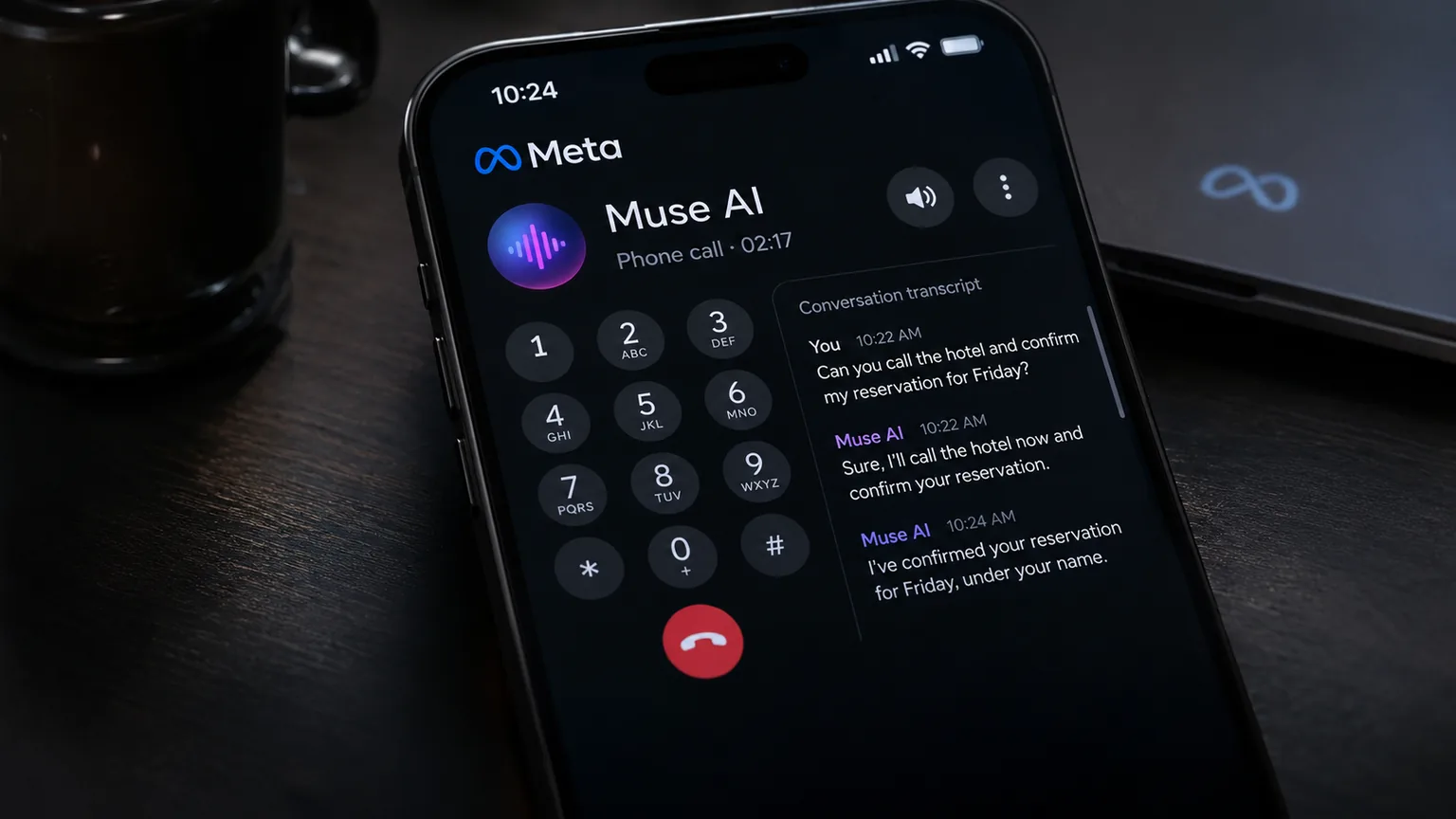
Meta has rolled out phone-calling capabilities for its consumer AI agent Muse, allowing paid subscribers to offload real-world phone calls to the AI.
The feature handles the tasks users typically dread — calling the cable company, the DMV, or a restaurant that does not take online reservations — and brings the results back in a conversation thread.
The company had been testing the feature since September with a select group of early adopters who asked the AI for access.
Alexandr Wang, Meta's chief AI officer and head of its Superintelligence Labs division, announced the full rollout on X, calling it one of the most requested Muse features.
The announcement highlighted the practical value: an AI that waits on hold, navigates phone trees, and speaks to human representatives on the user's behalf.
Muse phone calling is available to any paid subscriber in the US. Subscriptions start at $20 per month, which includes 500 million Muse tokens per week.
Heavier users can opt for $100 per month, which provides 3 billion tokens weekly. The feature is not available on the free tier, which Meta still offers as a basic AI assistant.
How Muse phone calls work
The feature turns Muse into a phone-calling assistant that executes calls on behalf of the user.
When a subscriber asks Muse to handle a call, the AI processes the request, identifies the business, places the call, and manages the conversation end to end.
The AI speaks with a natural voice, handles transfers and hold music, and reports back with the outcome once the call is complete.
TechCrunch reported that Meta demonstrated use cases ranging from making dinner reservations at restaurants that do not accept online bookings to dealing with insurance claims and cable provider plan changes.
The DMV was another highlighted use case — one of the few public services where an AI with infinite patience is genuinely useful.
Muse uses the same voice synthesis technology Meta introduced for its real-time voice and video chat feature, which launched in late October.
The voice quality is designed to sound natural enough to pass initial screening, though the reception on the other end varies.
The hang-up problem
The biggest challenge for AI calling is not the technology on the caller's side. It is the human on the other end.
Many businesses and receptionists hang up as soon as they identify the caller as an AI agent. TechCrunch reported that the mixed reception is a known issue that Meta and its competitors are still working around.
The problem is not unique to Muse. Instinct, a startup, has been offering a similar AI calling service.
Google Gemini also supports outbound calls. All three face the same resistance from businesses that prefer to speak with human customers.
AI voice quality has improved significantly over the past year, making it harder for humans to distinguish AI callers from real customers.
The latest voice models can handle interruptions, adapt tone based on the conversation, and even perform the verbal pauses and backchannels that make phone conversations feel natural.
As these models improve, businesses will find it increasingly difficult to detect and reject AI-initiated calls.
Some businesses may eventually build detection systems specifically designed to identify AI callers, creating a technical arms race.
Others may accept AI calls as a normal part of doing business, especially as more consumers delegate routine calls to their AI agents.
What the September testing phase revealed
Meta tested Muse phone calling with a small group of early adopters starting in September. Users who requested access were able to try the feature before the public rollout.
The company used the testing phase to refine the AI's conversational abilities and handle edge cases like aggressive sales pitches, long hold times, and bad connections.
The testing revealed that the most common use cases revolved around customer service — exactly the calls people dread making. Restaurant reservations, appointment bookings, and service inquiries were the most frequent requests.
The company also observed that users tended to trust the AI with low-stakes calls first, then graduated to more important interactions over time.
Alexandr Wang said during the announcement that Muse making a phone call feels like having a personal assistant who handles the tedious parts of life.
He demonstrated the feature by asking Muse to book a dinner reservation and to check on a delayed shipment, both of which the AI handled without transferring back to the user.
How Muse fits into Meta's broader AI strategy
Muse has been at the center of Meta's consumer AI push since its launch in September 2026.
The company announced that it had reached 10 million users in the US and Canada by late October, making it one of the fastest-growing consumer AI products.
Meta has been adding features rapidly: real-time voice and video chat in late October, Spaces for custom app-like workspaces in early November, and now phone calling.
The company is also building toward a communication suite around Muse. Alexandr Wang said this week that the option to create a Muse email address, which launched as a paid feature, will soon roll out to free users.
That suggests Meta sees Muse not just as a chatbot but as a communication hub that manages calls, email, and tasks on behalf of the user.
Meta created a new class of non-voting shares to fund its AI push as Muse growth accelerated. The company is investing heavily in the Prometheus supercluster in Ohio, which trained the Muse Wonder model.
Nvidia invested $3 billion in expanding the Meta-Muse partnership, signaling that hardware makers also see Muse as a significant AI platform.
What is next for Muse calling
Meta has not disclosed a timeline for international rollout of the calling feature. The company is focused on the US market for now, where the phone system, business hours, and English-language voice models are well understood.
Expanding to other countries would require adapting to local languages, business cultures, and phone systems.
The broader question is whether consumers will actually use the feature. Delegating a phone call to an AI requires trust: the user cannot hear the conversation in real time, and the AI makes decisions on their behalf.
Meta will need to build that trust gradually, starting with low-stakes calls and expanding to higher-value interactions over time.
Whether businesses will adapt to AI callers or build detection systems that block them remains an open question. But Meta is betting that consumers, not businesses, will decide the outcome of that debate.
Common questions
How much does Muse phone calling cost?
Muse phone calling is available to paid subscribers only. Plans start at $20 per month for 500 million Muse tokens per week, with a $100 per month tier offering 3 billion tokens.
Can Muse call any business?
The feature is available for US businesses. Meta has demonstrated use cases such as restaurants, cable companies, insurance providers, and the DMV, but has not specified limits on which businesses can be called.
Do businesses know they are talking to an AI?
Often yes. Many businesses and receptionists hang up when they identify the caller as an AI agent, though improving voice synthesis makes detection harder over time.
Sources & further reading
How this story was made
Written by Kristian Kostov with AI assistance and checked against the linked sources. Company performance claims are attributed to the company. Analysis reflects AiLookout’s interpretation; we have not independently tested the products discussed. The cover is an AI-generated editorial illustration, not a photograph or evidence of an actual event.
Our editorial standards