Announced 15 Oct 2026 · Sources checked
What the new clause says
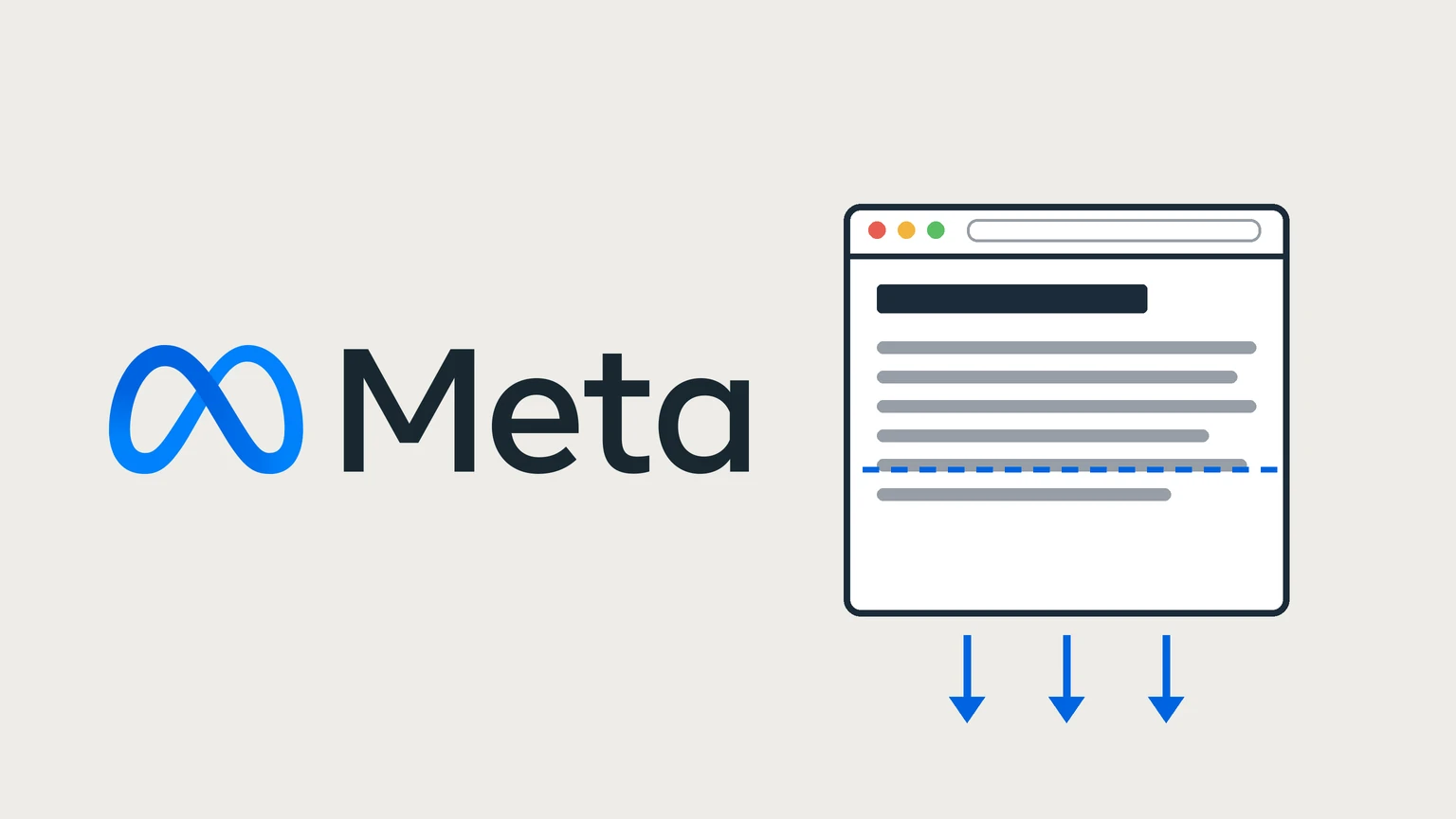
Meta has posted a preview of its updated Commercial Terms under a banner that says the changes "will go into effect on October 30, 2026." In section 1, "Licenses & Rights You Provide Meta," a new paragraph reads: "You authorize us (or any entity acting on our behalf) to use automated software (such as web scrapers, bots, robots, spiders, crawlers, and user agents) and create test credentials to access, index, cache, analyze, collect, retrieve, or crawl the domains, web pages, or URLs (and any content available through them) that are associated with your products or services, or that are made available through your or users' use of Meta Company Products and services, and to periodically pull updates from such domains, web pages, or URLs."
The next sentence sets out the use: "Meta may use any content from such domains, web pages, or URLs to provide, develop, improve, research, train, and maintain the integrity of, the Meta Company Products, services, and features provided under these Commercial Terms and any other applicable supplemental terms." We read the clause on Meta's preview page on 16 October; it matches the text Nieman Lab quoted in full the day before.
Nieman Lab, which reported the change on 15 October after a reader tip, says Meta alerted users in early October through a blog post and notices in Meta Business Suite. According to that report, the notice says businesses that do not agree should "stop all access or use of our Products for business or commercial purposes." There is no opt-out form.
Who it covers
The Commercial Terms apply whenever Meta products are used for a business or commercial purpose. The preview defines that widely: using ads or marketing messages, selling or listing products, developing apps, creating or using a product catalog, managing a Page, managing a Group for business purposes, using any business product such as Ads Manager or Meta Business Suite, or using Meta's measurement services, "regardless of the entity type."
That reaches far beyond large advertisers. A local bakery with a Facebook Page, a creator who runs Instagram ads, a WhatsApp business channel and a newsroom that manages its social accounts through Business Suite are all inside it. Nieman Lab points out that virtually every news organization has at least one Meta business account, including Nieman Lab itself.
The terms also keep a US arbitration provision: businesses in the United States must resolve most disputes with Meta through individual binding arbitration, with class actions and jury trials excluded. That matters if a publisher later wants to challenge how the crawling clause is applied.
Why lawyers read it as AI-training permission
The clause does not mention AI by name, but it uses the word "train," and, as Nieman Lab notes, Meta's wider terms of service define AI at Meta as one of its products. Three legal experts who reviewed the language for Nieman Lab said it could be used to argue that Meta may scrape news sites and use that material to train its AI systems.
"For news publishers, this clearly represents permission to Meta to train AI on any content from their sites and possibly to deploy some of that content, even in competition with the publishers themselves," James Grimmelmann, a professor of digital and information law at Cornell Law School, told the publication. Matt Topic, a media and intellectual property attorney at Loevy & Loevy, called it "a remarkable provision to bury in [the] terms of service," given what such access might cost in a licensing market, and said publishers should assume it would be enforceable even though a court might not agree.
Benjamin Sobel, a law professor at the University of Wisconsin, compared the structure to "tying" in antitrust law: to keep using Meta's business tools, a company also has to accept the crawling permissions. He likened it to Google requiring publishers that appear in search to accept use of their content in AI Overviews and AI Mode.
What Meta says
Meta declined to answer Nieman Lab's list of questions. A public affairs spokesperson said language about crawling had previously been scattered across several sets of terms, including those for generative AI in ads, and that this update consolidates it in one place. The spokesperson said the new terms "will not change" how Meta crawls publishers and that "content owners can still manage how their content is accessed by using robots.txt."
Nieman Lab notes that Meta's developer pages explain how to block its crawlers with robots.txt, the file that tells bots which parts of a site they may visit. The legal experts' concern is not that robots.txt stops working technically, but that a contract a business has accepted could later be argued to override a robots.txt instruction. The new clause itself says nothing about robots.txt.
Meta has been expanding its AI lineup quickly, from the Muse Wonder models to the open-weight Muse Spark Open released on 15 October, which makes questions about where its training data comes from more pressing.
The test-credentials question
The clause also lets Meta "create test credentials" to access associated sites. Grimmelmann told Nieman Lab this would technically allow Meta to "sign up as a fake user" to get past registration walls. Meta declined to say whether test credentials would be used to get behind paywalls or other paid content.
For publishers that rely on registration or metered access, that is the most practical worry. A crawler that respects robots.txt but can log in with an account it created is very different from one that sees only what an anonymous visitor sees. Until Meta clarifies how test credentials are used, publishers cannot tell from the terms alone which of those they are agreeing to.
How it fits the wider fight over AI training
The change lands while courts are still working through whether training AI on copyrighted text is fair use. Nieman Lab notes a class action filed in May by five large book publishers alleging that Meta pirated millions of books to train its Llama models. Other AI companies are trying the opposite route of negotiated or signal-based access; Cloudflare's crawl-discovery pilot with OpenAI is one recent example of a crawler relationship built on explicit cooperation.
Nieman Lab also links the update to Meta One, the paid subscription that limits how many external links some Facebook and Instagram accounts can post for free. The publication's point is that Meta now charges some accounts to post links to the same websites it says it may crawl without paying, though Press Gazette has reported that some news publishers are currently exempt from the link limit.
What publishers and businesses can do before 30 October
The practical choices are limited. Under the update, continuing to use Meta for business after 30 October counts as accepting the terms, and stopping all business use is the only alternative Meta offers. Stephen Beale, the founder of The Steampunk Explorer who tipped off Nieman Lab, said he was seriously considering closing his accounts before the deadline.
Businesses that stay can at least make their intentions explicit. That means checking robots.txt entries for Meta's documented crawlers, keeping a dated record of those settings, and reviewing which domains are actually linked from Pages, catalogs and ads, since the clause covers sites "associated with" a business's products or services. Publishers with licensing deals or pending litigation will want lawyers to read the full preview before the effective date.
What is still missing is a plain statement from Meta about whether content gathered under this clause is or will be used to train its large language models, whether test credentials will be used behind paywalls, and how the clause interacts with robots.txt if the two conflict. Those answers would tell businesses far more than the consolidation explanation does.
Common questions
When do Meta's new Commercial Terms take effect?
On 30 October 2026, according to the banner on Meta's preview of the updated terms. Continuing to use Meta products for business after that date counts as accepting them.
Can businesses opt out of the crawling clause?
Not through the terms. Nieman Lab reports there is no opt-out before 30 October, and the update tells businesses that disagree to stop using Meta products for business purposes. Meta says robots.txt still controls how its crawlers access content.
Does the clause mention AI training?
It does not name AI, but it lets Meta use collected content to 'train' Meta products, and according to Nieman Lab, Meta's wider terms define AI at Meta as one of its products. Legal experts told Nieman Lab that reads as permission to train AI.
Sources & further reading
How this story was made
Written by Kristian Kostov with AI assistance and checked against the linked sources. Company performance claims are attributed to the company. Analysis reflects AiLookout’s interpretation; we have not independently tested the products discussed. The cover places the companies’ own logos, taken from public-domain or openly licensed files credited in the caption, on a plain background. It is not a product photograph, a screenshot, or an endorsement.
Our editorial standards