Announced 21 Oct 2026 · Sources checked
What Kakao released
Kakao, the company behind South Korea's KakaoTalk messenger, has published the weights of two vision encoders from its Kanana-2 model family on Hugging Face. kanana-2-vision-encoder-medium has 426 million parameters and kanana-2-vision-encoder-tiny has 98 million. The model cards date the release to 21 October 2026 in Korea and also point to a Kakao tech blog post about how the encoders were built.
Kakao had said it would release them. At its if(kakao)26 developer conference on 13 October, which AI Lookout covered alongside its KakaoTalk agent plans, the company described Kanana-o, an omni model that combines language, vision and speech. According to Digital Today's report on the release, Kakao says the vision encoder is one of the in-house parts of that model and that it plans to release other components over time.
What a vision encoder does
A vision encoder is the part of a multimodal AI system that looks at an image. It turns pixels into a sequence of numerical features that a language model can read, covering objects, text, positions and shapes. When a chatbot reads a menu, summarises a scanned contract or answers a question about a photo, the encoder decides how much of that detail reaches the language model.
These two models are encoders only. They do not generate text or answer questions on their own. Kakao's model card says they are built for training vision-language models and work best in that role. A developer would attach one to a language model, train the connection, and use the result. That makes this a release for model builders, not a new app for KakaoTalk users.
Encoders matter most for document work, where small text and dense layouts have to survive the trip from image to features. Recent releases such as Datalab's tiny Indra OCR model and LightOnOCR 3 attack the same problem from the OCR side, by building complete models for reading pages.
How Kakao built it
Kakao says both encoders are based on its Kanana-2-0.9B language model rather than a separate vision backbone, with the text generation part removed. According to the configuration files published with the weights, the medium model has 28 transformer layers with a hidden size of 768, and the tiny model has 18 layers with a hidden size of 512. Both cut images into 16-by-16-pixel patches.
The model card highlights two design choices. The encoders process images at their native resolution and aspect ratio rather than squashing them into a fixed square, which helps with tall receipts and wide charts. And they mix sliding-window attention, where each patch mainly looks at nearby patches, with grouped-query attention to keep the cost of high-resolution images down. In both configurations, 8 layers use full attention across the whole image and the rest use a 1,024-token sliding window.
In Kakao's statement as reported by Digital Today, the company says training the encoder with its own Kanana-2 language model made training about four times more efficient than before, and that a design tailored to high-resolution images cut processing latency by more than 60% compared with major global encoders. It also used knowledge distillation and model-lightweighting techniques to produce the tiny version with on-device use in mind. Kakao has not published the measurement setup behind the latency figure in the model card.
Kakao's benchmark numbers
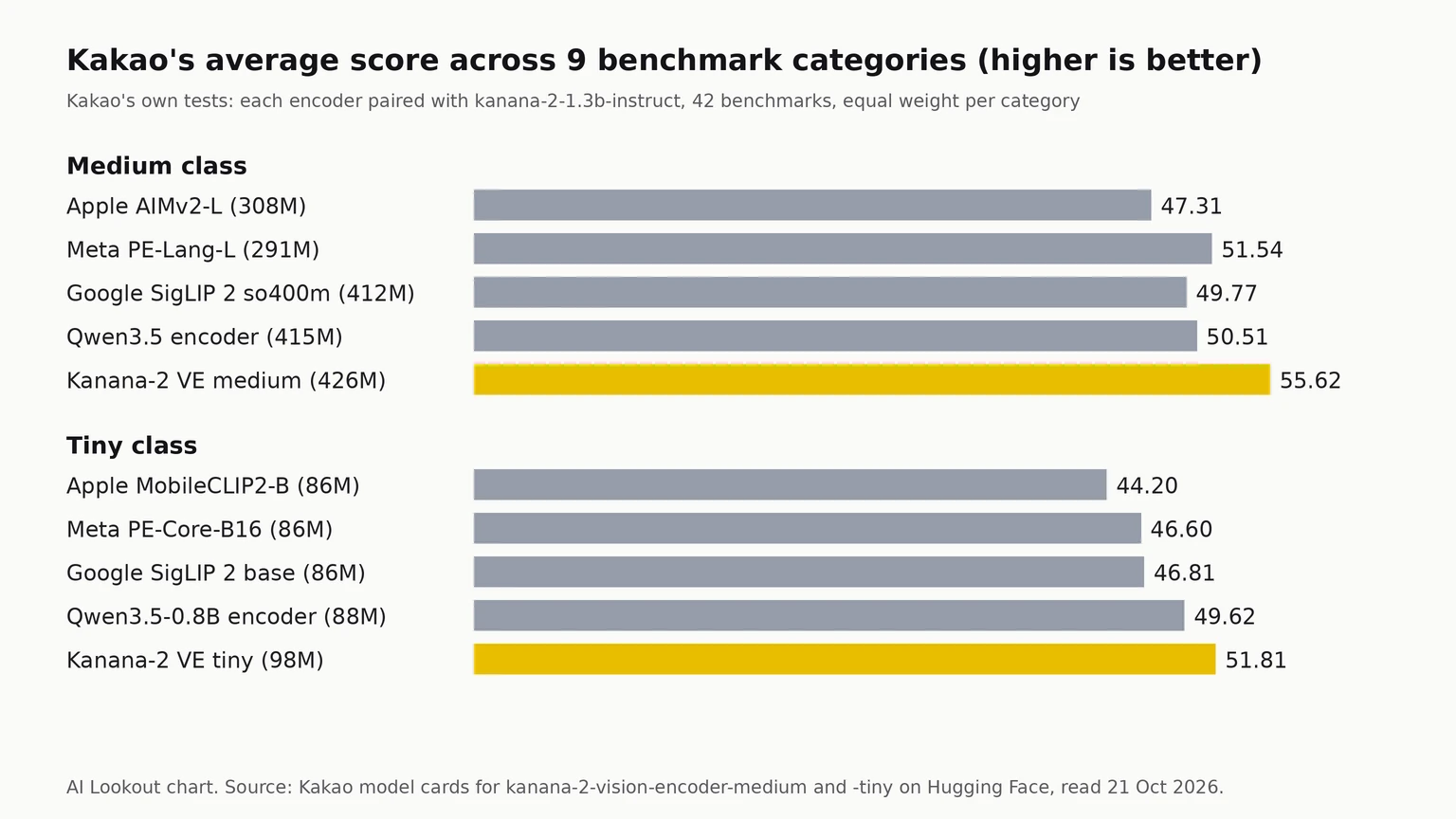
Kakao compared each Kanana encoder with four similarly sized encoders from Apple, Meta, Google and Alibaba's Qwen team. To make it a fair fight between encoders, each one was paired with the same small language model, kanana-2-1.3b-instruct, through a patch merger and trained and evaluated under the same conditions. The test set covers 42 benchmarks in nine categories, and the headline average weights each category equally.
On that average, the medium model scores 55.62, against 51.54 for Meta's PE-Lang-L14-448, 50.51 for the Qwen3.5 encoder, 49.77 for Google's SigLIP 2 so400m and 47.31 for Apple's AIMv2-L. The tiny model scores 51.81, ahead of the Qwen3.5-0.8B encoder at 49.62, SigLIP 2 base at 46.81, Meta's PE-Core-B16-224 at 46.60 and Apple's MobileCLIP2-B at 44.20. The tiny Kanana encoder's average is slightly higher than the medium-sized Meta encoder's.
These are Kakao's numbers from its own pipeline. Several of the nine categories are Korean-language tests, and many of those, such as KoOCRBench, KoReceiptQA and KoFoodMenu, are in-house benchmarks that outsiders cannot check. Because each category counts equally, strength on Korean tasks lifts the overall average.
Where Kanana wins and where it does not
The detailed tables are more mixed than the average suggests. The clearest leads for the medium model are in visual grounding and documents. It scores 79.88 on CountBenchQA against 61.05 for the next best, 76.14 on RefCOCO against 61.57, and 75.60 on OCRBench against 69.60. On Kakao's Korean OCR test it reaches 86.80, more than seven points ahead of Meta's encoder.
Elsewhere it trades places with rivals. SigLIP 2 so400m edges it on MMBench in English and on MMMU-Pro, Meta's encoder leads on WildVision, LogicVista and both high-resolution HR-Bench tests, and the Qwen encoder is ahead on HallusionBench, MathVision and the V* fine-grained test. On Korean celebrity recognition and KoCelebQA, Kanana does not lead.
The tiny comparison is closer still. The Qwen3.5-0.8B encoder beats or matches the tiny Kanana model on several reasoning tests, including MMMU, DynaMath and WeMath. So the fair summary is that Kanana's encoders are strong for documents, counting and pointing at things, and for Korean content, rather than better across the board.
The licence is open, with limits
Digital Today's report describes the release as open source. The weights are free to download, but they come under the Kanana Open License, Kakao's own licence, not a standard open-source one. It grants a worldwide, royalty-free licence to use, modify and distribute the models, and Kakao claims no rights to outputs.
There are conditions. Anyone who distributes Kanana or a derivative must pass on the licence, follow Kakao's Guidelines for Responsible AI, and display "Powered by Kanana" on related websites or documentation. Models trained using Kanana or its outputs must have "Kanana" at the start of their name. Anyone who sues claiming that Kanana or its outputs infringe their intellectual property loses the licence.
The commercial terms are the part builders should read most carefully. Using the encoders to run your own service does not need a separate licence. But offering Kanana to others through an API or cloud service, selling it as part of an integration or on-premise deal, or selling it embedded in devices requires a commercial licence granted at Kakao's discretion. That last clause sits awkwardly with a tiny model designed with on-device use in mind: a phone or appliance maker selling it in a product would need Kakao's permission.
How to use it
Both models load through Hugging Face Transformers with remote code enabled, using AutoImageProcessor and AutoModel, and run in bfloat16. Kakao's example for the medium model returns 768 feature values for each image patch. The weights are not gated, so there is no access request.
What you get is the encoder, not a finished assistant. To reproduce Kakao's results you would need to connect it to a language model and train that connection. Korean developers building document or screen-reading systems are the obvious audience; Byung-seok Noh, who leads performance work on Kakao's unified foundation model, told Digital Today that computer-use agents that read and operate screens make high-resolution encoders more important. Korean model makers have been pushing in that direction, as with MNC.ai's Hunmin computer-use model.
Why it matters
Most open multimodal models borrow their eyes from a handful of encoders, chiefly Google's SigLIP family and encoders from Meta and Qwen. A strong encoder tuned for Korean text, receipts, charts and menus gives Korean companies an alternative they control, and Kakao is releasing it in a size small enough to run on a phone.
The caveats are real. The benchmark wins come from Kakao's own tests, many of them private, and the licence attaches branding, naming and commercial conditions that a permissive licence would not. Until independent groups pair these encoders with their own language models, the numbers are best read as a strong claim from a company with obvious home advantage on Korean data.
Common questions
Is Kanana-2 vision encoder open source?
The weights are free to download and use under Kakao's Kanana Open License, which is a custom licence with branding and commercial-resale conditions rather than a standard open-source licence.
Can I chat with the Kanana-2 vision encoder?
No. It only extracts image features. You need to connect it to a language model and train that pairing to build a working vision-language model.
Which encoders did Kakao compare against?
Apple's AIMv2 and MobileCLIP2, Meta's Perception Encoder models, Google's SigLIP 2 and encoders from Qwen3.5 models, all paired with the same Kanana language model.
Sources & further reading
How this story was made
Written by Kristian Kostov with AI assistance and checked against the linked sources. Company performance claims are attributed to the company. Analysis reflects AiLookout’s interpretation; we have not independently tested the products discussed. The cover places the companies’ own logos, taken from public-domain or openly licensed files credited in the caption, on a plain background. It is not a product photograph, a screenshot, or an endorsement.
Our editorial standards