Announced 13 Oct 2026 · Sources checked
What did Kakao announce at if(kakao)26?
Kakao opened its eighth developer conference, if(kakao)26, on 13 October 2026 at the Kakao AI Campus in Yongin, Gyeonggi Province, under the slogan “Connections Meet Intelligence.” Its press release says chief executive Chung Shin-a used the opening keynote to describe how Kakao is building agentic AI services tailored to each person.
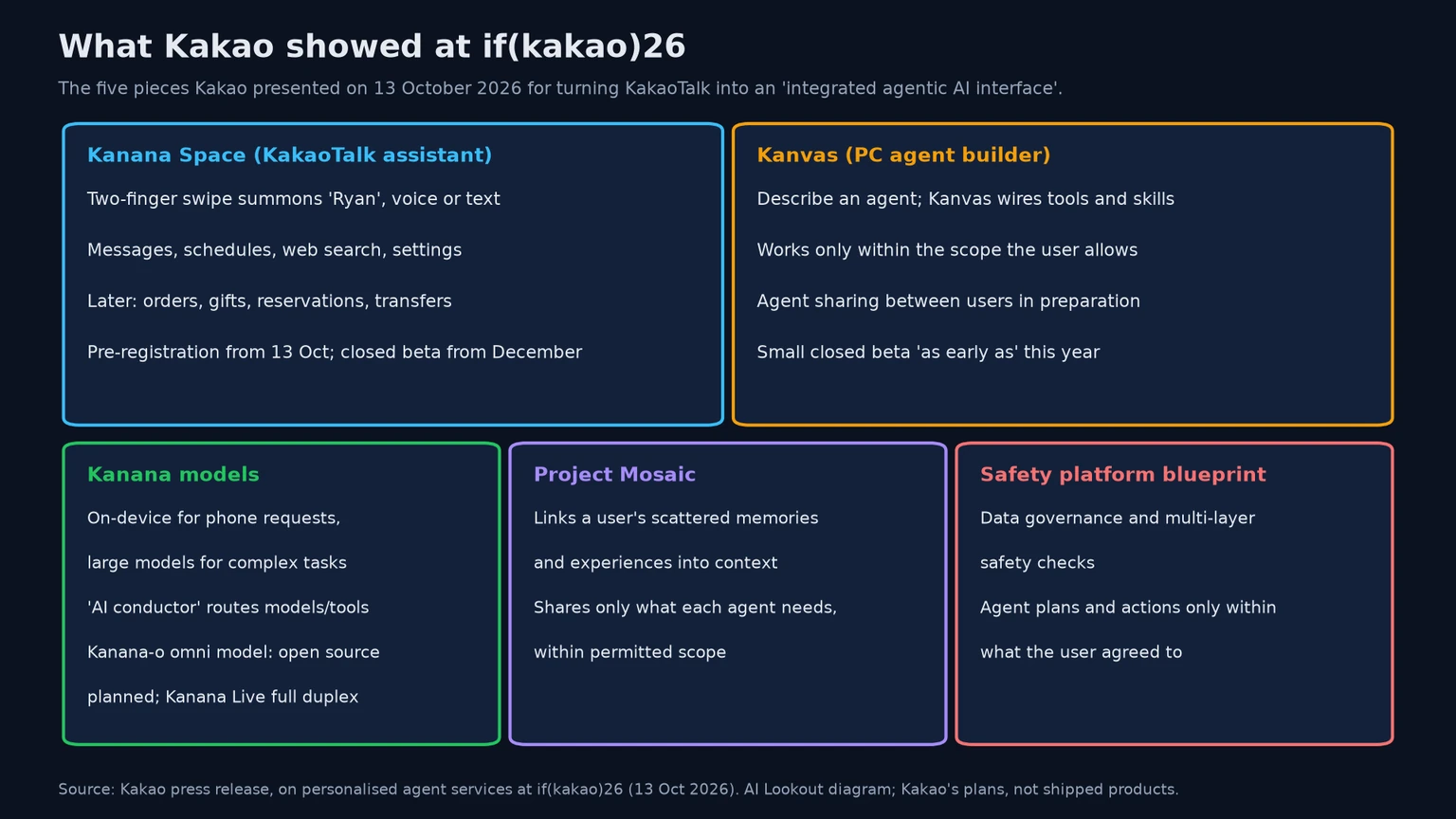
Kakao presented five pieces in sequence: Kanana Space, an assistant that can be called up anywhere in KakaoTalk; Kanvas, a PC service for building and running your own team of agents; the Kanana AI models underneath; Project Mosaic, for personalised context; and a blueprint for an AI safety platform. Chung framed the strategy as extending the connections KakaoTalk has built over 15 years with a new layer of intelligence that understands individuals.
The conference runs over two days with 55 sessions by Kakao and affiliate staff on AI direction, trust and safety, models and agents, and reliability and infrastructure. The keynote and sessions are streamed, with recordings promised afterwards. The announcements are plans and betas, so the useful questions are how each piece is supposed to work and when users can try it.
How will Kanana Space work inside KakaoTalk?
Kanana Space was introduced by design lead Kim Dae-nyeon. The idea is that help should be one gesture away: swiping the KakaoTalk screen with two fingers brings up Ryan, one of Kakao’s best-known characters, and users ask for things by voice or text. At launch the listed jobs are sending messages, managing schedules, searching the web and changing KakaoTalk settings, plus casual conversation. Kakao says more characters based on other intellectual property will follow.
Kakao’s ambition goes further. It says it will extend Kanana Space so a single sentence can complete orders, gifts, reservations and money transfers. Its example: in a chat about running out of bottled water, a user says “order water,” and the assistant picks the brand they bought before, applies an available coupon, and prepares everything from order to payment. That is a description of intended behaviour, not something demonstrated to the public in testable form.
The design choice matters. Rather than a separate AI tab, Kakao is putting the assistant on top of the app people already use for messaging, a pattern other platforms are also chasing, as in Google’s Gemini agent for work. Kakao says the aim is that anyone can use AI without learning a new interface.
What is Kanvas, the PC agent builder?
Kanvas is the second product, aimed at people who want their own agents. A user describes the agent they need, and Kanvas connects the right tools and skills and configures what is required to run it. The agent then works only within the scope the user has allowed; instead of supervising every step, the user checks in at key points. Kakao pitches it for repetitive work and everyday to-do lists.
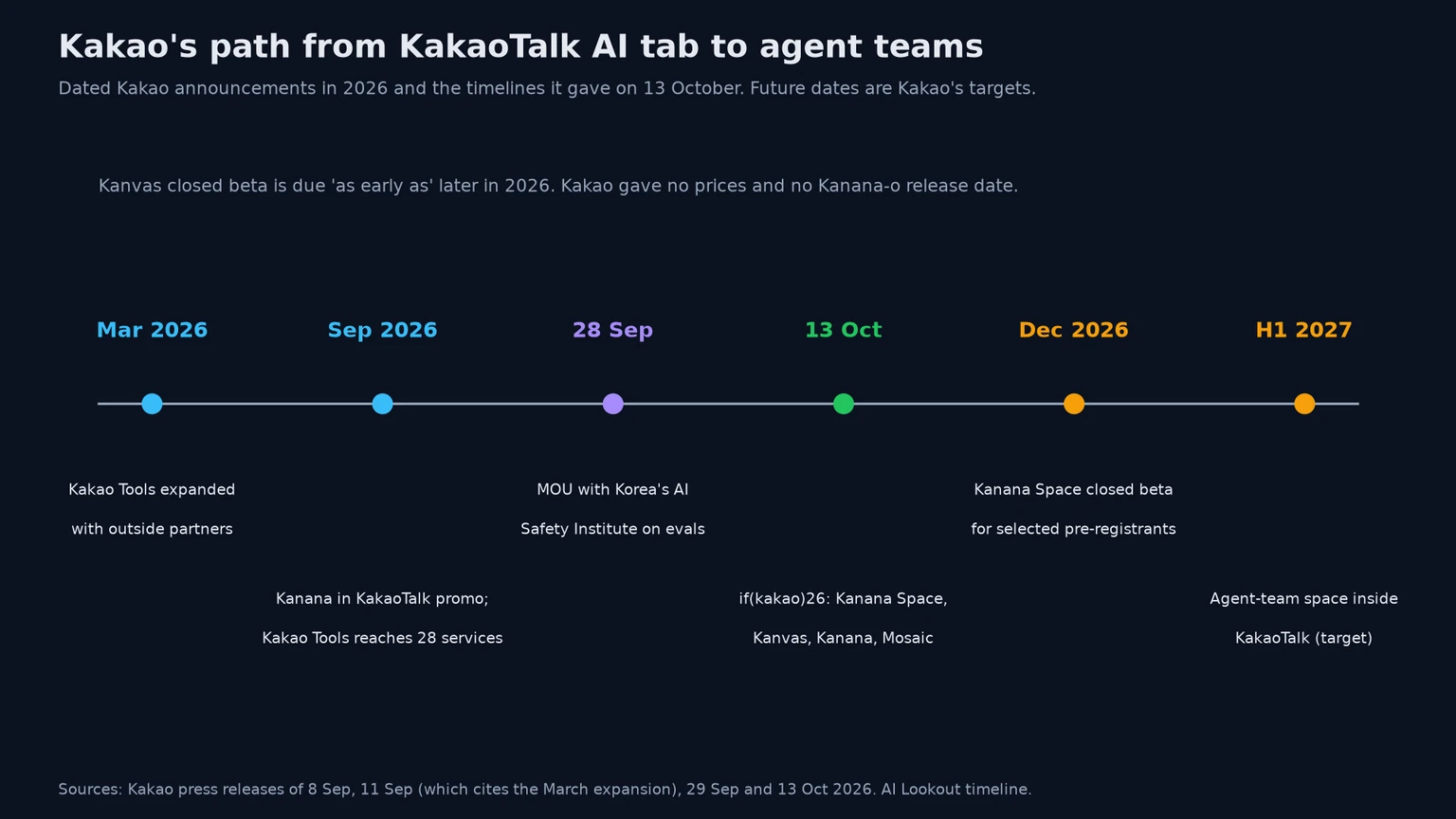
Kakao is also preparing a sharing feature so users can publish useful agents and use ones that others have built, which it describes as a user-centred agent ecosystem. The longer goal is what Kakao calls an integrated agentic AI interface: in the first half of 2027 it plans a new space inside KakaoTalk where a user’s team of agents is connected, supporting agents built with Kanvas and with other frameworks.
That cross-framework promise is notable because agent interoperability is an open problem across the industry, from the Personal Agent Protocol backed by Meta and Sierra to vendor-specific tool stores. Kakao did not say which standards or protocols Kanvas will support. It already runs Kakao Tools, an agent service inside ChatGPT for Kakao that connected 28 Kakao, affiliate and partner services as of September, according to a separate Kakao release.
Which Kanana models sit underneath?
Noh Byung-seok, who leads Kakao’s foundation-model development, described the direction of the Kanana models in terms of serving 50 million users’ daily lives. The three pillars are full-stack optimisation across model lightweighting, computation and serving; multimodality across text, images and speech; and agentic AI that actually completes requested tasks.
Kakao plans a split architecture: requests a smartphone can handle run on on-device models, while complex tasks go to large models. An “AI conductor” interprets each request and chooses the models, tools and execution order, which Kakao says reduces inference cost, and an in-house tokenizer helps efficiency. The on-device side builds on Kanana in KakaoTalk, which Kakao describes as an on-device service that reads conversation context, proactively suggests help and gives morning schedule briefings from the Friends tab.
Kakao also showed Kanana-o, an omni language model that understands text, images and speech and answers by voice, and says it built all of its encoders and decoders in-house and will release Kanana-o as open source. Separately it presented Kanana Live, a full-duplex system that listens and speaks at the same time. No weights, benchmarks or release date were given, so it is too early to compare Kanana-o with on-device rivals such as OpenBMB’s MiniCPM-V 4.7.
How does Kakao plan to handle memory and safety?
Chief technology officer Song Jae-ha presented the plumbing for personalisation. Project Mosaic is meant to connect a user’s scattered memories and experiences into meaningful context, then pass each agent only the information it needs, within permitted bounds, so agents with different roles can share context and cooperate.
On safety, Kakao described a platform with systematic data governance and multiple verification layers, so that an agent’s plans and actions complete only within the scope the user has agreed to. That builds on an agreement Kakao signed on 28 September with Korea’s AI Safety Institute: the two plan pre- and post-deployment safety evaluations of language models, then multimodal models and AI agents, and joint development of evaluation tools. Kakao says it ran a joint safety evaluation of its Kanana-1.5-9.8B model with the institute last year.
These are commitments and architectures, not audited results. An assistant that can place orders and send money from a chat window raises obvious questions about consent prompts, payment confirmation and recovery from mistakes, and Kakao has not yet published how those flows will work.
When can people use it?
Not yet, for most people. Kakao opened pre-registration for Kanana Space on its website on 13 October and says it will pick some applicants for a closed beta starting in December. Kanvas is due for a closed beta with a small group of users as early as later this year. The agent-team space inside KakaoTalk is a first-half 2027 target.
Kakao gave no pricing for any of the services, no language or country availability beyond its Korean launch context, and no general-availability dates. The existing Kanana in KakaoTalk service, the on-device assistant in the Friends tab, is the part users in Korea can already try today.
What should readers watch for?
The first test is the December beta: whether Kanana Space handles real messaging and scheduling reliably, and how quickly Kakao turns on transactions such as orders and transfers. The second is Kanvas: whether non-developers can actually assemble useful agents, and how permissions are presented when an agent touches accounts and payments.
The third is openness. A Kanana-o open-source release would give developers a concrete Korean multimodal model to evaluate, and support for agents built with other frameworks in KakaoTalk would make the 2027 agent space more than a walled garden. Until those land, if(kakao)26 is best read as Kakao’s detailed roadmap for putting agents inside South Korea’s dominant messenger.
Common questions
Can I use Kanana Space now?
Not yet. Kakao opened pre-registration on 13 October 2026 and plans a closed beta for selected applicants from December. No general-availability date was given.
What is the difference between Kanana Space and Kanvas?
Kanana Space is an assistant summoned inside KakaoTalk for tasks like messages and schedules. Kanvas is a PC service for building and running your own agents, which act only within the scope you allow.
Will Kakao open-source its models?
Kakao says it will release its omni model Kanana-o as open source for the domestic and global AI ecosystem, but it did not give a date or licence.
What to remember
Kakao’s if(kakao)26 announcements sketch a full stack for agents in KakaoTalk: a swipe-to-summon assistant, a PC agent builder, on-device and large Kanana models, a memory layer and a safety platform. Betas start from December, with an agent-team space targeted for 2027, so the real verdict depends on how the betas perform.
Sources & further reading
- 카카오, if(kakao)26에서 개인화 기반 완결형 에이전트 서비스 및 기술 선보여 (Kakao shows personalised agent services and technology at if(kakao)26) ↗
- if(kakao)26 event site ↗
- 카카오, 인공지능안전연구소와 AI 안전성 평가 체계 구축을 위한 MOU 체결 (Kakao signs MOU with AI Safety Institute) ↗
- 카카오, ‘카카오툴즈’에 새로운 파트너 서비스 연동 (Kakao adds partner services to Kakao Tools) ↗
- 카카오, ‘카나나 인 카카오톡’ 가입 프로모션 진행 (Kanana in KakaoTalk promotion) ↗
How this story was made
Written by Kristian Kostov with AI assistance and checked against the linked sources. Company performance claims are attributed to the company. Analysis reflects AiLookout’s interpretation; we have not independently tested the products discussed. Cover photography is illustrative and does not depict the specific announcement or product.
Our editorial standards