Announced 21 Oct 2026 · Sources checked
What IBM released
IBM has refreshed its open speech models. In a Hugging Face post published on 21 October 2026, the IBM Granite team announced three releases at once: a new speech-language model called granite-speech-5.0-2b, a revised granite-speech-5.0-470m-turboctc, and updated weights for granite-speech-4.1-2b-plus. IBM says that together they cover "the full range of enterprise speech work": accurate transcription and translation, very fast transcription on small devices, and recordings where it matters who spoke and when.
All three models are released under the Apache 2.0 licence, which allows commercial use, and they run with native support in the Hugging Face Transformers library. The new 2B model's card gives a release date of 20 October 2026, a day before the announcement post, while the Turbo CTC card dates its multilingual update to 21 October. The models are free to download from IBM's Granite organisation on Hugging Face.
This follows another recent Granite release. Last week IBM shipped Granite Switch 4.1, which bundles chat, decisions and speech behind one endpoint. Granite Speech 5.0 is narrower: it is about turning audio into accurate text and translations, with tools to steer the output toward the names and terms a business actually uses.
Granite Speech 5.0 2B: accuracy, languages and keyword lists
granite-speech-5.0-2b is the successor to granite-speech-4.1-2b and keeps the same size, about two billion parameters. It transcribes English, French, German, Spanish, Portuguese and Japanese. It translates to and from English in those languages, and it can also translate from English into Italian and Mandarin. IBM says it was trained on 390,000 hours of audio from public corpora, plus synthetic data built for Japanese recognition, keyword biasing and translation.
The model card describes how it was built. A speech encoder made of 16 conformer blocks turns audio into acoustic embeddings, a small adapter compresses them, and an intermediate checkpoint of IBM's granite-4.0-1b-base language model produces the text. IBM says training took 40 days on 8 NVIDIA H100 GPUs on its Blue Vela cluster: 26 days for the encoder and 14 for the projector.
IBM lists five improvements over version 4.1. English accuracy is higher on short-form benchmarks, and the model handles noise, echo and distant microphones better. Users can now name the input language in the prompt to steer multilingual transcription. Translation of longer, more conversational speech holds up better. Keyword lists can now hold up to 2,000 terms, which lets a user bias transcription and translation toward product names, people and acronyms. And punctuation and capitalisation can be requested in the prompt; IBM reports capitalisation F1 scores from 89.7 to 99.5 across its test sets.
On the Open ASR Leaderboard, a public ranking of English speech recognition models, IBM says the model averages a 5.06 percent word error rate across the leaderboard's short-form test sets, which it says ranks second among top open-weight models. IBM calls those results unofficial as of 15 October 2026. The model card separately cites official leaderboard results as of 20 October. Either way, these are IBM's own figures, and word error rate on read benchmark audio does not always match accuracy on real phone calls or meetings.
Turbo CTC becomes multilingual and faster
Turbo CTC is the speed option. When IBM introduced it in August, it was an English-only, 470-million-parameter encoder built to transcribe as fast as possible. The new revision keeps that size and adds what IBM says users asked for most: transcription in seven languages (English, Japanese, Spanish, German, French, Italian and Portuguese), punctuation and capitalisation built into the output, and better handling of echoey rooms and far-field recordings.
IBM says it also got faster. By compiling a single conformer block and reusing its graph across the stack, the team cut warm-up time and raised Turbo CTC's speed on the Open ASR Leaderboard to 19,870 RTFx, up from about 12,600 RTFx at launch. RTFx measures how many seconds of audio a model can process per second of compute, so higher is faster. IBM puts the gain at about 1.6 times at the same accuracy level.
The model card adds that, despite gaining six languages, the multilingual model's average English word error rate improved to 5.51 percent from 5.78 percent for the original English-only release. For Japanese, IBM says the small Turbo CTC model beats the larger 2B model on all three test sets it reports. The card says the model suits laptops, smartphones and other edge devices, and IBM points users to a WebGPU streaming demo that runs it in a web browser.
Granite Speech 4.1 2B Plus: who said what, and when
The third release is aimed at the messy audio most companies actually store: meetings, support calls and interviews with several people talking for a long time. granite-speech-4.1-2b-plus keeps its 4.1 name because its architecture, prompt format and interface are unchanged, so IBM says it is a drop-in replacement with better weights.
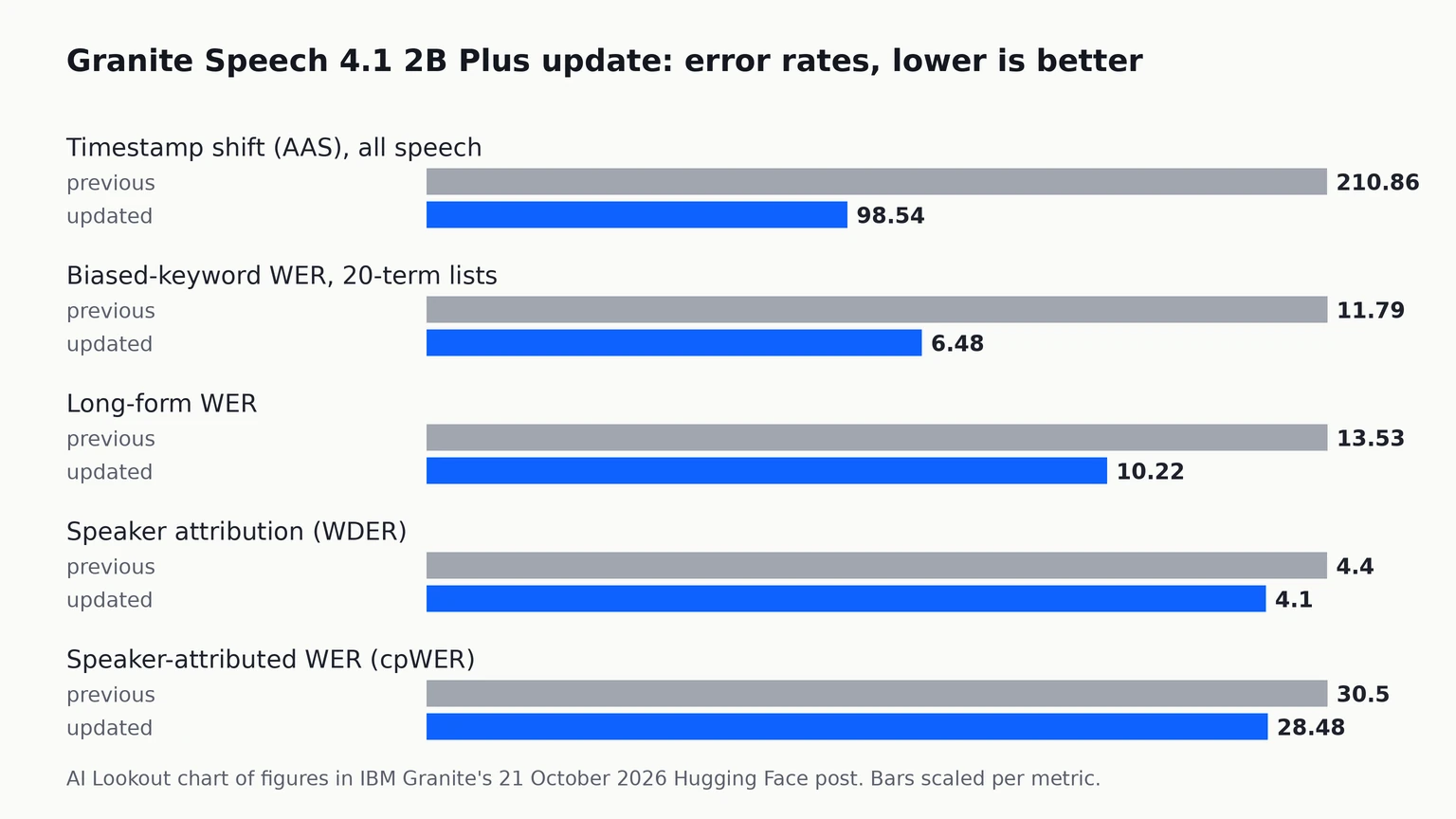
IBM reports gains in four areas. The word diarization error rate, which measures how often words are credited to the wrong speaker, falls 7 percent, from 4.40 to 4.10. Speaker-attributed word error rate drops by the same share, from 30.50 to 28.48. The average timestamp shift across all speech more than halves, from 210.86 to 98.54, which should mean tighter timing for captions and search. Word error rate on long-form test sets falls 24 percent, from 13.53 to 10.22, and errors on biased keywords fall 45 percent with 20-term keyword lists, from 11.79 to 6.48.
How to run the models
IBM's advice for choosing between them is simple. Use granite-speech-5.0-2b when accuracy, translation or keyword biasing matter most. Use the Turbo CTC model for raw speed or on-device transcription. Use granite-speech-4.1-2b-plus for meetings and multi-speaker calls.
The 2B model card shows the model running in Transformers, in the vLLM serving engine with an OpenAI-style API, in llama.cpp through a GGUF build, and in mlx-audio on Apple Silicon Macs. Tasks are chosen with plain-language prompts: for example "transcribe the speech with proper punctuation and capitalization", or a prompt that ends with "Keywords:" followed by a list. IBM recommends splitting recordings into segments of up to about two minutes, and says the Q8_0 quantised build matched the unquantised model in its tests, while lower-bit builds lose accuracy on audio longer than about a minute.
For production use, IBM recommends pairing the models with Granite Guardian, its separate model for flagging risky prompts and responses.
Why it matters for enterprise speech work
Open speech models have become a crowded field this autumn. Mistral recently launched Voxtral 3 and a voice agent SDK, and Ant Group open-sourced its Ming 3.0 speech models under the MIT licence. IBM's pitch is less about voice assistants and more about business records: transcripts that spell product names correctly, captions with accurate timestamps, and meeting notes that credit the right person.
The keyword feature is the most practical change. General speech models often mangle internal jargon, drug names or customer names, and fixing that usually means custom training or manual clean-up. A prompt that carries up to 2,000 terms is a cheaper way to try. The Apache licence also matters for companies that want to run transcription on their own servers, keeping recordings off third-party clouds.
The Turbo CTC update points the same way at the edge. A 470-million-parameter model that transcribes seven languages with punctuation can run on a laptop or phone, which helps with privacy and cost. That is a different trade-off from hosted voice services such as xAI's Grok Voice 3.0 API, which handle speech in the cloud.
Limitations and open questions
Every benchmark number in IBM's announcement is IBM's own, and AI Lookout has not tested the models. The blog post describes its leaderboard ranking as unofficial, and short-form benchmark audio is cleaner than many real recordings. Independent tests on noisy calls, accented speech and long meetings will say more than leaderboard averages.
Language coverage is still limited. The 2B model transcribes six languages, and Italian and Mandarin are supported only as translation targets from English. The model card also notes the usual risks: like other speech and language models, it may sometimes produce inaccurate, biased or unwanted output, and IBM says whether smaller models are more prone to hallucination is still an open research question.
The speaker-attribution gains are modest in absolute terms. A 7 percent relative drop in diarization errors is useful, but cpWER for multi-speaker transcripts is still around 28 percent on IBM's test sets, so meeting transcripts will still need human review where accuracy matters.
Common questions
What is Granite Speech 5.0?
IBM's latest open speech model family. The main release, granite-speech-5.0-2b, transcribes and translates speech in six languages, and a smaller Turbo CTC model handles fast transcription on devices.
Can businesses use Granite Speech 5.0 commercially?
Yes. IBM releases all three models under the Apache 2.0 licence, which permits commercial use, and they can be downloaded from Hugging Face and run on a company's own hardware.
Which Granite speech model should I use for meetings?
IBM recommends granite-speech-4.1-2b-plus for meetings and multi-speaker calls, because it labels speakers and timestamps. Its updated weights are a drop-in replacement for the earlier release.
Sources & further reading
How this story was made
Written by Kristian Kostov with AI assistance and checked against the linked sources. Company performance claims are attributed to the company. Analysis reflects AiLookout’s interpretation; we have not independently tested the products discussed. The cover places the companies’ own logos, taken from public-domain or openly licensed files credited in the caption, on a plain background. It is not a product photograph, a screenshot, or an endorsement.
Our editorial standards