Announced 23 Oct 2026 · Sources checked
What Hi3D released
Hi3D, a Beijing-based AI 3D creation platform, has open-sourced Hi3D v1.0, the production version of the image-to-3D system it previously called Sparc3D. The model card on Hugging Face gives the release date as 23 October 2026, and a PR Newswire announcement the same day said developers, researchers and companies can now download the source code and weights, or generate 3D models for free on Hi3D's website.
The release is narrower than a full text-to-3D or image-to-3D product. Hi3D v1.0 is the second stage of a two-stage pipeline: it takes a coarse 3D mesh plus a reference image of the same object and refines the mesh into much more detailed geometry. The GitHub repository holds the inference code, and Hugging Face holds eight model files: a sparse VAE and two flow transformers, each around 3.7 GB.
Sparc3D drew attention in 2025 for high-resolution 3D geometry. Hi3D says the open model is the same approach trained on far more data and tested in its own commercial product before being published. The company also said it is cutting credit consumption on its hosted platform by more than half.
How the refiner works
According to the Hi3D v1.0 technical report, the model keeps the core of the original Sparc3D paper. Image features from the reference picture condition a sparse flow model that works only on coordinates near the coarse mesh surface. A self-pruning sparse VAE decoder then expands those features eightfold around the predicted surface, and an isosurface extractor produces the refined mesh. No dense volume is ever stored, which is what makes the high nominal resolutions possible.
Refinement runs as a ladder of up to three passes. The first pass works on a 64-cubed structural grid and extracts a surface at 512 cubed. The mesh is then revoxelised for a second pass at 1024 cubed, and a third pass reaches an effective sparse extraction grid of 1536 cubed. Each level is usable on its own, so a user can stop at 512 or 1024 if speed matters more than detail.
The headline change from Sparc3D is scale. Hi3D says it trained the checkpoint on about two million curated 3D assets, up from about 500,000 in the earlier Sparc3D work, and added training data for the 1536 level. The report is candid that it does not claim a new generative objective, decoder or surface representation. The bet is that more data and more resolution, inside a proven architecture, produce a better general model.
What the benchmarks show
Hi3D compares its model with eight other image-to-3D systems, including Microsoft's TRELLIS and TRELLIS.2, Tencent's Hunyuan3D-2.1, TripoSG and Direct3D-S2. Beyond the common ULIP-2 and Uni3D similarity scores, it reports three measures of its own: Multi-View Fidelity, which renders each asset from six views and penalises broken or floating parts; Detail Richness, scored from clay renders and normal maps; and Slicing Success Rate, which tests whether a mesh can be sliced for a Bambu Lab A1 3D printer without any repair.
On those measures Hi3D v1.0 scores 0.75 for Multi-View Fidelity and 0.841 for Detail Richness, the best in its table, with a 90% slicing success rate. That last number is the most interesting. Other high-resolution models in the same table slice far less reliably: the report puts TRELLIS.2 at 17% and Pixal3D at 7%. On the plain ULIP-2 and Uni3D scores, though, TRELLIS.2 and Pixal3D rank higher than Hi3D, and lower-resolution models such as TripoSG reach 100% on slicing.
Hi3D also ran a pairwise user study. Thirteen participants with professional 3D-algorithm experience made 562 judgments, preferring Hi3D's geometry in 469 cases, calling 28 roughly equal and preferring the other model in 65. With half credit for ties that gives a preference score of 85.9%. Against the closest rival, Pixal3D, Hi3D won only 37 of 72 comparisons. All of these results come from Hi3D's own evaluation set and team, and the release does not include the harness or test split needed to reproduce them.
What you need to run it
This is not a laptop model. The README lists Linux, Python 3.10, an NVIDIA GPU of compute capability 8.0 or newer and a CUDA toolkit between 12.0 and 12.5. There is no CPU path, and flash-attention has no fallback. Hi3D measured its stack on a 96 GB NVIDIA H20, and says the full 1536 ladder has only been validated on that card. Peak memory on smaller GPUs has not been established, though a sequential CPU offload mode is offered.
Users also need a coarse mesh to start from. The repository includes a demo that calls Tencent's Hunyuan3D-2 mini model for that first stage, but Hunyuan's code and weights must be obtained separately under Tencent's own licence. The conditioning encoders, Meta's DINOv2-large and OpenAI's CLIP ViT-L/14, are downloaded from Hugging Face on first use. Hi3D's proprietary first-stage system is not part of the release, and neither is training code.
The output is geometry only: no textures, materials or vertex colours, batch size one, recentred and scaled to unit radius. A short Python API loads the pipeline with from_pretrained and exports a GLB file, with resolutions of 512, 1024 or 1536.
The licence, in plain terms
The weights are not under a standard open-source licence. They ship under the Hi3D Open License Agreement 1.0, issued by OCEANO HK HOLDING LIMITED and dated 22 October 2026. It allows commercial use, modification, fine-tuning, hosting and redistribution, and it lets users train other models on Hi3D outputs. Hi3D claims no ownership of generated meshes.
There are conditions. Any commercial product that integrates the model must display “Powered by Hi3D 1.0” with a link to the company's website. A related product that passes 200,000 monthly active users or $1 million in monthly revenue must notify the licensor and apply for a separate written licence within 60 days. An acceptable-use policy also applies. Selling or sharing the meshes themselves does not trigger the branding or scale rules, as long as they do not contain the model.
That puts Hi3D v1.0 in the familiar middle ground between open weights and open source. Teams planning a product should read the scale threshold and branding clause carefully, using a model licence checklist rather than treating the release like Apache-2.0 code. Parts of the repository inherited from earlier projects keep their Apache-2.0 and MIT terms, and the README's sample images are excluded from the licence entirely.
Where it fits in AI 3D
Open 3D generation has moved quickly this autumn. Tools such as TopviewAI's open-source 3D Builder assemble editable scenes, while world models like Tencent's Hy-Nomas generate whole environments. Hi3D aims at a different job: single objects that have to survive rotation, editing and fabrication.
The company pitches the model at 3D printing, e-commerce product models, industrial design, VR and AR, and animation. The focus on slicing success fits that pitch. A mesh that looks good from the front but has holes, floating fragments or thousands of disconnected parts is of little use to someone printing a figurine, and fabrication is becoming a serious AI use case, as robotic construction printing shows at a much larger scale.
Hi3D is clear that v1.0 is not its best model. The report says its production system has moved on to Hi3D v3.0, which raises nominal resolution to 2048 cubed and adds texture quality, alongside a Hi3D Agent and an MCP integration so outside agents can call its 3D tools. The open release is the older, stable generation, a common pattern for companies that sell a hosted product.
Limits and open questions
The biggest caveat is reproducibility. Without the training code, evaluation harness, benchmark split or comparison meshes, outsiders cannot check the tables in the report, and the user study is small. The metrics Multi-View Fidelity and Detail Richness are Hi3D's own definitions, and the report does not say how many assets were in the test set.
There are practical limits too. Because the model works from a single image, anything hidden from that image is a plausible guess, not a reconstruction. Serious errors in the coarse mesh can survive refinement. Results are not bit-for-bit deterministic on GPUs, and the report itself notes that a successful slice does not guarantee a part can actually be manufactured.
It is also unclear how the hardware requirement will play out. A model validated only on a 96 GB data-centre GPU will be hard for many hobbyists and small studios to run at full resolution until the community tests smaller cards.
Why it matters
Hi3D v1.0 gives developers a free, commercially usable refiner that, on its maker's tests, produces more detailed and more printable geometry than the open models it compares against. The trade-offs are a custom licence with branding and scale strings, heavy GPU requirements, a dependency on someone else's first-stage model and benchmark claims that cannot yet be independently reproduced.
Common questions
Is Hi3D v1.0 free for commercial use?
Yes, under the Hi3D Open License 1.0, but commercial integrations must show Powered by Hi3D 1.0, and products above 200,000 monthly users or $1 million monthly revenue must apply for a separate licence.
Can Hi3D v1.0 make a 3D model from a single photo?
Not on its own. It refines an existing coarse mesh. The demo uses Tencent's Hunyuan3D-2 mini to create that first mesh, which must be downloaded separately under Tencent's licence.
What hardware does it need?
Linux and an NVIDIA GPU of compute capability 8.0 or newer with CUDA 12.0 to 12.5. Hi3D validated the full 1536 resolution only on a 96 GB H20; there is no CPU mode.
Sources & further reading
How this story was made
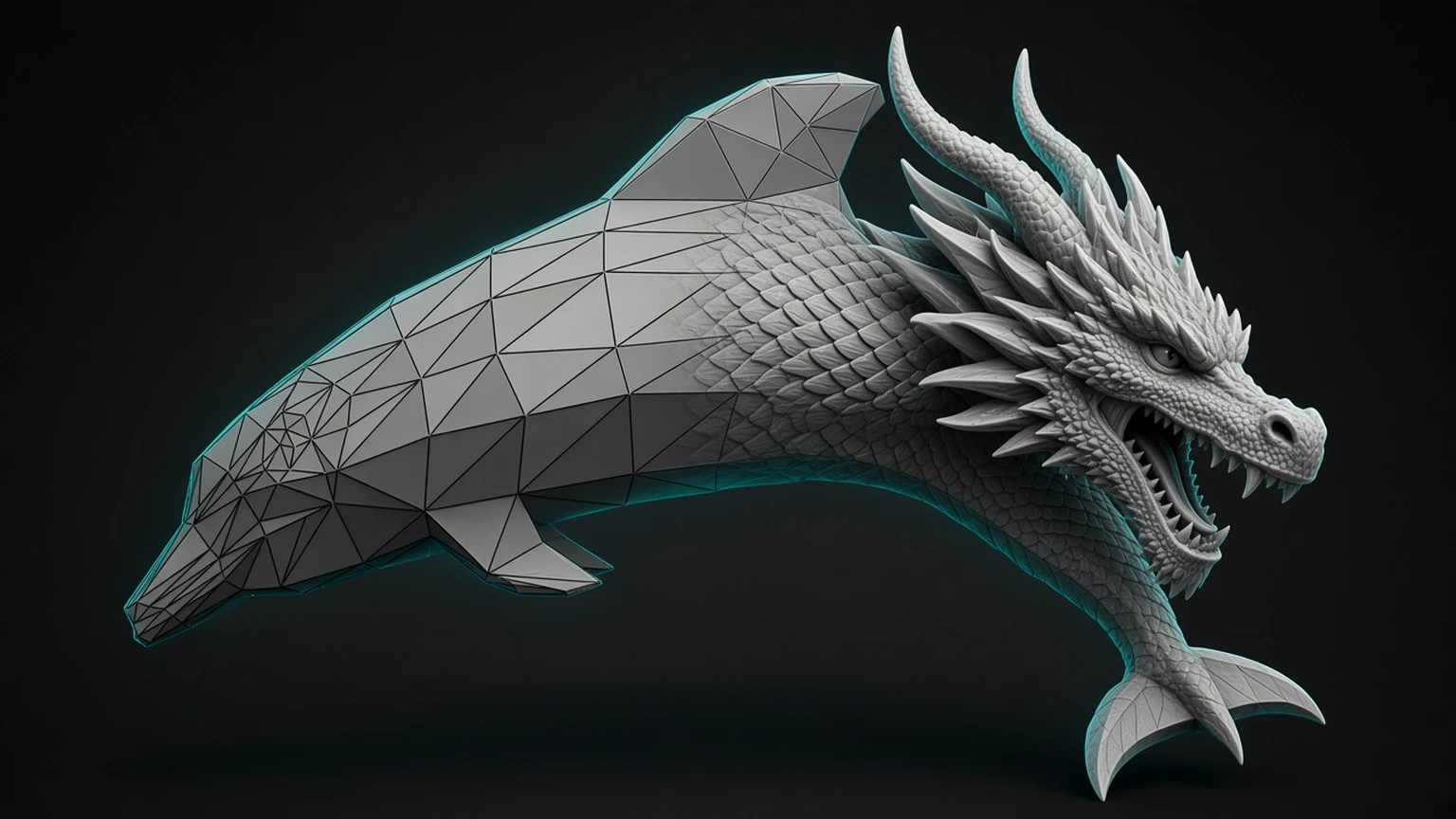
Written by Kristian Kostov with AI assistance and checked against the linked sources. Company performance claims are attributed to the company. Analysis reflects AiLookout’s interpretation; we have not independently tested the products discussed. The cover is an AI-generated editorial illustration, not a photograph or evidence of an actual event.
Our editorial standards