Announced 23 Oct 2026 · Sources checked
What Tencent released
Tencent's Hunyuan team has published Hy-Nomas, an open video world model that generates a scene a few seconds at a time and lets the user change it between segments with new text instructions or a camera path. The weights are on Hugging Face under the Apache 2.0 licence, and the Hy-Nomas code repository on GitHub carries the inference, training, demo and data annotation code.
Both repositories were created on 21 October 2026, and the model card and weights were last updated on 23 October. Tencent describes the project as "towards free-form interactive world generation". In practice that means you start a world with a prompt, then keep extending it: introduce an object, change the style or the scene, describe what a character does next, or move the camera, and the model continues from what it already generated.
Tencent also runs an online interactive demo where you can start a world, continue it with text or camera moves, and download the video. A technical report is listed as "coming soon". Alongside the weights, Tencent released Hy-Nomas-Bench, a set of 280 test cases for this kind of interactive generation.
How Hy-Nomas builds a world
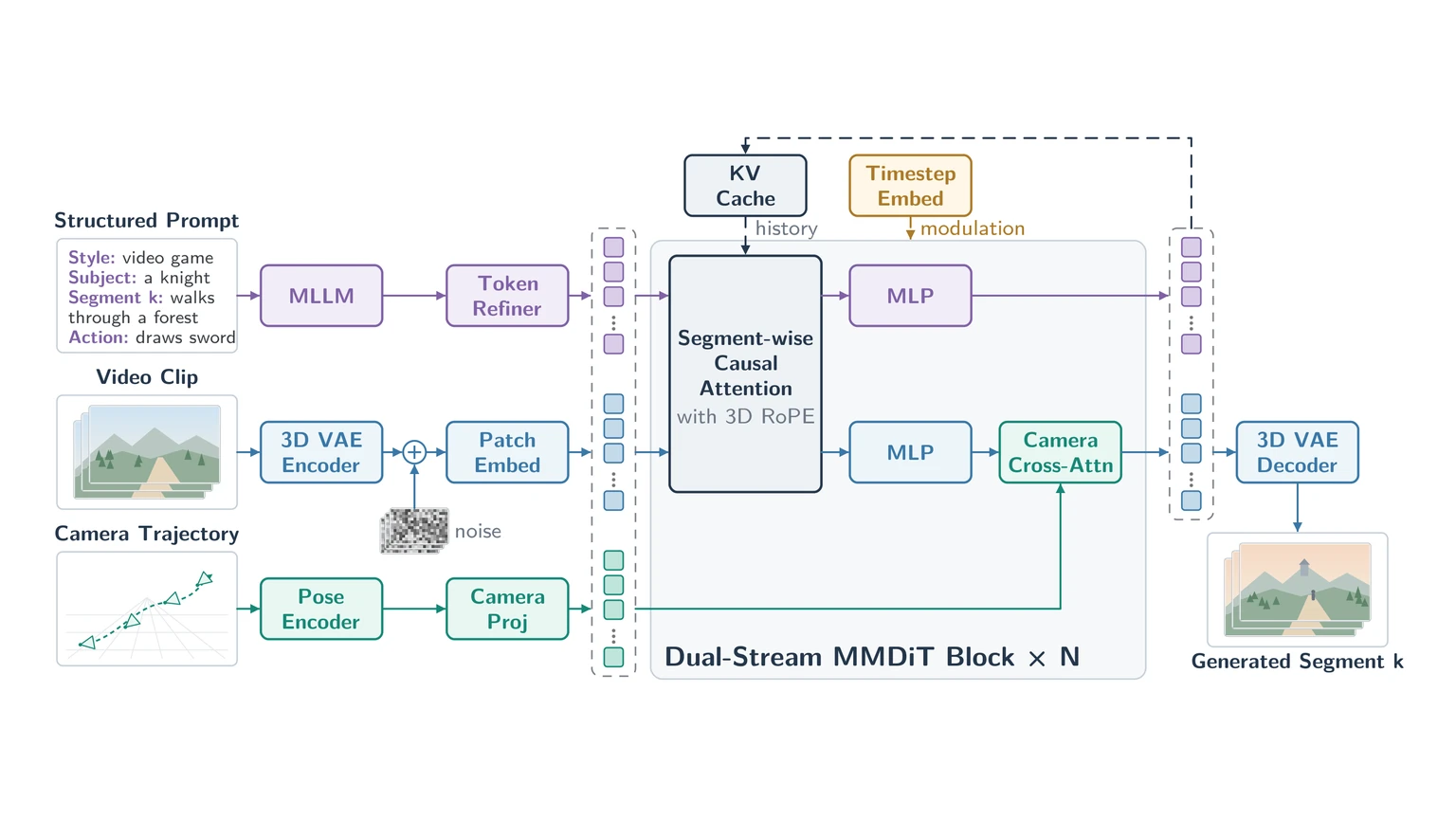
Hy-Nomas combines diffusion and autoregression. Within each segment, a diffusion transformer turns noise into a short clip in a compressed video latent space. Across segments, generation runs forward like a language model: each new segment attends to everything generated so far, but never to the future, so the model does not need to know where the story is going.
The memory that makes this work is a persistent key/value cache. Instead of recomputing the whole history for every new clip, the model stores the attention keys and values from earlier segments and reuses them. In the standard configuration the full history is kept, so the cache grows as the world gets longer.
The backbone is a dense multimodal diffusion transformer with 54 dual-stream blocks, a hidden size of 2,048 and 16 attention heads. Text and video run in separate streams that meet in a joint attention step, with 3D rotary position encoding for video. Text comes from the language model inside Qwen2.5-VL-7B-Instruct, refined and projected into the transformer. Camera control is a third input: camera matrices are grouped over four frames and fed in through cross-attention in each block.
Video is stored as DCAE-V latents with 32 channels, 32 times spatial compression and 4 times temporal compression. A fine-tuned PixelUMM decoder, itself a 36-layer transformer, turns those latents back into pixels in a single decoding step. The distilled model needs only 8 denoising steps per segment, and the GitHub README says the same checkpoint also supports 4 and 6 steps. Default output is 720 by 1280 at 24 frames per second.
In the web demo, a separate prompt-enhancement model called Nomas-PE first rewrites a user's instruction into the structured prompt the model expects, with fields for style, perspective, subjects, segment timing and actions. Offline users can write those structured prompt files themselves.
What runs where
Hardware is the first thing to check. The standard setup uses 8-way sequence parallelism and needs eight GPUs in one inference group. Tencent strongly recommends its pre-built Docker image, which bundles PyTorch for CUDA 13.0 and the attention kernels; a manual install builds FlashAttention 2, FlashAttention 3 and MagiAttention, which the README warns can take some time.
There is also a low-memory configuration aimed at a single GeForce RTX 4090. It stores the transformer weights and the cache in INT8, uses an FP8 decoder, keeps only up to 18 earlier latent frames on the GPU and archives the rest in system memory, and moves each model on and off the GPU as it is needed. Tencent is clear about the cost: system RAM has to hold the offloaded models and a growing history, and the transfers add latency. The single-GPU claim covers video inference only; the demo's prompt-enhancement service needs its own resources.
The GitHub repository also shows a Diffusers pipeline loaded from a separate tencent/Hy-Nomas-Diffusers repository, and a guide for deploying the full web demo with a gateway and GPU workers on one or more hosts.
A benchmark with no scores yet
The Hy-Nomas-Bench dataset has four suites: multi-turn free-form text interaction, camera navigation, interleaved text and camera control, and spatial memory. Each case comes with structured prompts, interaction sequences, keyboard timelines and reference camera trajectories.
What the release does not include is any result. The model card publishes no scores on Hy-Nomas-Bench or any other benchmark, and no comparison with other world models. It says explicitly that the architecture and sampling defaults it lists are configuration details, not benchmark results. Until the technical report appears, there is no Tencent number for how well Hy-Nomas follows instructions, keeps a scene consistent, or remembers a place the camera has left.
Fine-tuning and the robotics adapter
Tencent ships two optional LoRA adapters. A cinematic adapter is meant to improve visual quality. A dual-arm robotics adapter was trained on RealSource-World, a public dataset of real robotic-arm video, and is meant to improve how generated worlds simulate robot manipulation. Both are merged into the distilled checkpoint before inference; the INT8 single-GPU loader cannot load a separate adapter.
The training code is included too. LoRA fine-tuning starts from the non-distilled base checkpoint with what Tencent calls a segment forcing pipeline, then the learned weights are merged into the distilled model. The example configuration trains at rank 256 for 2,000 steps on 128 GPUs. A captioning harness turns local videos into annotated, encoded training files.
Where it fits among world models
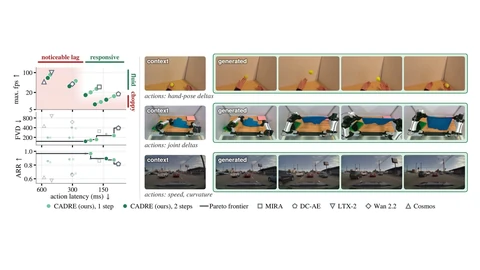
Interactive world models have become one of the busiest corners of open AI this month. Skywork's Matrix-Game 4 renders playable low-poly games, Kyutai's CADRE autoencoders target world models that react in under 230 milliseconds, and Odyssey has its own foundation world model.
Hy-Nomas leans toward free-form storytelling rather than game controls: text instructions that change the content mid-stream, combined with camera paths. It is also the second Hunyuan release this month built around memory, after Hy-Memory-30B-A3B, although the two solve different problems.
Limits and open questions
The biggest gap is evidence. There are no published scores, the report is not out, and we have not run the model. Speed is not stated either: Tencent notes that 24 frames per second is the playback rate of the output, and that generation speed depends on hardware, resolution, segment length and history.
Long sessions have a memory cost. With full history the cache keeps growing, and the single-GPU mode bounds GPU memory only by limiting how much history the model can see. How well a world stays consistent once older segments fall out of that window is exactly what the spatial-memory suite is designed to test, and it is still unanswered.
Finally, Apache 2.0 covers Tencent's code and weights. The licence notes that third-party components, including the Qwen text encoder, keep their own terms.
Who should try it
Researchers working on world models, video generation or simulation for robotics get a permissively licensed system with weights, training code and a benchmark in one place. Hobbyists with a single RTX 4090 and plenty of system memory can try the low-memory path, and everyone else can start with the web demo. Anyone comparing it with other world models should wait for Tencent's numbers, or run the benchmark themselves.
Common questions
Is Hy-Nomas free to use commercially?
Tencent licenses its code and weights under Apache 2.0. Third-party parts such as the Qwen text encoder keep their own licences.
Can I run Hy-Nomas on one GPU?
Tencent provides a low-memory configuration for a single RTX 4090 using INT8 and FP8 weights and CPU offload. The standard setup uses eight GPUs.
How good is it compared with other world models?
Unknown for now. Tencent published a benchmark but no results, and its technical report has not been released.
Sources & further reading
How this story was made
Written by Kristian Kostov with AI assistance and checked against the linked sources. Company performance claims are attributed to the company. Analysis reflects AiLookout’s interpretation; we have not independently tested the products discussed. The cover places the companies’ own logos, taken from public-domain or openly licensed files credited in the caption, on a plain background. It is not a product photograph, a screenshot, or an endorsement.
Our editorial standards