Announced 15 Oct 2026 · Sources checked
What Google Quantum AI showed on Willow
Google Quantum AI said on 15 October 2026 that it has made a technique called magic state cultivation work on real hardware for the first time. In a paper published that day in Science, the team reports that cultivation on its Willow superconducting processor cut the error of a key quantum resource by a factor of about 40 compared with preparing it without cultivation, and reached a logical fidelity of at least 99.99%.
The work was led by research scientist Emma Rosenfeld and quantum software engineer Craig Gidney, who wrote Google's announcement post. A preprint of the same study, with more than 200 authors from Google Research plus collaborators at NASA Ames and several universities, has been on arXiv since December 2025, and Science released the peer-reviewed version online on 15 October 2026.
Google calls the result the first demonstration of a practical solution to one of quantum computing's most severe resource bottlenecks. It is a laboratory experiment on a small patch of qubits, not a working algorithm, but it tests on hardware an idea that until now existed only in theory and simulation.
Why magic states are a bottleneck
Error-corrected quantum computers can run a set of operations called Clifford gates fairly cheaply. Those alone are not enough for useful programs. To reach a universal gate set, a machine also needs at least one non-Clifford gate, usually the T gate, and the standard way to run it under error correction is to prepare a special input called a magic state and consume it through gate teleportation.
The catch is quality. The paper notes that factoring a 2048-bit RSA key would need magic states with an error of roughly one in ten billion, and some chemistry and optimisation simulations need one in a million to one in a hundred million. Reaching those levels has traditionally meant magic state distillation, which burns many noisy states to produce a few clean ones. Google's post cites estimates that up to 95% of a quantum computer's capacity might go to making magic states, and each state can be used only once.
How cultivation works
Gidney, Noah Shutty and Cody Jones proposed magic state cultivation in 2024 as a cheaper alternative. Google describes it as a filter. A noisy magic state is injected into a small error-correcting code, then a carefully choreographed sequence of measurements checks whether the state is the one wanted. Any attempt that shows a sign of error is thrown away and restarted, and the attempts that survive are far purer than what went in.
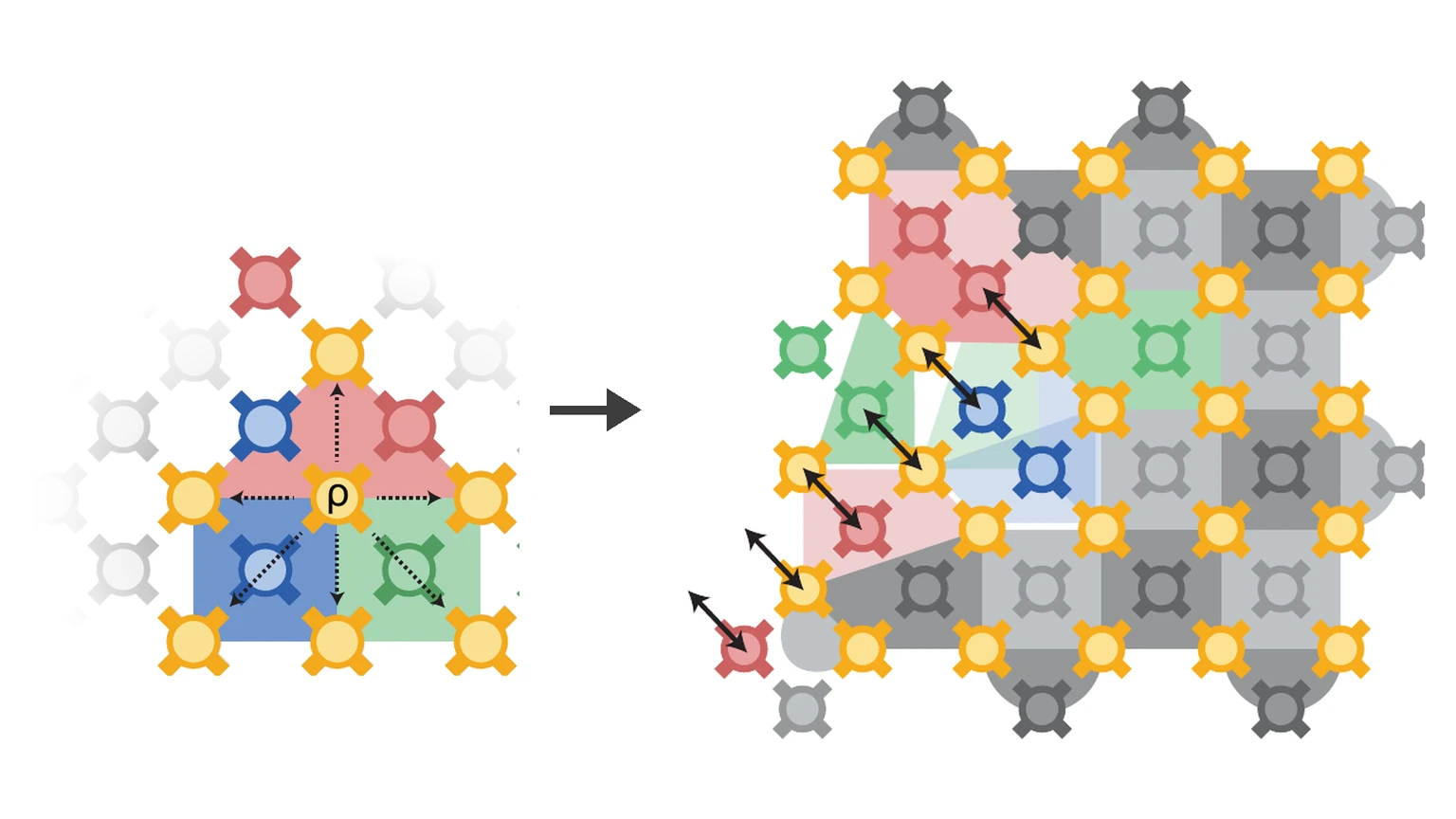
On Willow, the team started in a distance-3 colour code, a small triangular patch of data qubits and helper qubits inside the processor's square grid of superconducting transmon qubits. Colour codes suit cultivation because their single-qubit logical gates are transversal, meaning they can be applied to every physical qubit independently, which keeps errors from spreading. The circuit folds the logical measurement down onto a single physical qubit, reads it, then runs the whole sequence in reverse so the code is restored and the helper qubits double as extra error detectors.
The 40-fold result and how it was measured
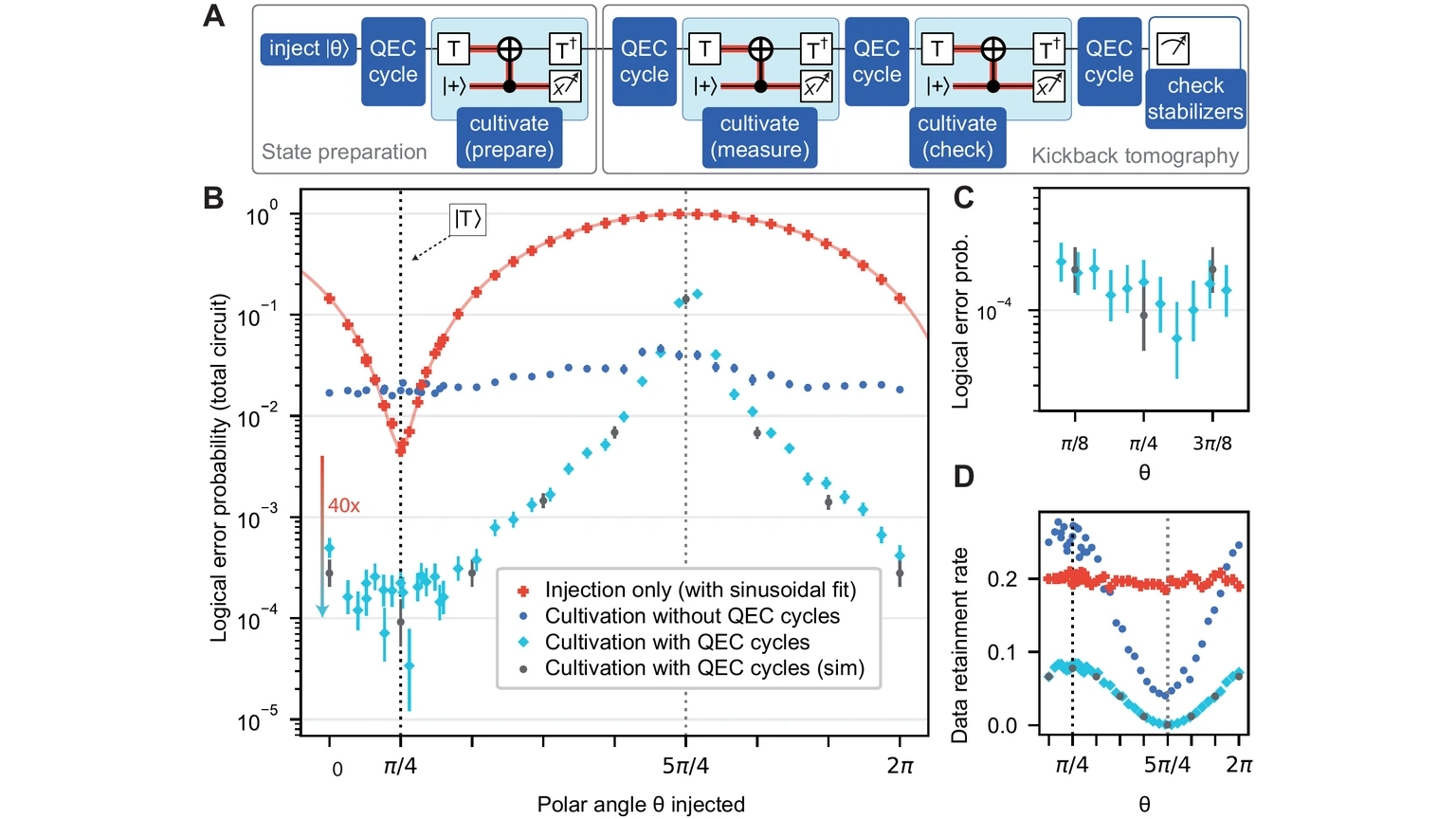
Measuring an error rate near one in ten thousand is hard in itself. The paper says ordinary tomography would need around 100 million shots to resolve it and can overestimate purity when noise is coherent. Rosenfeld found that early data seemed to defy physics; the Google post says the cause was drift in lab electronics and temperature that broke an assumption in the team's usual benchmark. The team added control to reduce that noise and invented a new method, kickback tomography, that uses further rounds of cultivation to measure the cultivated state in a single self-consistent circuit.
With that method, the logical error at the target T state improved by about a factor of 40 relative to injection alone, to an upper bound of roughly one error in ten thousand, or a fidelity of 0.9999 with an uncertainty of one in the last digit. The price is post-selection: only about 8% of attempts were kept in that configuration, which included two extra rounds of cultivation and three error-correction cycles. In the simpler tomography experiment without the extra measurement rounds, injection alone kept about 76% of shots, but with far higher error.
The authors say this fidelity is similar to recent trapped-ion demonstrations, while superconducting circuits keep their speed advantage. Removing the error-correction cycles from the circuit made the error drastically worse, which the team presents as evidence that the colour code itself is doing real work.
Grafting the state into a surface code
A clean magic state in a tiny code is not useful for long, because a small code accumulates errors quickly while it idles. The team therefore moved, or grafted, the cultivated state from the distance-3 colour code into a distance-5 code compatible with the surface code, the more established scheme that Google's earlier below-threshold experiments used. The grafting step used 54 qubits.
The grafted states stayed projected toward the magic-state axis after two and three cycles in the larger grid. Google says this shows purified states can survive and transfer inside its hardware. The paper is careful about scope: a full implementation would need more cycles in the grafted code before switching to a decoder-friendly surface code, which it describes as beyond this work.
Where machine learning comes in
One detail will interest readers who follow AI more than physics. The paper says the team fine-tuned its control calibration throughout the experiment with reinforcement learning, optimising control parameters to minimise the number of error-detection events in the error-correction circuit. Machine learning is not the headline here, but it is part of how the hardware reached the stability the protocol needed.
Quantum error correction is also becoming a target for AI systems more broadly. This week Claude Mythos 5 designed quantum circuits that beat published resource counts in a Harvard collaboration, and frontier models are being benchmarked on research-level physics problems. Cheaper magic states change the cost targets that such circuit-design work is optimising against.
What is still missing
Google is explicit that this is a step, not a finished factory. Its post says cultivation still has to be demonstrated at a larger scale before it is realistic for practical quantum computing, and that plenty of technical challenges remain. The best fidelity reported here, about one error in ten thousand, is still several orders of magnitude short of the one-in-ten-billion level the paper cites for breaking RSA-2048.
The retention rate is a real cost too. Keeping 8% of attempts means a machine would run many cultivation attempts in parallel or in sequence to supply each usable state, and the experiment did not run a full algorithm that consumes the states. The study also used one target state and one small code size. Independent groups have proposed other cultivation variants, which the paper cites, but none of those has yet been compared with this result on the same hardware.
Why it matters beyond quantum hardware
The practical significance is in resource estimates. The paper notes that the cultivation proposal has already substantially lowered published estimates of what it costs to run quantum applications, and this experiment is the first evidence that its assumptions hold on a real superconducting chip. If magic states become cheap enough, the number of physical qubits needed for useful chemistry, materials or cryptography work drops with them.
For Google, the result sits alongside its push to use AI agents in science, from autonomous wet-lab experiments to circuit search, and gives its quantum group a concrete milestone on the path to an error-corrected machine. The figures are Google's own, but they come from a peer-reviewed Science paper with an open preprint and a published dataset on Zenodo, so other groups can check the analysis.
Common questions
What is a magic state in quantum computing?
A specially prepared qubit state that lets an error-corrected quantum computer perform a T gate, the non-Clifford operation needed for universal computation. Each magic state is consumed when used, so machines need a steady supply of very clean ones.
How is cultivation different from distillation?
Distillation combines many noisy magic states into fewer clean ones, which is expensive. Cultivation checks a single injected state inside a small code with fault-tolerant measurements and discards failed attempts, which Google says needs far fewer resources.
Does this mean useful quantum computers are here?
No. The demonstration used a small code and reached about one error in ten thousand, while applications such as breaking RSA-2048 need around one in ten billion. Google says cultivation must still be shown at larger scale.
Sources & further reading
How this story was made
Written by Kristian Kostov with AI assistance and checked against the linked sources. Company performance claims are attributed to the company. Analysis reflects AiLookout’s interpretation; we have not independently tested the products discussed. The cover is an original AiLookout conceptual diagram, not measured data or a product photograph.
Our editorial standards