Announced 20 Oct 2026 · Sources checked
What Eka announced
Eka Robotics, a startup building AI for robot hands, has raised $150 million. In an announcement on 20 October 2026, the company said the Series A was led by Andreessen Horowitz and F-Prime, a venture fund affiliated with FMR LLC, the parent of Fidelity Investments, with continued support from its seed lead investors Obvious Ventures and E14 Fund. MFV Partners, Bison Ventures, Glasswing Ventures, Samsung Next and several Fortune 500 strategic investors also took part.
Eka's post does not give a valuation. TechCrunch reported that the round values the company at $1.45 billion after the investment. Eka says the money will go into scaling its model to more tasks, expanding what its robotic systems can do, and accelerating customer deployments.
The company's pitch is about one hard problem: dexterous manipulation, the everyday handling of objects that people do with their hands. Eka's post points to work ranging from packing delicate strawberries to assembling GPU server racks, and argues that robots doing this work need both versatility and commercial-grade speed.
Who is behind Eka
Eka was founded by Pulkit Agrawal and Tuomas Haarnoja, who met as PhD students at the University of California, Berkeley. Agrawal is an MIT professor who runs the Improbable AI Lab at CSAIL and previously co-founded SafelyYou. Haarnoja created Soft Actor-Critic, a reinforcement learning algorithm widely used in robotics, and later worked at Google DeepMind, where Obvious Ventures' Kahini Shah writes he led humanoid soccer research.
According to Obvious, which co-led the seed round with E14 in May 2025, Eka was just the two founders and one founding engineer when it first invested. In the 16 months since, the team has outgrown three offices and hired researchers and engineers from MIT, Carnegie Mellon, Boston Dynamics, DeepMind and other labs. F-Prime says Eka launched publicly in April 2026, when WIRED wrote about an earlier version of its robot.
What a vision-force-action model is
Most general-purpose robot models today are vision-language-action models. They take in camera images and an instruction and output a short burst of motions, which F-Prime describes as executed largely open loop, with little ability to react once a movement is under way. Eka calls its approach a vision-force-action model, or VFA, which combines what the robot sees with force feedback from its hand.
The investors' posts explain why that matters. a16z's announcement uses the example of inserting a connector: vision can find the socket, but once contact begins the useful questions are about touch, such as whether an edge has caught or the part is starting to bind. With force sensing, a grasp that starts to slip can be corrected, contact with a surface can help locate an object, and resistance during an insertion can change the robot's motion instead of triggering an error.
Eka designs the model, sensing, controller and hardware together rather than as separate systems. F-Prime writes that the company uses a proprietary, low-cost way of sensing force, and that early demos used simple two-fingered grippers with articulated fingers, though the approach is meant to extend to other gripper designs. Agrawal told TechCrunch that vision tells a robot roughly where an object is, but the actual grabbing happens through forces.
Training in simulation instead of on demonstrations
The second half of Eka's bet is how the model learns. Much of the robotics field trains on human demonstrations, collected by teleoperating robots, using handheld data-collection grippers or filming people. Eka instead trains its manipulation policies with reinforcement learning in physics simulation, where virtual robots practise huge numbers of variations in object position, friction and contact before a policy reaches real hardware.
Eka says it can generate thousands of hours of robot experience in simulation in minutes, and compares its approach to AlphaZero, which reached superhuman play in chess and Go through self-play without human game data. a16z points out that demonstrations rarely show the many ways a task can fail, while simulated robots can experience failures and learn to recover from them. If it works at scale, the firm writes, robot experience could grow with compute rather than human labour.
The obstacle is the gap between simulation and reality. Contact physics is hard to model, and small errors in friction or actuator behaviour can make a policy that works in simulation useless on a real robot. Eka says its VFA results show that barrier falling for dexterous, contact-rich work. F-Prime says closing that gap is where much of Eka's know-how sits, and the founders are cagey about the details for competitive reasons.
What the robots can do, by Eka's numbers
Eka says its robots can pick a wide variety of objects outside their training distribution at 1,500 operations an hour, about two and a half times a human baseline of roughly 600. a16z specifies that the figure comes from laboratory induction and bin-picking tasks. TechCrunch reported that the robot handles objects weighing up to 1 kg and that Eka says it picks objects successfully more than 95% of the time.
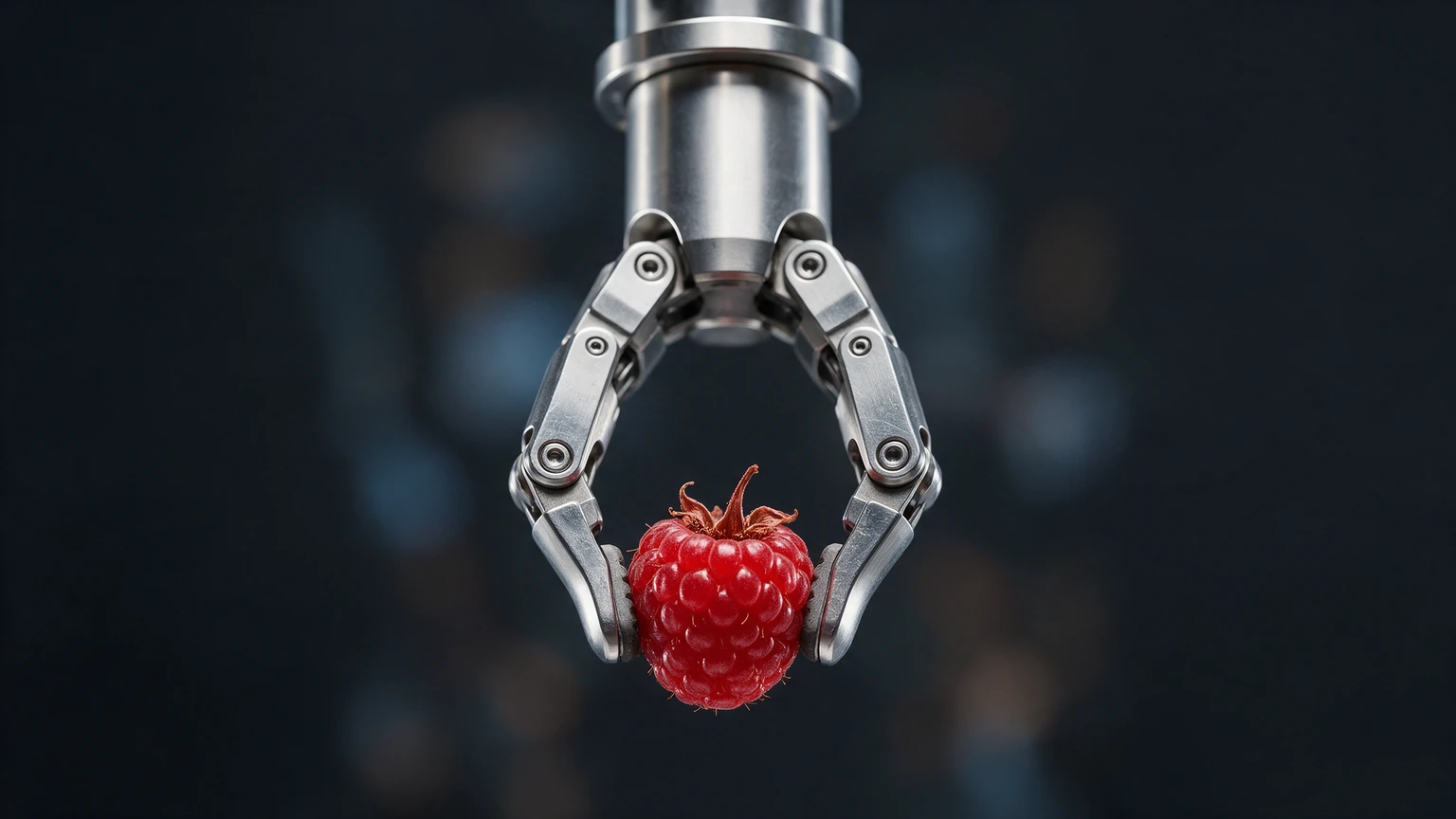
The company says the same robot can screw in a light bulb and insert wires, and that its model has shown signs of generalising across environments, objects and tasks. Obvious says the robots operate without safety cages and with a touch gentle enough to take a single raspberry from a child's hand.
Outside roboticists who have seen it were impressed. Kris Hauser, a professor at the University of Illinois Urbana-Champaign, told TechCrunch the robot adapted to many different objects without retraining and kept retrying when it failed. On hardware, Agrawal told TechCrunch that Eka's gripper costs less than $1,000 and is rated for 5 million duty cycles, against a goal of the 20 million cycles expected of standard industrial arms. None of these numbers has been independently published.
Where Eka fits in robot AI
Eka is positioning itself below the high-level planners that much of robot AI has focused on. F-Prime notes that several capable vision-language-action models are now open, including Physical Intelligence's pi0.5, NVIDIA's GR00T N1.7 and Ai2's MolmoAct2, and that general models such as OpenAI's Astra and Google's Argon are starting to operate robots directly. Recent tests bear out the limits: a SenseNova report found GPT-6-Astra nearly maxes out robot benchmarks but not real robots, and Artificial Analysis put frontier models in charge of a real robot arm, finding they needed about 30 minutes per task against a human average of 20 seconds.
Haarnoja told TechCrunch that most of the field approaches the problem from the top, pushing high-level intelligence down toward the physical, while Eka works from the bottom up. In that picture, a general model decides that plates go in the cupboard and Eka's model handles picking up the plate without breaking it. It is a different bet from startups such as Dream Labs, which opened Dream-1 to run two-armed robots it has never seen with a world action model that it says needs no data from the target robot.
What still has to be proven
Eka has not released a paper, a model or a public benchmark for its VFA model, and its performance figures come from its own lab tests and investor posts. The company is running pilots with industrial customers in pick-and-place and wire handling, which TechCrunch described as secretive, and has not named those customers.
a16z says sustaining the lab performance through full production shifts is the next test. Hauser told TechCrunch the big challenge will be working with integrators on real assembly lines where the system must run for a year without breaking, and that most of what he has seen is pick-and-place, while many valuable industrial tasks involve more. Agrawal said Eka is starting with two verticals and wants to make them home runs before expanding.
If Eka's numbers hold up in factories, the payoff is large: robots that adapt to new parts without being re-engineered for each one. Until then, the round is a big, well-funded bet that touch and simulation, not more human demonstrations, are the missing pieces in robot hands.
Common questions
What is a vision-force-action model?
Eka's term for a robot model that combines what the robot sees with force feedback from its hand, so it can correct a slipping grasp or adjust during contact instead of only planning motions from camera images.
Who led Eka Robotics' Series A?
Andreessen Horowitz and F-Prime led the $150 million round, with Obvious Ventures and E14 Fund continuing from the seed and MFV Partners, Bison Ventures, Glasswing Ventures and Samsung Next among other investors.
Can you buy an Eka robot?
Not publicly. Eka is running pilots with unnamed industrial customers in pick-and-place and wire handling and has not announced products or prices.
Sources & further reading
- Eka Robotics Raises $150M to Build Superhuman Intelligence for the Physical World ↗
- Eka Robotics (home page) ↗
- Investing in Eka Robotics ↗
- Eka Robotics: The path to superhuman general-purpose robots ↗
- Why We Invested in Eka Robotics ↗
- Eka is worth $1.45B thanks to a physical AI model that has experts raving ↗
How this story was made
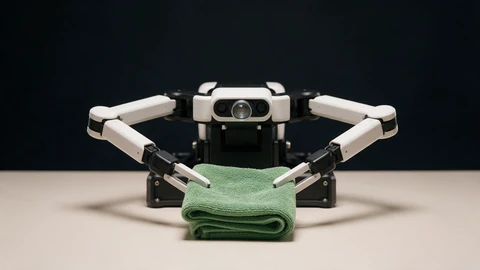
Written by Kristian Kostov with AI assistance and checked against the linked sources. Company performance claims are attributed to the company. Analysis reflects AiLookout’s interpretation; we have not independently tested the products discussed. The cover is an AI-generated editorial illustration, not a photograph or evidence of an actual event.
Our editorial standards