Announced 21 Oct 2026 · Sources checked
What Cohere released
Cohere released Rerank 5 on 21 October 2026, a new generation of its reranking models for search and retrieval-augmented generation. There are two tiers. Rerank 5 Pro, model name rerank-v5.0-pro, is aimed at the best ranking quality, especially for complex queries and long or specialised documents. Rerank 5 Fast, rerank-v5.0-fast, is built for low latency and high volume, such as agents that run many searches per task. Both are generally available, according to Cohere's launch post and developer changelog.
Two features are new. Context Focus is an optional mode that returns the most relevant passages inside each document, as scored character ranges, in the same call that ranks the documents. And Cohere says the relevance scores are now calibrated, so a score of 0.7 means about a 70 per cent chance that a document is useful. Both models take up to 32,000 tokens of context, support more than 100 languages and can rerank semi-structured data such as JSON and tables formatted as YAML strings.
Rerank 5 completes a new generation of Cohere's search models alongside Embed 5 and Parse 5. It comes a week after Cohere announced its plan to buy the security start-up AISLE.
What a reranker does
A reranker is the second step in most enterprise search pipelines. A fast first-stage search, using keywords, vectors or both, pulls back a long list of candidates. The reranker then reads the query and each candidate together and puts them in a better order, so the handful of documents passed to a language model are the ones that actually answer the question.
That step has become more important as AI agents search more often and read longer documents. Every token a model reads costs money and time, and irrelevant text can make answers worse. Cohere's pitch is that "retrieval decides which tokens those are." It competes with rerankers from Voyage AI, open models such as Qwen3-Reranker, and new open releases like NVIDIA's Nemotron 3.5 Rerank. Because a reranker reads raw text at query time, Cohere notes that upgrading does not require re-indexing or re-embedding a corpus. Customers change the model name in their API call.
Benchmarks, by Cohere's measure
Cohere says Rerank 5 Pro leads four public benchmarks it reports: ViDoRe V3, nanoMTEB, BRIGHT and BEIR. Of 46 composite datasets evaluated, Pro ranked first on 39 and at least second on 43. The largest jump is on BRIGHT, a benchmark of reasoning-heavy retrieval, where Pro scores 82.2, which Cohere says is 5.8 points ahead of Voyage AI Rerank 3 and 12.4 points ahead of its own Rerank 4 Pro. Pro also leads the strongest outside competitor by 1.6 points on ViDoRe V3, 1.8 on BEIR and 3.4 on nanoMTEB.
In domain tests, Cohere reports its widest lead in finance and economics, 9.6 points over Voyage AI Rerank 3. On text parsed from PDFs, averaged over 47 datasets, Pro scores 89.9 against 88.4 for Voyage AI Rerank 3 and 88.3 for Rerank 4 Pro, with Fast at 88.5. In a multilingual suite, Pro improves on Rerank 4 Pro in every language tested and ranks first on 14 of 19 non-English languages.
One caveat runs through all of these numbers. They are scored with RCP-nDCG@10, a method Cohere developed to correct for incomplete relevance judgments in standard benchmarks. That may be a reasonable fix, but it means the scores are not directly comparable with leaderboards that use plain nDCG, and no third party has yet reproduced them.
On speed, Cohere says Fast reranks about 187 documents of roughly 1,000 tokens per second on a single NVIDIA A100 GPU under sustained load, 2.9 times Pro's throughput, with response times nearly three times faster.
Context Focus: passages instead of whole documents
Context Focus is the feature most likely to change how developers build with the model. Instead of only saying which documents matter, Rerank 5 can return the specific spans inside each document that match the query, each with its own score, start and end offset. Developers set a threshold and a maximum number of spans. Applications can then send only those passages to a language model, or highlight them for users to show why a result matched. It is off by default.
Cohere tested how much answer quality survives as text is removed across 30 question-answering datasets. Removing half of the retrieved text kept 96 per cent of answer quality, and removing three quarters kept 87 per cent, with up to ten times less context possible at a larger quality cost. In those tests a Qwen3.5-9B model wrote the answers and a Qwen3.5-35B model graded them.
In a search-agent experiment across 17 datasets, adding Rerank 5 Pro to plain keyword search raised accuracy from 46 to 49 per cent. Turning on Context Focus at a threshold of 0.4 lifted accuracy to 58 per cent while using 35 per cent fewer tokens than keyword search alone. On six deep-search benchmarks, including BrowseComp-Plus, tokens fell 41 per cent and accuracy rose from 39 to 52 per cent. Those are large claims for a retrieval change, and they are the kind of result rival search providers such as Exa also publish, so independent runs will matter.
Scores that read as probabilities
Calibration addresses a practical headache. Most rerankers produce scores that are useful for sorting but mean different things from one model or domain to the next, so teams tune a cutoff for each model and re-tune it on every upgrade. Cohere says Rerank 5's raw scores read directly as probabilities, and that Pro and Fast agree on where the line is: "more likely useful than not" is 0.50 for Pro and 0.45 for Fast.
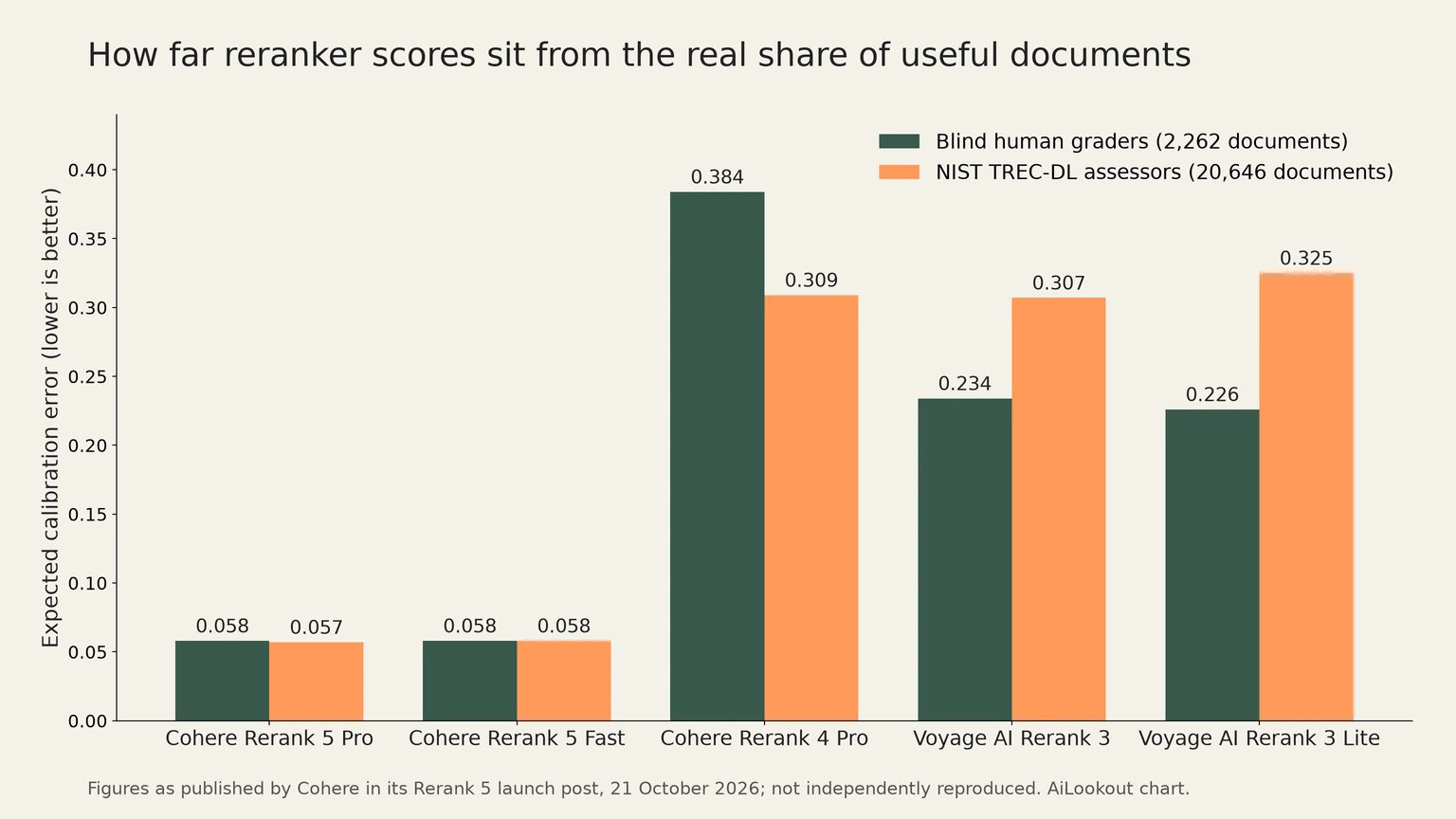
Cohere checked this against two sets of human judgments that it says no model was trained on: a blind panel of graders who rated 2,262 documents and NIST's TREC Deep Learning assessors, who judged 20,646. It reports an expected calibration error of about 0.06 for both Rerank 5 models on both sets, against 0.23 to 0.38 for Rerank 4 Pro and the Voyage AI models. In one example, documents that Voyage AI Rerank 3 scored around 0.55 were judged useful only 24 per cent of the time.
With calibrated scores, an application can keep every document above a threshold instead of a fixed top five, and an agent can tell when nothing relevant came back and rewrite the query or say it does not know. Cohere says the default threshold stays between 0.47 and 0.53 for Pro across BRIGHT, NanoBEIR and ViDoRe V3.
Price and where to get it
API pricing is $0.05 per million tokens for Pro and $0.02 for Fast, according to the launch post. Both are available through the Cohere API, Cohere's single-tenant Model Vault, Microsoft Foundry and Amazon SageMaker, and to all users of Cohere's North workplace platform. Private deployments in a customer's own cloud or on premises are sold through Cohere's sales team. The documentation covers the new relevant_spans request field.
Cohere also says Rerank 5 works with existing keyword, vector or hybrid search and through frameworks including LangChain, Haystack, Elasticsearch and Weaviate. Alongside the launch, it opened a private beta of Compass Cloud, a managed service that bundles parsing, embedding, hybrid search and reranking. For teams building their own stacks, open embedding options such as UIBK-Embedding remain an alternative for the first stage.
What to keep in mind
Every benchmark in the launch post is Cohere's own, run with its own scoring method, and the comparisons cover a chosen set of rivals. The Context Focus experiments used specific open models as answerer and judge, so results with other models may differ. Calibration figures depend on how usefulness was defined: a mean grade of Useful or higher for the human panel, and highly relevant or above for NIST.
The models are closed and available only as hosted or licensed services, so outside researchers cannot inspect them. Cohere has not given parameter counts or training details in the materials AI Lookout reviewed.
Still, the release targets two real problems for anyone running retrieval at scale: deciding how much text to send to an expensive model, and knowing when a score is good enough to trust. If independent tests confirm the calibration and token-saving claims, Rerank 5 could make thresholds, rather than a fixed number of results, the normal way to build search for agents.
Common questions
What is Cohere Rerank 5?
A pair of reranking models, Rerank 5 Pro and Rerank 5 Fast, released on 21 October 2026. They reorder search results so the most relevant documents reach a language model, and can return the most relevant passages inside each document.
How much does Rerank 5 cost?
Cohere lists API pricing of $0.05 per million tokens for Rerank 5 Pro and $0.02 for Rerank 5 Fast. Private and single-tenant deployments are priced separately.
Do I need to re-index my data to use Rerank 5?
No. Cohere says rerankers read raw text at query time, so switching only means changing the model name to rerank-v5.0-pro or rerank-v5.0-fast.
Sources & further reading
How this story was made
Written by Kristian Kostov with AI assistance and checked against the linked sources. Company performance claims are attributed to the company. Analysis reflects AiLookout’s interpretation; we have not independently tested the products discussed. The cover places the companies’ own logos, taken from public-domain or openly licensed files credited in the caption, on a plain background. It is not a product photograph, a screenshot, or an endorsement.
Our editorial standards