Announced 13 Oct 2026 · Sources checked
What did Apple announce?
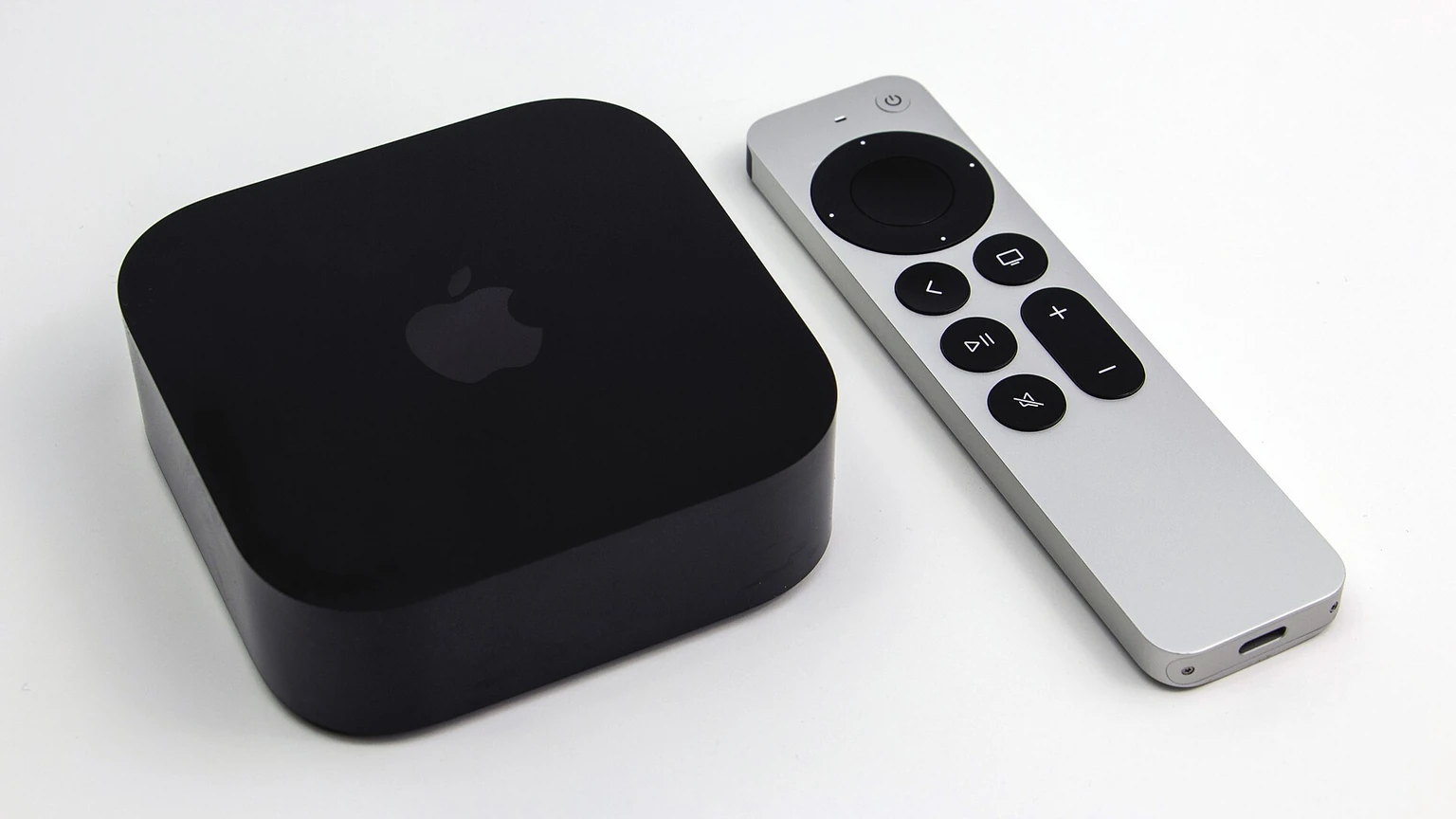
Apple used its Welcome Home event in New York on 13 October 2026 to launch a new Apple TV 4K, the first update to the streaming box since 2022. Apple’s press release calls the fourth-generation model its “most immersive home theater experience yet,” but the headline feature is software: Siri AI, which Apple describes as “an entirely new version of Siri powered by the next generation of Apple Intelligence.”
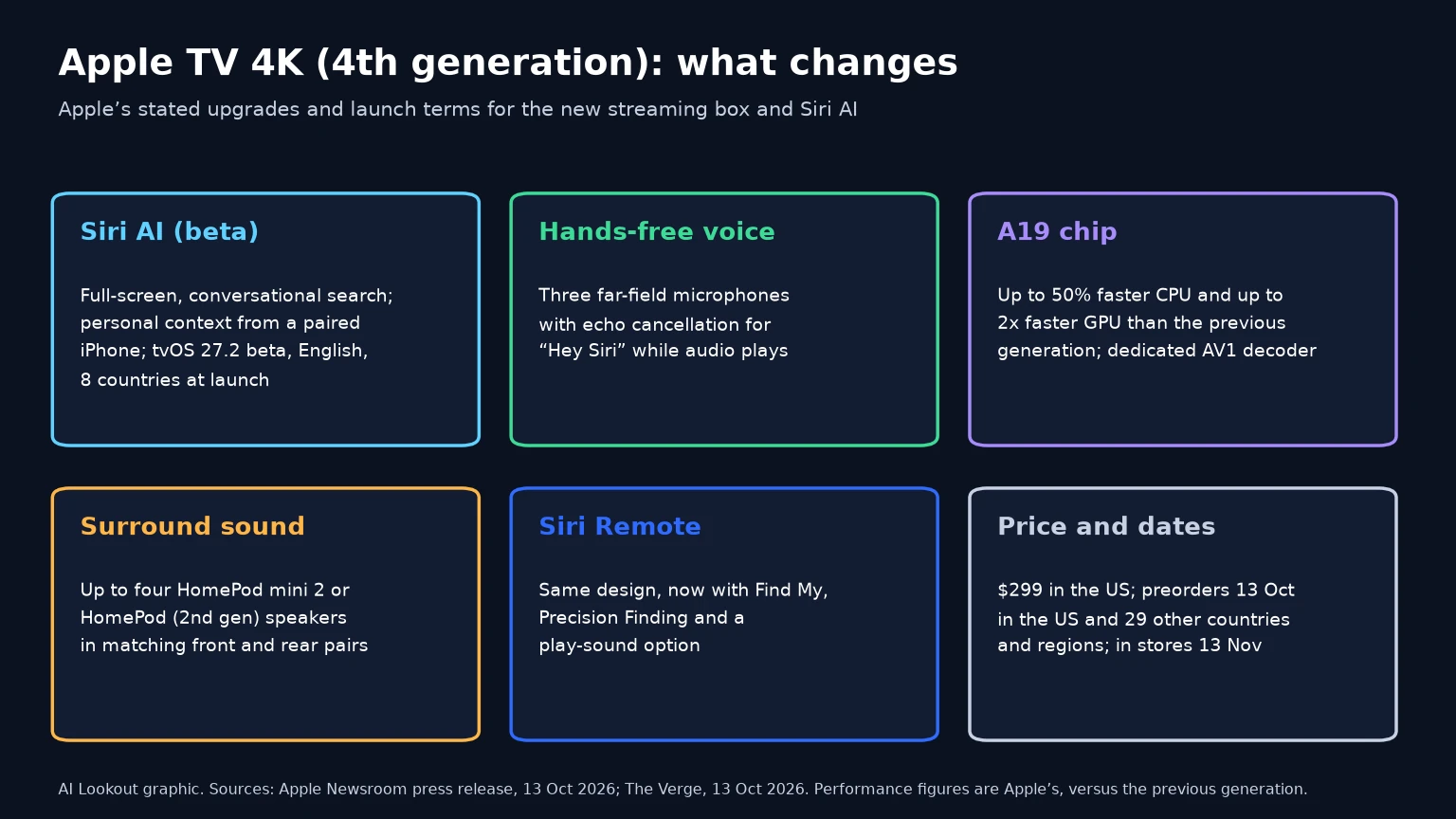
The box costs $299 in the US, or $49.83 a month for six months on Apple Card instalments. Apple says customers in the US and 29 other countries and regions could pre-order it from 13 October, with availability in stores from Friday, 13 November.
The Apple TV was one of three home products announced together. According to The Verge, Apple also launched a HomeView smart display at $299 and a HomePod mini 2 at $149, plus a collection of smart home devices developed with LG Electronics and Schneider Electric. The Verge notes that the new Apple TV 4K costs more than twice the launch price of the previous model and $50 more than the current top configuration, which is being discontinued.
Bob Borchers, Apple’s vice president of Worldwide Product Marketing, said in the release that “with Siri AI, finding something to watch becomes a full-screen, conversational experience, and with built-in far-field microphones, it’s completely hands-free.”
What can Siri AI do on Apple TV 4K?
Apple says Siri AI has personal context understanding, broad world knowledge and the ability to take more actions across apps. On the TV, that is pointed at finding something to watch.
Ask a question such as “What Apple TV shows won at the Emmy Awards this year?” and Siri AI fills the screen with poster art pulled from the Apple TV app, along with follow-up suggestions such as “More award-winning comedies.” While a show is playing, you can ask follow-up questions such as “Where was Pluribus filmed?” or “Is this appropriate for a 15-year-old?” Apple says the answers appear in a compact overlay so the video keeps playing.
The most distinctive piece is personal context. With an Apple Intelligence-enabled iPhone paired to the TV, Siri AI can act on requests that depend on your own data. Apple’s example is “Play the show Alinda recommended.” The Verge describes a similar request, “Play that show my friend texted me,” which pulls from your messages to find the title you were sent.
Unlike on a HomePod or the new HomeView, The Verge reports that Siri does not speak its answers aloud on Apple TV. Results appear full screen for content searches or in a text bubble for general questions. In a demo The Verge saw, someone asked whether the football team in an episode of Ted Lasso was real, and Siri displayed a few sentences explaining that it is fictional.
Siri AI also reaches into the smart home. Apple says it can control compatible accessories and turn scenes on or off by voice, and the box adds Apple Intelligence-generated descriptions of HomeKit Secure Video camera activity and summarised notifications in the Home app.
How do the far-field microphones and A19 chip change the box?
The new hardware exists mostly to make Siri AI practical. The fourth-generation box has three far-field microphones, so you can say “Siri” or “Hey Siri” without picking up the remote or owning a paired HomePod. Apple says advanced echo cancellation isolates your voice from background sound, so recognition works even while audio is playing.
Inside is the A19 chip, which first appeared in the iPhone 17. Apple claims up to 50 percent faster CPU performance and up to twice the GPU performance of the previous generation, plus a dedicated AV1 decoder for more efficient streaming. Those are Apple’s figures; independent benchmarks will come once reviewers have units.
Other changes are incremental. The Verge reports the new model keeps 128GB of storage, an Ethernet port, Thread and Matter, and moves to Wi-Fi 7 and Bluetooth 6. For the first time, the Apple TV 4K can drive four speakers for surround sound, using either HomePod mini 2 or HomePod (2nd generation) units in matching front and rear pairs. The Siri Remote keeps its design but gains Find My support, Precision Finding on recent iPhones and a play-sound option.
How does Apple handle privacy for Siri AI on the TV?
Putting always-listening microphones in a living-room box raises obvious questions, and Apple’s release addresses them directly. The A19 includes what Apple calls Secure Exclaves, protected and compartmentalised runtimes that process microphone data separately from the rest of the system. Apple says data processed in the Secure Exclaves “cannot be accessed by tvOS, apps, the user, or Apple.”
Siri requests on the TV can be handled on the device or sent to Private Cloud Compute, Apple’s server system for Apple Intelligence. Apple says that when a request goes to Private Cloud Compute, the data is neither stored nor made accessible to Apple or anyone else. HomeKit Secure Video footage stays end-to-end encrypted.
That approach mirrors a wider industry push to keep assistant data inside hardware-isolated zones, similar in spirit to Android’s AISeal on-device enclave. As with every such design, the guarantees are Apple’s description of its own system; outside researchers will want to examine how far the isolation extends.
Who gets Siri AI, and when?
Siri AI is launching as a beta in tvOS 27.2. It works on the Apple TV 4K (2nd generation) and later, so owners of the 2021 and 2022 models get the assistant without buying the new box. Only the fourth-generation model has the built-in microphones, the four-speaker surround mode and the play-sound feature on the remote.
At launch, Siri AI on Apple TV is available in English in the US, Australia, Canada, India, New Zealand, Singapore, South Africa and the UK. Apple’s footnotes add that the owner of the home in the Home app needs an Apple Intelligence-enabled iPhone or iPad with Siri AI turned on, and that Siri AI will not initially be available in the EU on iOS or iPadOS. MacRumors also confirms the tvOS 27.2 beta and the older-model support.
Apple also flags a cost question for later. The release says certain Apple Intelligence features that rely on server-side models are subject to daily usage limits, and that “expanded access to such features will be available for a fee in the future.” Apple has not said which TV features that covers or what the fee will be.
How does it compare with Google and Amazon’s AI TV assistants?
Apple is not first to put a generative assistant on a TV box. The Verge points out that Google’s TV Streamer already offers Gemini-powered search and Amazon’s Fire TV has Alexa Plus. TechCrunch notes that Bloomberg had reported Apple wanted to launch new home devices in 2024 but delayed them because the AI-powered Siri was late.
Apple’s pitch is that Siri AI can use personal context from the phone in your pocket, which neither rival matches in the same way today. Google is pushing its own models deeper into consumer surfaces; this week it made Gemini 4 Argon available in the Gemini app and Search. Phone makers are making a similar bet on agents that act across apps, as OPPO did with ColorOS 17’s Agent Mode.
For Apple, the TV is also a test of whether the rebuilt Siri can win back trust after years of complaints. A living room is a demanding place for an assistant: several people, background noise and a wide range of questions. Hands-free microphones and personal context make it more useful, but also raise the stakes when it gets an answer wrong or surfaces the wrong person’s recommendation.
What are the limits and open questions?
Several things are not yet known. Apple has not published accuracy figures for Siri AI on the TV, and no independent reviewer has tested the shipping hardware. The feature is labelled beta, which usually means rough edges.
Personal context depends on a household’s devices and settings. Apple’s footnotes tie it to the Home owner’s iPhone and a paired Apple Intelligence device, which may not suit homes where several people share a TV. Far-field microphone support is also limited to certain system languages, including English, Mandarin Chinese, Dutch, Finnish, French, German, Hebrew, Norwegian and Swedish, which is a broader list than the eight English-language markets where Siri AI itself is available.
Finally, the price is a real change. At $299, the Apple TV 4K moves well above most streaming sticks, and the reader comments on MacRumors already include people asking for a cheaper model without Siri AI. Apple is betting that an assistant people actually want to talk to is worth that premium.
Common questions
Do older Apple TV models get Siri AI?
Yes. Siri AI comes as a beta in tvOS 27.2 to the Apple TV 4K (2nd generation) and later. The built-in microphones, four-speaker surround and the remote’s play-sound feature are exclusive to the new fourth-generation box.
When can I buy the new Apple TV 4K?
Preorders opened on 13 October 2026 in the US and 29 other countries and regions. Apple says it will be available in stores from 13 November 2026, priced at $299 in the US.
Is Siri AI on Apple TV available outside the US?
At launch it works in English in the US, UK, Canada, Australia, New Zealand, Singapore, South Africa and India. Apple says some features vary by region and language, and Siri AI will not initially be available in the EU on iOS or iPadOS.
Sources & further reading
How this story was made
Written by Kristian Kostov with AI assistance and checked against the linked sources. Company performance claims are attributed to the company. Analysis reflects AiLookout’s interpretation; we have not independently tested the products discussed. Cover photography is illustrative and does not depict the specific announcement or product.
Our editorial standards