Announced 13 Oct 2026 · Sources checked
What did OPPO announce on 13 October?
OPPO’s ColorOS 17 global page and a same-day Media OutReach press release issued by OPPO present ColorOS 17 as the next major release of the company’s mobile operating system: smoother system motion under a Living Flow Design brand, an Adaptive Scheduling Architecture for performance, and a wider OPPO AI suite built around AI Mind.
The press release is dated 13 October 2026 from Shenzhen and says ColorOS 17 will debut on the upcoming Find X10 Series before rolling out progressively to more OPPO devices worldwide. That matches the product page’s device tables, which list October 2026 through Q1 2027 windows rather than a single day flip for the whole catalog.
GSMArena’s rollout schedule write-up adds that the Find X10 and Find X10 Pro Max global launch is scheduled for 21 October, with stable ColorOS 17 for older lines starting around 29 October. Those dates are secondary reporting; OPPO’s own page is the primary device list used here.
What is Living Flow Design, and why does OPPO lead with smoothness?
OPPO spends as much of the announcement on feel as on models. Living Flow Design is described as three ideas: Luminous Effect (softer translucency and lighting that responds to touch), Fluid Motion (elements that merge and transform across states), and Flexible Feedback (buttons and bars that compress and rebound). A Unified Rendering Architecture on a refreshed Luminous Rendering Engine is said to cut redundant rendering work.
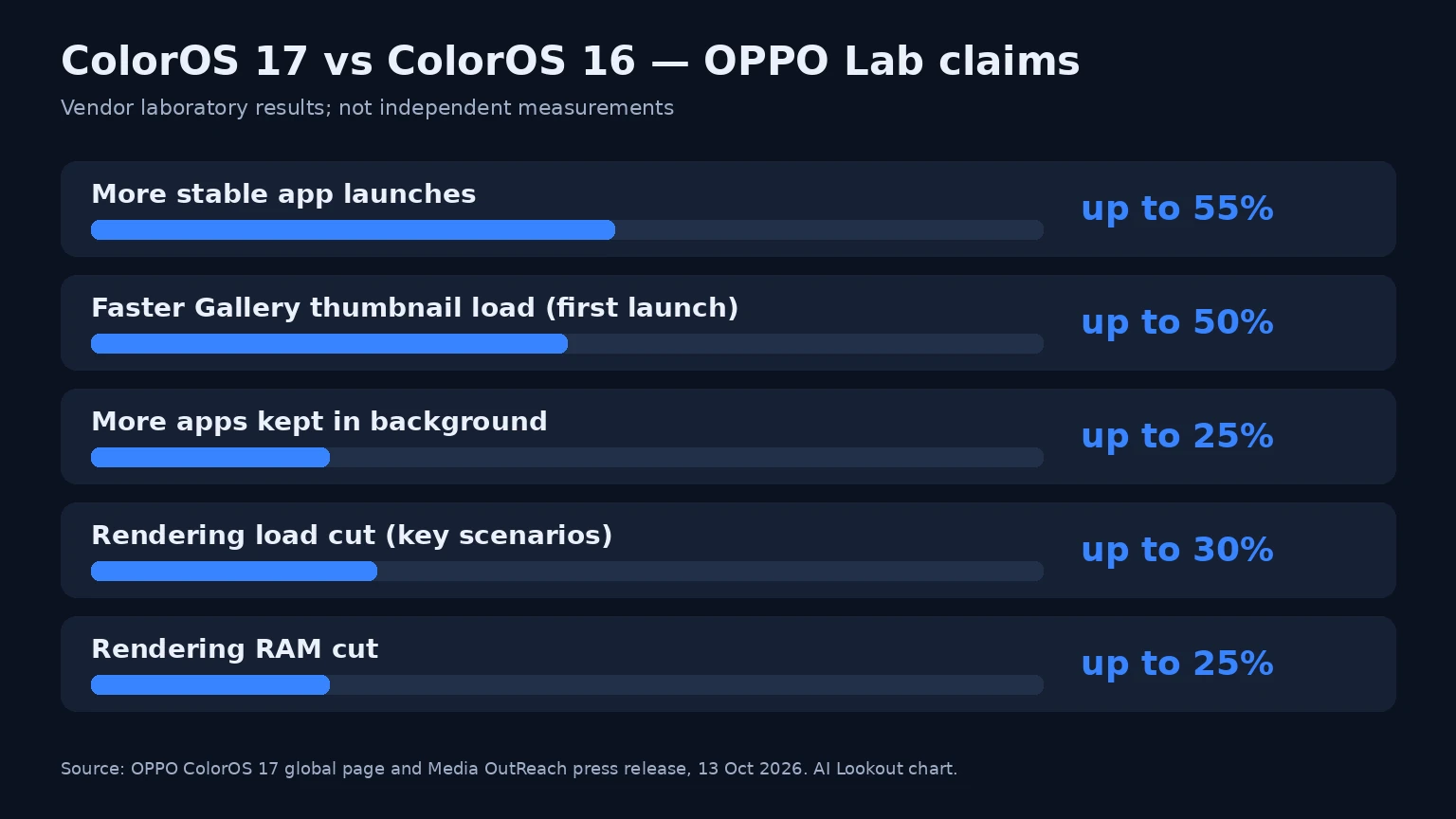
The company numbers, attributed to OPPO Lab comparisons with ColorOS 16, include up to 30% lower rendering load and up to 25% lower RAM use for rendering in key scenarios, up to 55% more stable app launches, up to 50% faster first Gallery thumbnail loads, over 25% more apps retained in the background during multitasking, and more than 90% of initial smoothness retained in a six-year aging simulation even at 90% storage fill. Those are vendor lab claims, not third-party traces.
The Laminar Flow Engine is presented as an intelligent scheduler on top of an Adaptive Scheduling Architecture that coordinates foreground and background work as one flow. For readers, the practical claim is fewer stutters when switching apps and opening Gallery—not a new silicon story.
How does AI Mind Pilot’s Agent Mode work?
AI Mind Pilot is the feature OPPO is pushing as the agent story. On the global page it is summarized as “Say It and Solve It”: tell the system what you want, and it organizes what matters, finds information, connects it, and acts. The press release is more concrete about Agent Mode.
According to OPPO, Agent Mode can work directly with photos and files on the device, search across multiple sources, pick tools, and coordinate multiple steps. Examples include finding and organizing scattered files, renaming them from content and date, using that information to create outputs such as travel itineraries or webpages, collecting trip photos into albums, and turning a selected photo into a vlog cover or other creative variants.
A footnote on the ColorOS 17 page matters for anyone planning to rely on it: limited free usage is included, and users must sign in to a ChatGPT or Manus account to continue after the limit. Manus is the agent startup whose large raise we covered in Butterfly Effect’s Manus funding report. OPPO is therefore shipping a phone agent that is partly local workflow and partly a metered bridge into third-party agent accounts, not a fully self-contained offline co-pilot.
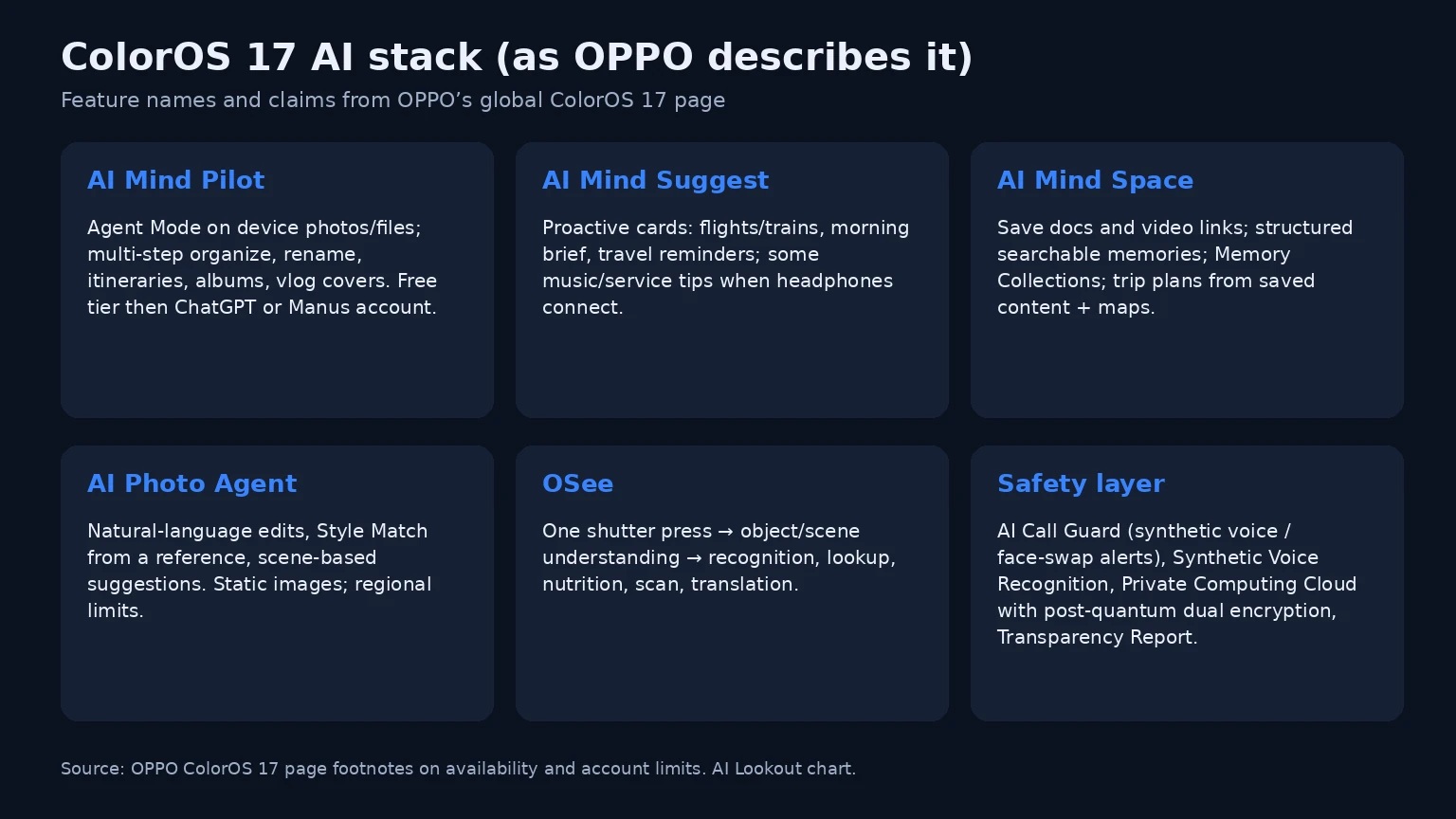
Mind Space, Mind Suggest, Photo Agent and OSee
AI Mind Space is framed as a personal information hub that now accepts documents and video links, turns them into structured searchable memories, and auto-builds Memory Collections. For travel, OPPO says it can combine remembered content with destination maps into personalized trip plans. Europe footnotes say Long-doc Capture and Link Capture are not available there.
AI Mind Suggest is the proactive layer: morning briefs, travel reminders, flight and train cards, and music recommendations when headphones connect. OPPO’s footnotes warn that cards such as MakeMyTrip train information, some flight reminders and Spotify tips are country-specific.
AI Photo Agent targets natural-language editing, professional-style suggestions, and Style Match from a reference image or template. It is limited to static images, rolls out gradually, arrives later in Europe, and has monthly usage caps that vary by region. OSee collapses several visual tools behind one shutter press—recognition, knowledge lookup, nutrition analysis, scanning and translation—so the camera becomes a router into services rather than a single filter. That sits in the same on-device visual lane as work like OpenBMB’s MiniCPM-V 4.7, though OPPO is shipping a product surface, not open weights.
Privacy, call guards and post-quantum claims
OPPO’s privacy section centers on Private Computing Cloud (PCC): end-to-end encryption for cloud AI processing in an environment the company says is designed to block third-party access, including OPPO. ColorOS 17 adds what OPPO calls post-quantum security capabilities in PCC, with a dual-encryption mechanism on device-to-cloud transmission.
A new on-device Transparency Report is supposed to show which AI services were used, when, and what operations ran, with export support. Proactive protection includes AI Call Guard, which OPPO says uses on-device detection to watch calls for synthetic voices and AI face swaps, plus Synthetic Voice Recognition on phone and WhatsApp calls and a separate AI Face Swap Detection feature for video.
Those claims should be read as product marketing until independent tests exist. They do rhyme with the broader industry push to put sensitive inference behind stronger device boundaries, including Google’s Android AISeal on-device enclave work. OPPO is not publishing threat models or red-team results alongside the launch page.
Which phones get ColorOS 17, and when?
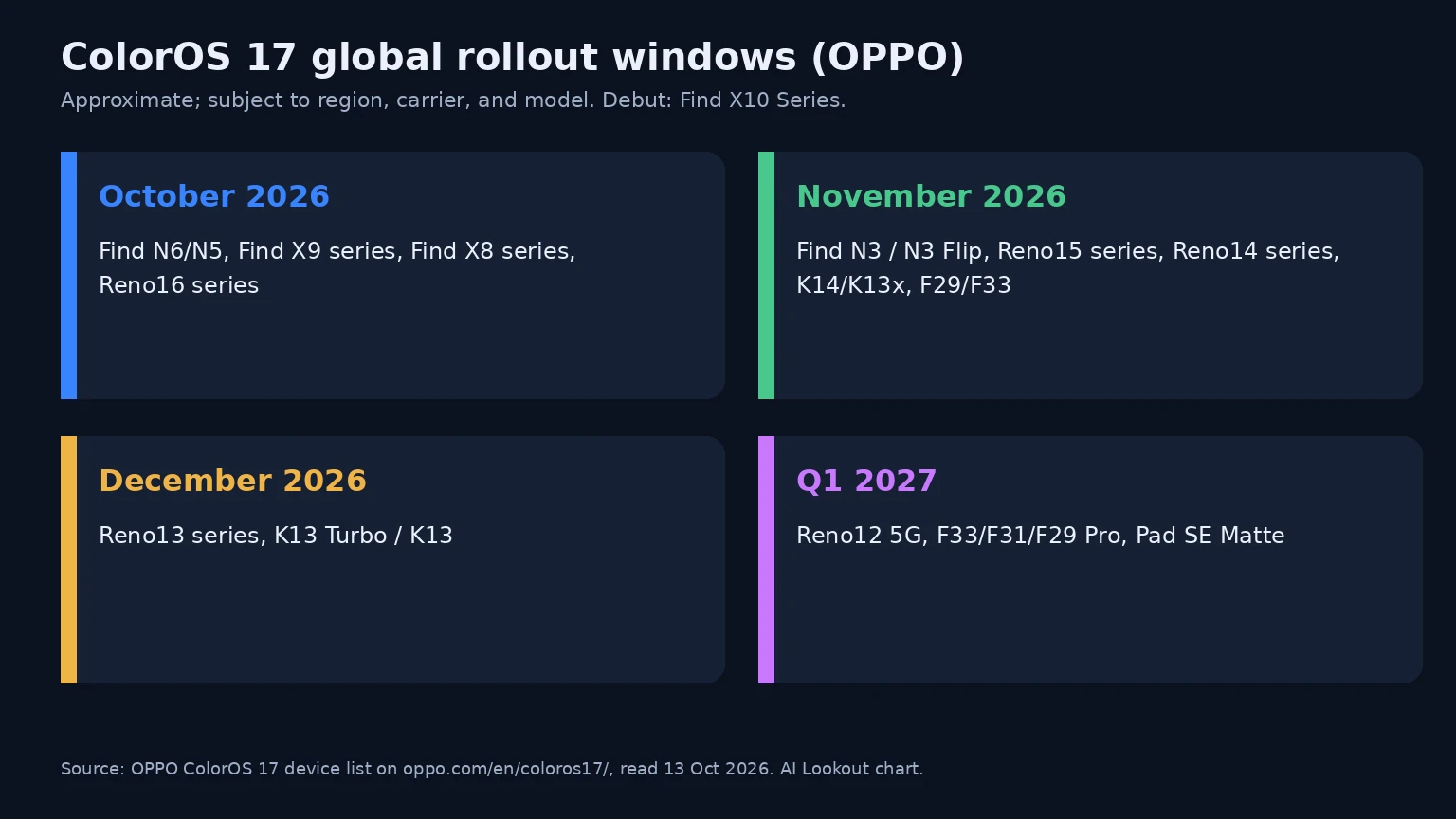
OPPO’s own schedule tables are the cleanest primary source. October 2026 lists Find N6 and N5, the Find X9 family (Ultra, s, Pro, base), Find X8 Pro and Find X8, and the Reno16 Pro / 16 / 16c / 16 FS / 16 F 5G set. November expands to Find N3 and N3 Flip, Reno15 and Reno14 families, and several K and F models. December covers Reno13 and K13 Turbo / K13 lines. Q1 2027 reaches Reno12 5G, F-series Pro models and a Pad SE Matte Display Edition.
OPPO states the schedule is approximate, can change by region and carrier, and does not apply to carrier-exclusive models. Some AI features need specific hardware and may arrive by OTA after the first ColorOS 17 build. The Find X10 Series is the debut vehicle; older phones get the update in waves rather than day one.
Android press coverage on 13 October also carried OnePlus and realme stable-rollout calendars beginning 29 October for flagship units such as OnePlus 15 and Pad 4. Those calendars are useful for owners of those brands but are not reproduced on the OPPO ColorOS 17 page inspected for this article, so treat them as secondary until the brands’ own pages are checked.
What this means for on-phone agents
ColorOS 17 is another signal that phone makers want agents that act on local libraries—photos, files, tickets—while still leaning on cloud models for headroom. The ChatGPT and Manus account footnote makes that hybrid explicit. It also sits next to efforts to standardize how personal agents talk to businesses, such as Sierra’s Personal Agent Protocol draft, even though OPPO is not claiming PAP support here.
For users, the useful test is not the Living Flow demo reel. It is whether Agent Mode can finish a multi-step job on a messy Camera roll without uploading everything, how quickly the free allowance burns, and whether regional footnotes remove the exact features you wanted (Europe’s capture limits, Photo Agent delay, country-locked Suggest cards).
For developers and rivals, the interesting piece is the product packaging: agent mode + personal memory store + proactive cards + camera router + call-time deepfake guards, all under one OS update. That is a different shape from a single chatbot app icon.
What is still unproven or limited?
Almost every quantitative claim is OPPO Lab data versus ColorOS 16. There is no independent smoothness, battery or privacy audit in the materials reviewed. Feature availability is hedged heavily: software version at launch may omit AI features; laws, cloud capability, model and region all gate what appears; internet is required for many AI features; UI screenshots are illustrative.
Agent Mode’s dependence on ChatGPT or Manus after the free tier means OPPO’s agent story is partly a distribution deal. Pricing, rate limits and data-handling terms for those continuations live in the third-party accounts, not only in OPPO’s footnotes. Photo Agent’s Europe delay and static-image limit further shrink the “edit like a pro” pitch for some markets.
Finally, ColorOS 17 is not yet on the Find X10 Series in customers’ hands as of this article’s source check; the global software story landed on 13 October ahead of the 21 October Find X10 event cited by secondary coverage. Early reviews of Agent Mode on shipping hardware will be the first non-vendor evidence.
Common questions
Is ColorOS 17 available today?
OPPO opened the global ColorOS 17 story on 13 October 2026. It debuts on the Find X10 Series and then upgrades older OPPO models on a staged calendar from October 2026 into Q1 2027. Exact day-by-day availability depends on model, region and carrier.
Do I need ChatGPT or Manus for AI Mind Pilot?
OPPO says limited free usage is included. After that limit, the ColorOS 17 page says you must sign in to a ChatGPT or Manus account to continue. Details are left to in-app screens.
Will OnePlus and realme get the same update?
Press reports on 13 October described OxygenOS/realme schedules beginning 29 October for some flagships. Confirm on OnePlus and realme’s own channels; OPPO’s ColorOS 17 page lists OPPO models.
What to remember
ColorOS 17 pairs a vendor-claimed smoothness rewrite with on-phone agents that organize local media and then hand off to ChatGPT or Manus. The primary sources are OPPO’s own page and press release; independent tests of Agent Mode and the lab percentages are still ahead.
Sources & further reading
How this story was made
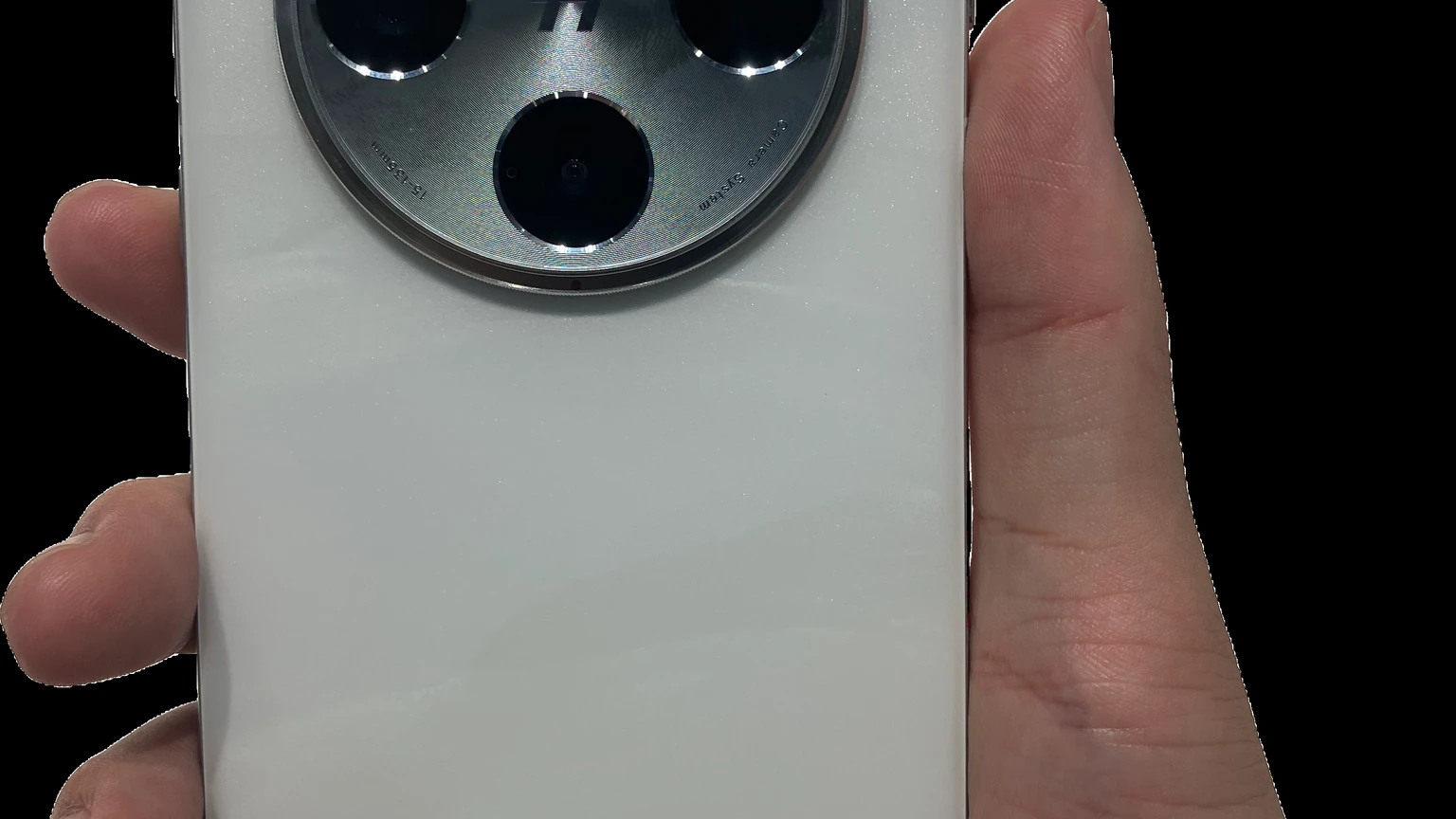
Written by Kristian Kostov with AI assistance and checked against the linked sources. Company performance claims are attributed to the company. Analysis reflects AiLookout’s interpretation; we have not independently tested the products discussed. Cover photography is illustrative and does not depict the specific announcement or product.
Our editorial standards