Announced 19 Oct 2026 · Sources checked
What doubleAI announced
doubleAI, a Tel Aviv AI lab co-founded by Mobileye founder Amnon Shashua, unveiled Maxwell on 19 October 2026 and called it the first code execution model. Instead of writing code, Maxwell sits inside a program while it runs, watches the hardware and the data, and swaps in faster machine code for the slow parts. The company's Maxwell site says every replacement is formally proven equivalent to the original code, so the program's results do not change and its source code is never touched.
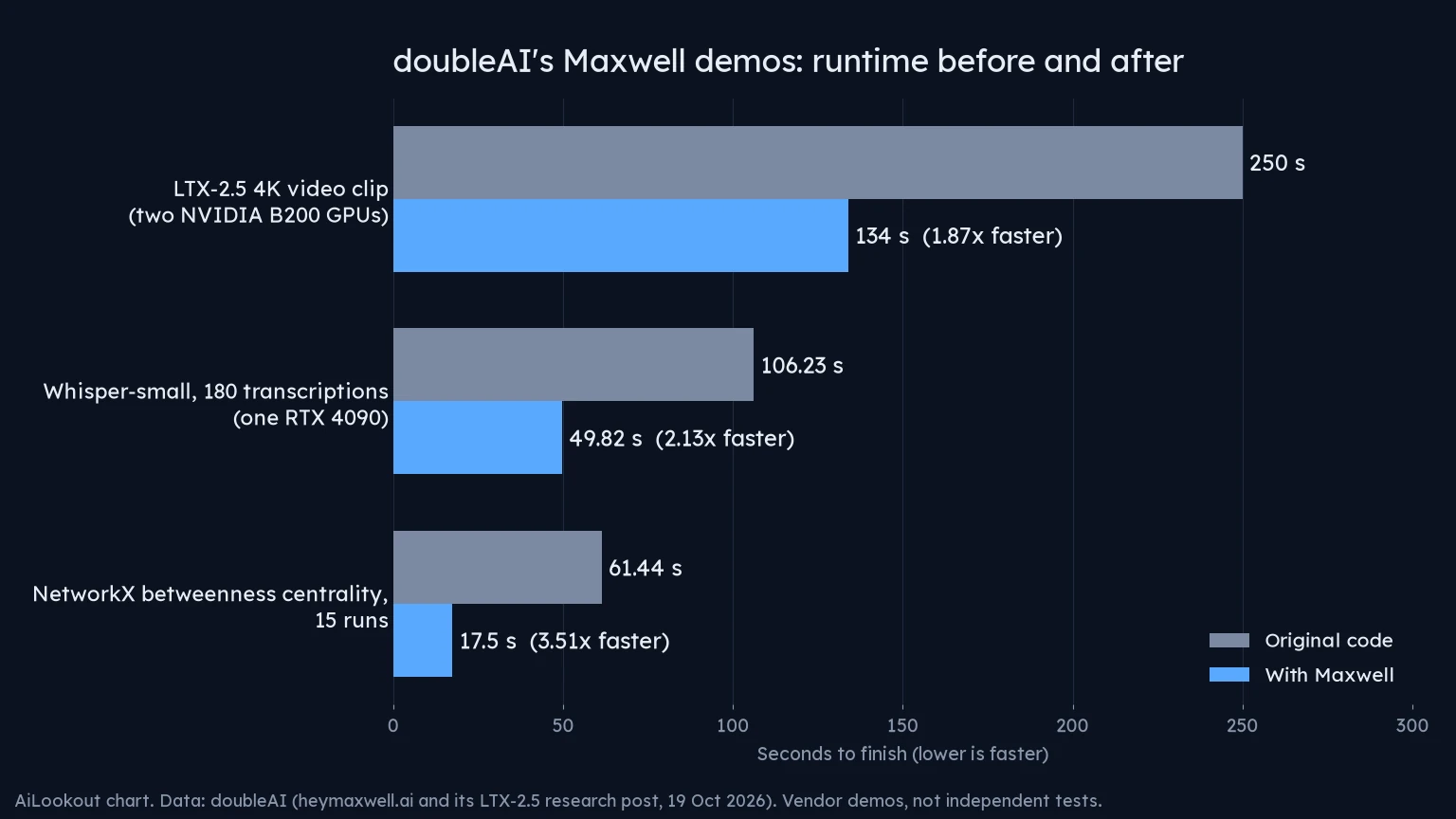
The headline numbers are doubleAI's own: data processing pipelines up to 38 times faster and AI inference kernels up to 4.25 times faster. Its featured customer is LTX, whose open LTX-2.5 video model now renders a 4K clip in 134 seconds on two NVIDIA B200 GPUs instead of 250.
Maxwell is not yet something developers can install. The manifesto on the site says Maxwell will be available soon in early access, and the page offers a form to request a place. There is no published price, release date or list of supported platforms beyond CPUs, GPUs, Python and PyTorch.
Who is behind doubleAI
The Register describes doubleAI as founded in 2023. Shashua is its co-founder and chief executive, as well as the founder and departing chief executive of Mobileye and a computer science professor at the Hebrew University of Jerusalem. The company's research page names Shai Shalev-Shwartz as another co-founder, and Gal Beniamini, a co-founder with a PhD in theoretical computer science, answered The Register's technical questions.
doubleAI's news page links to a November 2025 Globes report of a $200 million round led by Lightspeed with NVIDIA taking part, and to Wall Street Journal coverage of the Maxwell launch headlined as an NVIDIA-backed startup launching a model to pare the cost of compute. doubleAI's summary of that article says the company cut one early customer's compute costs by 67 percent. AI Lookout could not read the Journal piece and has not seen which customer that was.
Maxwell has appeared in doubleAI research posts since March, when the company said it generated and verified a drop-in version of NVIDIA's cuGraph graph library that ran 3.6 times faster on average. What is new is the product framing: a runtime that keeps optimising real programs as they run.
How a code execution model differs from a compiler
Beniamini compared Maxwell to a just-in-time compiler, the kind of system that turns code into machine instructions while a program is running. Both work at run time and both emit new machine code, he told The Register, but a compiler cannot do high-level reasoning. A compiler will make a general-purpose sort as fast as it can; it will not swap it for a different algorithm. Maxwell can and does, he said.
The argument rests on information that only exists at run time. Maxwell sees the exact processor or GPU the program landed on, the real shapes and types of the data flowing through it, what else is running and which bottlenecks actually appear. It then builds a specialised version of each hot spot for that machine, while guarding against the case where the assumptions it relied on stop holding.
The manifesto frames this as self-improving code. Once Maxwell proves a faster version, that version becomes the starting point for the next attempt, so a long-running program can keep getting faster while its source stays exactly as its authors wrote it. doubleAI pitches Maxwell as a complement to coding agents such as Claude Code: they write the program, and Maxwell makes the machine run it well.
Proofs instead of tests
Rewriting code under a running program with no human reviewer would be reckless if the rewrite could be wrong. doubleAI's answer is formal verification. For each replacement Maxwell writes a machine-checked proof of semantic equivalence, meaning that for every possible input the new code produces the same result and has the same effect on the outside world as the old code.
The manifesto gives a toy example: a Python double loop that counts pairs is replaced by a one-line Rust function computing n times n minus one over two, with a short proof by induction attached. The company says it has built a complete formalisation of Python, including its most dynamic behaviour, and trains Maxwell to write code and proof together. Proofs are assembled from reusable pieces proved once, which doubleAI says keeps the work tractable.
This borrows from the same trend AI Lookout has followed in mathematics, where AI-written proofs are checked by tools such as Lean; Lean's new con-leche checker, written and proved consistent by Claude is one recent example. doubleAI's footnotes concede the theoretical limit: Rice's theorem says no algorithm can decide equivalence for every pair of programs, though the company argues that proofs can still be written for the specific pairs that matter in practice.
The LTX-2.5 case study
The most detailed evidence is the LTX-2.5 research post. LTX's pipeline was already compiled end to end, split across GPUs and decoding on a hand-written attention kernel. Maxwell came back with more than a dozen significant changes, from how work is divided between GPUs down to edits inside single kernels, and cut a 4K clip from 250 to 134 seconds on two B200s, a 1.87 times speedup.
Three examples show the range. In audio-to-video cross attention, each GPU used to send its half of the video keys and values to the other, 262 MB per GPU in every block at every step. Maxwell has each GPU compute a partial answer on the data it already holds and swap those instead, about 1 MB, then merge them exactly with the running-maximum trick FlashAttention uses inside one GPU. It also moved PyTorch to a FlashAttention kernel nine times faster than the cuDNN kernel it had picked for that shape, and dropped a padding token whose mask forced a slower path.
In the final 4K pass, which took more than half the original runtime, overlapping tiles meant almost every pixel was denoised twice; thinner overlaps and one fewer row of tiles brought that close to once, and the weights now stay in FP8 instead of being converted to BF16 before each multiply. In the decoder kernel, Maxwell filled tiles with real frames instead of copies, halving launches, fixed an instruction cache stall, and found and fixed a rare hang caused by a race on a shared barrier.
doubleAI says the output is effectively unchanged: the soundtrack is bit for bit identical and the video differs from the original by a peak signal-to-noise ratio of 41 dB, which it says is less than turning torch.compile on or off. LTX's faster pipeline is published in its open-source repository.
Other numbers doubleAI cites
The Maxwell site shows two shorter demos recorded side by side. On one RTX 4090, a Python script running 180 Whisper-small transcriptions from a cold start took 106.23 seconds without Maxwell and 49.82 seconds with it, producing identical transcripts. A NetworkX betweenness-centrality job run 15 times fell from 61.44 to 17.50 seconds with identical results.
Earlier doubleAI posts claim Maxwell beat NVIDIA's optimised PyTorch baselines on 90 percent of the 235 Blackwell kernels in the SOL-ExecBench benchmark after one day of search and on 99 percent after two, running 3.14 times faster on average, and that it rewrote pandas' kernels for modern hardware. The Register reported the inference-kernel figure as more than 4.5 times, while doubleAI's own site says 4.25 times; AI Lookout uses the company's page.
Access, overhead and trust
According to Beniamini, setup is light: developers install the Maxwell runtime and run their code, while the model itself is hosted by doubleAI. He put the maximum overhead of Maxwell's tracing and profiling at 2 percent, falling to zero when it is not tracing, and said Maxwell also optimises the runtime itself, so programs are never slower overall. That is a company claim AI Lookout has not tested.
The hosted design means a customer's running program sends information to doubleAI. The Register noted that the arrangement requires some amount of trust. The privacy notice on the Maxwell site says it covers only the website and its forms, not the processing of customer code or data by the future product, so data-handling terms for Maxwell itself are not yet public.
Beniamini also claimed a security side effect: because Maxwell must reason formally about code, it can prove the absence of memory errors, and he said it had found cases where Python itself was not memory safe. He described that as anecdotal and doubleAI has not published details.
Limits and open questions
Every speedup in the launch materials was measured by doubleAI on workloads it chose, and the only named customer result is LTX. There is no independent benchmark yet, no paper describing the Python formalisation or the proof checker, and no way for outsiders to inspect a proof. Hardware vendors are attacking the same problem from other directions; AI Lookout recently covered vLLM's agent-assisted kernels for Kimi K3 and Amazon's TorchNeuron, which lets PyTorch code run on Trainium chips without a rewrite.
A proof of equivalence is only as strong as the formal model of the language and hardware underneath it. doubleAI says Maxwell guards against changes in the preconditions it specialised for, but has not explained how those guards are verified. Pricing, the early-access timeline and which customers get in first are unknown. AI Lookout did not run Maxwell.
Why it matters
Most of the AI-for-code race is about writing software faster. Maxwell targets what happens after, the large amount of compute lost to code that runs well below what its hardware can do. With GPU time scarce and expensive, a runtime that safely recovers some of it without anyone editing source code would be valuable, if doubleAI's proof-backed approach holds up outside its own demos.
Shashua's own summary, quoted by The Register, is that code execution models are agents working on behalf of the hardware rather than the programmer. The next test is whether early-access users see the same gains on their own code.
Common questions
What is doubleAI's Maxwell?
A code execution model that runs inside a program, rewrites its slow parts into faster machine code for the hardware and data it sees, and formally proves each change gives the same results.
How is Maxwell different from a JIT compiler?
Like a JIT it works at run time, but doubleAI says it can change the algorithm itself, not just compile it, because each rewrite comes with a machine-checked equivalence proof.
Can I use Maxwell now?
Not yet. doubleAI says Maxwell will be available soon in early access and takes requests on its site. It has not published pricing, and the model runs hosted by doubleAI.
Sources & further reading
How this story was made
Written by Kristian Kostov with AI assistance and checked against the linked sources. Company performance claims are attributed to the company. Analysis reflects AiLookout’s interpretation; we have not independently tested the products discussed. Cover photography is illustrative and does not depict the specific announcement or product.
Our editorial standards