Announced 22 Oct 2026 · Sources checked
What Ai2 released
The Allen Institute for AI, known as Ai2, released OlmoEarth v1.3 on 22 October 2026, an Earth observation model built to produce satellite embeddings. Alongside the model, Ai2 published precomputed annual embeddings covering the whole planet's land at 10-metre resolution, and a free browser tool, the OlmoEarth Embeddings Explorer, for turning them into maps.
The pitch is about access. Until now, Ai2 says, the main way to use OlmoEarth was to fine-tune it in OlmoEarth Studio: train a model for each task and run it over satellite imagery, which needs GPUs and the ability to download and store large amounts of data. With the embeddings already computed, a crop map or change analysis becomes a small classification problem that can run on an ordinary computer.
The release includes the OlmoEarth v1.3 Base model on Hugging Face, the global embeddings hosted on Source Cooperative, the explorer, an interactive story and a technical report. Ai2 says the weights, pretraining data and pretraining code are all available.
What a satellite embedding is
An embedding is a compact list of numbers that captures what a model has learned about something. For OlmoEarth v1.3, the something is a year of satellite observations of one patch of ground. The model reads radar images from Sentinel-1 and multispectral images from Sentinel-2 and Landsat, and produces one 128-number vector for every 10-metre pixel on Earth.
According to the model card, the core is a vision transformer of about 128 million parameters. A small attention-based pooler of 14.3 million parameters combines its output into one vector per patch, and a linear layer squeezes 768 dimensions down to 128. Ai2 says the first 64 numbers also work on their own, as a half-size embedding for users who need to save storage.
The value is that the expensive step happens once. Pixels covering similar land, a soy field, a mangrove or a gravel pit, end up with similar vectors, so a user can label a handful of examples and train a lightweight classifier to find the rest. Comparing the same pixel's vector across years shows where the ground changed.
How OlmoEarth v1.3 compares
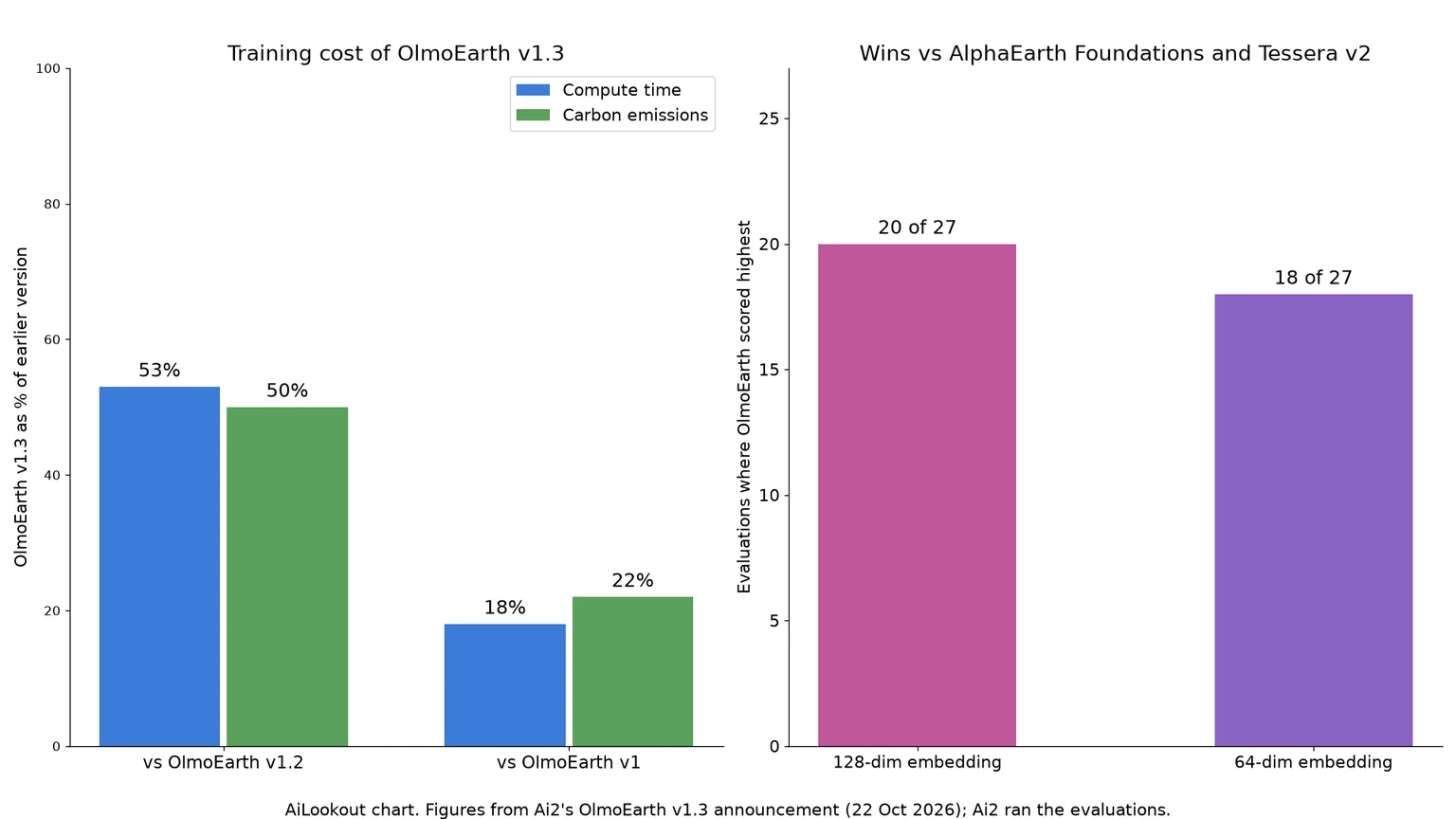
Ai2 compared OlmoEarth v1.3 with two other global embedding products, Google DeepMind's AlphaEarth Foundations and Tessera v2, across 27 evaluations on six continents. It reports that the 128-dimensional embedding scored highest on 20 of the 27 and ranked best overall, and that the 64-dimensional version still led on 18.
As part of the evaluation, Ai2 introduced PLANTEUR, a new benchmark for identifying crop types on tropical farms, and says its embeddings generalised best to places a classifier had never seen. Its examples include classifying smallholder crops in Kenya, detecting brick kilns west of Dhaka, assessing fire damage in Indonesia and tracking gold mining in the Peruvian Amazon.
The new version was also cheaper to make. Ai2 says training took 53 percent of the computing time of v1.2 and 18 percent of the original v1, with 50 and 22 percent of the carbon emissions, and that a rerun of the final pretraining would cost roughly $2,720 of rented H100 time. It says v1.3 still matches v1.2 as a base for fine-tuning.
These are Ai2's own results. The evaluation set and benchmark are new, and other groups have not yet reproduced the comparison.
A test case in the Peruvian Amazon
Ai2 illustrates the release with the La Pampa area of Madre de Dios in Peru. Citing Amazon Conservation's MAAP monitoring programme, it says illegal gold mining there peaked in 2017 and 2018, clearing more than 1,200 hectares of forest in the buffer zone of the Tambopata National Reserve, before Peru's Operation Mercurio shut most of it down in February 2019.
Comparing each pixel's embedding between 2017 and 2020, with no model training at all, highlights where mining was spreading to the southeast. The same comparison for 2020 to 2025 shows that corner going quiet, while change continues in the older mining zone to the west, which Ai2 describes as part regrowth and part renewed digging. SiliconANGLE's write-up of the release, using slightly different year ranges, puts the area of significant change at 34 square kilometres for the earlier period and 9 for the later one.
Ai2 also points to an August 2026 Associated Press report that Peru sent navy patrols back into the reserve after prosecutors found mining had crossed into Tambopata itself. In other words, the embeddings register both the crackdown and the pressure that followed.
Using the Embeddings Explorer
The OlmoEarth Embeddings Explorer shows the embeddings as a false-colour map of the planet. Users can pan anywhere, switch between years, and pull up the underlying Sentinel-2 imagery to check the map against reality. Clicking a place finds others that look similar, and dropping a few labelled points trains a small classifier on the spot, with results exportable as a GeoTIFF. Ai2 says no account or setup is needed.
The archive behind it holds about 150 terabytes per year at 10-metre resolution, covering land and nearby coastal waters. At launch, 2023, 2024 and 2025 are global, while 2017 to 2022 cover selected countries. For each 20-kilometre tile and year, provenance tables list the Sentinel-1, Sentinel-2 and Landsat scenes the model read, so any pixel can be traced back to its source imagery.
OlmoEarth joins a growing set of Earth-focused AI tools. Google offers a geospatial reasoning agent in Earth AI, the European Space Agency released EVE, an open Earth science assistant, and Ai2 itself recently published HiRO-ACEv2, a 3 km storm and climate emulator. Ready-made embeddings sit underneath that kind of work, making each new analysis cheaper.
The licence and its limits
Ai2 calls the release fully open, but the terms are not a standard open-source licence. The model, data and code are published under the OlmoEarth Artifact License, the same as earlier versions. It allows use, modification and redistribution with credit to Ai2, but forbids two kinds of use.
The first is military and defence applications, including weapons development, intelligence gathering and human surveillance or policing. The second is extractive activities, defined as removing raw materials from the earth, such as planning oil, gas or mineral extraction through drilling, mining or deforestation. Anyone redistributing derivatives must pass those restrictions on.
The ban on extractive uses is notable given the release's main example. Monitoring illegal mining, as in Madre de Dios, is the opposite of planning it, but companies in mining, forestry or energy will need to read the licence carefully before building on OlmoEarth. The licence also does not grant rights to Ai2's trademarks.
What to watch
Embeddings come with trade-offs. An annual vector summarises a whole year, so it suits slow changes such as land cover and expanding mines better than events that last days, like floods. Ai2 points users who need specific dates, sensors or resolutions to OlmoEarth Studio and to a tutorial for computing embeddings on their own hardware.
Coverage before 2023 is still partial, and the claims of state-of-the-art accuracy rest on Ai2's own evaluations. Independent comparisons with AlphaEarth Foundations and Tessera on standard benchmarks, and reports from NGOs and governments that already use OlmoEarth, will show how much the cheaper, open embeddings change everyday environmental mapping.
Common questions
What is OlmoEarth v1.3?
An Earth observation foundation model from Ai2 that produces satellite embeddings: one 128-dimensional vector per 10-metre pixel summarising a year of Sentinel-1, Sentinel-2 and Landsat observations.
Is OlmoEarth v1.3 free to use?
Yes. The model, global embeddings and explorer are free, under the OlmoEarth Artifact License, which requires credit to Ai2 and forbids military, surveillance and extractive uses such as planning mining or drilling.
Do I need a GPU to use the OlmoEarth embeddings?
No. Ai2 says the Embeddings Explorer runs in a browser with no sign-in, and a small classifier trained on the precomputed embeddings can run locally.
Sources & further reading
How this story was made
Written by Kristian Kostov with AI assistance and checked against the linked sources. Company performance claims are attributed to the company. Analysis reflects AiLookout’s interpretation; we have not independently tested the products discussed. Cover photography is illustrative and does not depict the specific announcement or product.
Our editorial standards