Announced 14 Oct 2026 · Sources checked
What is UltraBERT, and what shipped?
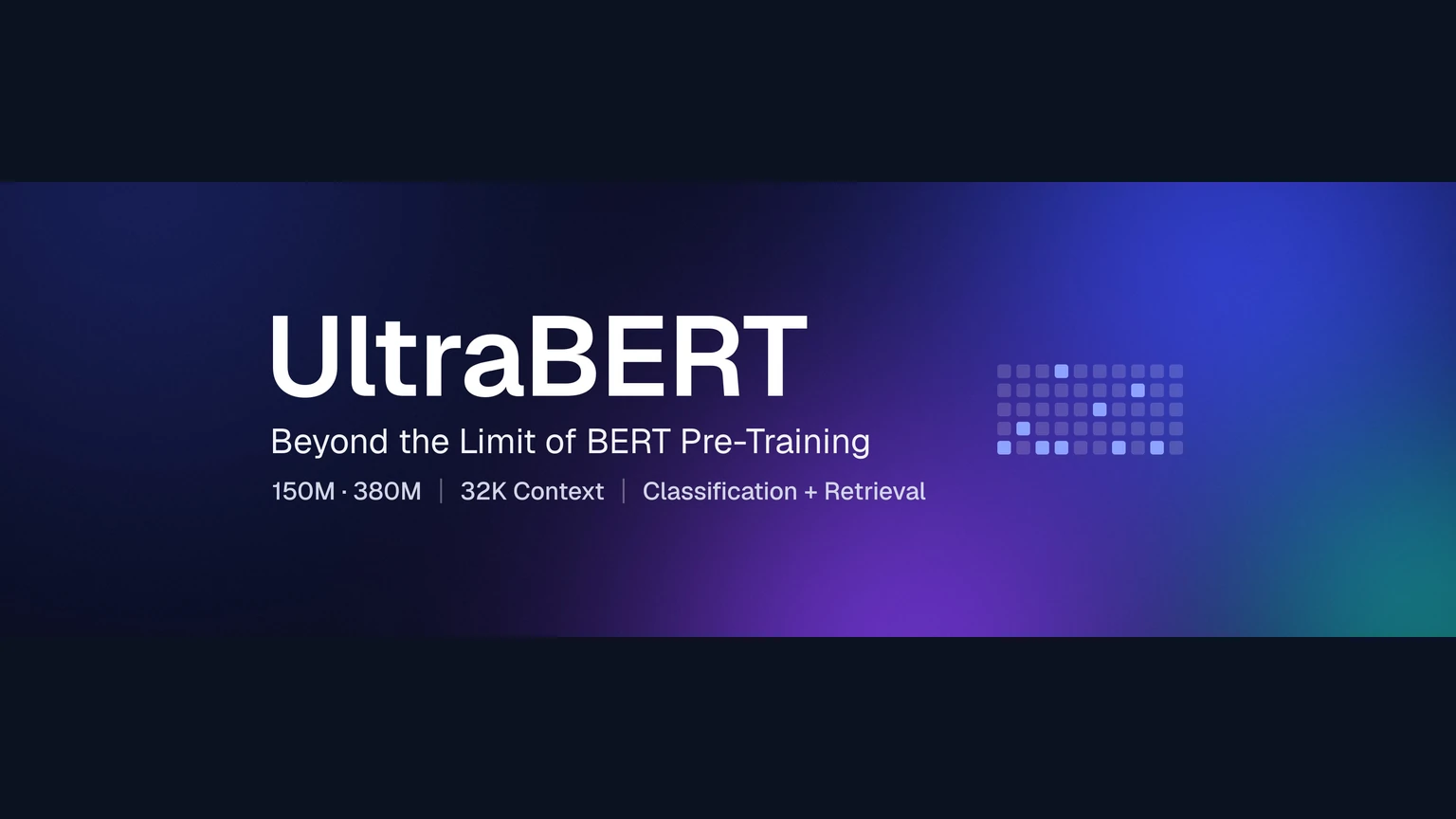
The UltraBERT-380M model card on Hugging Face describes UltraBERT as “a family of English bidirectional encoders with a native 32K context that reach state of the art on both classification and retrieval, two task families on which previous encoders had to choose a side.” Alongside it sit UltraBERT-150M and UltraBERT-Embed-150M, the latter presented as a text embedding model built on the 150M encoder. Cards declare Apache 2.0. Mirror listings and secondary AI-news posts dated the public drop to 14 October 2026; the scientific object is the paper plus the weight files.
The paper UltraBERT: Beyond the Limit of BERT Pre-Training (arXiv:2610.15028) by Jungwoo Park, Taewhoo Lee and Jaewoo Kang argues that recent encoders borrowed architecture ideas from causal LLMs but kept small-scale pre-training recipes, so no single encoder stayed competitive on both classification and retrieval. Their abstract says encoders saturate on downstream tasks beyond a few trillion tokens, that masking strategy should be reconsidered, and that they scale a recipe that jointly trains for both task families.
Architecturally, the 380M card lists 24 layers, hidden size 1,024, SwiGLU width 3,072, eight attention heads of dimension 128, a local×2 / global attention pattern with a 128-token local window, RoPE bases 10K local / 2.56M global, a 49,152 vocabulary, RMSNorm, and no bias terms. The 150M model keeps 24 layers but narrows width (hidden 768). Context length is 32,768 for both. Checkpoints ship float32 safetensors with the 5%-mask distilled MLM head; the 50% head is omitted from the public file.
How does the training recipe differ from classic BERT?
Classic BERT-style MLM usually uses a single masking rate and a shared head. UltraBERT’s cards describe a batch that mixes sequences masked at 5% and at 50% (about a 4:1 sequence ratio), each with its own LM head. Low masking is cast as better for classification-style features; high masking as better for retrieval-style ones. Separate heads are meant to avoid the interference a shared head would cause when those objectives conflict.
The 380M model is width-pruned from a 1.3B teacher; the 150M model is pruned again from the 380M student. Both are distilled from the 1.3B teacher with a KL loss applied only on the 5% masked sequences, while 50% sequences keep standard MLM loss. Channel, head and FFN importance is estimated on 2,000 calibration documents. Optimization uses AdamW, 1e-4 peak LR with a warmup-stable-decay schedule, 4M-token batches and 2T trained tokens, with context extended to 32K late in training. Hardware notes cite a single TPU v4-512, v5e-256 or v6e-256 slice via Google’s TPU Research Cloud.
Data mixture shares in the card (their Table 4) are dominated by DCLM and FineWeb-Edu web text, with Stack-Edu code, peS2o academic text, math corpora, Cosmopedia, Wikipedia and instruction sets—English-only by construction. That mixture explains both the long-context English web/code strength and the explicit limitation that the models are not multilingual out of the box.
What do the published scores say—and what they do not?
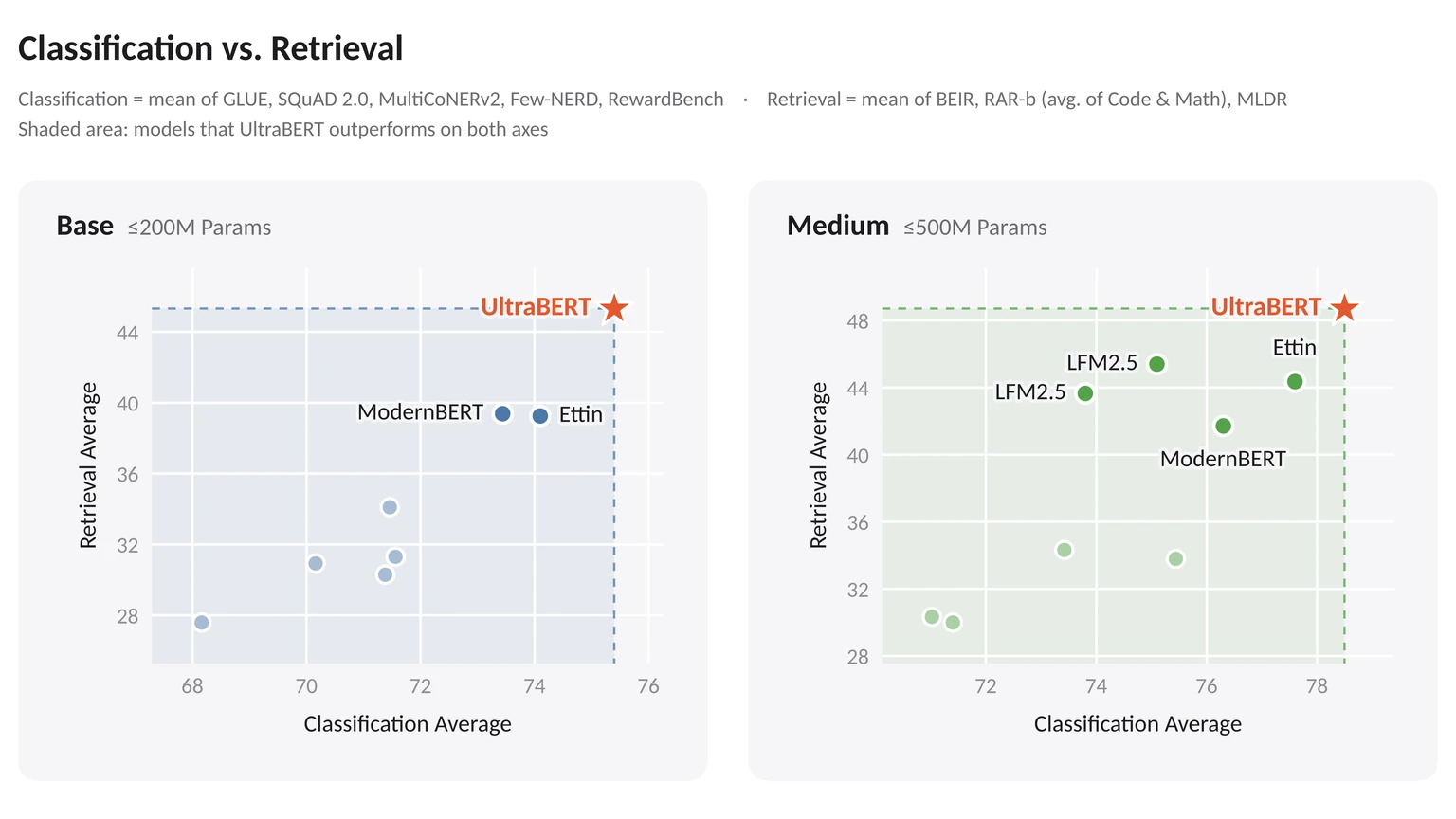
The model cards publish dense comparison tables. At base size (≤200M parameters), UltraBERT-150M is listed at 89.5 GLUE, 89.2 SQuAD 2.0, 45.2 BEIR and 72.0 LongEmbed in the authors’ columns, above ModernBERT and Ettin Encoder on those headline cells. At medium size (≤500M), UltraBERT-380M is listed at 91.0 GLUE, 90.9 SQuAD 2.0, 47.7 BEIR and 74.9 LongEmbed, above Ettin Encoder 395M and LFM2.5-Encoder rows in the same table. Reward-Bench, MultiCoNER, Few-NERD, RARb Code/Math and MLDR columns are included; UltraBERT leads many but not every cell.
Two caveats are printed on the card itself. First, every model is fine-tuned per task with the same grid search; retrieval numbers use a subset of MS MARCO or MLDR under that sweep, so they measure encoder potential after fine-tuning, not a frozen zero-shot embedder (for that, see UltraBERT-Embed-150M). Second, dedicated embedding models are usually trained on far larger pair corpora with longer schedules—the card says so explicitly. LongEmbed passkey plots are described as keeping 99% accuracy at every length through 32K for UltraBERT, while 512- and 8K-context baselines collapse past their windows.
Those are author-reported figures under author-chosen sweeps. They are useful for ranking research encoders, not a warranty for your production classifier. For other open embedding lines already covered on AI Lookout, compare the intent of EmbeddingGemma 2 and Perplexity’s PPLX Embed v2, which optimise different deployment and late-interaction trade-offs.
How do you run and fine-tune it?
Runtime requirements on the card: transformers ≥ 5 (tested with 5.16.1), trust_remote_code=True, with FlashAttention 2 recommended for long inputs (SDPA and eager also supported). Example code loads AutoModelForMaskedLM / AutoTokenizer for MLM probes and AutoModelForSequenceClassification for fine-tuning. Remote code registers UltrabertModel and task heads for sequence classification, question answering and token classification.
Recommended fine-tune starting points differ by task. Classification: AdamW (β1 0.9, β2 0.98, ε 1e-6), weight decay 0.1, linear schedule with 5% warm-up, LR swept over {5e-6 … 8e-5}. Dense retrieval: mean pooling with a contrastive loss and a wider LR sweep up to 1e-3. A highlighted note says UltraBERT “consistently prefers lower learning rates than other encoders, by up to 10×,” with best LRs cited at 5e-5 (150M) and 3e-5 (380M) versus 3e-4–5e-4 for many baselines—easy to miss if you copy a ModernBERT recipe unchanged.
Small open models aimed at document understanding remain a crowded shelf; CPU-first OCR such as Datalab’s Indra OCR solves a different problem than a general encoder. UltraBERT is for fine-tuned classification, retrieval and long-document encoding in English pipelines that can spend a GPU on transformers 5.x.
Where UltraBERT fits among encoders and embedders
Encoders did not disappear when decoder LLMs took the chat spotlight. Search, ranking, classification, NER and retrieval-augmented pipelines still want bidirectional representations that are cheaper to fine-tune and serve than a 70B generator. The 2024–2026 wave—ModernBERT, Ettin, NomicBERT, GTE-MLM, LFM encoders—modernised attention and context length. UltraBERT’s bet is that the missing piece was the pre-training objective mix and distillation path, not only the block design.
If you already ship a strong retrieval-only or classification-only encoder, UltraBERT matters only if one backbone replacing two fine-tune stacks cuts ops cost enough to justify migration. If you are starting a new English search-plus-classify service and want open weights with a 32K window, the cards give a concrete candidate with published tables and Apache terms.
UltraBERT-Embed-150M is the path for teams that want an embedding endpoint without running their own contrastive fine-tune first. The base 150M/380M checkpoints still need task heads. Mixing them up is the most likely integration mistake.
Limits, license and what to watch next
Documented limitations: English-only pre-training; base checkpoints are not ready-made classifiers or embedders; web-scale training data can carry bias. Downloads on the 380M card were still low (on the order of 10² in the past month) when AI Lookout checked—early days for community replication. There is no separate LICENSE file blob in the model tree; license metadata is the card’s apache-2.0 declaration, which is standard on Hugging Face but worth recording in your compliance log.
What to watch next: third-party reproductions of the GLUE/BEIR sweeps; Multilingual or domain-adapted UltraBERT variants; whether UltraBERT-Embed grows a larger contrastive recipe; and whether the 50% MLM head or the 1.3B teacher weights appear publicly. Until then, treat the 14 October drop as a serious open encoder release with strong author tables—and verify on your labelled sets before swapping production backbones.
Common questions
Is UltraBERT a chat model?
No. It is a bidirectional encoder family for classification, retrieval and related encoder tasks, plus an embedding variant. It is not a generative chat LLM.
Do I need to fine-tune the 150M/380M checkpoints?
Yes for task use. The cards say they are pre-trained encoders, not ready classifiers. UltraBERT-Embed-150M is the ready embedding option built on the 150M encoder.
What is the license?
Apache 2.0, per the Hugging Face model cards AI Lookout read on 14 October 2026.
Sources & further reading
How this story was made
Written by Kristian Kostov with AI assistance and checked against the linked sources. Company performance claims are attributed to the company. Analysis reflects AiLookout’s interpretation; we have not independently tested the products discussed. Cover photography is illustrative and does not depict the specific announcement or product.
Our editorial standards