Announced 22 Oct 2026 · Sources checked
What Tencent released
Tencent's WeChat Vision team has released WeVisOne-VL, an open vision-language model built to find things in images rather than describe them. The name stands for WeChat Vision All-in-One. The weights are on Hugging Face in two sizes, WeVisOne-VL-4B and WeVisOne-VL-2B, alongside an inference package, notebooks and an evaluation pipeline in the GitHub repository. The repository's license file is Apache 2.0 and the model cards declare the same license, which allows commercial use.
The technical report, arXiv 2610.31329, was submitted on 22 October 2026 by eight authors led by Tianming Liang, Junyi Pan and Yuxi Li. Both models are fine-tuned from Alibaba's Qwen3-VL, so they inherit a general-purpose vision-language backbone and then specialize it for what the paper calls unified visual perception, from whole objects down to individual pixels.
This is the second Tencent vision release we have covered this month, after the Youtu-Parsing-Omni document model. WeVisOne-VL is different in scope. It is not a document reader. It is a general tool for pointing at things in photos, counting them, reading scene text and cutting them out, and Tencent's own Youtu-VL shows up in the comparison tables as one of the baselines.
One model, seven jobs
Most open vision models are good at answering questions about a picture but vague about where things are. Specialist models such as object detectors and segmenters are precise but each does one job. WeVisOne-VL tries to do seven of those jobs in one network, chosen by a plain text prompt.
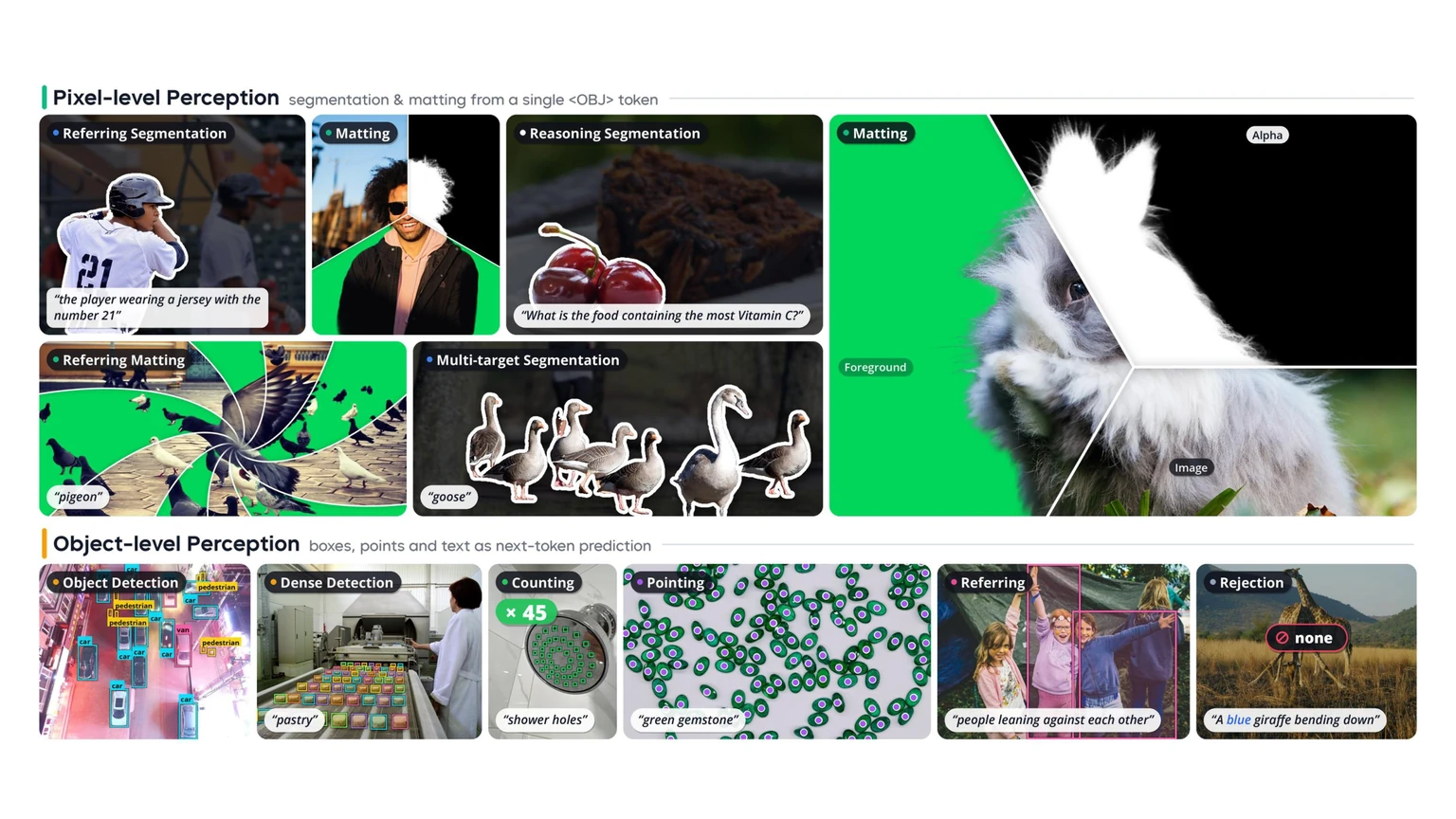
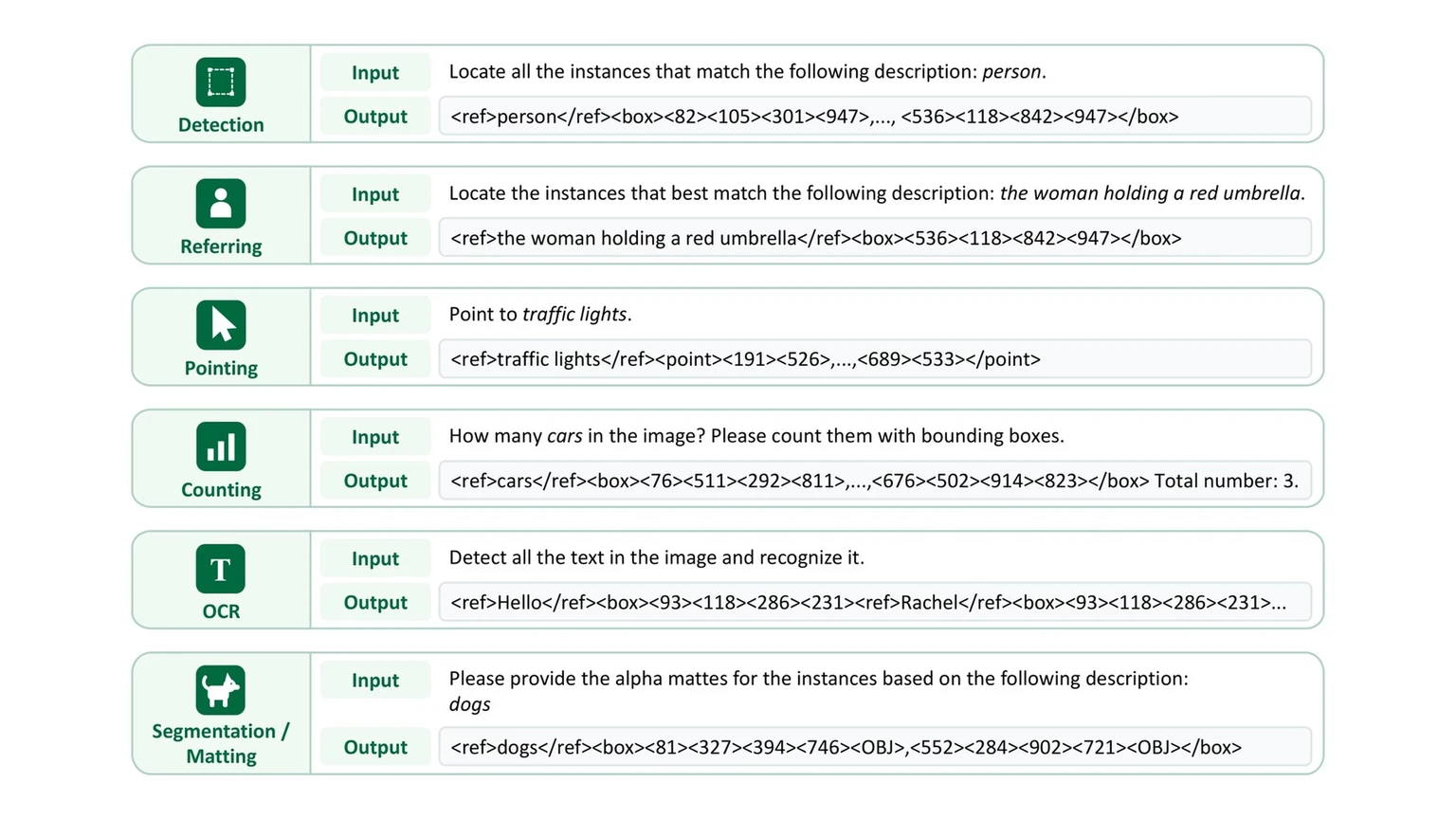
The tasks are open-vocabulary object detection, where you name any category and get every box; referring localization, where you describe one specific object such as the woman holding a red umbrella; counting; pointing, which returns a single point per object; OCR, which finds and reads text in the scene; referring segmentation, which returns a pixel mask; and image matting, which returns a soft alpha matte that keeps hair and translucent edges instead of a hard cutout.
In the Python package each job is a task name. A call such as predict with task set to matting and a query of person returns boxes plus alpha mattes for every person in the image. The repository says the models run with either Hugging Face Transformers or vLLM, and includes a local demo script, although a hosted web demo is still listed as a to-do.
The trick: coordinate tokens and a tiny pixel decoder
The interesting engineering choice is how a text model outputs geometry. WeVisOne-VL adds 1,001 coordinate tokens to the vocabulary, numbered 0 to 1000, so a box is written as four of those tokens and a point as two. Positions are normalized to the image, which means the same token means the same relative position on any picture size. Every answer, including a count, is just a sequence of tokens the model can learn with ordinary next-token training.
Masks and mattes cannot be written as a handful of tokens, so the model emits a special OBJ token after each box it wants to cut out. The hidden state at that token is passed to a small pixel decoder that turns it into a mask or an alpha matte. That decoder is tiny by modern standards: the paper puts it at about 9.6 million parameters, a rounding error next to the 4 billion in the language model. The heavy lifting of deciding which object is meant stays in the language model, and the decoder only draws the outline.
That design is close in spirit to earlier work the paper cites, such as LISA and GLaMM, which also connect a generated token to a mask decoder. The difference Tencent stresses is breadth: one set of weights covering detection, counting, OCR and matting as well as segmentation. Read alongside Kakao's Kanana-2 vision encoders, it is part of a steady stream of small, open vision components that developers can drop into their own pipelines.
How it was trained
Training data came from what Tencent calls the WeVisOne-VL Data Engine. According to the GitHub README and the paper, it draws on public sets including GRIT, CC3M, LAION and Meta's SA-1B and adds task-specific data, for roughly 100 million images and about 3.6 billion box annotations in total.
The training ran in four steps. Stage one froze the vision encoder and taught the language model the new tokens and output formats on 90 million examples. Stage two unfroze everything, raised the image budget to 1,960 visual tokens for small objects, and allowed up to 500 boxes or points in one answer for crowded scenes, using about 40 million examples. Stage three attached the pixel decoder and alternated text and mask training so that adding masks would not hurt box accuracy. A final reinforcement learning stage used GRPO with rewards computed on the full set of predicted boxes after matching them to the ground truth, which punishes both missed and duplicate objects.
The appendix says supervised training used 128 GPUs and reinforcement learning used 160, without naming the GPU model. Tencent has also open-sourced Mask2Alpha, the annotator it used to turn hard binary masks into soft alpha mattes for training, on a separate branch of the repository. Fine-tuning code for the model itself has not been released yet.
What the benchmarks say
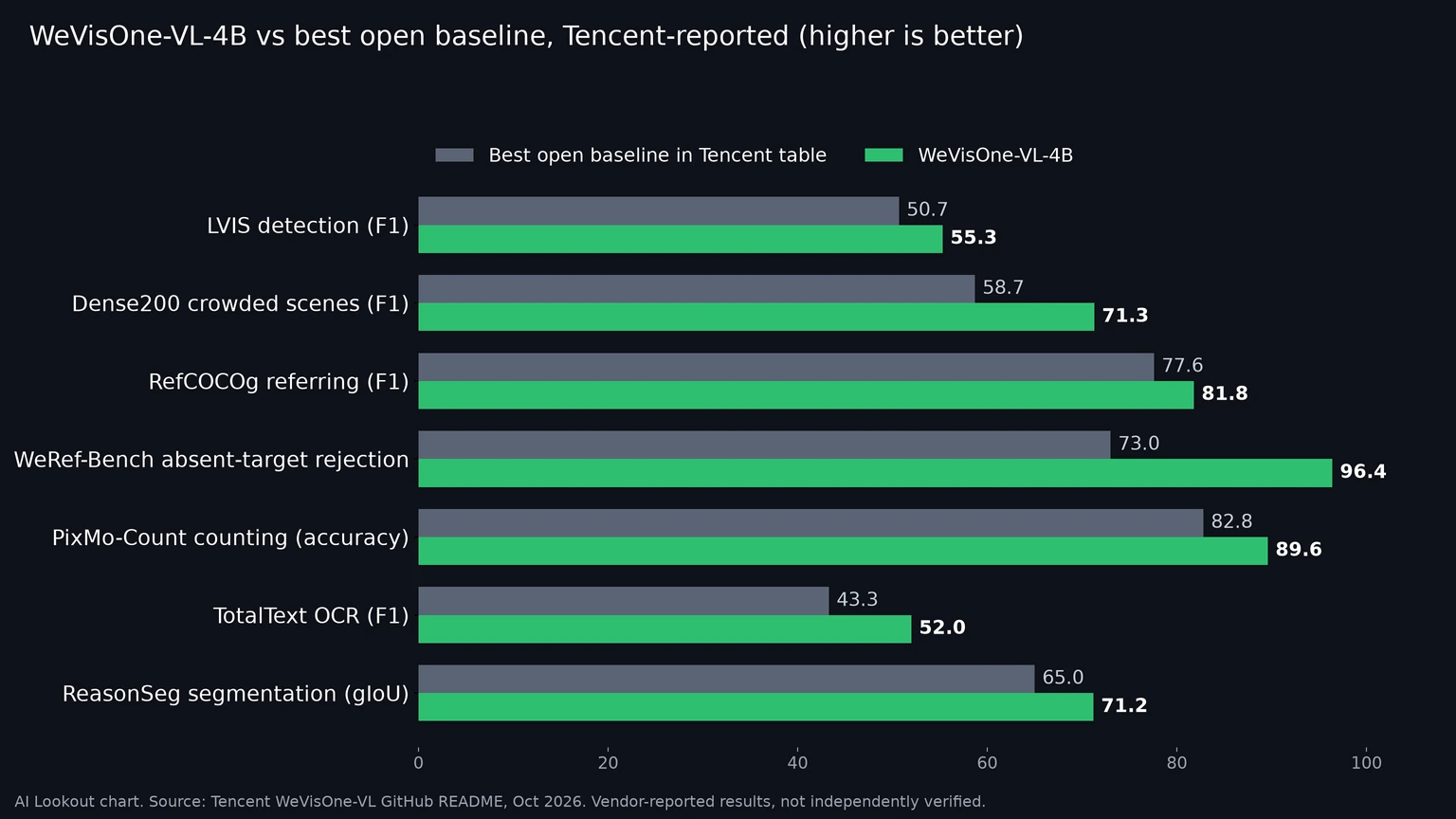
The paper reports results on more than 30 benchmarks, and the README summarizes ten of them for the 4B model against the strongest open baseline in each case. Those baselines include Qwen3-VL and Qwen3.5 models up to 9B parameters, Rex-Omni, LocateAnything and specialist segmentation and matting systems.
On LVIS detection the 4B model scores an F1 of 55.3 against 50.7. On Dense200, a crowded-scene test, it scores 71.3 against 58.7. Referring accuracy on RefCOCOg is 81.8 against 77.6, counting accuracy on PixMo-Count is 89.6 against 82.8, pointing on PointBench is 71.9 against 69.9, OCR grounding on TotalText is 52.0 against 43.3, and reasoning segmentation on ReasonSeg is 71.2 against 65.0.
Matting shows the largest gap. Lower error is better there, and on the P3M-500-NP portrait set the box-prompted error falls to 7.3 from 15.4 for SAM2-Matting. On Tencent's own WeRefMat test, where the target is named in words, it falls to 9.8 from 22.4 for a Qwen3.5-9B plus SAM2-Matting pipeline. One oddity in the detailed table: the smaller 2B model does slightly better than the 4B on two of the box-prompted matting sets, at 6.6 on P3M-500-NP and 5.3 on PPM-100.
All of these are Tencent's own numbers, and two of the benchmarks, WeRef-Bench and WeRefMat, were built by the same team. Nobody outside Tencent has reproduced them yet.
Saying no when the object is not there
The most practical result may be the least flashy one. Vision models asked to find something that is not in the picture often draw a box anyway. WeVisOne-VL is trained to answer None when the requested target is absent, and on Tencent's WeRef-Bench it correctly refuses 96.4 percent of the time, against 73.0 percent for the best baseline.
For anyone building an automated pipeline, such as a product photo cropper, a shelf counter or a moderation filter, a false box is often worse than no box, because it silently produces wrong data downstream. A model that says nothing is there when nothing is there saves a separate verification step. The caveat is that this test was designed by the same team, so the real-world refusal rate on messier prompts is still unknown.
What it cannot do yet
The paper's own limitations section is frank. Because the model was trained heavily on perception data, its general chat and reasoning abilities may be weaker than the Qwen3-VL base. It answers directly without chain-of-thought reasoning, which keeps it fast but limits harder reasoning prompts. It handles one image and one turn at a time, and there is no video support in the pixel decoder. The authors also note that benchmark prompts are clean and unambiguous while real users are vague, and they list better intent reasoning as future work. The full discussion is in the HTML version of the paper.
Practical gaps remain too. There is no hosted demo yet, no fine-tuning code, and no published speed or memory figures for the 4B model on common GPUs, which matters if it is meant to replace a cheaper specialist detector.
Who should try it
WeVisOne-VL looks most useful for teams that today chain a captioning model, a detector and a segmenter together and want one open model with an Apache license instead. Small open vision models are clearly a busy category: Prime Intellect recently bought Moondream, and OpenBMB keeps pushing MiniCPM-V on phones. A 4B model that also does matting and refuses absent targets is a reasonable thing to test against both.
Watch for independent results on LVIS and RefCOCO-style tests, the promised web demo and fine-tuning code, and whether Tencent ships the model inside WeChat features, which would be the clearest sign of how well it holds up at scale.
Common questions
Can I use WeVisOne-VL commercially?
The repository license and the Hugging Face model cards are Apache 2.0, which permits commercial use. The model is fine-tuned from Qwen3-VL, so check the base model's terms for your use as well.
How is it different from Meta's SAM models?
SAM-style models segment what you prompt them with. WeVisOne-VL is a language model that also detects, counts, reads text and decides which object a sentence refers to, then hands each object to a small decoder for the mask or matte.
Does it work on video?
No. The paper says it handles single images in a single turn, and the pixel decoder has no video support.
Sources & further reading
How this story was made
Written by Kristian Kostov with AI assistance and checked against the linked sources. Company performance claims are attributed to the company. Analysis reflects AiLookout’s interpretation; we have not independently tested the products discussed. The cover is a cropped example output published by the developer in its openly licensed repository, credited in the caption. It is not an AiLookout test or screenshot.
Our editorial standards