Announced 13 Oct 2026 · Sources checked
What did Prime Intellect announce?
In a post titled “Moondream is joining Prime Intellect” and dated 13 October 2026, the San Francisco company said simply: “We’ve acquired Moondream.” Founders Vik Korrapati and Jay Allen are joining Prime Intellect “to lead and scale inference, and to accelerate our work on multimodal models, including vision and computer use.”
Prime says Moondream was one of its earliest customers. It credits the team with shipping open-weight vision-language models that have “millions of monthly downloads” and with building Photon, “an inference engine that compiles each model into a single GPU program,” along with custom GPU kernels and the megakernel compiler behind them.
Neither side disclosed a price. Prime Intellect co-founder and chief executive Vincent Weisser told The Information that Moondream has fewer than 10 employees and that Prime is largely acquiring it for the team’s skill at writing software that makes models run more efficiently. The Information reported that Moondream had raised $4.5 million and that Prime Intellect was valued at $1 billion in an equity financing in July.
Jay Allen framed the deal as two companies betting on the same idea: “Moondream is proof that small, efficient models can beat giant ones at specific tasks. Prime is building for that same future: many specialized models that companies own.”
What is Moondream?
Moondream started as a tiny open vision-language model, a system that can look at an image and answer questions about it, find objects or read text. Its best-known release, moondream2 on Hugging Face, is published under the Apache 2.0 licence; the Hugging Face API showed about 2.35 million downloads over the past month when AI Lookout checked on 14 October. The company’s GitHub repository has just over 10,000 stars.
The current flagship, Moondream 3.1, launched on 7 July 2026. It is a mixture-of-experts model with 9 billion total parameters and 2 billion active per token, with skills for answering questions, captioning, pointing at objects and drawing bounding boxes around them. Moondream says it fine-tuned task-specific adapters with its own Lens product, then distilled them back into the base weights.
Moondream 3.1 uses a newer Moondream Model License rather than Apache 2.0. The company says the weights can be used commercially, self-hosted, fine-tuned and redistributed, with one restriction: you cannot offer general-purpose Moondream inference or fine-tuning as a hosted service to others. That clause matters more now that the model belongs to an inference provider.
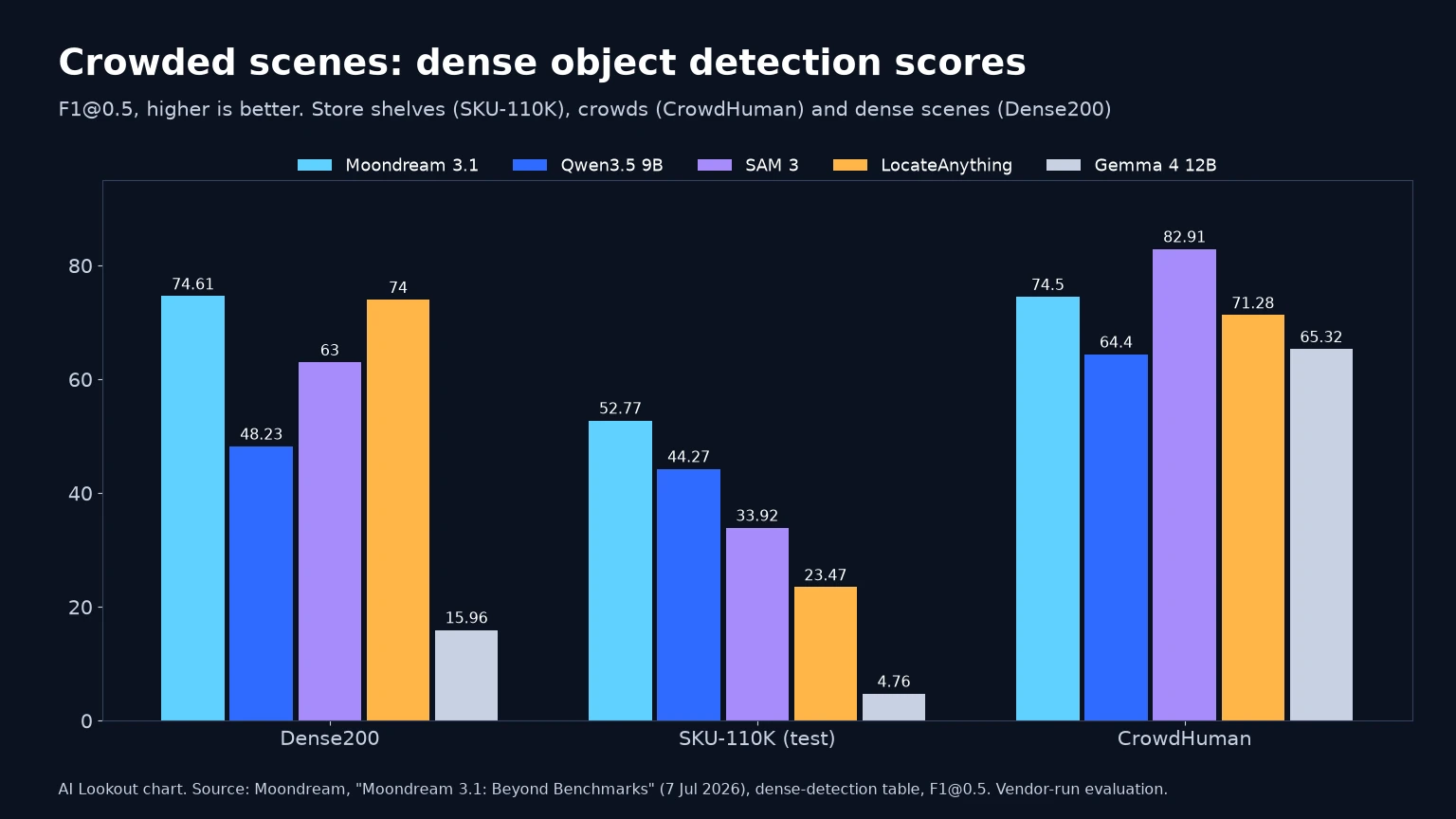
On Moondream’s own benchmarks, 3.1 leads on COCO and ODinW-13 object detection, DOTA-v2 aerial detection, ChartQA and PixMo-Count. Its biggest gains are on crowded scenes such as store shelves, though SAM 3 still scores higher on the CrowdHuman test of crowds of people.
What is Photon, and why does Prime want it?
Photon is the part Prime singled out. In its Photon 2.0 post, Moondream argues that mainstream engines such as vLLM and SGLang are built for chat: large batches of prompts and maximum tokens per second. Robots, cameras and computer-use agents are different, it says, because they stream images and video at low concurrency and care more about strict latency deadlines than throughput.
Photon’s answer is a compiler. Rather than having the CPU coordinate many separate GPU programs, the compiler produces a single “megakernel” that runs the whole inference path on the GPU. Moondream says this cuts launch and synchronisation overhead and lets the compiler optimise across operator boundaries. Photon 2.0 added Qwen 3.5 and Gemma 4 alongside Moondream on NVIDIA H100, and Moondream reported that it beat vLLM and SGLang in its matched throughput and cold-start tests.
The Photon inference engine is Apache 2.0 and its megakernels are free to run, but the compiler itself is proprietary. Prime now owns that compiler.
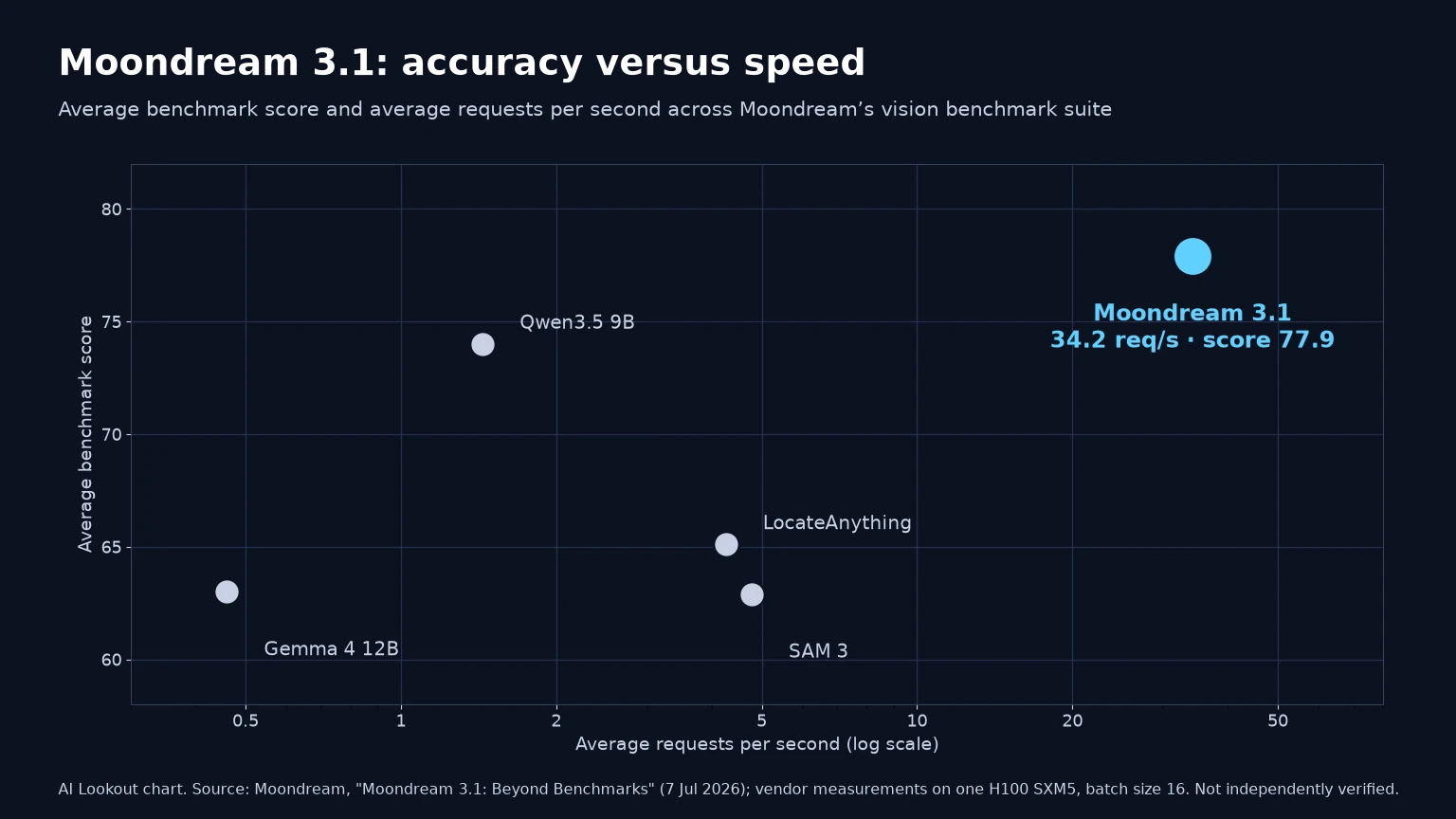
Prime’s announcement repeats the speed claims. It says Moondream 3.1 runs at 34 requests per second, “about 24x faster than the next most accurate open model,” and that on a single H100 Photon runs more than 60 Moondream inferences per second, which it calls fast enough for live video. It adds that Moondream 3.1 reaches 80% of the pointing accuracy of Meta’s new Muse Wonder at about one-thousandth of the cost.
What changes for Moondream users and Prime customers?
Prime says it has “already started shipping.” Moondream 3.1 is available through Prime Inference, powered by Photon, and Photon and Moondream’s kernel work are being integrated into Prime’s wider stack. The company describes this as “a commitment to having the fastest inference on the market.”
Existing customers get a transition offer. Prime says that “in the next few days, every customer of Moondream Cloud will receive credits on our platform,” usable for Moondream models and Prime’s other training and inference products. Moondream will remain Prime’s brand for small, efficient multimodal models.
The same post notes that Cloudflare’s Clef and Clef Flash models are live through Prime Inference and OpenRouter, with Clef priced at parity with Jev and Clef Flash at half the price. AI Lookout covered the newest member of that family, Clef-omni, last week. Moondream 3.1 was already on Cloudflare Workers AI through a partnership announced in July, at the same $0.30 per million input tokens and $1.00 per million output tokens as Moondream Cloud.
Why are inference providers buying efficiency teams?
The Information describes Prime Intellect as a “neocloud,” one of many companies renting GPUs and serving open models to developers. That market is crowded, and the levers for standing out are speed and price. Buying a small team that can make the same chips serve more requests is a direct way to pull both.
It also fits Prime’s broader story. The company calls its platform an “open superintelligence stack” that links evaluation, fine-tuning, reinforcement learning and inference, and its tooling already shows up in other labs’ work; Goodfire, for example, used Prime Intellect verifiers and sandboxes when training its Kimi K3 cyber monitors.
The deal is part of a wider push towards small, efficient multimodal models that can run close to where images are captured. OpenBMB’s MiniCPM-V 4.7 targets phones and tablets, while frontier systems such as Meta’s Muse Wonder go the other way, with large general models. Prime is betting that many companies will want a specialised model they own, served cheaply, rather than calling a frontier API for every frame.
What are the caveats?
Most numbers in the announcement are vendor claims. Prime’s own reference list cites an “unpublished internal evaluation” for the Muse Wonder pointing comparison and “unpublished internal measurements” for the H100 serving benchmark. Moondream’s benchmark tables were run by Moondream on its chosen settings. None of these has been independently reproduced.
The “millions of monthly downloads” claim is broadly consistent with what Hugging Face reports for moondream2, but download counts include automated pulls and are a weak proxy for production use.
Licensing could get more complicated. Moondream 3.1’s licence forbids others from reselling general-purpose Moondream inference as a hosted service, and its owner is now an inference provider. That is legal, but developers who want to serve Moondream for others should read the terms closely. Prime has not said whether it plans to change the licence.
Finally, small-team acquisitions often mean the product roadmap shifts towards the buyer’s needs. Prime says Moondream remains a brand, but it has not published a roadmap for future Moondream models or for Moondream Station and Lens.
What to watch next
The immediate signs will be practical: whether Moondream Cloud customers receive their Prime credits as promised, whether Photon starts accelerating models beyond Moondream, Qwen and Gemma on Prime’s servers, and whether Prime publishes the internal evaluations it cites. Independent latency and price comparisons on Prime Inference will show whether the “fastest inference on the market” claim holds up.
Common questions
How much did Prime Intellect pay for Moondream?
The price was not disclosed. Prime Intellect’s CEO declined to share terms with The Information, which reported that Moondream had raised $4.5 million and has fewer than 10 employees.
Can I still use Moondream models?
Yes. Prime says Moondream remains its brand for small multimodal models. Moondream 3.1 is available through Prime Inference, the weights stay on Hugging Face under the Moondream Model License, and Moondream Cloud customers are due to receive Prime credits.
What is Photon?
Photon is Moondream’s inference engine. Its compiler turns a model into a single GPU “megakernel” to reduce overhead. The engine is Apache 2.0 and its kernels are free to run, but the compiler is proprietary and now belongs to Prime Intellect.
Sources & further reading
How this story was made
Written by Kristian Kostov with AI assistance and checked against the linked sources. Company performance claims are attributed to the company. Analysis reflects AiLookout’s interpretation; we have not independently tested the products discussed. The cover is an original AiLookout chart of figures published in the cited sources, not a product photograph or independent test.
Our editorial standards