Announced 12 Oct 2026 · Sources checked
What did Hazy Research release?
In a 12 October 2026 Hazy Research blog post, Hermann Kumbong, Ishan S. Khare and colleagues introduced Next-Concept Modeling, or NCM: a language-modeling framework that generates text from coarse concepts to fine detail instead of emitting one token after another. The write-up sits under Stanford’s Hazy Research group, with equal advising credited to Simran Arora, Azalia Mirhoseini and Christopher Ré.
The same day the group pointed to an arXiv paper (2610.14162) and a public GitHub repository. By 14 October 2026 the repo’s README listed released tokenizer and generator weights in a Hugging Face NCM collection, with evaluation scripts and per-task configs. That combination—dated blog, paper, MIT code and downloadable checkpoints—is the event this article covers.
This is a research systems release, not a consumer chat model launch. There is no hosted NCM API in the announcement, no dollar pricing and no claim that one checkpoint replaces GPT-style assistants. The useful objects are the method, the code and the task-specific artifacts you can actually download.
How does Next-Concept Modeling generate text?
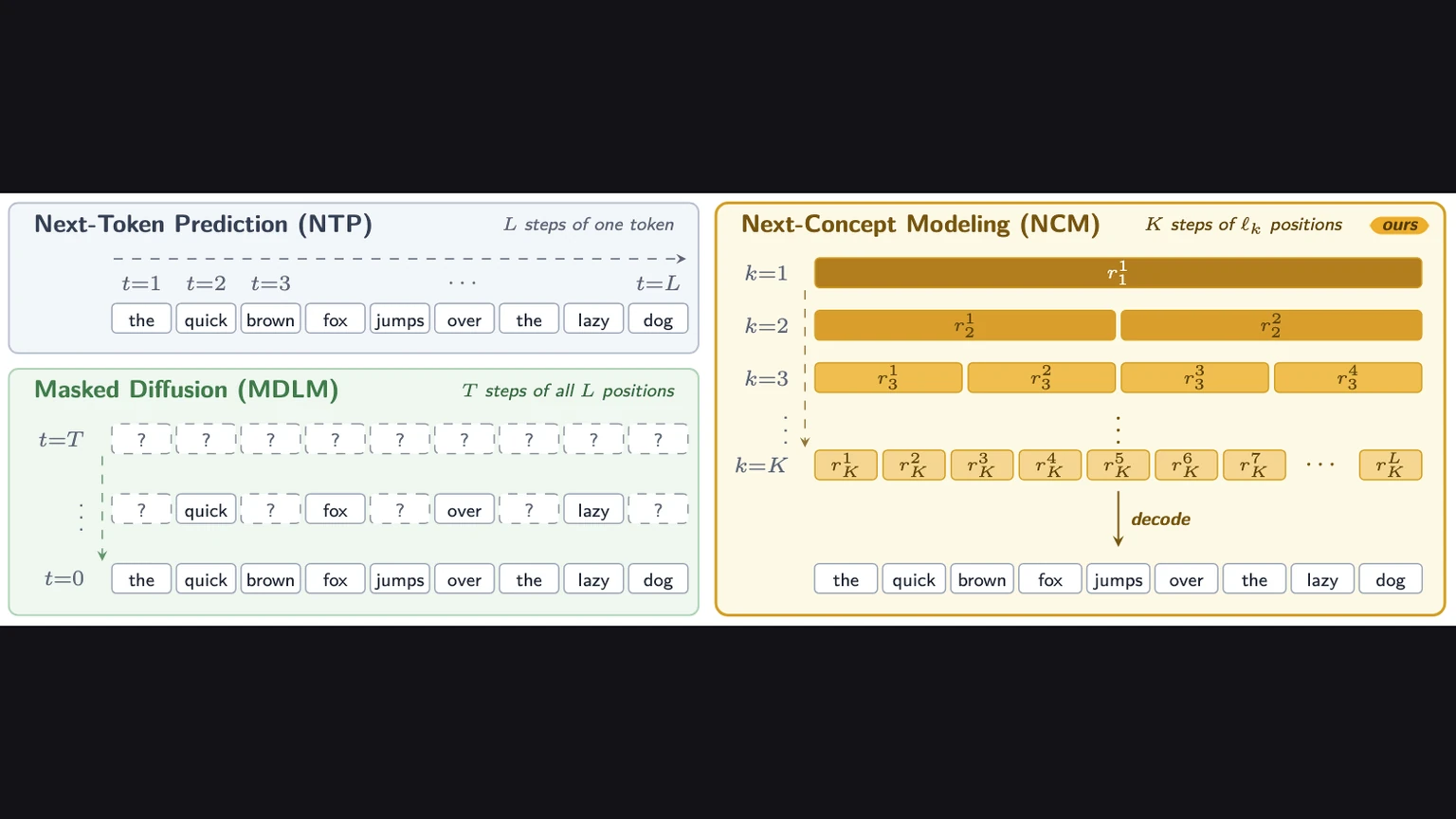
Autoregressive models generate left to right, one token per step. Diffusion language models refine many tokens in parallel but still need many sampling steps over the full sequence. NCM sits on a different axis: it first learns a multiscale residual vector-quantized tokenizer that turns a sequence into a hierarchy of discrete codes, then trains a transformer to predict each level from the cumulative reconstruction of earlier levels.
Within a level, every code is predicted in parallel, so generation needs one forward evaluation per level rather than one per token. The blog’s interactive German–English example shows a sample decoded level by level until BLEU against the reference climbs. The repository overview diagram places that coarse-to-fine path beside autoregressive and diffusion sketches so readers can see the scheduling difference at a glance.
Training is staged. Stage 1 builds the tokenizer with per-level codebooks, nested dropout so early levels carry meaning without depending on later ones, and a token-level reconstruction objective. Stage 2 freezes the tokenizer and trains the generator on all levels in one forward pass, corrupting some conditioning codes for robustness. At inference the completed hierarchy is decoded back to text.
If you already follow speculative decoding, the contrast is worth keeping straight: speculative methods still verify against an autoregressive target and preserve that distribution, while NCM changes the generation schedule itself. The public materials do not claim bitwise equivalence to an autoregressive teacher.
Which checkpoints and code are public?
The HazyResearch/ncm repository is MIT-licensed. Installation is a clone plus requirements.txt, with Python 3.10+ and CUDA PyTorch recommended. Evaluation downloads hazyresearch/ncm-checkpoints and the companion ncm-datasets dataset, then runs evaluate.py with a per-task config.
Released pairs cover XSum, WMT14 German–English, Sudoku (easy/medium/hard), LM1B (small/medium/large), TinyStories and OpenWebText. Each task ships a frozen tokenizer, a generator, a config.yaml and evaluation inputs. The README’s scoring notes spell out ROUGE for XSum, sacreBLEU/chrF for WMT14, solved-cell rates for Sudoku, and GPT-2-large generative perplexity with unigram entropy for the unconditional sets.
OpenWebText appears in the model table; community notes earlier flagged incomplete uploads on some auxiliary repos, so treat each Hugging Face path as something to open and hash before you depend on it in production. The collection page is the map; the individual checkpoint repos are the source of truth for licence badges and file lists.
For related reading on other decoding shortcuts that still stay inside autoregressive serving, see AI Lookout’s explainer on speculative decoding. For the broader training-versus-serving cost split that motivates faster generators, see training vs inference.
What this means for non-autoregressive language models
Non-autoregressive text generation has spent years chasing diffusion and masked models that trade quality for parallelism. NCM’s bet is that a learned concept hierarchy can keep quality while cutting the number of expensive steps, and that early levels stay cheap because they are short. If that holds beyond the authors’ suites, inference stacks that today default to token-by-token decoding gain another research branch to watch—especially for translation, summarization and constraint-heavy puzzles.
It does not automatically displace chat serving. Consumer assistants need tool calling, long multilingual contexts, safety filters and continuous post-training loops that this release does not claim to provide. The nearer opportunity is specialist generators where a fixed hierarchy and a few parallel steps are enough, and where wall-clock on one H100 is the metric that matters.
The open checklist also matters for reproducibility culture. Publishing tokenizer weights, generator weights, configs and evaluation entry points in one MIT repo lowers the cost of challenging the speed claims. That is healthier than a blog-only chart, even when every number still starts as the authors’.
What readers should verify before treating the speedups as settled
Re-run the published evaluate.py paths on your own H100 or equivalent before citing 10–31× as a hardware-invariant fact. Batch size, precision, kernel versions and the exact diffusion baselines all move wall-clock. The blog is careful to separate NFE from milliseconds; your write-ups should be too.
Confirm licence text on every Hugging Face repo you vendor. The GitHub tree is MIT; hosted checkpoint cards inspected on 14 October listed Apache-2.0, but badges can differ by subdirectory and can change after this article’s check date.
Do not blur research Sudoku accuracy into claims about general reasoning agents. The puzzle results support a planning hypothesis inside a closed domain; they are not a substitute for tool-use or long-horizon agent benchmarks.
Watch for joint tokenizer–generator training and adaptive depth, which the authors list as next steps. Those would be material follow-ups; until they ship, the dated object is the 12 October method plus the public checkpoints already linked above.
Common questions
Is NCM a drop-in replacement for GPT-style chat models?
No. The public release is a research framework with task-specific tokenizers and generators. It is not a general chat API or an open-weight chat model you load once for every task.
Are the 10–31× speedups independently verified?
They are wall-clock figures from the authors’ H100 benchmarks against diffusion baselines in the 12 October blog and paper. Re-run before treating them as settled across hardware and batch sizes.
What licence covers the code and weights?
The GitHub repository is MIT-licensed. Hugging Face checkpoint cards in the NCM collection list Apache-2.0 for the hosted artifacts inspected on 14 October 2026; confirm each repo’s card before shipping.
Sources & further reading
How this story was made
Written by Kristian Kostov with AI assistance and checked against the linked sources. Company performance claims are attributed to the company. Analysis reflects AiLookout’s interpretation; we have not independently tested the products discussed. The cover places the companies’ own logos, taken from public-domain or openly licensed files credited in the caption, on a plain background. It is not a product photograph, a screenshot, or an endorsement.
Our editorial standards