Announced 20 Oct 2026 · Sources checked
What SpaceX reported
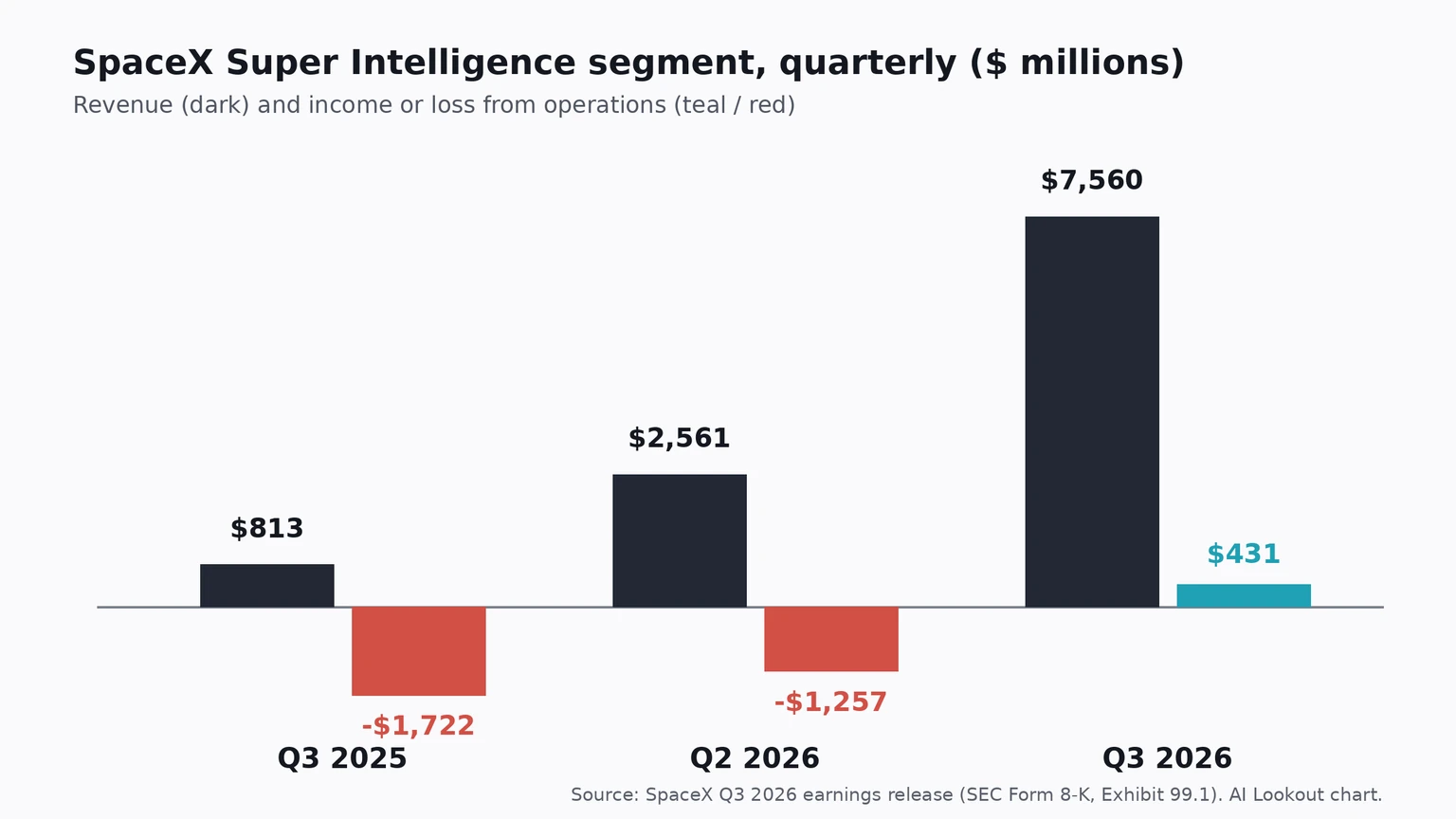
SpaceX's artificial intelligence business has swung to an operating profit. In its third-quarter earnings release, filed with the US Securities and Exchange Commission on 20 October 2026 as an exhibit to a Form 8-K, SpaceX said its Super Intelligence segment, which it abbreviates as SI, earned $431 million in income from operations on revenue of $7.56 billion in the quarter to 30 September, after operating losses in both earlier quarters of 2026.
That revenue figure is up 195% from the second quarter and 830% from the same quarter of 2025, when the segment brought in $813 million and lost $1.72 billion from operations. SI is now the largest of SpaceX's three segments by revenue, ahead of Connectivity, which includes Starlink, at $5.25 billion, and Space, the launch business, at $1.77 billion.
For the whole company, SpaceX reported revenue of $14.58 billion, up 161% from $5.58 billion a year earlier, income from operations of $2.79 billion and net income of $4.4 billion, against a net loss of $1.1 billion a year ago. Adjusted EBITDA, a non-GAAP measure that strips out depreciation, share-based pay and several other items, was $8.8 billion.
Inside the Super Intelligence numbers
SpaceX splits SI revenue into two lines. Advertising brought in $538 million, up from $454 million a year ago. Everything else is grouped as SI solutions and infrastructure revenue, which jumped to $7.02 billion from $359 million a year earlier and $2.19 billion in the second quarter. The release says that line grew on cloud services agreements, the Cursor acquisition and SpaceX's own SI models and software applications, including Grok Bot.
The release names three drivers for the increase: the activation of new cloud services agreements, the acquisition of Cursor, and increased Grok adoption among enterprise customers and consumers. It also says SpaceX signed more cloud services agreements during the quarter, adding to its pipeline of SI infrastructure capacity for third-party customers, and that it accelerated Grok model releases and introduced Grok Bot, which it describes as its always-on agentic SI system. The release does not name the cloud customers or say how the $7.02 billion divides between compute rental and software.
Costs grew quickly too. SI cost of revenue was $2.68 billion, research and development $3.18 billion and selling, general and administrative costs $1.27 billion. Adding back $2.47 billion of depreciation and amortization and $2.04 billion of share-based compensation, SpaceX reports SI adjusted EBITDA of $4.95 billion for the quarter, up from $1.15 billion in the second quarter.
Cursor's first quarter inside SpaceX
The quarter is the first to include Cursor, the AI code editor. SpaceX says it completed the acquisition on 14 August 2026 at an implied equity value of $60 billion. Under GAAP accounting, the purchase consideration was $42.5 billion, and SpaceX puts the value of equity awards issued in the deal that are tied to future service by Cursor employees at $23.4 billion, subject to forfeitures.
Between the closing date and 30 September, Cursor contributed $608 million of revenue to SpaceX's consolidated results, about one twelfth of SI revenue for a period of roughly six and a half weeks. The deal also weighed on profit: the SI operating result includes $1.22 billion of share-based compensation related to acquisitions, which SpaceX attributes to the Cursor purchase, plus $8 million of acquisition-related costs.
Since the merger, SpaceX has started selling its AI products together. Earlier this month the company, branding itself SpaceXSI, launched The X Subscription, which bundles Grok, Grok Bot, Cursor and X Premium into one plan. The third-quarter numbers do not yet show how that bundle is doing, because it went on sale after the quarter closed.
Compute: 1.7 GW and Colossus II
SpaceX measures its AI infrastructure in nameplate compute, the rated power capacity of its data centres. It reached 1.7 gigawatts at 30 September, up from 1.4 GW at the end of June and 0.6 GW a year earlier, as the company continued building Colossus II, its second large data centre project in Memphis, Tennessee.
That scale puts SpaceX among the largest operators of AI training and inference capacity, and it is now renting part of it out. Other labs mostly describe their clusters as a cost of building their own models, as Meta did when it detailed Prometheus, the Ohio supercluster that trained Muse Wonder. SpaceX instead reports compute as a business it sells to others as well as uses itself.
According to TechCrunch's account of the investor call, Elon Musk said he was spending four days a week in Memphis working to bring Colossus II online. He argued that the constraint on deploying AI is now power, cooling and infrastructure more than chips, and gave the example of gas turbines: manufacturers face 12 to 18 month waits for blades and vanes, so SpaceX is using the metal casting capabilities it built for rockets to make those parts itself.
The capital bill
The AI build-out is expensive. SpaceX spent $16.44 billion of capital expenditure on SI in the third quarter alone, out of $19.59 billion for the whole company, compared with $4.76 billion for SI a year earlier. Over the first nine months of 2026, SI capital spending reached $40 billion, against $8.08 billion in the same period of 2025.
TechCrunch reports that chief financial officer Bret Johnsen told investors SpaceX would spend $35 billion to $40 billion on capital investment in the fourth quarter, roughly double the third-quarter pace. Those figures came from the call, not from the written release, which contains no fourth-quarter guidance.
Depreciation is the other side of that spending. SI depreciation and amortization rose to $2.47 billion in the quarter from $922 million a year earlier, and it will keep rising as each new block of data centre capacity comes into service. Whether SI stays profitable depends on revenue growing faster than that charge.
What Musk and the CFO said on the call
Musk was characteristically expansive on the call. TechCrunch reports that he predicted SpaceX's annual recurring revenue would be somewhere between $500 billion and $1 trillion by the end of 2027, a forecast that is not in the company's filing and that the company did not support with a breakdown. Johnsen gave a more concrete number, forecasting total revenue of $33 billion to $37 billion for the first quarter of 2027, according to the same report.
The rest of SpaceX also grew. Starlink reached 13.6 million consumer subscribers, up 1.6 million in the quarter, with Connectivity income from operations of $2.37 billion. The Space segment completed Starship Flight 14, which SpaceX calls its first orbital Starship flight and its first revenue-generating Starship mission, delivering 26 Starlink V3 satellites. Musk said the next test flight, expected in November, will try to recover both stages, according to TechCrunch.
How to read the profit
The headline net income of $4.4 billion owes a good deal to items below the operating line. The consolidated statement shows $873 million of interest income and other income that includes $561 million from related parties. TechCrunch reported that about $1 billion of income related to a recovery in Bitcoin prices and unspecified related-party income also lifted the result, and noted that SpaceX still had a net loss of $413 million for the first nine months of the year.
The SI operating profit itself is thin relative to its revenue: $431 million on $7.56 billion, a margin of under 6%. It would have been larger without the $1.22 billion acquisition-related stock compensation, which SpaceX expects to keep recording as Cursor employees' awards vest. Adjusted EBITDA flatters the segment far more, because it excludes both that stock pay and the fast-growing depreciation on data centres.
Comparisons with other AI companies are imperfect. Anthropic reported $16.8 billion of third-quarter revenue ahead of its planned listing, but it is a pure model developer, while SpaceX's SI line mixes advertising on X, an IDE business, Grok subscriptions and rented compute. SpaceX does not break out Grok revenue on its own.
Why it matters
For most of the last year, SpaceX's AI arm has been a large loss-making bet funded by Starlink. The third quarter is the first this year in which the segment covered its own operating costs, mainly by selling compute to other companies and by buying a business, Cursor, that already had paying customers.
The open questions are the ones the release does not answer: who the cloud customers are, how long their contracts run, and how much of the revenue jump came from one-off activations rather than recurring use. With fourth-quarter capital spending set to roughly double, the next two quarters will show whether the profit was a turning point or a quarter in which new contracts arrived before the depreciation on the data centres that serve them.
Common questions
What is SpaceX's Super Intelligence segment?
SpaceX's AI business. It includes X advertising, Grok and Grok Bot, the Cursor code editor and the sale of data centre compute to outside customers.
How much did Cursor contribute to SpaceX's revenue?
$608 million between the deal's closing on 14 August 2026 and the end of the quarter on 30 September, according to SpaceX's earnings release.
Is SpaceX's AI business profitable?
In the third quarter of 2026, yes, at the operating level: $431 million. Over the first nine months of the year, the segment still lost $3.3 billion from operations.
Sources & further reading
How this story was made
Written by Kristian Kostov with AI assistance and checked against the linked sources. Company performance claims are attributed to the company. Analysis reflects AiLookout’s interpretation; we have not independently tested the products discussed. The cover places the companies’ own logos, taken from public-domain or openly licensed files credited in the caption, on a plain background. It is not a product photograph, a screenshot, or an endorsement.
Our editorial standards