Announced 22 Oct 2026 · Sources checked
What NVIDIA launched
NVIDIA announced Minerva on 22 October 2026, during its GTC Berlin conference, and describes it as an AIOps platform for AI factories, the company's term for large GPU data centres that train and serve models. Minerva collects telemetry from both the infrastructure and the AI workloads running on it, then uses what NVIDIA calls purpose-built AI models to turn that data into alerts and recommended fixes.
NVIDIA frames the product around a metric it calls AI factory yield: the useful work a cluster produces, measured through GPU hours, goodput, cluster uptime and token production. The pitch is that at this scale a single degraded part can slow an entire training job, and the warning signs are easy to miss. NVIDIA's own examples are a GPU running hotter than its neighbours or an NVMe drive losing performance under load.
Minerva arrives a day after NVIDIA used the same conference to show DSX POD, its pre-built containerised AI factory. Where DSX POD is about getting hardware into service quickly, Minerva is about keeping that hardware busy once it is running.
How Minerva works
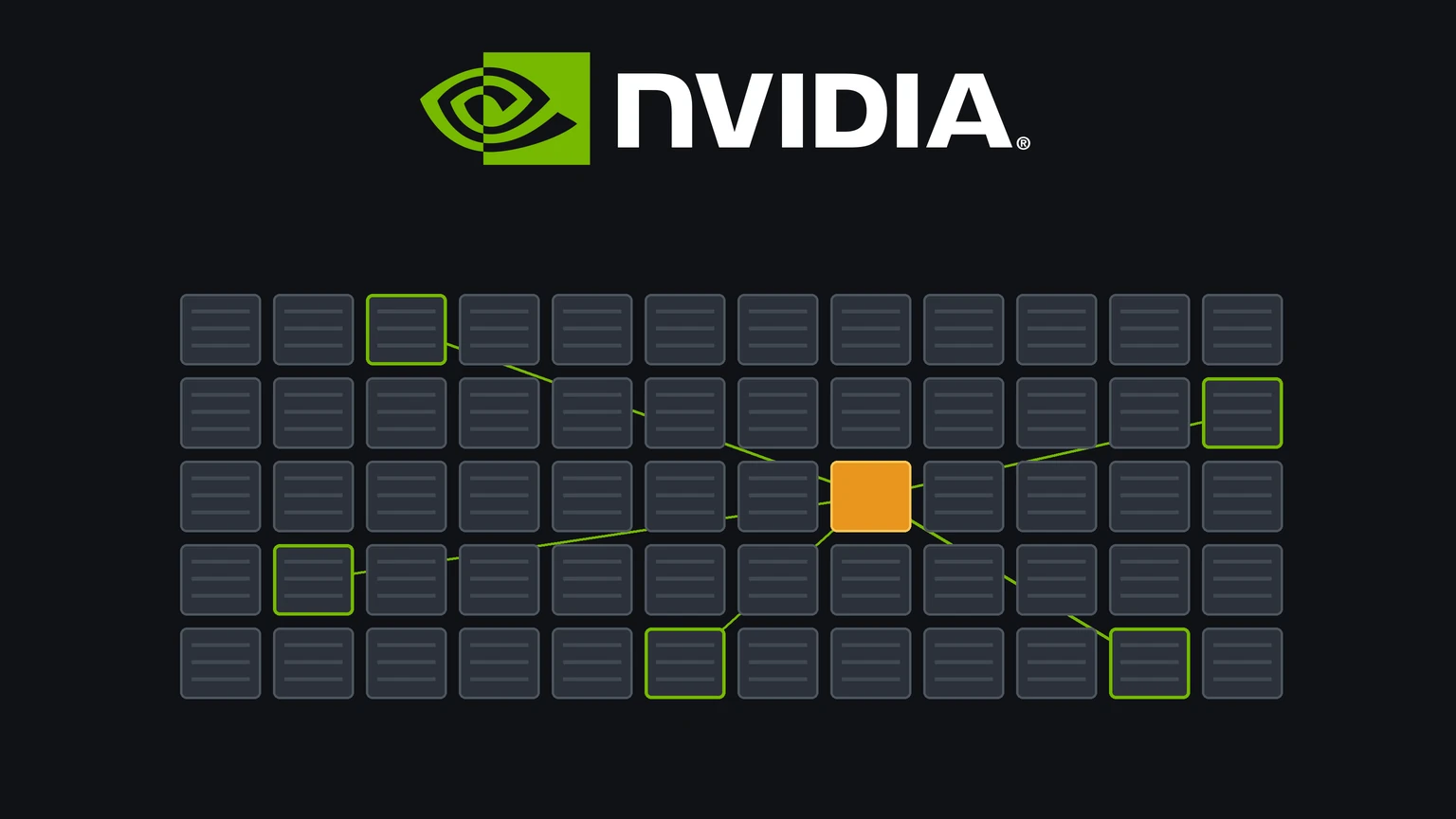
Traditional monitoring, NVIDIA argues, splits a data centre into separate views: networking, compute, site reliability and machine learning teams each watch their own slice. Minerva pulls signals from NVIDIA GPUs, networking, storage, schedulers and workloads into one place and builds what NVIDIA calls a dynamic knowledge graph. That graph maps the physical layout of the cluster, down to GPUs, SuperNICs, switches and cables, and ties it to the jobs running on each part.
The practical goal is tracing. If a training run slows down, the operator should be able to follow it back to the component causing the problem, even in a site with hundreds of thousands of GPUs. Cloud provider Bitdeer AI, in its own post about adopting Minerva, lists the layers Minerva reads: NVIDIA GPUs, ConnectX SuperNICs, BlueField DPUs, NVLink scale-up switches, Spectrum-X Ethernet in both east-west and north-south directions, the NCCL communication library, schedulers and the workloads themselves. It describes the inputs as metric, log and topology telemetry.
On top of that graph, NVIDIA says Minerva analyses billions of data points per hour with supervised and unsupervised machine learning. It learns what normal behaviour looks like, flags anomalies it has not seen before, predicts failures that are starting to develop and groups related events using the cluster's topology. Instead of forwarding every symptom, it is meant to fold an event storm into one incident with a likely root cause.
There is also a conversational layer. NVIDIA says Minerva ships with a native AI assistant and can connect to outside agent tools, so operators can ask about cluster health in plain language and get suggested fixes grounded in live telemetry. Bitdeer names the assistant Sherlock, calls it multi-agent, and says Minerva also exposes an MCP server, the Model Context Protocol interface many agent tools use to call external systems. Teams can keep a person approving each fix or wire Minerva into automation through infrastructure APIs.
What NVIDIA says it has measured
NVIDIA's announcement lists three benefits without numbers: longer time between interruptions because problems are caught early, faster repair because the faulty part is pinpointed, and fewer alerts because noise is filtered out. The company's post contains no benchmark table.
Bitdeer's post adds two specific cases, which it attributes to NVIDIA's own internal AI factory testing. In one, Minerva cut the time to repair an NVMe power fault from a multi-day outage to six hours. In the other, it collapsed 81 noisy events into a single alert, which Bitdeer says saved 54 hours of cluster uptime. Bitdeer also says the internal testing showed gains in mean time between interrupts, mean time to repair, actionable insights and effective GPU hours, but it gives no percentages for those.
These are vendor results from vendor-run tests. They are useful as a description of what Minerva is meant to do, not as evidence of what it will do in another operator's cluster.
Who is using it and how you get it
NVIDIA names IREN, an AI cloud and data centre operator, as already using Minerva. IREN chief technology officer Denis Skrinnikoff said in NVIDIA's post that Minerva "gives our operations team one view across the network, the GPUs and the jobs running on them, so we focus more on proactive maintenance rather than troubleshooting."
NVIDIA says Aolani, Bitdeer AI, IBM, Jio, Lambda, Quake AI and Tesla plan to deploy it. Dell Technologies, Lenovo and Supermicro will offer Minerva as part of their AI factory operations portfolios, so many buyers will meet it bundled with servers rather than as a separate download.
Bitdeer says Minerva can run as a standalone platform and is integrated with NVIDIA DSX OS. NVIDIA has not published pricing or a public licence for Minerva in the material we read, and the product page linked from its post returned a not-found page when we checked on 22 October. NVIDIA's software stack for AI factories is growing quickly; the company has also pushed OpenShell for sandboxing AI agents, which partners such as Red Hat are now wiring into OpenShift.
Why observability is now an AI factory problem
Large training runs are tightly coupled. Thousands of GPUs exchange data constantly, so one slow link or overheating card can stall everything waiting on it. Operators pay for idle GPU time either way, which is why NVIDIA talks about yield rather than uptime alone.
Monitoring tools for data centres already exist, and many operators have built their own. What NVIDIA is selling is depth on its own hardware: it designs the GPUs, NICs, DPUs, switches and NCCL, so it can map how they connect more precisely than a general tool. The flip side is that the announcement only describes NVIDIA components, and it does not say how well Minerva handles mixed fleets with other vendors' storage, network or accelerators.
The agent features follow a wider pattern in infrastructure software, where vendors add chat assistants and MCP access so operators and their own agents can query systems directly. Whether operators let Minerva change anything on its own, rather than only recommend changes, will likely depend on how much they trust its root-cause calls in their first months of use.
What we could not verify
AI Lookout read NVIDIA's announcement and Bitdeer's post directly on 22 October 2026. The internal test results come only from Bitdeer's post, which says they are NVIDIA's own. We did not find independent testing, pricing, a release date for general availability, documentation or a supported-hardware list. The names of the Sherlock assistant and the MCP server come from Bitdeer, not from NVIDIA's announcement.
What to watch
Useful next signals would be NVIDIA documentation or a technical blog showing how the knowledge graph and anomaly models work, pricing and packaging details from Dell, Lenovo and Supermicro, and public numbers from IREN or the planned adopters on interruptions and repair times. It will also matter whether Minerva can take telemetry from non-NVIDIA parts, and how its automation hooks limit what an agent is allowed to change.
Common questions
What is NVIDIA Minerva?
An AIOps platform NVIDIA launched on 22 October 2026 that monitors AI data centres, maps hardware and jobs into a knowledge graph, predicts failures, groups related alerts and offers an AI assistant for troubleshooting.
Who can use Minerva?
NVIDIA names IREN as a current user and says Aolani, Bitdeer AI, IBM, Jio, Lambda, Quake AI and Tesla plan to deploy it. Dell, Lenovo and Supermicro will offer it with their AI factory systems.
How much does Minerva cost?
NVIDIA has not published pricing or licensing terms in the announcement AI Lookout read.
Sources & further reading
How this story was made
Written by Kristian Kostov with AI assistance and checked against the linked sources. Company performance claims are attributed to the company. Analysis reflects AiLookout’s interpretation; we have not independently tested the products discussed. The cover places the companies’ own logos, taken from public-domain or openly licensed files credited in the caption, on a plain background. It is not a product photograph, a screenshot, or an endorsement.
Our editorial standards