Announced 22 Oct 2026 · Sources checked
What Huang said
NVIDIA chief executive Jensen Huang has put a price on the company's software for running AI agents. Speaking at GTC Berlin on 22 October 2026, he said that software licensing will become an increasingly major part of NVIDIA's business, and gave an example: about 2,000 dollars per GPU per year to run all the software NVIDIA provides for running agents on what the company calls AI factories, its term for data centres built to produce AI output. Tom's Hardware reported the remark on 25 October, quoting Huang from a video of the session.
The full quote is short and loosely phrased. Huang said that the way NVIDIA licenses will be, for example, about 2,000 dollars per GPU per year to run all of the NVIDIA software that runs agents on these AI factories. He did not name a product, give a start date or describe the terms, and NVIDIA has not published a price list, a press release or a licensing document that uses the 2,000 dollar figure. AI Lookout found no NVIDIA page that mentions it.
That makes the number a statement of direction rather than a launched product. It is still notable, because NVIDIA rarely talks about software prices on stage, and because the figure comes from the person who sets the company's strategy, at an event mostly devoted to selling the hardware the software would run on.
Where the 10 billion dollar figure comes from
Much of the attention on the remark comes from what it could add up to. Tom's Hardware cites a scenario posted on social media by the business analysis site FourWeekMBA on 22 October. It assumes 10 million eligible enterprise GPUs shipped in a year, half of them paying for the software, and 2,000 dollars per GPU per year. That gives 10 billion dollars of annual recurring revenue, and 50 billion dollars over five years if every customer keeps renewing, from a single year's worth of GPU shipments.
Those inputs are assumptions, not NVIDIA forecasts. NVIDIA has not said how many GPUs would be eligible, what share of customers it expects to pay, or whether 2,000 dollars is a standard price, a discount or a starting point for negotiation. The scenario also counts the fee as new money, which it would only be if the agent software were sold on top of what customers already pay for NVIDIA software, rather than replacing some of it.
The arithmetic is simple enough that the size of the outcome depends almost entirely on the attach rate. At a 10 percent attach rate on the same 10 million GPUs, the same price would bring in 2 billion dollars a year. Large cloud providers, which buy a big share of NVIDIA's data centre GPUs, often build their own software stacks and may have little reason to pay a per-GPU fee for NVIDIA's.
What NVIDIA already charges
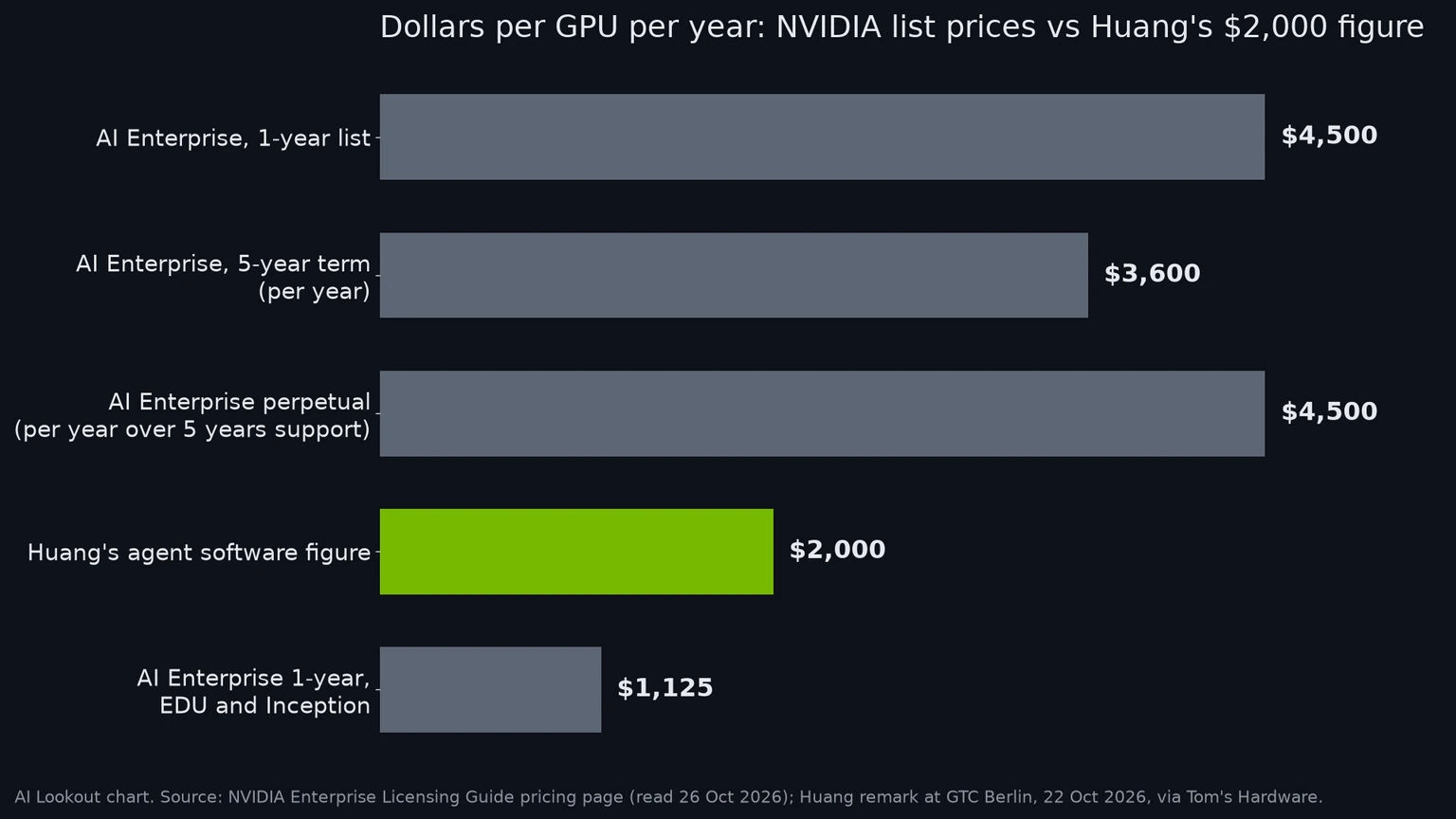
NVIDIA already sells a per-GPU software licence, and it costs more. According to NVIDIA's Enterprise Licensing Guide, read by AI Lookout on 26 October 2026, a self-managed NVIDIA AI Enterprise subscription has a list price of 4,500 dollars per GPU for one year, including standard business support. Two years cost 9,000 dollars, three years 13,500 dollars and four years 18,000 dollars. A five-year subscription also costs 18,000 dollars, which NVIDIA describes as five years for the price of four.
A perpetual licence with five years of support is listed at 22,500 dollars per GPU. Qualified education and research institutions and members of NVIDIA's Inception startup programme or its Connect programme pay a quarter of list, 1,125 dollars per GPU for one year, although Inception members are limited to 64 one-year subscriptions at that price within a 12-month period. The guide says AI Enterprise is included with NVIDIA H100, H200 NVL and A800 PCIe GPUs. On the big public clouds, the software can be bought on consumption terms for 1 dollar per GPU per hour on top of the instance cost, which works out to about 8,760 dollars for a GPU running all year.
Against those numbers, Huang's figure is less than half the one-year list price of AI Enterprise. Tom's Hardware cautions that this should not be read as a confirmed price cut, because NVIDIA has not said whether the two cover the same products or terms. AI Enterprise is a broad bundle of frameworks, inference microservices and support. The agent software Huang described may be a narrower layer, an addition to AI Enterprise, or a repackaging of parts of it.
The software the fee could cover
The likeliest candidates are the agent security products NVIDIA has been building through the autumn. In September NVIDIA introduced what it calls its Open Agent Safety Platform, and OpenShell, its runtime for setting boundaries around what agents can do, has become the centre of that effort. On 21 October NVIDIA announced an OpenShell Reference Architecture that combines Vera Rubin systems, Vera CPUs and BlueField-4 data processing units running software called NVIDIA Sentry. Tom's Hardware describes Sentry as watching agent activity independently and able to quarantine an agent that tries to cross its boundaries.
Partners have started building on it. Red Hat is bringing the OpenShell sandbox and BlueField monitoring to OpenShift, and ServiceNow's Arc work agent is policed by OpenShell. Tom's Hardware also reports that Anthropic is integrating OpenShell and BlueField hardware with Claude Managed Agents, and that Salesforce has built a Slack Admin Bridge that lets administrators approve or reject agent permission requests and watch agent activity from Slack.
None of that confirms what the fee would include. OpenShell itself has been presented as open software, so a paid licence would more plausibly cover enterprise support, the Sentry monitoring layer, certified builds and integration with NVIDIA hardware such as BlueField. That reading fits Huang's wording, all the software that runs agents on AI factories, but it is AI Lookout's interpretation and not something NVIDIA has stated.
Why NVIDIA wants a software line
Huang has been arguing for months that NVIDIA should be seen as more than a chipmaker. On the BG2Pod podcast he said that one of these days people might not categorise NVIDIA as a chip company anymore, and pointed to the full technology stacks the company sells into healthcare, automotive, telecoms and life sciences. A recurring software fee tied to every installed GPU would be the clearest financial expression of that idea.
Recurring revenue is valued differently from hardware sales. GPU orders arrive in large, uneven waves that depend on data centre build-outs, while a subscription keeps paying for as long as the hardware stays in service. NVIDIA has also been selling more complete systems, such as its DSX POD containerized Vera Rubin AI factories, and a per-GPU software licence would give it a share of the value those systems create after they are installed, not only when they are sold.
The model is familiar from other parts of the industry. Server makers sell support contracts, network equipment vendors license features per port, and virtualisation software has long been priced per processor. What is different is the scale of NVIDIA's installed base and its position in AI hardware, which gives it unusual leverage in setting such terms.
What it would mean for buyers
For companies deploying agents on their own hardware, a 2,000 dollar annual fee would be modest next to the price of a data centre GPU, which runs to tens of thousands of dollars, and next to the cost of power and cooling. Over a typical service life of four or five years it would still add 8,000 to 10,000 dollars per GPU, and for a cluster of a few thousand GPUs that becomes a line item finance teams will notice.
The more important question for buyers is whether the fee is optional. If it pays for support and monitoring on top of free software, companies can choose whether the extra controls are worth it. If key features only work with a paid licence, or if agent security on NVIDIA hardware becomes effectively tied to it, the fee starts to look like part of the cost of the GPU. Several readers commenting on the Tom's Hardware article argued that extra charges could push customers towards alternatives, a concern NVIDIA has not addressed.
Customers already paying for AI Enterprise will want to know how the two relate. Paying 4,500 dollars for one licence and 2,000 dollars for another on the same GPU would be a very different proposition from a single agent-focused licence at the lower price.
What is still unknown
NVIDIA has not said when a 2,000 dollar per GPU price would take effect, which products or features it would cover, whether it applies per physical GPU or per GPU in use, whether cloud customers would pay it through their providers, or how it fits with existing AI Enterprise subscriptions and the licences included with some GPUs. It has also not said whether the figure is a list price or an example.
AI Lookout did not contact NVIDIA for this article and relied on Tom's Hardware's report of Huang's remarks and NVIDIA's published licensing guide. Until NVIDIA publishes terms, the remark is best read as a signal that agent software will be sold per GPU and on a subscription, at a price below the current AI Enterprise list price, rather than as a product anyone can buy today.
Common questions
How much does NVIDIA charge for AI agent software?
Jensen Huang said at GTC Berlin that it is about $2,000 per GPU per year to run all the NVIDIA software for agents. NVIDIA has not published a price list or terms for that figure.
How much does NVIDIA AI Enterprise cost per GPU?
NVIDIA's licensing guide lists $4,500 per GPU for one year, $18,000 for four or five years, $22,500 perpetual with five years of support, and $1 per GPU per hour on public clouds.
Will NVIDIA really make $10 billion a year from the fee?
That figure is a FourWeekMBA scenario assuming 10 million GPUs and 50 percent paying. NVIDIA has not given any revenue forecast for agent software.
Sources & further reading
How this story was made
Written by Kristian Kostov with AI assistance and checked against the linked sources. Company performance claims are attributed to the company. Analysis reflects AiLookout’s interpretation; we have not independently tested the products discussed. The cover places the companies’ own logos, taken from public-domain or openly licensed files credited in the caption, on a plain background. It is not a product photograph, a screenshot, or an endorsement.
Our editorial standards