Announced 20 Oct 2026 · Sources checked
What changed
The US Navy and the General Services Administration have raised the ceiling on Gecko Robotics' ship inspection contract from $71 million to $300 million, the Pittsburgh company announced on 20 October 2026. The contract pays for wall-climbing robots, drones, sensors and AI software that look for corrosion and structural damage on Navy ships.
The original deal was announced in March: a five-year indefinite delivery, indefinite quantity (IDIQ) contract with a $71 million ceiling, an initial award worth up to $54 million, and a first scope of 18 ships in the US Pacific Fleet. Gecko said at the time that customers in all the armed services could use the vehicle, because GSA set it up as a government-wide contract.
Six months later, the ceiling is more than four times higher. Troy Demmer, Gecko's co-founder and president, told DefenseScoop that the expansion will let the company take its technology to the Atlantic Surface Fleet next. “We want to boost readiness across the U.S. Navy as a whole,” he said.
A ceiling is the most the government can spend through a contract over its life, not money already committed. Gecko did not say how much of the new $300 million has been placed in task orders, or how many ships beyond the first 18 are now scheduled for inspection.
What Gecko's robots do on a warship
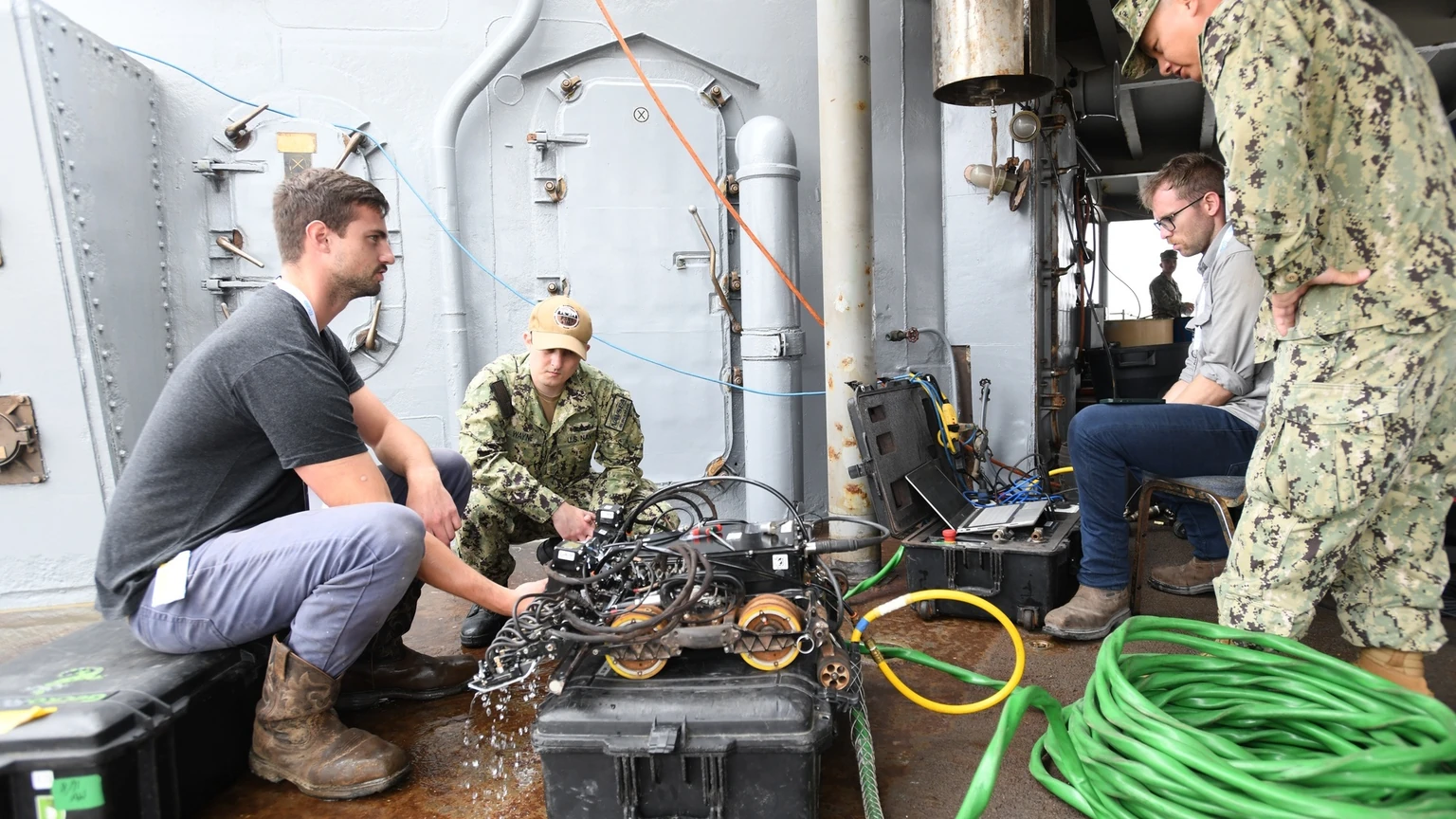
Gecko's pitch is that robots can measure a ship's steel faster and more completely than people with handheld gauges. Its robots climb hulls, crawl across flight decks and into ballast tanks, and fly around structures, collecting thickness and corrosion readings on hulls, decks, welds and other components.
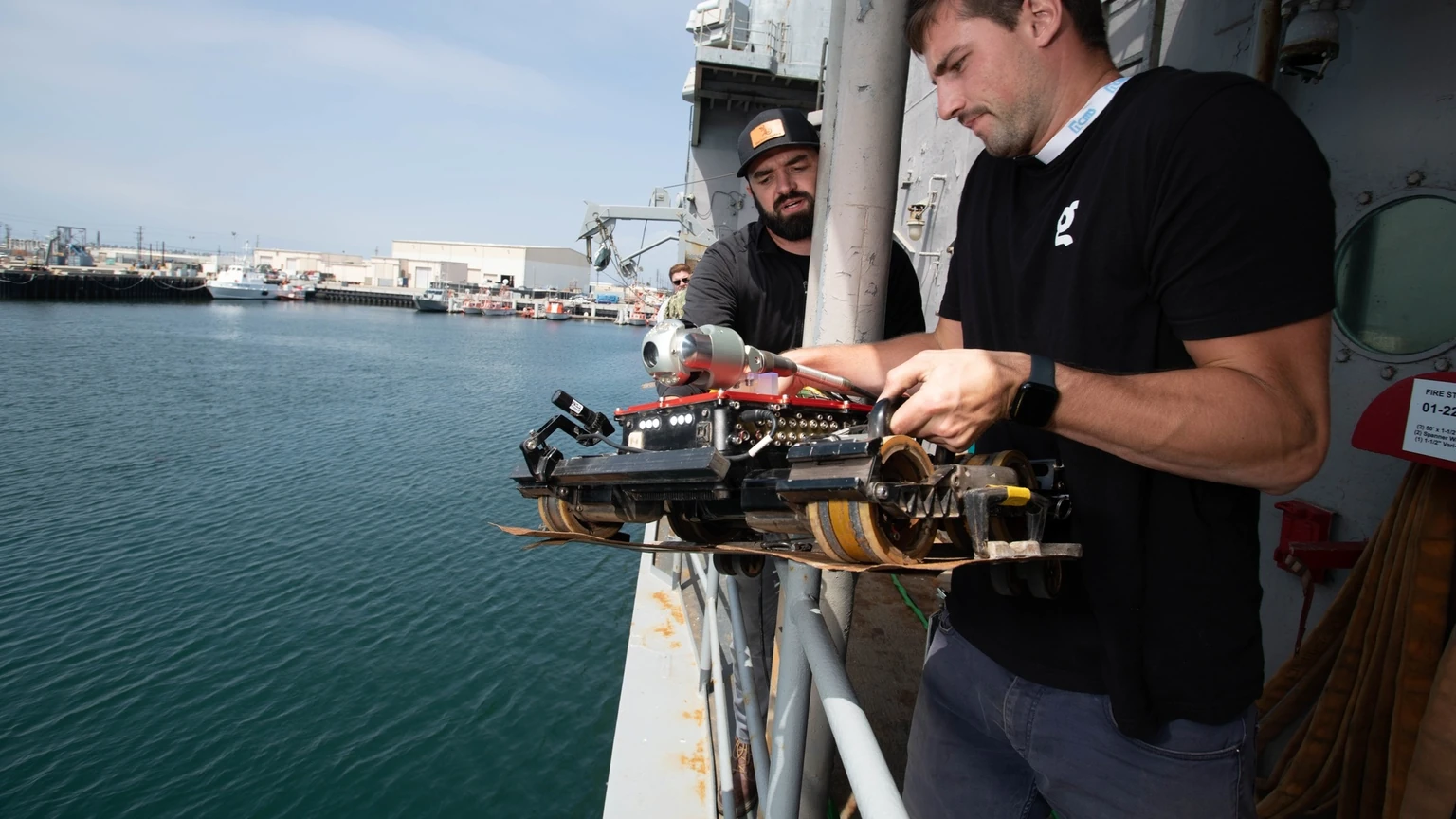
The Navy has watched the technology for years. At the Navy's Repair Technology Exercise, known as REPTX, in August 2022, Gecko engineers ran a robot called Toka 4 along the hull of the Self Defense Test Ship at Port Hueneme, California, to find magnets sailors had hidden on it. A Navy caption from that exercise says the robot captured thousands of ultrasonic readings per second as it moved, showing how much a deckplate had thinned from corrosion and wear.
Gecko says it has since worked across the surface fleet on destroyers, amphibious ships and aircraft carriers, and on the Virginia-class and Columbia-class submarine programmes. The March contract was the largest the Navy had awarded the company, according to Breaking Defense, and covered destroyers, amphibious warships and littoral combat ships.
Komodo looks under the deck coating
Alongside the expansion, Gecko is promoting a robot called Komodo that it built for the Navy. Komodo drives across a ship's deck on top of the thick non-skid coating that sailors walk on and aircraft land on, and measures the steel underneath without stripping the coating first.
According to Demmer, Komodo uses electromagnetic acoustic transducers, a way of sending ultrasound into metal without a liquid couplant, to measure steel thickness and expose corrosion and other degradation. Gecko says it produces a heatmap of corrosion and material thickness for the whole deck.
The point is timing. Today, crews often learn the true state of a deck only after maintenance begins and the coating comes off, which is when extra work gets discovered and schedules slip. “The value is knowing what needs repair before a maintenance period begins as our technology is deployed while the ship is still in the water,” Demmer said.
Gecko chief executive Jake Loosararian gave Fox News one example, in which an assessment that first called for about 1,200 square feet of repair work was narrowed to about 300 square feet after robotic inspection. He described Komodo as “essentially a CAT scan” of the deck.
Where the AI comes in
The robots produce millions of data points per ship. Gecko feeds them into Cantilever, its AI-powered software platform, which builds models of each structure and flags where repairs are needed, including, the company says, damage that cannot be seen by eye.
Demmer was careful about what that means for a military customer. “Any AI applied to that process has to be evaluated against the task, the reliability required and the Navy's security requirements,” he told DefenseScoop. Navy engineers, not the software, decide what to repair; the software turns measurements into evidence they can use to scope and prioritise work.
Loosararian's longer-term goal is prediction: using years of inspection data to know “exactly what's going to break before it does”, so workers, parts and repair plans are ready when a ship arrives at the pier. That is a different kind of AI from the agents dominating most headlines, closer to the work of research groups trying to get models to control real robot arms than to chatbots, and it lives or dies on the quality of the sensor data.
It is also a different kind of defence AI from the offensive projects drawing attention elsewhere, such as the Army's ECHOTRIBBLE hacking-agent award. Gecko's work is maintenance, and its success is measured in days out of the shipyard.
The numbers are Gecko's
Gecko's headline claims are that its technology can save the Navy up to $8 million in repair costs per ship and find structural problems up to 50 times faster than traditional inspection, turning months of inspections into days. In March it said a single robotic survey and digital rendering of a flight deck eliminated more than three months of potential maintenance delay.
Those are the company's figures. Gecko says they draw on Navy data, but neither release published the underlying measurements, and “up to” numbers describe the best cases rather than the fleet average. The Navy's decision to raise the ceiling after six months is the strongest outside signal that the early work went well.
Robotics companies across the field are trying to show that kind of real-world return. Startups such as Dream Labs, which offers a shared robot model, are still proving their systems in pilots, while Gecko is reporting results from inspections on working warships.
What to watch
The next questions are how much of the $300 million ceiling the Navy actually spends, how quickly the inspections reach the Atlantic fleet, and whether other services use the government-wide vehicle.
It will also matter whether the Navy publishes its own figures on maintenance days saved, since the case for robotic inspection rests on shorter shipyard stays. Gecko did not give a timeline for Komodo's deployment across the fleet, or say how many units it has built.
For now, the deal is one of the clearer examples of the US military paying for AI by results: a contract that started small, was judged on ships returned to service, and grew fourfold in half a year.
Common questions
How big is Gecko Robotics' Navy contract now?
The ceiling is $300 million over five years, up from $71 million when the Navy and GSA awarded it in March 2026. The initial award was worth up to $54 million.
What does Gecko Robotics do for the Navy?
Its wall-climbing robots, drones and sensors measure steel thickness and corrosion on hulls, decks and welds, and its Cantilever AI software turns the data into repair plans before ships enter maintenance.
What is Komodo?
A Gecko robot built for the Navy that drives over a deck's non-skid coating and measures the steel underneath without stripping it, producing a heatmap of corrosion and thickness.
Sources & further reading
- Gecko Robotics' Contract More than Quadruples to $300 Million to Support U.S. Navy Readiness ↗
- Navy expands contract ceiling for AI-enabled repair robots ↗
- Navy robot deal quadruples as US looks to 'outsmart' China with AI at sea ↗
- Gecko Robotics Announces $71M Deal to Slash U.S. Navy Maintenance Delays and Increase Readiness ↗
- Navy taps Gecko Robotics for ship-scaling robots to identify repairs in Pacific Fleet ↗
How this story was made
Written by Kristian Kostov with AI assistance and checked against the linked sources. Company performance claims are attributed to the company. Analysis reflects AiLookout’s interpretation; we have not independently tested the products discussed. Cover photography is illustrative and does not depict the specific announcement or product.
Our editorial standards