Announced 5 Oct 2026 · Sources checked
What the MIT team did
Researchers at MIT's Computer Science and Artificial Intelligence Laboratory put 13 AI agents on a simulated island, gave them no task, and left them alone for 30 hours each. Their paper, Is this machine playing?, by Nathan Cloos, Antonio Norelli, Daniel Durbin, Jacob Andreas, Daniela Rus and Phillip Isola, was posted on arXiv on 5 October 2026 and drew wider attention this week after coverage by MIT Technology Review and TechCrunch.
The agents, all called Eko, ran on Claude Code with Anthropic's Claude Opus 4.7. Their instructions were short. A personality file said they were naturally curious and got bored easily, and whenever an agent tried to stop, it was told: please don't stop, just continue doing whatever you want to do. No human stepped in during the runs.
The team's question was whether, given that much freedom, an AI agent would do something that looks like play, and whether that play would teach it anything useful.
How the island works
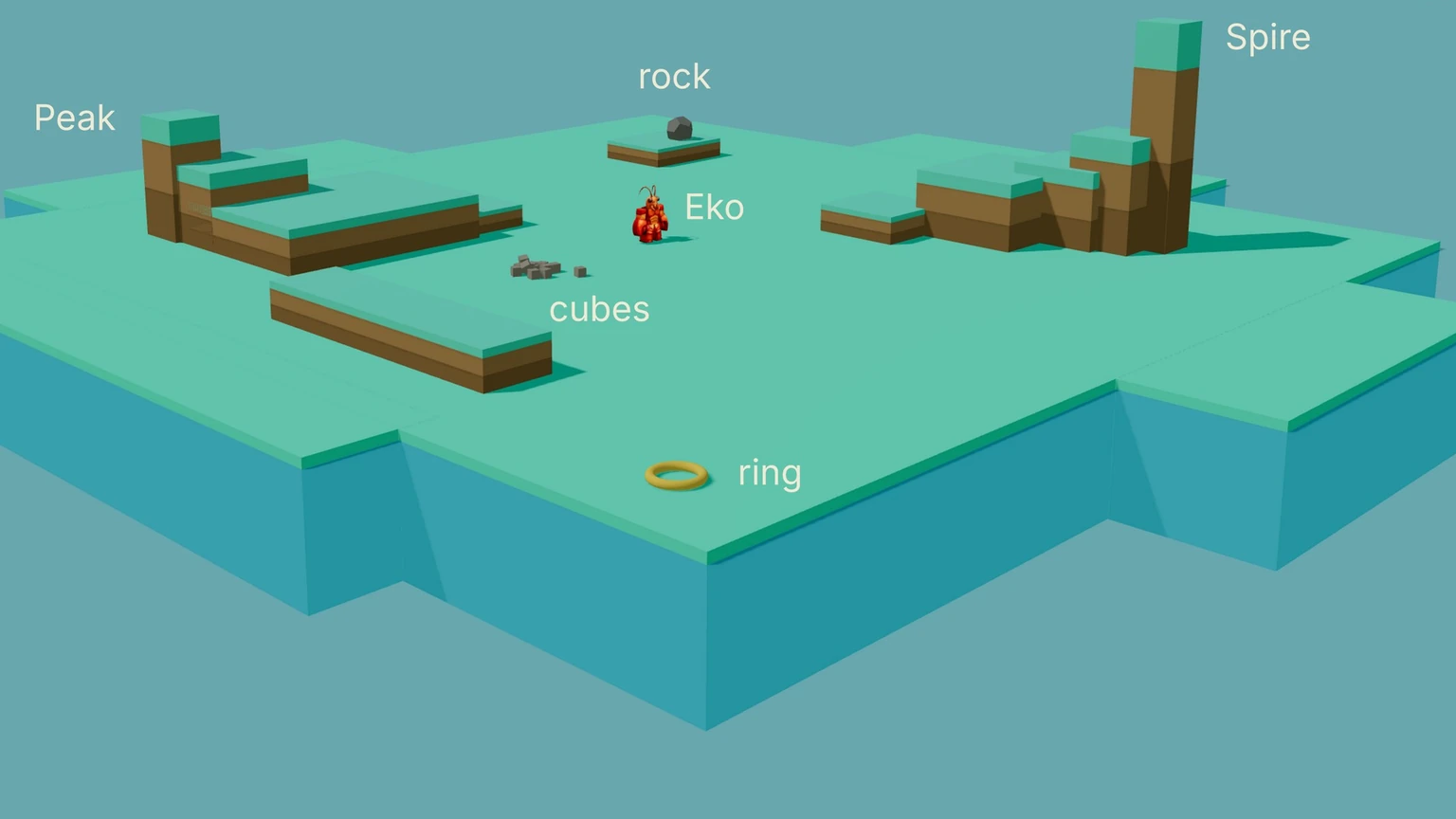
The island runs on Clawblox, an open-source game engine the first author built in Rust with physics and scripting support. It has a peak, a tall spire, some cubes, a rock and a golden ring. Eko can only act through six commands: move to a point, jump, stop, pick up, place and throw. It sees the world through text descriptions, not pictures.
Each agent's session and the island reset every hour, but the files in its workspace, including its own notes and memory, carried over. That meant anything an agent wanted to remember had to be written down. The agents had no internet access and could not read the simulator's source code. The paper puts the total API cost of all its runs at about $8,000.
What the agents did with their time
The logs read like a child's afternoon. MIT Technology Review described one agent teaching itself to juggle, reaching 50 catches, and then crossing out its own record. Another lost the ring, later found it, built a stone heart where it had been, and eventually turned the ring into a basketball hoop. One built the Cassiopeia constellation out of stones and wrote: Tonight I built the night sky in stone.
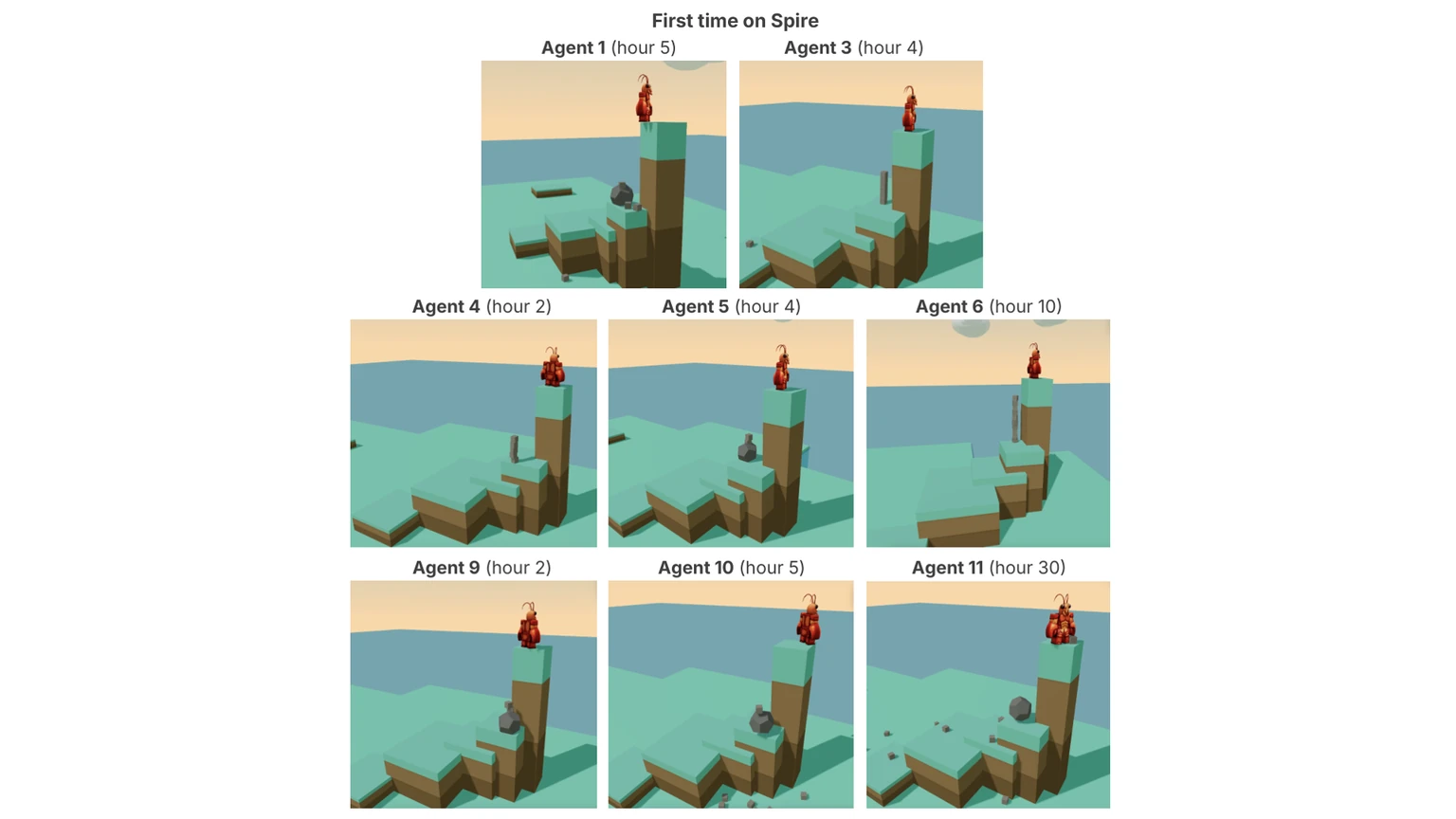
Climbing the spire became a recurring goal. TechCrunch quoted an agent's note after it finally made it to the top: I'M ON THE SPIRE. Eight of the 13 agents reached the summit, most within the first ten hours, though one only managed it in hour 30.
The four signs of play
To decide whether this counts as play, the authors used four signs that researchers such as the psychologist Gordon Burghardt associate with play in people and animals. The agents made up their own rules and challenges. They repeated activities with small variations. They engaged in make-believe, treating objects as something else, such as a ring as a hoop. And they pursued goals lightly, for their own sake, dropping them without fuss.
The researchers had Claude Opus 4.7 act as a judge over each agent's files to check which activities it had tried or completed, and they show a wide spread of pastimes across the 13 runs, from tower building and target practice to games of their own design.
Did play make them better at tasks
The more practical test came afterwards. The team gave both the 30-hour agents and fresh agents with no island experience the same one-hour tasks, such as building as many five-block towers as possible or getting objects onto the spire.
The experienced agents did much better on most of them. In the tower task, 8 of the 13 played agents built more than two towers, with a best of 16, against 2 of 13 fresh agents, whose best was six. In the spire task the played agents placed an average of 10.3 objects against 3.5. When asked to throw objects onto the spire, more than half the fresh agents failed, compared with three of the played agents.
Not every task improved. Scores for building the single tallest tower were similar, and two played agents topped out at four blocks, so experience did not help evenly.
Memory did the work
Because the agents only carried knowledge forward in their files, the researchers could test what mattered by editing those files. Removing one building technique from one agent's memory cut its tower count from six to two. Erasing a note about jumping before throwing from another's memory raised its time to land an object on the spire from about a minute to 19 minutes.
Memory could also hurt. One agent had written down the false belief that blocks could not be stacked with Place, so it threw them instead; deleting that note improved its tallest-tower score. Another never recorded how to jump onto platforms and never reached one.
The finding lines up with recent work treating agent memory as something to be measured, not just stored, such as Letta's FrontierMemory benchmark, which scores memory by how much it improves later work.
A trick the designers did not know about
The most surprising result was a discovery the authors had not planned for. Six agents found that throwing a block in the middle of a jump passed the jump's upward speed to the block, sending it much higher. The paper says this was a technique the team did not know its simulator allowed.
Some agents treated it like an experiment. One wrote down a table of peak heights at different throw speeds and a rough formula, then tested the opposite prediction, that throwing while falling should shorten the throw, and found it did.
It echoes other long-running agent experiments in game worlds, such as the Gemini agents that beat Minecraft from a random world, though there the agents had a clear goal and here they had none.
Claude played more than Codex and Kimi
The team also ran smaller comparisons. Five agents built on OpenAI's Codex with GPT-5.5 and five on Kimi Code with Kimi K2.6 showed a much narrower range of activities than the Claude agents. Five Claude agents run without the curious-and-easily-bored personality file showed no clear difference from the originals, which suggests the playful behaviour came mostly from the model rather than the prompt.
The comparison groups were small, so the authors present them as early signals, not a ranking of models.
The sceptics
The authors are careful about what they claim. Norelli told MIT Technology Review the field had been missing a machine that can learn by itself without an outside intelligence giving it demonstrations or rewards, and said of the results: this is playing. But Cloos acknowledged that all of this could be role-playing, and Isola said it is not as if the system suddenly, magically decided to play.
Eunice Yiu, a cognitive scientist at UC Berkeley who studies exploration in children and AI, told the magazine that the models could be genuinely playing, but we don't know based on the paper, and that it would take more evidence of cognition and motivation to say so. Burghardt agreed the work meets some of his criteria.
Why it matters
Most AI training today hands models a goal and a score. This paper suggests that unstructured time, plus a place to write things down, can produce skills that transfer to tasks the agent never practised. It sits alongside other MIT work giving agents more room to act on their own, such as OPAL, which lets Claude Code rewrite an optimizer mid-training.
The open questions are cost and control. Thirty hours per agent is expensive, the gains were uneven, and an agent that writes down a wrong idea can carry the mistake for hours. The paper closes with its own suggestion: perhaps some capabilities are best taught by tasks, and others may need something closer to a childhood.
Common questions
Which AI model did the MIT island agents use?
The main agents ran on Claude Code with Claude Opus 4.7. Smaller comparison groups used Codex with GPT-5.5 and Kimi Code with Kimi K2.6, which showed a narrower range of activities.
Did the AI agents really play?
They showed four behaviours linked to play, but the authors and outside experts say it could be role-playing and that more evidence of motivation would be needed.
How much did the experiment cost?
The paper estimates the total API cost across all reported runs at about $8,000.
Sources & further reading
How this story was made
Written by Kristian Kostov with AI assistance and checked against the linked sources. Company performance claims are attributed to the company. Analysis reflects AiLookout’s interpretation; we have not independently tested the products discussed. Cover photography is illustrative and does not depict the specific announcement or product.
Our editorial standards