Announced 21 Oct 2026 · Sources checked
What Mirendil announced
Mirendil, an AI lab that came out of stealth in June, said on 21 October 2026 that it has pretrained its first foundation model with a team of one. In a post titled "Pretraining at scale without a pretraining team", the company says Mirendil-Base was "built by one researcher in 3.5 months, with less than $10M in compute." AI agents, it says, "wrote over 99% of the code, ran experiments and diagnosed failures, while the researcher decided what to try and what to trust, and intervened when needed."
The company is careful about what the compute figure covers. It says the under-$10 million total is "all-in": it includes the research and small-scale experiments that led up to the final run, the final training run itself, the agents' own token spending and data processing. It is a compute figure, not a measure of the company's total spending, and it does not include salaries.
Mirendil-Base is a coding model. The company describes it as "the first in a series of coding-specialized models, designed to perform especially well on the coding work done inside a frontier AI lab." It has not been released. There are no weights to download and no API yet, and the model shown is a base model that has not been post-trained to follow instructions. In an accompanying post on X, Mirendil's Behnam Neyshabur put Mirendil-Base in the 100 billion to 500 billion parameter range and promised "independent evaluations, post-training benchmarks and API-access sooner than you think."
Who Mirendil is
Mirendil formally announced itself on 24 June 2026 with a $200 million seed round led by Andreessen Horowitz and Kleiner Perkins, followed by an investment from NVIDIA. At launch it described a founding team of 20 researchers and engineers from Anthropic, xAI, Google DeepMind and OpenAI. In August it announced a multi-year partnership with Google Cloud to run training, inference and research on Google's TPUs and NVIDIA systems.
Andreessen Horowitz's investment note names four people: Behnam Neyshabur, who worked on AI for science at Google and Anthropic; Harsh Mehta, who built the first version of Anthropic's autoresearch platform; Shayan Salehian, an ML engineer from xAI; and Tara Rezaei, an MIT graduate. Mirendil's post does not say which researcher built Mirendil-Base, and AI Lookout has not assumed it.
The company's stated mission is self-accelerating AI research. Its home page says it is building "systems that excel at AI R&D" and wants to redesign the whole lab around them, so that labs in chemistry, biology or robotics do not each have to become frontier AI labs themselves. Mirendil-Base is the first public test of that idea: if agents can do most of the hands-on work of pretraining, fewer specialists are needed to make a strong model.
How the model was built
Pretraining is the expensive first stage of building a large language model, when it learns to predict text from trillions of tokens. At open-model projects it usually takes dozens of specialists and at frontier labs hundreds, split across model research, data collection and cleaning, and keeping thousands of chips running. Mirendil's point is that it collapsed all of those roles into one person plus agents.
The post lists several conditions it set to keep the experiment clean. The project "started from an empty repository." The researcher and agents wrote the training infrastructure, model architecture, training algorithm and data pipelines themselves, building only on general libraries such as PyTorch and JAX and using popular open-source projects as references. All training data came from GitHub and other publicly available code, web pages and datasets. Mirendil says it "did not purchase or license any additional data" and used no distillation from other models and no synthetic data.
The company credits three sources of efficiency: an improved architecture, careful tuning of the data mixture, and kernel optimization, the low-level GPU code that decides how fast training runs. Agents writing faster kernels has become a theme this year, as in vLLM's agent-assisted kernels for Kimi K3. Mirendil does not describe the architecture, the token count, the hardware or the agents and models that did the work, so none of those claims can yet be checked.
What the numbers show
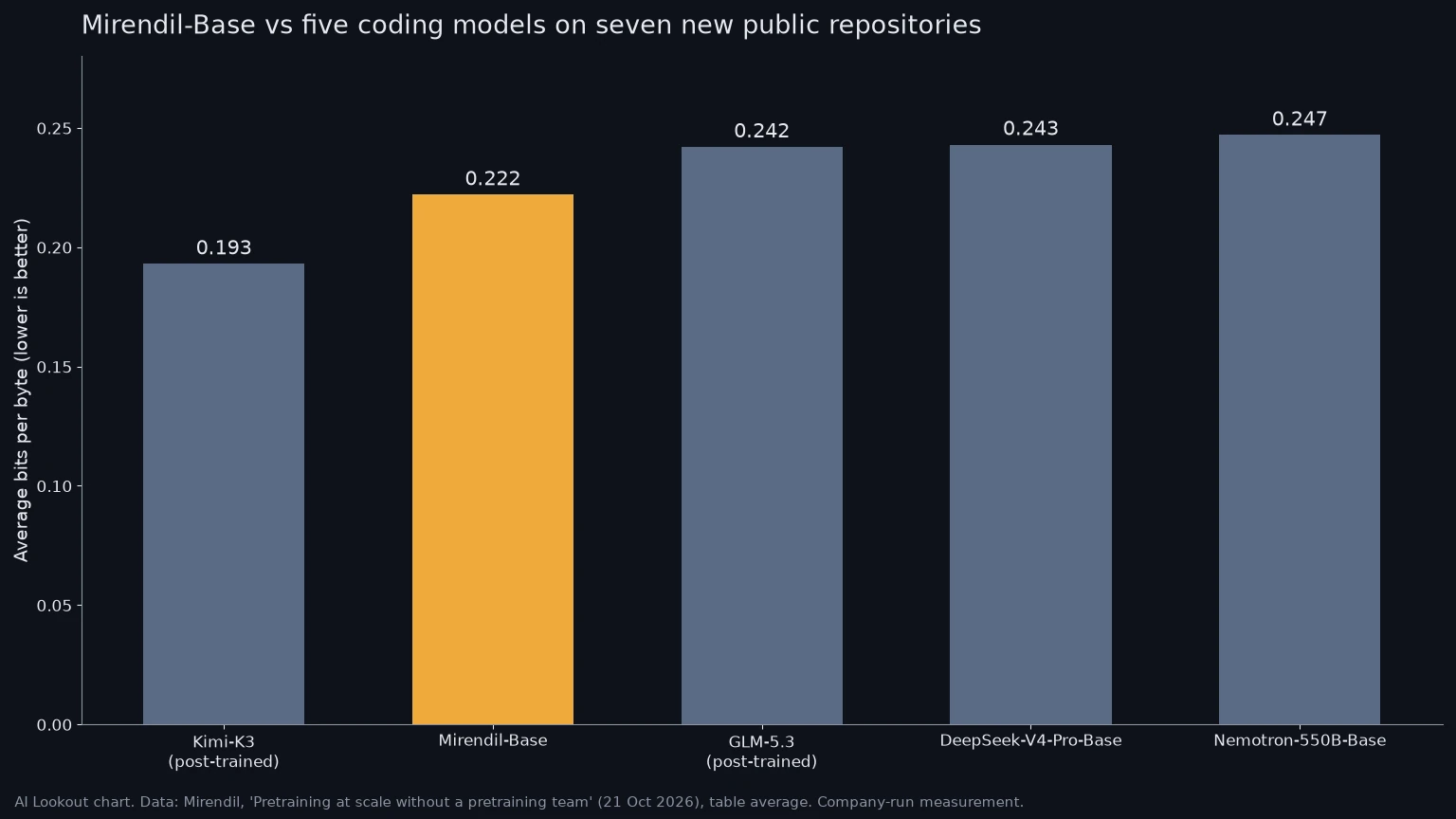
Mirendil's evidence is a single kind of measurement: bits per byte on held-out code. Bits per byte is a model's prediction loss per byte of text, which lets models with different tokenizers be compared, and lower is better. It shows how well a model predicts code it has not seen. It does not show how well it writes working programs, fixes bugs or follows instructions.
In the main comparison, on seven code repositories that were published after the models were trained, Mirendil-Base averaged 0.222 bits per byte. That beat Nemotron-550B-Base at 0.247, DeepSeek-V4-Pro-Base at 0.243 and GLM-5.3 at 0.242, but trailed Kimi-K3 at 0.193. Kimi-K3 had the best score on six of the seven repositories and tied Mirendil-Base on the seventh. Mirendil notes that Kimi-K3 and GLM-5.3 are post-trained models, which "generally score slightly worse on bits per byte than their base versions", so the comparison is not exactly like for like.
The comparison models are large. Mirendil lists them as Kimi-K3 at 2.8 trillion total parameters, DeepSeek-V4-Pro-Base at 1.6 trillion, Inkling at 975 billion, GLM-5.3 at 753 billion and Nemotron-550B-Base at 550 billion, all mixture-of-experts models. A second chart, on held-out code from Mirendil's own repositories, also includes Inkling. The company says Mirendil-Base-Large is about 80% through training and Mirendil-Base-XL about 19%, and that both are improving in line with its scaling trends. Neyshabur put Large at 500 billion to 2 trillion parameters and XL at 2 to 10 trillion.
Why the claim matters
If it holds up, the result changes who can build a base model. Small teams have pretrained models before, such as the solo Kisoku 1.6B run on TPU Research Cloud, but at a far smaller scale. Mirendil's claim is a model of hundreds of billions of parameters, close to much larger systems on code prediction, made by one person directing agents for under $10 million in compute.
It is also part of a broader shift this week toward labs saying AI built their models. On the same day, Recursive released Flint, a 40B open coding model it says was largely built by its own AI system, the Eureka Machine, and Flapping Airplanes raised $1 billion on a pitch about getting more from existing chips and data. Mirendil's post says both Anthropic and OpenAI have published internal measurements showing agents doing a growing share of model-building work.
Mirendil frames the change in economic terms. "Until recently, the bottleneck in pretraining a competitive model was people," the post says. When agents do most of the hands-on work, "the bottleneck moves to compute, to data, and to the judgment of whoever is directing the agents." It argues that a chip-design team, a robotics lab or a hospital could one day train a base model on its own data instead of renting a general one. It stops short of claiming self-improvement: "Mirendil-Base didn't build itself autonomously," and "we don't think we have reached fully autonomous recursive self-improvement yet." Research on that idea, such as Sakana AI's MASS paper, is still early.
What Mirendil has not shown yet
Every number in the announcement comes from Mirendil. The bits-per-byte tables are company-run, on repositories the company chose, and no outside group has reproduced them. Low bits per byte on code is a useful signal, but it is not a coding benchmark. The usual tests of coding models, such as fixing real GitHub issues or passing hidden test suites, have not been published for Mirendil-Base.
Key details are missing. Mirendil gives no exact parameter count, only Neyshabur's 100 billion to 500 billion range, and says nothing about the number of training tokens, the chips used or how much of the under-$10 million went to the final run. It also does not say which agents or models did the work, how often the researcher had to step in or how many failed runs there were. Those are the details that would show whether the process could be repeated by someone else.
The phrase "one researcher" also deserves context. The researcher worked inside a funded company of about 20 people, with a cloud partnership and access to frontier-model agents. The experiment shows what one expert can direct with those resources, not what an individual could do alone.
What comes next
Mirendil says it has started post-training Mirendil-Base and will share more soon, along with updates on the two larger models. Its next model, it says, "will be built partly by Mirendil models." Neyshabur's post promises independent evaluations and API access.
Those are the things to watch. An independent benchmark run, a released model card or API access would let outside developers check whether Mirendil-Base is as competitive at writing code as it is at predicting it. Until then, the announcement is a strong claim about how cheaply and quickly a base model can now be made, backed by one company-run test.
Common questions
What is Mirendil-Base?
The first pretrained model from Mirendil, an AI lab founded in 2026. It is a coding-focused base model in the 100 billion to 500 billion parameter range, according to the company.
Did AI build Mirendil-Base by itself?
No. Mirendil says agents wrote over 99% of the code and ran the experiments, but one researcher decided what to try and stepped in when needed. The company says the model did not build itself.
Can I use Mirendil-Base?
Not yet. Mirendil has not released weights or an API. It says API access, post-training results and independent evaluations are coming.
Sources & further reading
How this story was made
Written by Kristian Kostov with AI assistance and checked against the linked sources. Company performance claims are attributed to the company. Analysis reflects AiLookout’s interpretation; we have not independently tested the products discussed. The cover is an AI-generated editorial illustration, not a photograph or evidence of an actual event.
Our editorial standards