Announced 12 Oct 2026 · Sources checked
What is StudentSim?
StudentSim is a Microsoft Research system for testing AI tutors on simulated students before trying them on real ones. A Microsoft Research blog post published on 12 October describes it, alongside a paper first posted to arXiv on 1 September and open-source code. The authors are Ke Yang and ChengXiang Zhai of the University of Illinois Urbana-Champaign and Microsoft’s Chenglong Wang, Michel Galley, Chandan Singh, Jeevana Priya Inala and Jianfeng Gao.
The problem it tackles is feedback. A tutor’s answer can look good on paper, but what matters is what the student does next: whether they fix the mistake, reason toward the answer or just copy a hint. Measuring that requires studies with real learners, which are slow and expensive, so AI tutor developers rarely get student feedback while they are iterating on a model.
StudentSim tries to supply some of that feedback with simulators of specific students. Microsoft is explicit about the limits: the blog says it is a research system, not a product, not deployed in classrooms and not meant to replace teachers. The work also introduces StudentSimEval, a benchmark that covers 60 students across chess, second-language English writing and mathematics.
Why can’t a chatbot simply pretend to be a student?
The obvious shortcut is to ask a large language model to role-play a learner, for example a primary-school pupil who struggles with maths. The researchers say this changes the tone but not the ability: the model may sound young and unsure while still reasoning far beyond the student it imitates. A tutor tested against it can look effective simply because its pretend student is too capable.
Older student-modelling tools have the opposite problem. Knowledge-tracing and behaviour-prediction models are built on real learning records and can estimate what a student knows, but most cannot read natural-language guidance, so they cannot say how a student would react to a particular hint or question.
StudentSim therefore scores simulators on two measures drawn from education research, in particular Vygotsky’s idea of the gap between what a learner can do alone and with help. Behavioural fidelity measures whether a simulator matches a student’s own recorded answers on problems it has not seen. Guidance responsiveness measures whether it revises a wrong answer after reading a tutor’s guidance the way the student did. Both matter if simulators are to stand in for learners; recent work such as the COLM study finding that AI help can reduce persistence shows how much the effect of help depends on the learner.
How does StudentSim learn one student from a few records?
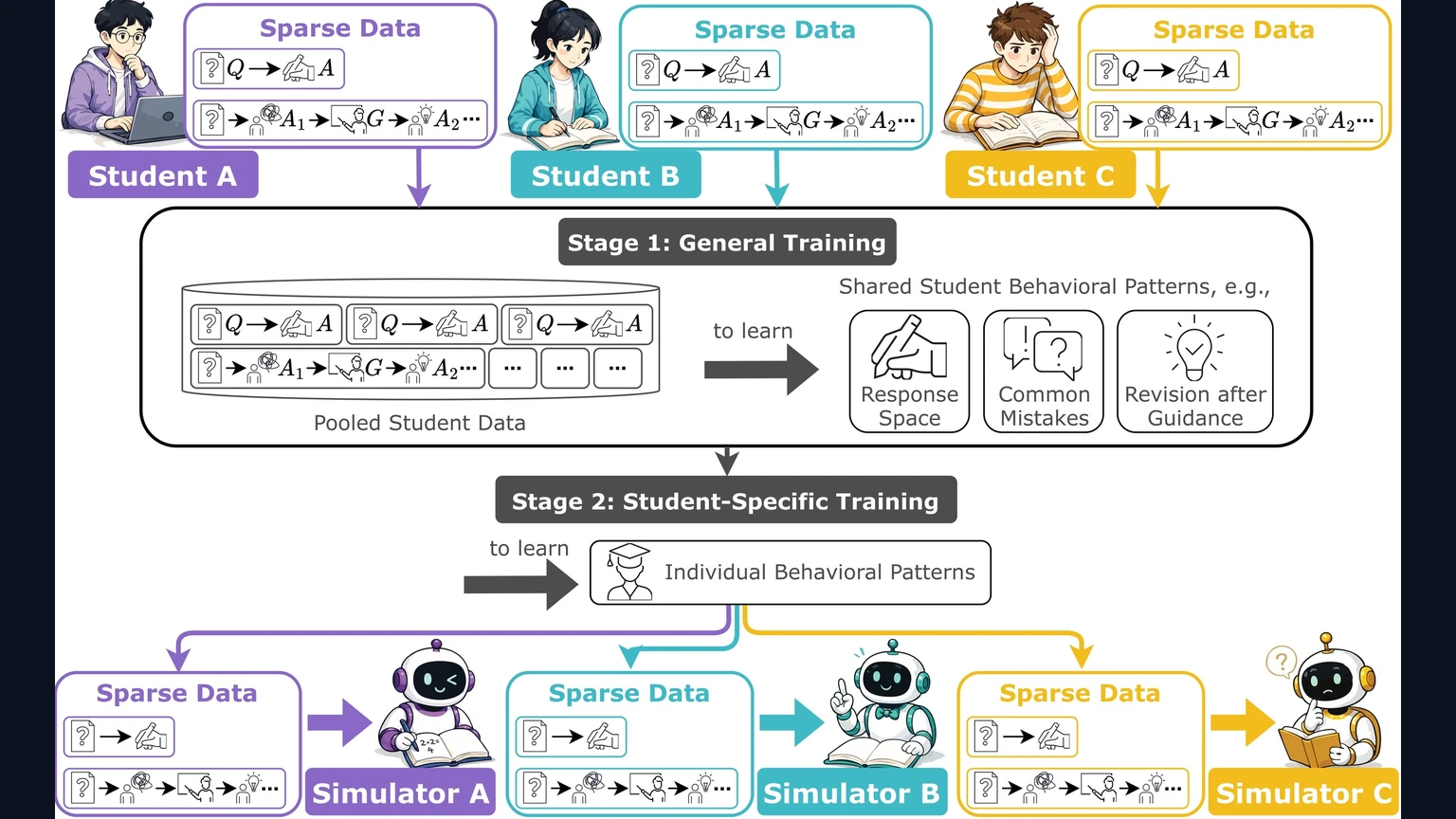
Real students leave sparse data: a few essays, a few dozen answers. Training a separate model from scratch for each would overfit. StudentSim uses two stages. First it trains one adapter per subject on records pooled from many students, learning common answer formats, common errors and common ways students revise after help. Then it continues training that adapter on a single student’s records, producing one specialised simulator per person.
The base model is Qwen3-4B-Instruct, a small open model, with lightweight LoRA adapters for each stage. Each subject has two kinds of record: single answers, which teach the simulator what the student does alone, and multi-turn exchanges in which the student answered wrongly, received guidance and answered again. The tutor guidance spans direct correction, comparison with stronger alternatives, strategy and Socratic questions.
All the data comes from public research datasets with de-identified records. Chess positions and moves come from the Lichess open database for May 2025, released under CC0. English writing comes from EFCAMDAT, a corpus of essays by English learners with teacher corrections, and maths from FoundationalASSIST, a dataset of middle-school answers. The paper evaluates 30 chess players, 15 writing learners and 15 maths students.
How closely does it match real students?
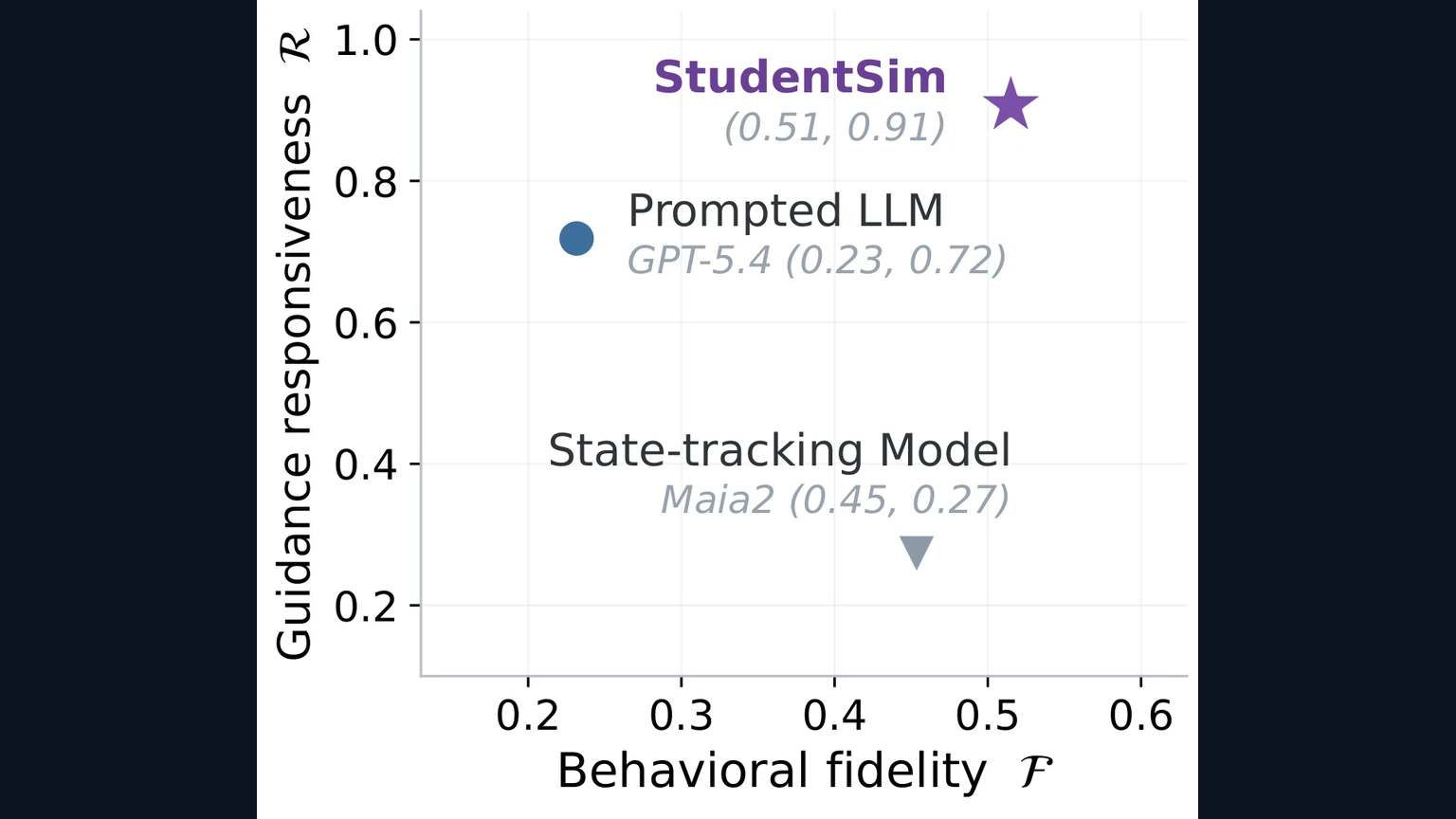
Microsoft says StudentSim beats every baseline on both measures in all three subjects. In chess, it reaches a behavioural fidelity of 0.515 and a guidance responsiveness of 0.907. GPT-5.4, prompted with each player’s profile and history, scores 0.232 and 0.719. Maia2, a chess model built to predict human moves by rating, scores 0.454 on fidelity but only 0.272 on responsiveness, because it cannot read text at all.
The paper gives two illustrations. In one held-out position, three real players chose three different moves; Maia2 predicted the same move for all three, GPT-5.4 missed all three, and the per-player simulators reproduced each one. In another, a player had blundered, and a Socratic hint pointed toward a queen check without naming the square. GPT-5.4 picked the wrong queen move; StudentSim found the right one.
The writing and maths results are measured differently, by how well simulated essays match a learner’s error profile and how often the simulator picks the same multiple-choice answer as the student. Microsoft reports gains there too but describes those experiments as more limited than chess.
Can a simulated student train a better tutor?
The second half of the study asks whether simulators can train tutors. The team trained a chess tutor, Qwen3-VL-8B, which sees the board as an image, using reinforcement learning. Each episode replayed a real student’s wrong move; the tutor wrote guidance, a frozen simulator played the revised move, and the reward was how much better that move was according to the Stockfish chess engine, so the scoring did not depend on the simulator’s judgement.
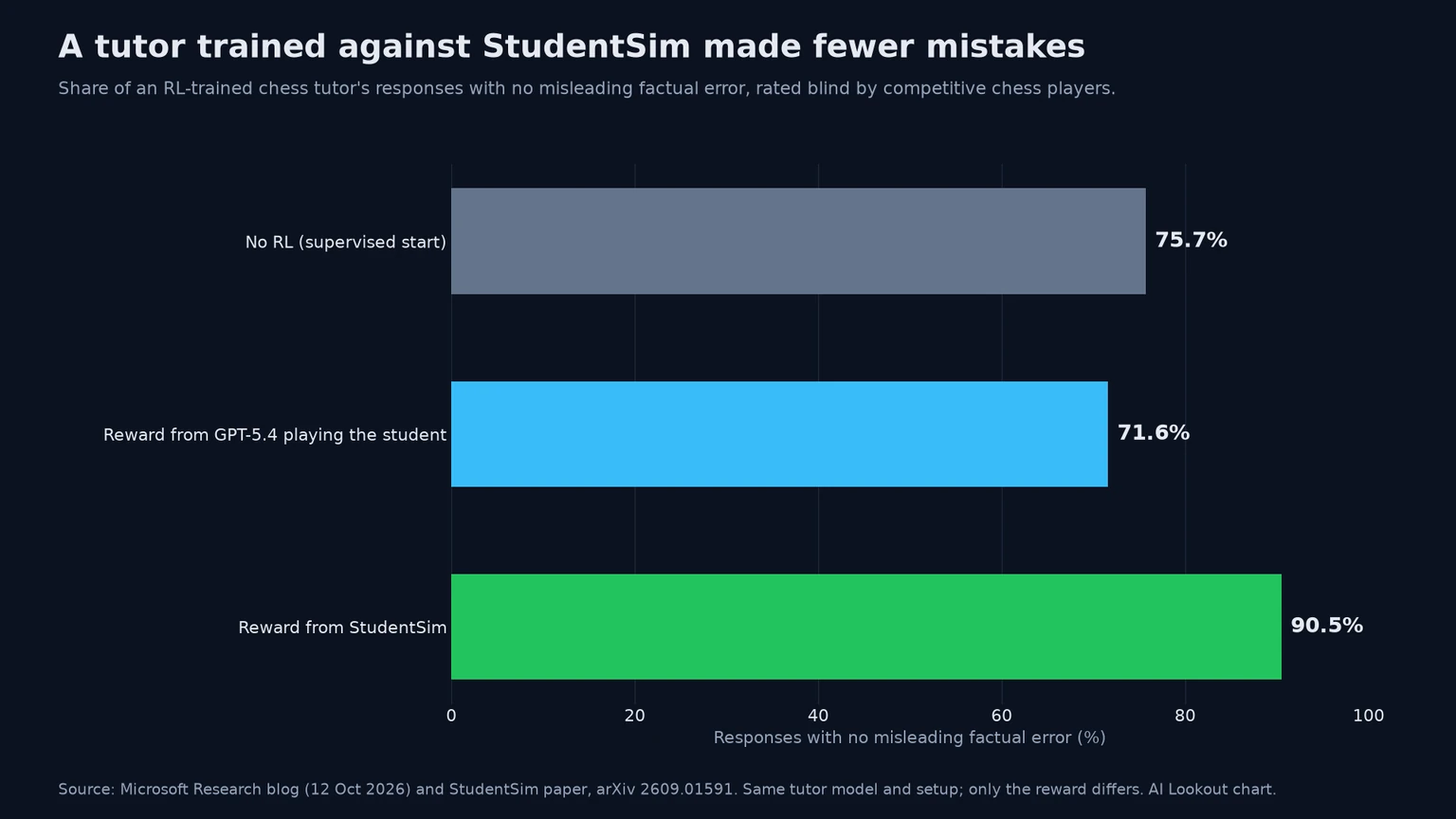
Three tutors were compared: the starting tutor without reinforcement learning, one trained with GPT-5.4 playing the student, and one trained with StudentSim, which also had two small add-ons on its own network that checked teaching style and penalised wrong descriptions of the board. Competitive chess players rated the tutors blind. The StudentSim-trained tutor was accurate in 90.5% of responses, against 75.7% for the starting tutor and 71.6% for the GPT-5.4 version, and it scored best on guidance quality and personalisation. Microsoft calls it a proof of concept. It fits a wider trend of training agents in realistic environments, as with Microsoft’s Agent Lightning framework.
How can researchers use it?
The StudentSim repository is released under the MIT licence and includes training and evaluation code, the StudentSimEval protocol and the chess tutor reinforcement-learning pipeline, with a project site in English and Chinese. Chess data ships ready to use. The writing and maths records must be rebuilt from extracts of EFCAMDAT and FoundationalASSIST that researchers obtain separately, and steps that call a language model need an Azure OpenAI endpoint, so some parts carry API costs.
For AI tutor developers, the practical use is earlier and cheaper testing: comparing teaching strategies or models against simulated students before running studies with people. Because the simulators are small and run locally, they can sit inside a training loop in a way that calling a frontier model for every rollout cannot.
What are the limits?
Microsoft’s own transparency note is cautious. It says StudentSim is for research only, that its outputs are simulated responses rather than measurements of a real person, and that it must not be used to assess, rank or make decisions about an identifiable learner. The recipe was tested most thoroughly on chess, its performance on other subjects and populations is unknown, and it was built and tested in English. That matters given concerns about AI products for teenagers.
The tutor experiment covers only chess, where an engine provides an objective reward; Microsoft notes that other subjects would need their own reward functions. Simulators capture a student’s state and a single step of revision, not learning over weeks. And human studies remain essential for measuring real learning outcomes. We have not run the code; all results are the authors’.
Common questions
What is Microsoft StudentSim?
A Microsoft Research system that trains one AI simulator per student from a few de-identified records, to test and train AI tutors before trying them on real learners.
Is StudentSim open source?
Yes. The training and evaluation code is on GitHub under the MIT licence. Chess data is included; writing and maths data must be rebuilt from separately obtained datasets.
Is StudentSim used in schools?
No. Microsoft says it is a research tool, not a product, not deployed in classrooms and not meant to assess real students or replace teachers.
What to remember
Microsoft Research’s StudentSim builds a small simulator for each learner from public, de-identified records, matching their answers and how they respond to help. It beats GPT-5.4 role-play in chess, writing and maths, and helped train a more accurate chess tutor.
Sources & further reading
How this story was made
Written by Kristian Kostov with AI assistance and checked against the linked sources. Company performance claims are attributed to the company. Analysis reflects AiLookout’s interpretation; we have not independently tested the products discussed. Cover photography is illustrative and does not depict the specific announcement or product.
Our editorial standards