Announced 9 Oct 2026 · Sources checked
What did the COLM 2026 paper test?
The paper, titled AI Assistance Reduces Persistence and Hurts Independent Performance, is by Grace Liu of Carnegie Mellon University, Brian Christian of UC Berkeley, Tsvetomira Dumbalska of the University of Oxford, Michiel A. Bakker of MIT and Rachit Dubey of UCLA. A first draft appeared on arXiv on 6 April 2026 and drew wide coverage. The fifth version, posted on 3 October, is marked as published at COLM 2026, the Conference on Language Modeling, held at the Hilton Union Square in San Francisco from 6 to 9 October.
UC Berkeley News reported on 9 October that the team presented the updated, peer-reviewed paper at COLM that week. The question it tests is simple: today's assistants are built to give instant, complete answers and rarely say no. What happens to a person's own ability, and their willingness to keep trying, when that help is suddenly removed?
How were the AI persistence experiments set up?
All three studies recruited US adults through the online research platform Prolific and paid them for 13 to 15 minutes of work, at a rate the authors give as $15 an hour. Participants were randomly assigned to an AI condition or a control condition, and told there was no penalty for wrong answers or for skipping. That makes the skip button a measure of persistence: choosing it means deciding not to try.
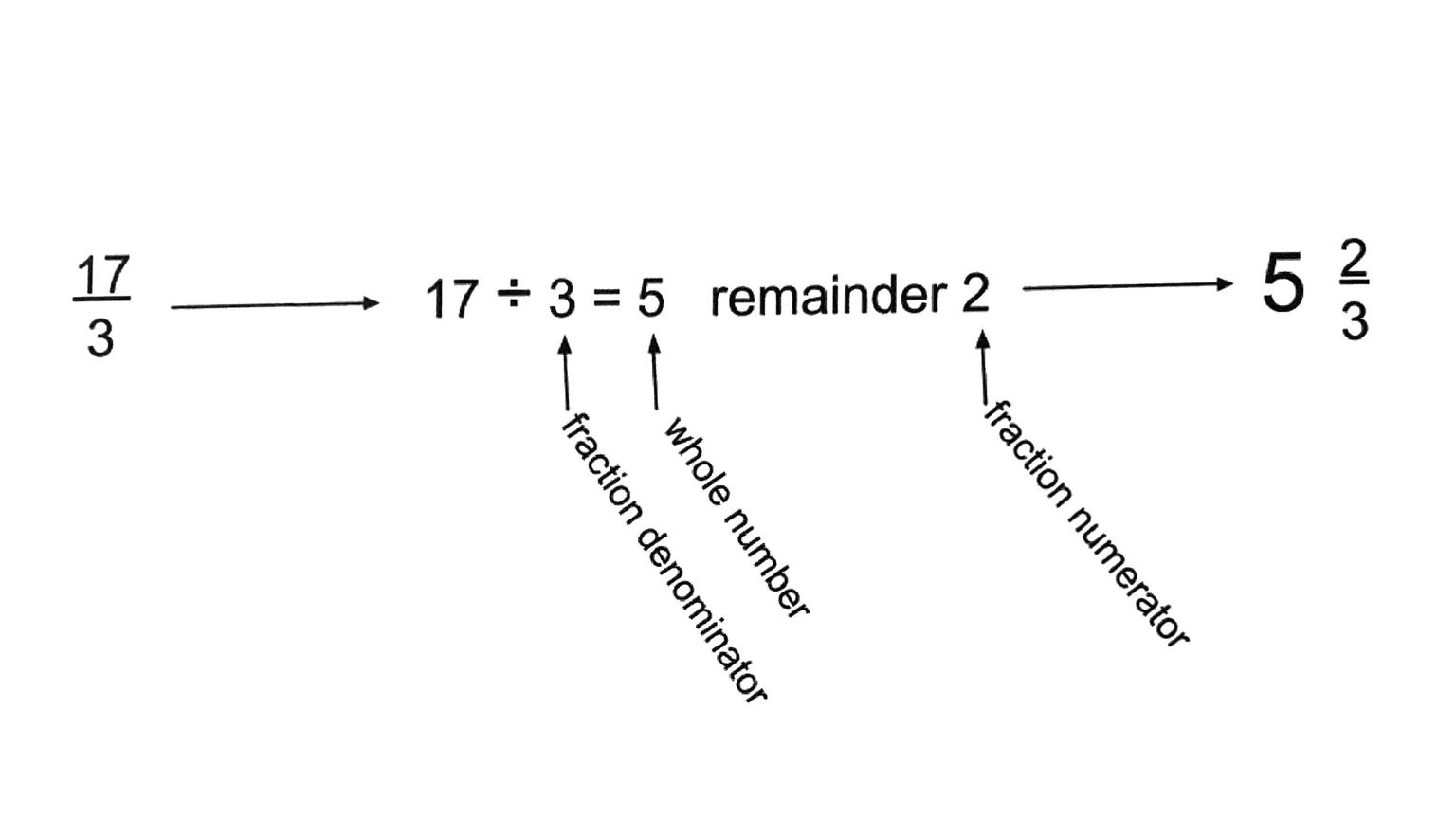
In Experiment 1, 354 people solved 15 fraction problems of rising difficulty. The AI group had a GPT-5 assistant in a sidebar for the first 12, pre-loaded with each problem and its solution, so typing a word like answer? was enough to get the result. Then the sidebar disappeared without warning for three final test problems that were identical across groups. Experiment 2 repeated the design with 667 people, added a three-question pretest to screen for basic skill, and gave the control group a sidebar of worked pretest solutions so both groups saw an interface change. Experiment 3 moved to reading comprehension, using SAT practice passages, with 201 people.
What did the three experiments find?
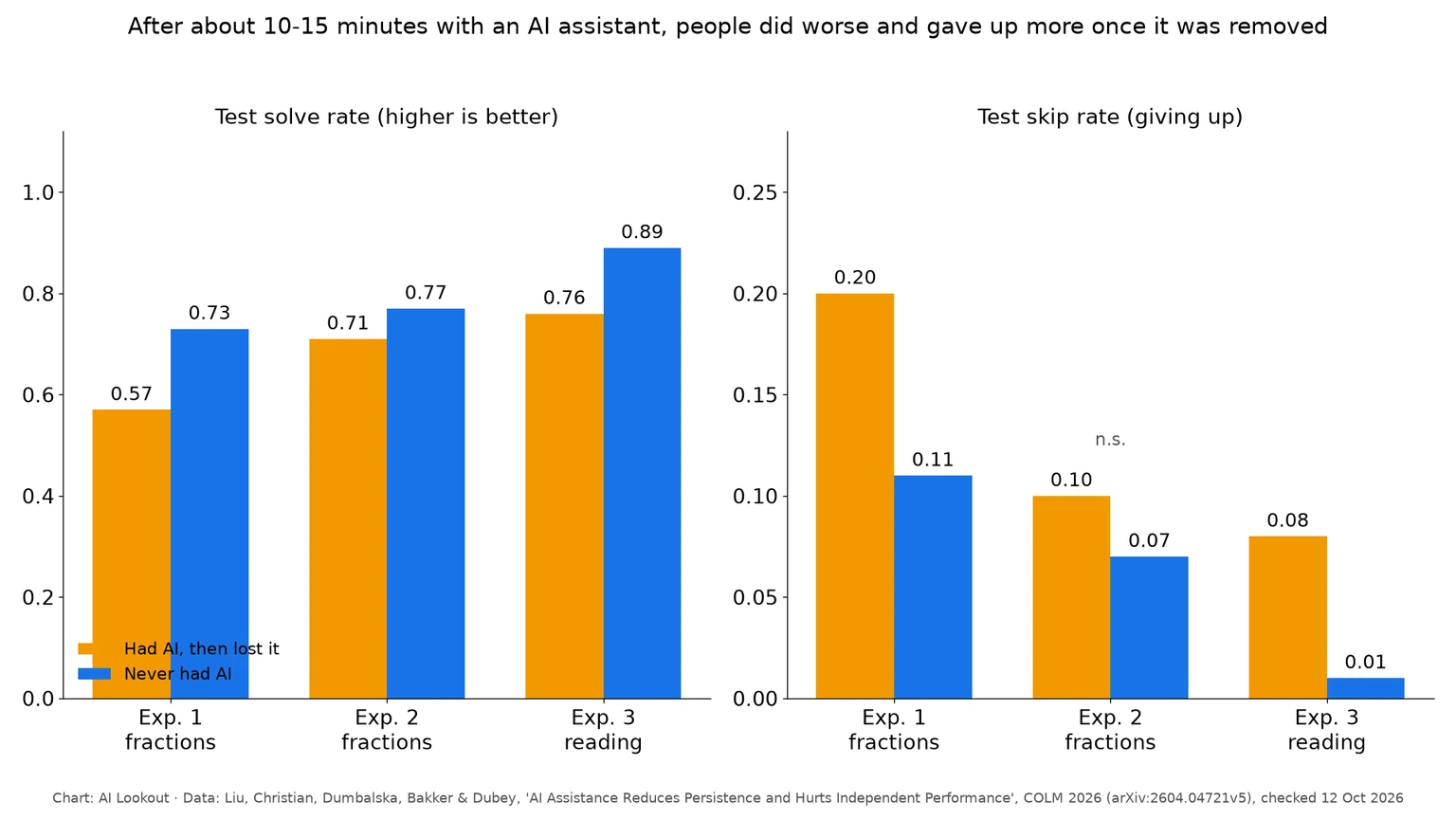
In every experiment the AI group did better while the assistant was available and worse once it was gone. In Experiment 1, after exclusions left 307 participants, the AI group solved 57% of the final three problems against 73% for the control group, a moderate effect with P below 0.001, and skipped 20% against 11%.
Experiment 2, with 585 participants after exclusions, was designed to rule out a confound in the first study, where the exclusion rule may have kept weaker participants in the AI group. The gap shrank but held: 71% solved against 77%, a small but statistically significant difference. The skip rate was 10% against 7%, which was not significant. In the reading study, with 168 participants after exclusions, the AI group solved 76% of the final questions against 89% and skipped 8% against 1%; answers given in under five seconds were counted as skips, since nobody could read a passage that fast.
Does it matter how people use the AI?
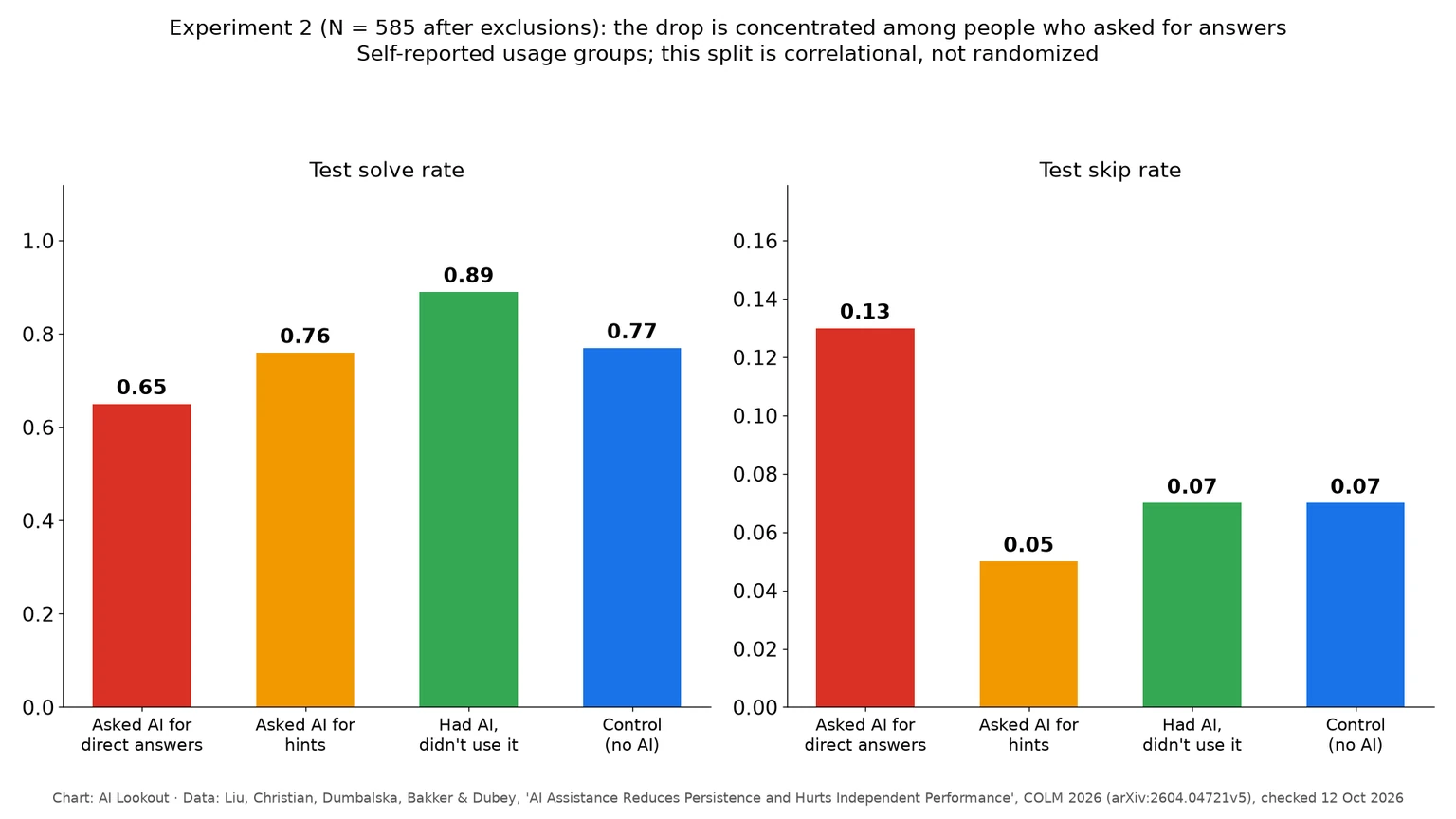
At the end of Experiment 2, participants in the AI group were asked how they had used it. Sixty-one percent said mainly to get answers directly, 27% for hints or clarification, and 12% said they had not used it; chat logs largely confirmed the last group. All groups had performed similarly on the pretest.
At test, the direct-answer group solved 65% of problems and skipped 13%, worse than the control group at 77% and 7%. People who had asked for hints solved 76% and skipped 5%, close to the control group, and those who had the AI but did not use it solved 89%. The direct-answer group also declined relative to its own pretest, while the other groups held steady or improved. The authors caution that these groups chose their own behaviour, so this part of the analysis is correlational rather than causal.
Why would AI help reduce persistence?
The authors propose two mechanisms. First, when an assistant finishes tasks in seconds, the sense of how long a task should take shifts, so working unaided starts to feel more costly, much like adapting to a higher standard of living. Each act of offloading resets that reference point and makes the next one more attractive. Second, AI removes what they call productive struggle, the effort through which people learn not only the material but what they themselves are capable of.
The authors also connect the result to how assistants are trained. Models tuned with methods such as reinforcement learning from human feedback are rewarded for responses people rate highly in the moment, which favours complete answers over teaching. The paper argues that interface fixes such as Socratic modes or time limits are likely to be band-aids, and that developers need objectives that value a user's long-term competence, not only immediate satisfaction.
What does this mean for learners, teams and AI builders?
For students and parents, the practical message matches the usage split: asking an assistant for hints or explanations was not linked to the same drop as asking it for answers. That is relevant to debates such as Common Sense Media's rating of ChatGPT for Teens, which focused on safety rather than learning, and to how assistants now reach almost everyone, as when OpenAI rolled out GPT-6 and Intelligent UI to every ChatGPT user this month.
For teams, the study is a reminder that a skill used only with an assistant may not be available without one, which matters for training junior staff and for tasks that must be done when tools are down. For AI builders, the authors' point is that helpfulness measured per answer is not the same as helping. Brian Christian told Berkeley News, "You almost couldn't ask for a clearer story."
What are the study's limits?
The authors list the main limits themselves. Exposure was brief, about 10 to 15 minutes, so the study cannot say whether the effect grows, fades or stays the same with months of daily use. Participants were tested immediately after the AI was removed, so durability over hours or days is unknown. The assistant was maximally helpful, giving complete answers on demand, which is not how every tutor or product behaves.
The tasks were short fraction problems and SAT-style reading questions done online by paid participants, and effect sizes were small to moderate. The first experiment had a possible selection confound that the second was designed to fix, and the usage-type analysis is not randomized. The findings fit earlier randomized work, including a 2025 PNAS study in which high-school students who practised math with GPT-4 did worse later without it, but longitudinal studies are still needed. We have not run the experiments; this article relies on the paper, its project page and Berkeley News.
Common questions
Does using AI make you worse at thinking?
This study shows a short-term effect: after about 10 to 15 minutes of answer-giving help, people did worse and gave up more often once the AI was removed. It did not measure long-term use or how long the effect lasts.
Is it better to ask AI for hints instead of answers?
In Experiment 2, people who said they used the AI for hints or clarification performed about as well as the no-AI group, while those who asked for direct answers did worse. That comparison is correlational, so it suggests but does not prove that hints are safer.
Where was the AI persistence study published?
It is a peer-reviewed conference paper at COLM 2026, the Conference on Language Modeling, held in San Francisco from 6 to 9 October 2026. The paper is also on arXiv as 2604.04721; version 5 is dated 3 October 2026.
What to remember
Three randomized experiments presented at COLM 2026 found that brief answer-giving AI help lowered unaided performance and persistence once it was removed, mostly for people who asked for answers rather than hints; treat it as strong short-term evidence, not proof of long-term deskilling.
Sources & further reading
How this story was made
Written by Kristian Kostov with AI assistance and checked against the linked sources. Company performance claims are attributed to the company. Analysis reflects AiLookout’s interpretation; we have not independently tested the products discussed. Cover photography is illustrative and does not depict the specific announcement or product.
Our editorial standards