Announced 22 Oct 2026 · Sources checked
What iFlytek launched
iFlytek, the Hefei-based speech and AI company, launched Spark X2.6 on 22 October 2026 at its annual 1024 Global Developer Festival in Beijing. According to IT Home's report from the event, the new flagship is a mixture-of-experts model with 293 billion total parameters, of which about 30 billion are active for each token, and a context window extended to one million tokens. iFlytek pitches it at coding and AI agent work, the two areas where Chinese and US labs have been competing hardest this year.
The headline claim is about hardware rather than benchmarks. iFlytek says Spark X2.6 is the first model to reach a breakthrough in coding and agent abilities using only Chinese-made computing power. People's Daily, citing the Global Times, reports that the model is deployed on a domestic inference cluster of 10,000 cards, and quotes chairman Liu Qingfeng saying it "has taken the lead in breaking through the efficiency bottleneck of long-horizon task training on domestic chips."
Alongside the cloud model, iFlytek published Spark-X2.6-4B, a small model meant to run on phones, laptops and other devices. That one is open under Apache 2.0. The flagship is not: its weights are closed, and it is offered through iFlytek's own API and the Spark website. The company calls the pairing an end-cloud integrated design, where simple tasks run locally on the small model and harder ones are handed to the large one in the cloud.
The domestic chip claim
Liu made the comparison blunt. IT Home quotes him saying that Spark is the only model trained entirely on Chinese compute, that all the others were trained on Nvidia cards, and that iFlytek's model is also the smallest of the group. The statement was made on stage and is iFlytek's own; the company did not publish a list of the chips, cluster size used for training, or a training-compute figure that would let anyone check it.
What iFlytek did describe is the engineering it says made training workable. Chinese accelerators have less memory bandwidth than Nvidia's top parts, and iFlytek says that gap slowed mixed training on long, multi-step tasks. Its answer, per IT Home, is a dynamic parallel training method adapted to domestic platforms for long-horizon tasks. For inference it lists two more changes: distributed inference across mixed domestic hardware, and a technique that reuses earlier results instead of recomputing them, which sounds like a form of caching for agent sessions.
The claim lands in a year when chip supply is shaping Chinese AI strategy. US export rules block Nvidia's most capable data-centre chips from China, and People's Daily notes that a team at the Shenzhen Loop Area Institute has reported post-training DeepSeek-V4-Pro on Huawei Ascend 910C chips. Earlier IT Home coverage lists iFlytek's Spark X2-Flash as trained on a Huawei Ascend 910B cluster, so the company has been on this path for several model generations. Beijing has also been tightening oversight of model releases, as with the new export registration that DeepSeek and MiniMax cleared.
The open 4B model and its scores
The part outside developers can actually test is the small model. Spark-X2.6-4B on Hugging Face was uploaded on 19 October, three days before the festival, under the XHToken organisation that iFlytek uses for its open releases. The card says it keeps exactly the same architecture as Spark-X2.5-4B, released on 1 September, and gets its gains from better post-training. IT Home reports that the X2.5-4B model has ranked among the top four on-device models worldwide by downloads since then, a figure from iFlytek's launch.
The published configuration file describes a dense model with 36 layers and a hidden size of 2,560. Most layers use sliding-window attention over 512 tokens, with a full-attention layer every fourth layer, a common way to keep memory use low while still supporting very long inputs. The maximum position setting is 1,048,576 tokens, matching the one-million-token claim. The model offers three thinking levels, none, low and high, so an app can trade answer quality for speed and cost.
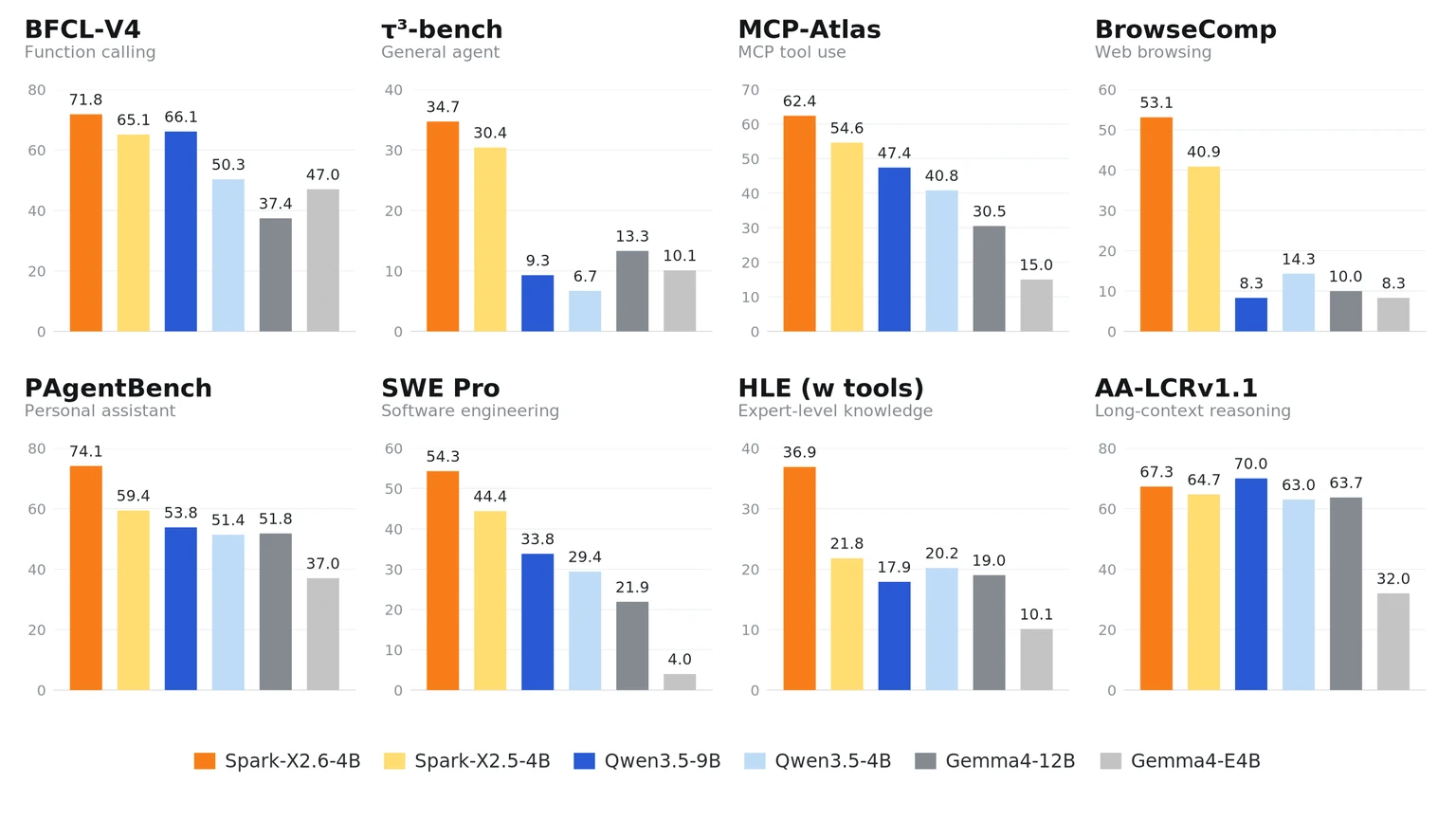
The benchmark chart below is iFlytek's. With thinking set to high, the company reports 71.8 on BFCL-V4 for function calling, 62.4 on MCP-Atlas for tool use, 53.1 on BrowseComp and 54.3 on SWE Pro, against 65.1, 54.6, 40.9 and 44.4 for the previous X2.5-4B. In the team's own write-up, it also lists 62.8 on SWE-bench Verified, up from 41.6. On iFlytek's chart the 4B model beats Qwen3.5-9B and Gemma4-12B on seven of eight tests. The exception is the AA-LCR long-context test, where Qwen3.5-9B scores 70.0 against 67.3. For comparison, Nvidia's recent small model, Nemotron 3.5 Bolt E4B, targets local voice agents rather than coding.
Price and access
Spark X2.6 is available to try on the Spark website, and through iFlytek's Spark API. IT Home lists limited-time launch pricing of 0.9 yuan per million input tokens, 0.08 yuan per million cached input tokens and 3.6 yuan per million output tokens. AGI Pulse converts that to about $0.13 and $0.51 for input and output, which would put it in the same price band as other Chinese agent models such as MiniMax M3.1 Flash. The prices are promotional, and iFlytek has not said when they end.
The open 4B model is free to download, and IT Home says its hosted inference is free for a limited time as well. The model card gives setup instructions for Hugging Face Transformers, SGLang, vLLM, Apple's MLX, llama.cpp from build b10828, Ollama from version 0.34.1 under the name SparkLLM/Spark-X2.6-4B, and LM Studio. Notably, its SGLang and vLLM examples include images for Huawei Ascend NPUs alongside Nvidia GPUs, in keeping with the domestic-hardware message. The Transformers path needs trust_remote_code, so teams should review the custom model code first.
For developers outside China the two halves differ in practice. The 4B weights sit on Hugging Face under a permissive licence. The cloud flagship runs on iFlytek's platform, which, as China Hot Tech notes, is likely to require a Chinese account and local payment for most overseas users.
Why it matters
If the training claim holds up, Spark X2.6 is evidence that a large, agent-focused model can be built without Nvidia hardware at all. That matters for Chinese buyers such as state-owned firms, schools, hospitals and courts, which Liu named as target sectors, and which increasingly want a supply chain free of US export controls. People's Daily quotes an industry observer saying the focus is moving from model size and leaderboards toward domestic deployment, data security and real-world use.
It also shows how crowded the Chinese model market has become. In the same week, Moonshot launched Kimi K3.1 Pro and DeepSeek was reported to be raising about $15 billion, as covered in our DeepSeek funding report. iFlytek's angle is different: rather than claiming the top benchmark spot, it is selling independence from foreign chips plus a cheap small model that runs locally.
What is still unproven
Several key claims have no outside check yet. iFlytek published no benchmark scores for the 293B flagship, only the statement that its coding and agent abilities are at a leading industry level. Liu also said the model performs better in real deployments than its public benchmark scores suggest, a claim that is hard to test from outside. The "only fully domestic" line is the company's, and other Chinese labs have reported training or post-training work on Huawei chips.
The 4B scores are the company's own runs with thinking on high, and comparison scores for rival models were partly taken from their published cards, as the team notes. Small models often post strong agent benchmarks that do not carry over to messy real tasks, so community tests over the next few weeks will matter more than the launch chart. AI Lookout did not run either model for this article.
What to watch next is whether iFlytek publishes a technical report for Spark X2.6 with training details, whether the flagship shows up on independent leaderboards, and how long the launch pricing lasts.
Common questions
What is iFlytek Spark X2.6?
A large language model from iFlytek, launched on 22 October 2026, with 293 billion parameters in a mixture-of-experts design, about 30 billion active per token, and a one-million-token context. It targets coding and agent tasks and is offered through iFlytek's API.
Is Spark X2.6 open source?
The 293B flagship is not; its weights are closed. The small Spark-X2.6-4B is open under Apache 2.0 on Hugging Face and runs in Ollama, llama.cpp, MLX and other tools.
Was Spark X2.6 really trained without Nvidia chips?
That is iFlytek's claim. The company says it was trained on domestic Chinese compute but did not publish chip models, cluster size or training figures, so it has not been independently verified.
Sources & further reading
- 讯飞星火 X2.6 端云一体大模型发布 (iFlytek Spark X2.6 launch report) ↗
- Chinese tech company unveils new AI model based on fully domestic computing power ↗
- XHToken/Spark-X2.6-4B (model card) ↗
- Spark-X2.6-4B: stronger on-device agents, coding and controllable thinking ↗
- iFlytek launches Spark X2.6: a 293B-A30B MoE with 1M context ↗
- iFlytek Spark X2.6: Domestic-Trained Cloud MoE Plus an Open 4B On-Device Agent Model ↗
How this story was made
Written by Kristian Kostov with AI assistance and checked against the linked sources. Company performance claims are attributed to the company. Analysis reflects AiLookout’s interpretation; we have not independently tested the products discussed. The cover places the companies’ own logos, taken from public-domain or openly licensed files credited in the caption, on a plain background. It is not a product photograph, a screenshot, or an endorsement.
Our editorial standards