Announced 22 Oct 2026 · Sources checked
What Hugging Face released
Hugging Face released Carbon-X on Thursday, 22 October 2026, an open language model that reads raw DNA and answers questions about it in plain English. The model card describes a 14.8-billion-parameter decoder that takes DNA sequences inside an ordinary chat conversation. It can predict whether a mutation is likely benign or disease-causing, identify regions that control gene activity, classify a sequence by organism group, continue a sequence and explain its reasoning.
The weights are published under the Apache 2.0 licence by the HuggingFaceBio team, together with a GGUF version and a release blog. The model was built with researchers at Zhongguancun Academy in China and the Telethon Institute of Genetics and Medicine at the University of Naples Federico II in Italy. It is a step on from Hugging Face's earlier genomics releases, the Carbon DNA foundation models and the Carbon-A gene annotator covered here in early October, which could score or continue sequences but could not discuss them.
"We've unlocked a new capability in language models, which is fundamentally about being able to chat with DNA," Hugging Face senior research scientist Lewis Tunstall told WIRED.
One model for DNA and English
Most genomic AI models fall into one of two camps. DNA foundation models learn statistical patterns from billions of bases and output numbers, such as a likelihood score for a mutation. General chatbots know a great deal about biology from papers but have seen little raw DNA, so they can explain what a gene does yet struggle to judge a change in its sequence. Hugging Face's pitch is that Carbon-X joins the two.
It does that without a separate DNA encoder. Text and DNA share one token stream in one decoder. A hybrid tokenizer keeps the Qwen3 vocabulary for words and adds 5,515 DNA tokens: all 4,096 possible six-letter chunks of A, C, G and T, tail tokens for sequences whose length is not a multiple of six, and markers for where DNA starts and stops. Runs of six or more bases in a prompt are detected and tagged automatically, and the model can write answers that mix DNA and prose.
The blog says six-base tokens use roughly a third as many tokens as Qwen3's normal tokenizer for the same DNA. The context window is 40,960 tokens, and training used sequences of up to about 49,000 base pairs, so Carbon-X reads stretches of a genome, not whole genomes. Google DeepMind's AlphaGenome takes a different route, predicting the effects of sequence changes as numeric tracks rather than conversation.
How it was trained
Carbon-X starts from Alibaba's open Qwen3-14B. The team first trained only the new DNA embeddings for about 10 billion tokens with the rest of the model frozen, then unfroze everything for 302 billion tokens of mid-training. That mix was 55 per cent raw DNA from vertebrates, invertebrates, plants, fungi, protozoa and bacteria, 20 per cent general English, 15 per cent biology text that contains or describes sequences, and 10 per cent instruction data.
The blog is candid about the hard part: DNA and English wanted different learning rates. Higher rates taught DNA faster but made the model forget English, and lower ones preserved English but left DNA near chance. Tricks such as separate learning rates, layer protection and merging specialist models did not fix it. What worked was a lower learning rate, a bigger model and a longer run. At 4 billion parameters the approach still cost English ability, while at 14 billion it preserved most of it.
Post-training also needed care. Hugging Face says frontier models were unreliable teachers, often refusing genomic requests or inventing details, and its own early outputs invented database references. So the team built deterministic checkers with domain experts that test claims against the supplied DNA, used them to build supervised examples, and then ran two rounds of reinforcement learning with verifiable rewards on tasks such as variant-effect prediction and sequence recovery. Reinforcement learning applied directly to the base Qwen model never beat chance on its hardest variant test, the blog says, but it did after mid-training.
How it scores, by Hugging Face's measure
Hugging Face evaluates Carbon-X on five benchmarks: BioReason Coding and BioReason Non-SNV, which ask whether mutations in protein-coding regions and insertions or deletions are harmful; GenomeQA, 2,600 multiple-choice questions about sequence features; and two it built itself, NextBase for predicting the next bases and FrontierVEP for judging single-base variants in up to 8,192 bases of context.
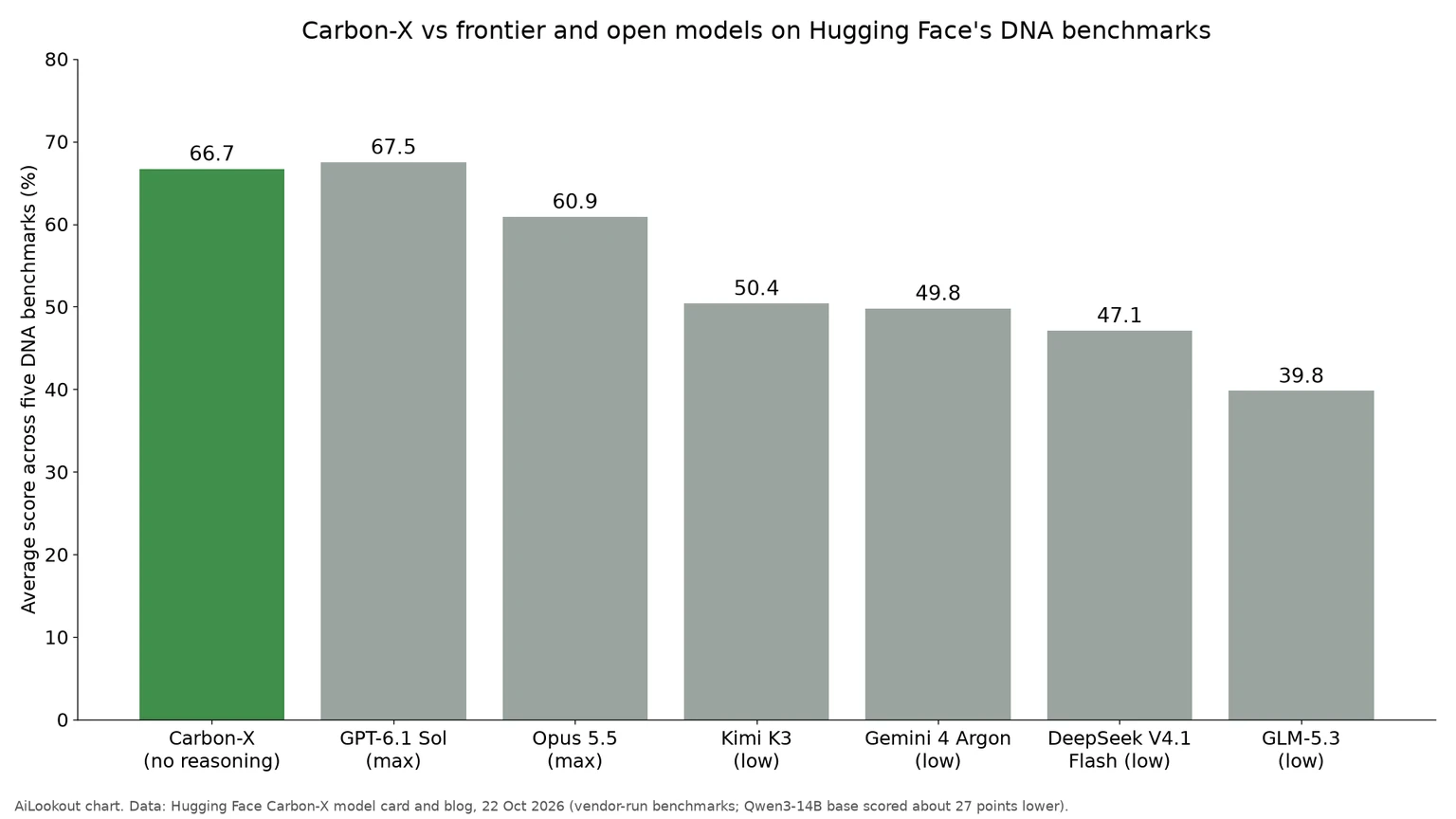
Averaged across the five, Carbon-X scores 66.7 per cent with reasoning switched off. That is 27 points above Qwen3-14B and ahead of every other open model tested, including Kimi K3 at 50.4 and DeepSeek V4.1 Flash at 47.1. Among closed models, GPT-6.1 Sol at maximum reasoning edges it at 67.5, while Opus 5.5 at maximum scores 60.9 and Gemini 4 Argon 49.8. Carbon-X leads every model on coding-variant effects, at 74.9, and on next-base prediction, at 39.4. Frontier models stay ahead on insertions and deletions, general DNA questions and single-base variants.
Two caveats apply. These are the developers' own tests, two of the five benchmarks are of their own making, and no outside group has yet reproduced them. Hugging Face says it decontaminated training data against all five with DNA overlap, text overlap and sequence-similarity checks. And within GenomeQA the model is weak on splice sites and histone marks, at 29.8 and 34.6 per cent.
Cost, refusals and running it locally
Cost is a large part of the argument. Because Carbon-X answers directly rather than reasoning at length, Hugging Face puts its cost per problem at about 1/1,800 of GPT-6.1 Sol's, using a $5 per hour price for an H200 GPU. It estimates that analysing the 2.4 million variants of uncertain significance in the ClinVar database would cost about $300 with Carbon-X, against $32,000 to $4 million with the frontier models it tested.
The team also measured refusals. On FrontierVEP, Gemini 4 Argon's accuracy fell from 58 to 38 per cent as its reasoning effort rose, alongside more refusals, and Claude Opus 5.5 fell from 17.7 per cent to 1.1 per cent on NextBase between low and maximum effort. Tunstall told Business Insider that general chatbots sometimes mistake legitimate biology questions for attempts to "design a bioweapon".
Privacy is the other selling point. The bfloat16 weights fit on a single 80 GB GPU and serve with vLLM or Transformers, so labs can keep patient or unpublished sequences in-house. Tunstall told Business Insider the team wanted to give researchers tools "that don't make them fully dependent on some external single provider". There is one inconsistency to note: the blog says Carbon-X works with llama.cpp and shows it on a MacBook, while the model card warns that llama.cpp and other GGUF runtimes cannot load the custom DNA tokenizer, so DNA would be tokenized incorrectly.
Using Carbon-X as a helper for other agents
Carbon-X is also designed to be called by other AI systems. In Hugging Face's agent test, requiring Kimi K3 to consult Carbon-X raised Kimi's average across the five DNA benchmarks from 49.4 to 60.5 per cent. The repository ships a ready-made skill for coding agents such as Claude Code and Codex CLI, plus examples for any tool-calling agent. That fits a wider move toward AI agents in the lab, from Claude-designed protein binders to OpenAI's purchase of Orchestra Bio.
The model card's advice for agent builders is practical: pass DNA by file or name rather than pasting it, because language models often miscopy long sequences; tell the agent explicitly to consult Carbon-X; and leave counting, coordinates and edits to ordinary code, which is more reliable than either model.
Limits and safety
Hugging Face is clear that Carbon-X has not been clinically validated and should not be used for medical decisions. WIRED reports that the developers have not yet tested its predictions in wet-lab experiments. The model can miscount bases, confuse coordinates, invent a sequence's identity when context is missing, and produce worse DNA as generated sequences get longer. It was trained to read and explain sequences, not to design new ones.
On dual use, the team excluded genomes of viruses that infect eukaryotes from training and tested the model on sequence-editing tasks with possible misuse relevance. It found limited editing reliability and no advantage over standard deterministic tools, but says more research is needed, including on what happens after fine-tuning. Open weights make that kind of outside scrutiny possible, and they also mean anyone can adapt the model.
For geneticists, the immediate use is triage: a cheap, local second opinion on variants, or a DNA specialist plugged into a larger assistant. Whether its variant calls hold up against clinical labels outside Hugging Face's benchmarks is the test that will decide how far it goes.
Common questions
What is Carbon-X?
An open 14.8-billion-parameter language model from Hugging Face and partners in China and Italy that takes raw DNA in a chat and answers in English, for example predicting whether a mutation is benign or pathogenic and explaining why.
Can Carbon-X read my whole genome?
No. Its context window is 40,960 tokens and it was trained on stretches of up to about 49,000 base pairs, so it handles small parts of a genome at a time. It is also not validated for medical use.
How do I run Carbon-X?
Download it from Hugging Face under Apache 2.0 and serve it with Transformers or vLLM on one 80 GB GPU. The tokenizer needs trust_remote_code, and the model card says GGUF runtimes such as llama.cpp do not handle its DNA tokens correctly.
Sources & further reading
How this story was made
Written by Kristian Kostov with AI assistance and checked against the linked sources. Company performance claims are attributed to the company. Analysis reflects AiLookout’s interpretation; we have not independently tested the products discussed. The cover places the companies’ own logos, taken from public-domain or openly licensed files credited in the caption, on a plain background. It is not a product photograph, a screenshot, or an endorsement.
Our editorial standards