Announced 22 Oct 2026 · Sources checked
What HeyGen launched
HeyGen, best known for AI avatars that read a script on camera, has launched its first general-purpose video model. HeyGen Video, called heygen-video-1 in the API, turns a written description into a 5- to 15-second clip that comes with its own soundtrack: dialogue, room tone, ambience and sound effects, all generated with the picture. The company announced it on 22 October 2026 and says it is available now through the HeyGen API and its Creative Studio.
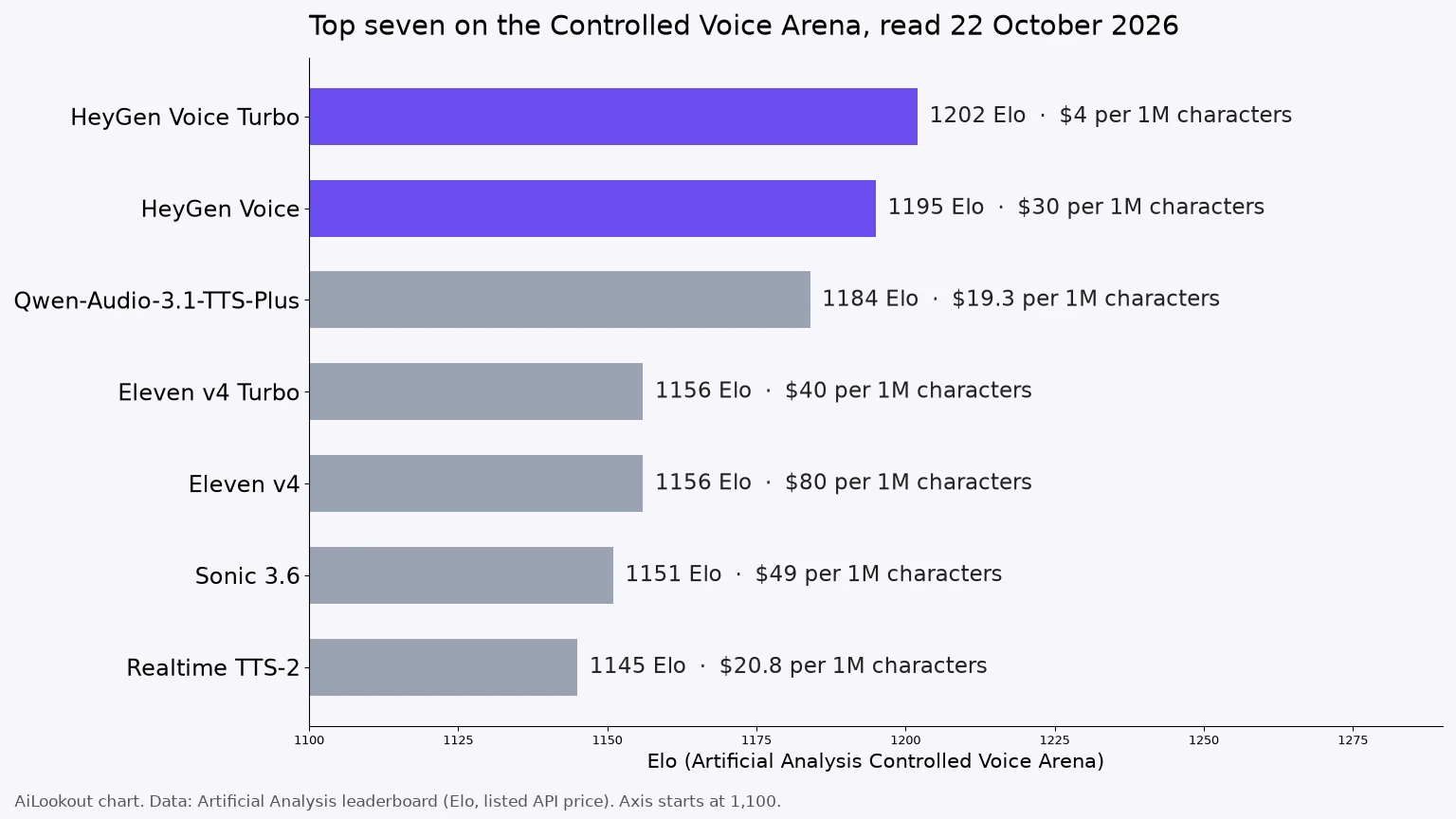
A day earlier HeyGen made a second move on the audio side. Its new HeyGen Voice Turbo text-to-speech model, a faster mode of the in-house voice engine behind its videos, is free to call through the API until 30 November 2026. Turbo currently sits first on Artificial Analysis's Controlled Voice Arena, one place above HeyGen's own HeyGen Voice model, which reached the top of that board earlier this month.
Taken together, the two launches show a company that built its business on talking-head video trying to own the whole clip: the scene, the sound and the voice.
One pass for picture and sound
HeyGen's pitch for the video model is about seams. Most AI video, its launch post argues, is still built in pieces: one model draws the picture, another voices the lines, a lip-sync step stitches them together and a sound library fills the gaps. The result, in HeyGen's words, is "room tone that doesn't match the room, footsteps that land a beat late."
HeyGen Video instead produces the picture and the audio from the same prompt in a single generation. There is no separate speech pass, no lip-sync step and no avatar to choose first. HeyGen gives the example of a train arriving at an empty platform: near silence, then the horn, the wheels on the rail joints, the rush of air and the brakes, in that order.
The company also claims the model was post-trained to keep whole shots consistent. Objects should keep their size and shape and stay where they were placed, nothing should duplicate or vanish halfway through, and the model should follow a brief literally. "If you didn't ask for dialogue, you don't get dialogue," the post says. These are HeyGen's descriptions of its own model; it has not published benchmark scores, and AI Lookout has not tested it.
HeyGen is also candid about where the model works best: short, contained shots with one subject, one place, one action and a locked or gently moving camera. That, it notes, describes most of the shots brands actually need.
Three ways to call it
There is one model with three modes. Text to video builds a scene from words alone. Image to video takes a still and uses it as the first frame, which HeyGen suggests for bringing a key visual or storyboard frame to life, or for continuing from the last frame of a previous shot.
Reference to video is the mode aimed at brands. A request can include up to nine images, three videos and three audio files, twelve in total, which the prompt refers to by name, such as Picture 1. HeyGen says a product photographed this way keeps its colour, form and markings in the new scene, turning a generic product shot into the customer's own product shot.
The company positions the model as a partner to Avatar V, its avatar engine, rather than a replacement. Avatar V animates a presenter from a short recording and a script; HeyGen Video fills in what an avatar cannot, such as a cold open, a product turning on a table or B-roll that cuts away while the presenter keeps talking. HeyGen's suggested edit opens on a generated scene, hands over to the avatar and closes on a reference-to-video shot of the real product.
Specs, styles and prompting
According to the published specification, clips run any length from 5 to 15 seconds at 480p, 768p, 1080p or 2K, with 1080p and 2K billed at three times the 768p rate. Aspect ratios run from 21:9 to 9:16, plus an adaptive option for reference to video. Output is an H.264 MP4 at 24 frames per second with AAC stereo audio. Prompts can be up to 32,000 characters, and an optional prompt enhancer comes in turbo, quality and ultraquality settings or can be switched off so the model follows the prompt word for word.
Jobs are started with one request to the new videos endpoint and finished clips arrive by webhook or polling, alongside the user's other HeyGen videos. A fixed seed returns the same clip for the same prompt, so creators can change one clause at a time. The model runs on paid API keys; HeyGen's launch post does not list a per-second price.
Style is part of the prompt. HeyGen's launch film shows the same shot as live-action cinema, plasticine stop-motion, hand-painted cel anime, mid-century screen print, watercolour and impasto oil, and the company says every title in the film was generated in camera rather than added in editing. Its advice is to name real production details: a camera body, lens and aperture rather than "cinematic", real skin and materials with "no retouching, no beauty filter", and the room tone and distance of each sound. Short phrases render reliably as on-screen text, it says, while longer copy should still be added in the edit.
Voice Turbo goes free until 30 November
The voice news is about price. HeyGen Voice Turbo uses the same voices as the full HeyGen Voice model with a shorter generation step, so audio comes back sooner and costs less. On Artificial Analysis's Controlled Voice Arena, where every model reads the same eight cloned voices, four American and four British, and blind listeners pick the better clip, Turbo had an Elo score of 1,202 on 22 October, ahead of HeyGen Voice at 1,195 and Qwen-Audio-3.1-TTS-Plus at 1,184. ElevenLabs' Eleven v4 and v4 Turbo were tied at 1,156.
The board's own ranges put the top three in a single statistical band, and Turbo's ranking rests on 1,685 votes, fewer than its neighbours, as an analysis by OrcaRouter points out. In practice that means Turbo and the full model sound about the same in this test. The difference is cost: Artificial Analysis lists Turbo at $4 per million characters against $30 for HeyGen Voice, while HeyGen's own launch page lists $4 and $15. Either way, Turbo is several times cheaper.
Until 30 November it is free through a separate model name, heygen-voice-1-turbo-free, with no credit card needed. HeyGen calls the free tier best effort: there is no uptime or latency guarantee, and requests return an HTTP 429 error when free capacity is full. Turbo works with HeyGen's public voices and instant clones made from one recording; professional voice clones still need the full model. Moving to the paid version means changing the model name.
How it fits the AI video race
HeyGen is entering a crowded field. Kuaishou's Kling 4.0 now generates 30-second scenes with stereo audio and lip sync, so HeyGen is not alone in pairing sound with generated video. HeyGen's 15-second limit is shorter than that, so its case rests on consistency, prompt adherence and the fit with the avatar and voice tools its business customers already use.
On voice, the competition is about price as much as quality. Open-weight models such as Fish Audio's Drama 3 and fast agent-focused offerings such as ElevenLabs' Eleven Realtime are pushing costs down, and a top-ranked voice at $4 per million characters, or free for five weeks, puts pressure on rivals charging $20 to $80 on the same board.
For developers, the practical appeal is one API for avatar, voice and generated footage, with clips that can be retrieved through the same endpoint as other HeyGen videos.
What to watch and what is missing
Several things are missing. HeyGen has published no quality benchmarks for HeyGen Video and no independent leaderboard results yet, so its claims about consistency and literal prompt following are untested outside the company. The launch post does not give a per-second price, a content policy for generating real people or trademarks in reference mode, or details of the training data.
The voice ranking is a narrow measure. The Controlled Voice Arena tests cloned voices reading short lines in English; it says nothing about long narration, other languages or latency under load, and the free tier explicitly offers no service guarantees. The price figures on the leaderboard are Artificial Analysis's conversions, and they differ from HeyGen's own page for the full model.
The useful test will be whether teams that already script avatars in HeyGen start generating their B-roll and product shots there too, and whether HeyGen Video appears on public video arenas against Kling and other leaders in the coming weeks.
Common questions
What is HeyGen Video?
HeyGen's general-purpose video model, heygen-video-1, which turns a prompt, an image or reference files into a 5- to 15-second clip with matching audio, available through the HeyGen API and Creative Studio on paid keys.
Is HeyGen Voice Turbo really free?
Yes, until 30 November 2026, through the model name heygen-voice-1-turbo-free. It is best effort, with no uptime or latency guarantee, and works with public and instant voices but not professional clones.
How long can HeyGen Video clips be?
Between 5 and 15 seconds per clip, at 480p, 768p, 1080p or 2K, output as an MP4 at 24 frames per second with stereo audio.
Sources & further reading
How this story was made
Written by Kristian Kostov with AI assistance and checked against the linked sources. Company performance claims are attributed to the company. Analysis reflects AiLookout’s interpretation; we have not independently tested the products discussed. The cover places the companies’ own logos, taken from public-domain or openly licensed files credited in the caption, on a plain background. It is not a product photograph, a screenshot, or an endorsement.
Our editorial standards