

Announced 7 Oct 2026 · Sources checked
What did HelixDB publish on GitHub?
The dated object is the public repository HelixDB/helix-foundry. GitHub’s API record we opened lists created_at 2026-10-07T05:10:45Z, pushed_at 2026-10-11T00:39:21Z, license Apache-2.0, and a description that matches the README lede: company data connected into one ontology on your own computer. The Releases endpoint returned an empty list—there is no tagged release object yet, so the news is the open repository and docs, not a v1.0 GitHub Release.
The LICENSE file in the tree is the standard Apache License, Version 2.0, January 2004 text. The README’s get-started path tells readers to paste a setup prompt into Claude Code, Codex, Cursor or another coding agent that can run terminal commands, or to run ./scripts/setup.sh --compose after a manual clone. First-run downloads include the app image, HelixDB, Ollama and qwen3:4b—described as roughly 2.5 GB for the model alone.
This is a local data workspace with an agent-assisted install path, not a new frontier chat model. For an OS-layer shared shell on Alibaba Cloud Linux, see ANOLISA v1.0. For a Git-backed team skill vault, see Tencent’s TeamAI CLI.
How does the local stack work?
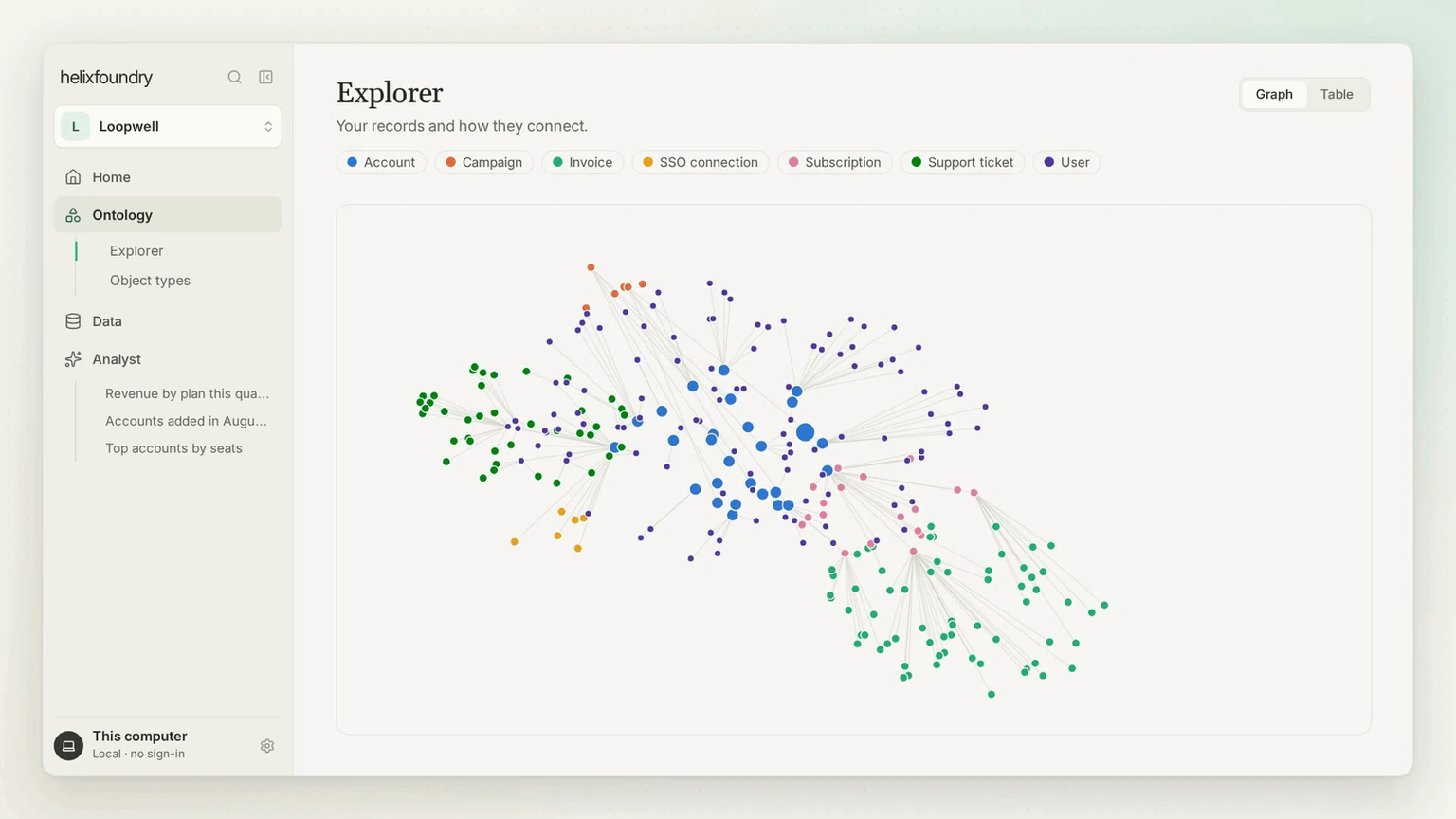
Helix Foundry is described as a Docker Compose application. setup.sh writes encryption keys into .env, then builds and starts the app, a background worker, a DuckDB executor, HelixDB and Ollama. Health is checked at http://localhost:3001/api/health. Guided setup walks AI → Data → Ontology: choose Local, Claude or OpenAI; connect sources or continue with sample data; confirm a suggested ontology.
Connectors named in the README include Neon, Supabase, PlanetScale, PostgreSQL, MySQL, Stripe, WorkOS, PostHog, REST APIs, S3-compatible storage, file uploads (CSV, JSON, JSONL, Parquet) and an ingestion API. Automatic sync uses native PostgreSQL and MySQL change capture where the database allows it, otherwise scheduled snapshot refreshes. Versioned data is stored as immutable Parquet snapshots with profiles, schema-drift review and history, queried by isolated DuckDB processes.
The ontology layer stores matched customers and records as HelixDB objects and relationships. Home and Analyst surfaces expose key metrics and natural-language questions backed by executed SQL with snapshot citations. Developer access includes OpenAPI at /api/docs, a TypeScript SDK, scoped API tokens, and backup, restore and upgrade scripts.
| Layer | What the docs claim | What that is not |
|---|---|---|
| Ontology | HelixDB objects and relationships | A hosted Palantir tenant |
| Analytics | DuckDB over immutable Parquet snapshots | A live write-through warehouse |
| AI default | Local Ollama qwen3:4b | A frontier API included for free |
| Install | Docker Compose + setup.sh | A Windows-certified installer |
What do the validation notes actually cover?
docs/VALIDATION.md is explicit that results come from a local development machine and are not a production SLA. Most verified paths were recorded on 23–24 September 2026. A publication-read benchmark and tests of rewritten backup, restore and upgrade scripts are dated 10 October 2026.
Verified paths listed include HelixDB persistence and relationships, DuckDB Parquet ingestion with isolation from files/network/undeclared inputs, owner bootstrap and scoped tokens, MySQL 8.4 discovery streaming, REST and S3 fixtures, native Ollama plus Claude and OpenAI adapters, and Chromium acceptance of login and Add-data flows. The rewritten backup, restore and upgrade scripts had, as of that document, run only against a stub docker in tests—not against a real Compose installation.
A local AI workflow note says a clean reference workspace completed a goal-to-review path with digest-pinned qwen3:4b: three catalog entries, one SQL pipeline, Customer and Order types, a relationship, and a two-widget dashboard after automatic validation repairs. Six local model calls, 14,516 reported tokens, and about 153 seconds from first stage to ready proposal are the authors’ measurements on that machine. We did not reproduce them.
How should teams try it without over-claiming?
Start from the README’s health-check path on a machine that already runs Docker Compose v2, then use sample data before pointing connectors at production credentials. Treat AI-proposed ontology edits as drafts that wait for review—the README’s own framing. If you need an agent sandbox rather than an ontology workspace, compare with AWS Strands Box or Postman Agent Mode on Bedrock.
On Apple Silicon the README recommends native Ollama because Docker cannot use Metal. Changing PUBLIC_PORT without PUBLIC_ORIGIN is called out as a 403 Origin failure on every save. Those are operational details from the docs, not problems we hit ourselves.
Secondary articles sometimes call Foundry a Palantir alternative. The primary README never uses that trademark comparison. Keep competitive claims in the secondary column until you run your own connector matrix and ontology review.
What remains unverified?
We did not clone HelixDB/helix-foundry, run setup.sh, ingest Stripe or Postgres data, or ask Analyst a question. We did not measure cold-start time, Parquet expansion ratios, or Ollama token rates. We did not audit the September versus 10 October validation sections beyond reading the markdown we hashed.
Star counts move. The API object we opened on 11 October showed more than 1,000 stars; that is interest, not quality. Absence of a GitHub Release tag means readers should pin a commit SHA if they need a reproducible install.
This article is an evidence review of the README, LICENSE, GitHub API object, AGENTS.md and VALIDATION.md as opened on 11 October 2026. It is not a first-hand Foundry deployment and not a ranking against commercial ontology platforms.
Common questions
Is Helix Foundry the same product as Helix Cloud?
No. The README presents Foundry as a local workspace with no accounts and nothing to host. HelixDB’s separate site describes Helix Cloud as a managed option for the database engine. We did not open a Cloud signup.
Does local AI stay on the machine?
The README says AI runs locally by default through Ollama and qwen3:4b. If you choose Claude or OpenAI during setup, prompts and context for those requests go to the selected provider. Keys are entered in the browser, not handed to a coding agent.
Is Windows supported?
The Requirements section says Foundry is developed and validated on macOS with Apple Silicon, CI runs on Linux, and Windows is untested. Scripts need bash.
What to remember
Helix Foundry’s useful signal is an Apache-2.0, Docker-local ontology and analytics workspace with optional on-machine AI—not a vendor bake-off against Palantir or a cloud control plane.
Sources & further reading
How this story was made
Written by Kristian Kostov with AI assistance and checked against the linked sources. Company performance claims are attributed to the company. Analysis reflects AiLookout’s interpretation; we have not independently tested the products discussed. Cover photography is illustrative and does not depict the specific announcement or product.
Our editorial standards