Announced 13 Oct 2026 · Sources checked
What did Google announce on 13 October?
In a Keyword post titled “New on Google Play: More ways to create, discover, and play”, Sam Bright, Google’s vice president and general manager for Google Play and the developer ecosystem, said Play is becoming “the place you go to connect with the ones that you create.” The headline feature is personal apps: Android apps that people build with AI and run privately through Play.
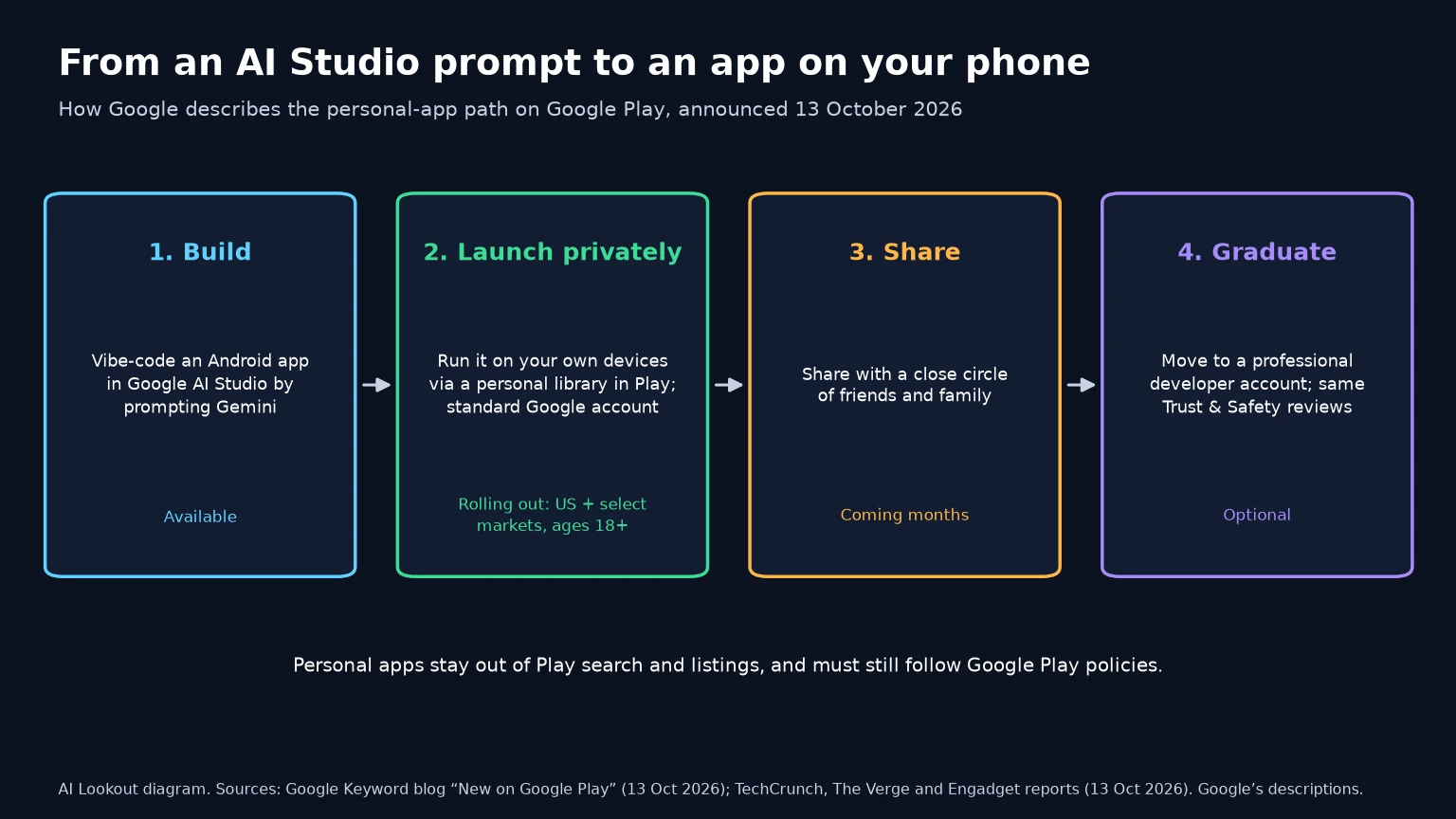
“Using Google AI Studio, you can vibe code a custom Android app,” the post says, and “through Google Play you can now launch these personal apps on your own device.” Only a standard Google account is needed, with “no developer account required.” Google says the feature starts rolling out on 13 October in select markets, including the US, for users 18 and over.
The announcement came with a wider set of Play changes: AI app comparisons in Ask Play, broader Play in Gemini, a new Game Finder, social gaming features and age-range sharing for families.
Google also published a companion post for developers on the Android Developers Blog describing new tools and quality incentives.
How do personal apps on Google Play work?
The flow starts in Google AI Studio, Google’s web tool for building with Gemini. Engadget explains that AI Studio can generate an app from a written prompt, which you can then refine with more prompts or by editing the generated code yourself. The Verge notes that Google first let people vibe-code personal Android apps in AI Studio in May; what is new is how they reach a phone.
Until now, running such an app on Android meant either publishing it to the public Play Store, available to billions of users, or sideloading it. The Verge says you no longer need to connect your phone to a computer to install it. Engadget adds that Google has made sideloading more complex over the past year, so the new route removes a growing hurdle.
Launched apps appear in what Engadget describes as a “personal library” section of the Play Store, available on your own devices, including tablets and computers that have Play. Google says the apps stay “private, secure, and separate from the public store catalog.” TechCrunch reports that they will not appear in Play search or listing pages and are not shared with anyone except their creator.
Google’s plan has two further steps. In the coming months, people should be able to share personal apps with a close circle of friends and family. If an app proves worth publishing, Play will help its creator “graduate” to a professional developer account, at which point it goes through the same Trust and Safety reviews and quality standards as any other app.
Who can use it, and what are the limits?
Availability is limited at first. Google names the US as one of several select markets but does not list the others, and the feature is for people 18 and over. Sharing is not yet available.
TechCrunch reports that personal apps must still comply with Google Play’s existing policies, even though they skip public review. Google does not say in its post what checks, if any, a personal app goes through before it runs, or what happens if one breaks a policy after launch.
The tool chain is also Google’s own. The announcement describes building in AI Studio; it does not say whether apps made with other AI coding tools, such as Android Studio, Claude Code or Cursor, can use the same no-account path.
Anyone weighing AI app builders can compare this with Google’s no-code Playground game maker, which opened to US adults a week earlier with access tiered by Google AI subscription.
Privacy and security matter more when people install code they did not write line by line. A vibe-coded app can request the same permissions as any Android app, so it is worth reading what an AI-generated app asks for before granting access to contacts, location or files.
What else is new for people using Google Play?
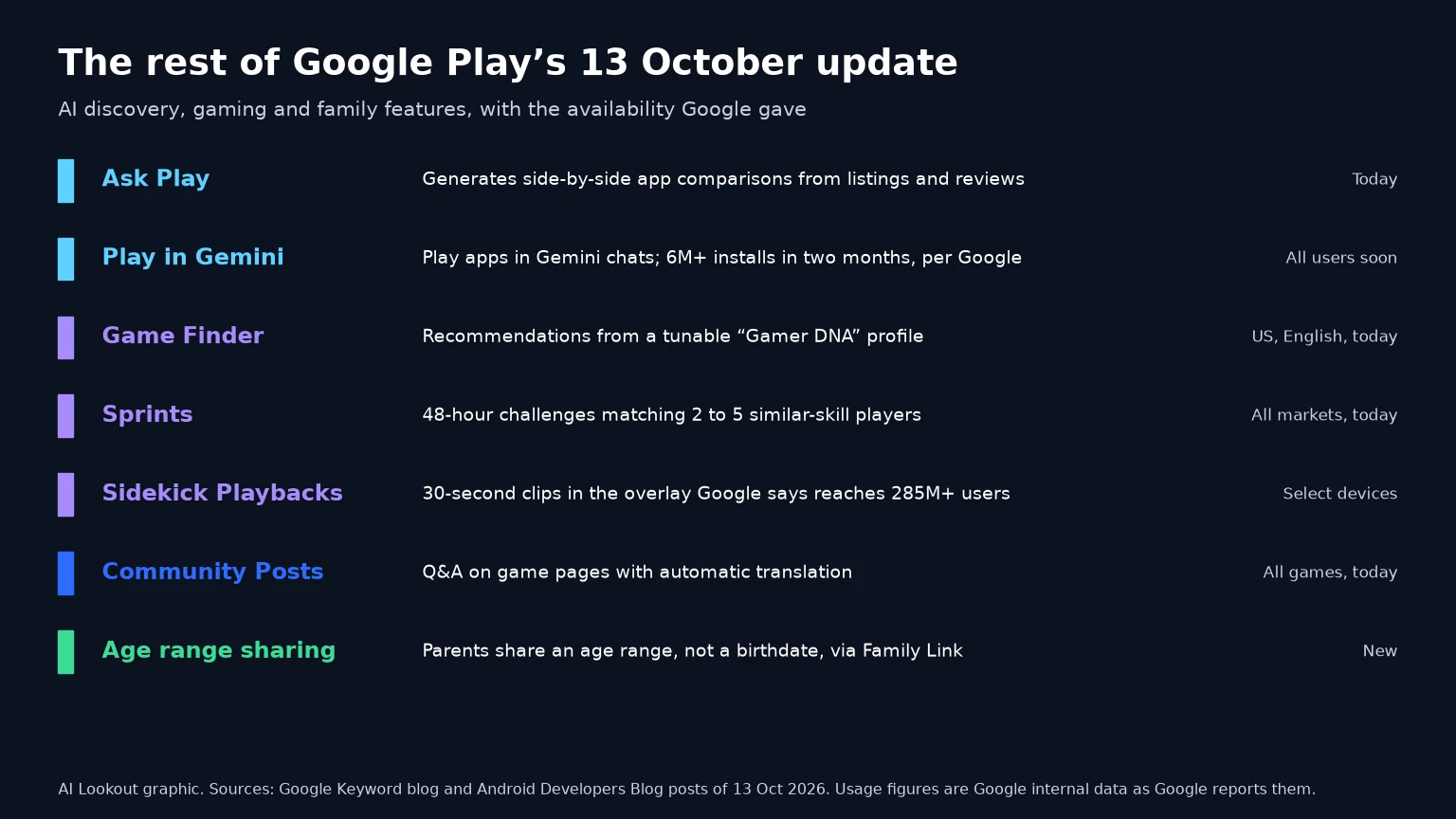
Ask Play, the conversational search Google introduced earlier this year, can now generate side-by-side comparisons of apps. The developer post says it summarises store listings and user reviews to compare details such as subscription models or offline features.
Play in Gemini brings Play apps, games and developer content into Gemini conversations, and Google says it will reach all Gemini users soon. The developer post says conversations in Gemini drove more than 6 million app installs in the two months after launch, and that Gemini Live can now give the same recommendations by voice. The newly available Gemini 4 Argon shows how much Google is routing through the Gemini app.
For games, Game Finder recommends titles using what Google calls Gamer DNA, an analysis of how you play plus preferences you set, and draws on a community Google puts at more than 2 billion players. It is rolling out in English in the US. Game Playlists let people curate collections, with sharing to come.
Social features include Sprints, 48-hour challenges that match two to five players of similar skill, rolling out in all markets, and 30-second Playbacks recorded in the Sidekick overlay on select devices. Community Posts add a question-and-answer area to every game’s page, with automatic translation. Parents can also share a child’s age range, not an exact birthdate, with apps through Family Link.
What changes for app developers?
Paul Feng, Google Play’s vice president of product management, gives developers a checklist for the new AI discovery surfaces: keep listings and events fresh, upload high-resolution media, test deep links in a new Play Console emulator, and integrate the Engage SDK, which now supports nine content categories.
Games can share basic gameplay events through Game Stats to show streaks and join Leagues and Sprints, and Play Games Rewards is now generally available for in-game rewards that sync with Play Points. Google says Sidekick has reached more than 285 million users.
Google also points to its Apps Experience and Level Up programs, which reward apps that meet quality guidelines with lower service fees. Both are available in Australia, Japan, the EEA, the UK and the US, and are due in Korea by the end of the year. Google cites partner data for PUBG MOBILE showing a 22% rise in new installs from high-value players; those figures are Google’s and its partner’s.
Why does this matter?
Personal apps formalise something many people already do: ask an AI model to build a small tool for one job, such as a family chore tracker or a team roster. TechCrunch says the difficulty of getting such apps onto Android pushed many vibe-coders toward web apps. Removing the developer-account step makes native Android a realistic target.
It also keeps those apps inside Google’s systems. Instead of sideloading files from unknown sources, users install through Play, under Play policies and with a defined path to public review. Engadget frames the wider update as Google trying to stay competitive now that third-party app stores can be installed through Play.
For Google, the feature ties AI Studio, Gemini and Play into one loop. It also fits Android’s on-device AI work, from the AISeal protected VM for personal context to Gemini integrations, in which Play is less a catalogue of finished apps and more a place where personal software is created and run.
What is still unclear?
Google has not given a date for sharing personal apps, named the markets beyond the US, or said whether personal apps count against any usage limits in AI Studio. Its post does not describe how updates to a personal app reach your devices.
It also does not say how personal apps are screened. Google says graduating to a developer account brings the full Trust and Safety review, which implies personal apps get lighter treatment; the details will matter if sharing opens to wider groups.
AI Lookout has not tested the feature, which was only beginning to roll out when we read Google’s posts. Hands-on reports should show how smooth the AI Studio to Play path is, and how well the generated apps work on real devices.
Common questions
Do I need a Google Play developer account to run my vibe-coded app?
Not for personal use. Google says apps built in Google AI Studio can be launched through Google Play on your own devices with a standard Google account. You only need a professional developer account if you want to publish the app publicly.
Can other people install my personal app?
Not yet. Personal apps are private to their creator and do not appear in Play search or listings. Google says sharing with a close circle of friends and family will come in the coming months.
Where is the feature available?
Google says it is rolling out from 13 October 2026 to users 18 and over in select markets, including the US. It has not published the full list of markets.
What to remember
Google Play now gives AI-built Android apps a private route to your own phone: build in AI Studio, launch through Play with a normal account, and graduate to public release later. It starts with US adults and select markets, with sharing still to come and screening details still unclear.
Sources & further reading
- New on Google Play: More ways to create, discover, and play ↗
- New ways to drive smarter discovery, deeper engagement, and business growth on Google Play ↗
- Google Play now lets anyone build private, vibe-coded apps that run on Android ↗
- Google makes it easier to launch your vibe-coded apps ↗
- Google will let you distribute vibe-coded Android apps with just a Google account ↗
How this story was made
Written by Kristian Kostov with AI assistance and checked against the linked sources. Company performance claims are attributed to the company. Analysis reflects AiLookout’s interpretation; we have not independently tested the products discussed. Cover photography is illustrative and does not depict the specific announcement or product.
Our editorial standards