Announced 28 Oct 2026 · Sources checked
What Google announced
The Decoder reported on Google's Android Dev Summit announcements on 28 October 2026, led by the 'Bring Your Own Agent' feature in Android Studio Rabbit 2. Developers are no longer limited to Google's own AI tools: using the open Agent Client Protocol, they can run more than 40 different coding agents directly in the IDE.Developers can install and simultaneously run Anthropic's Claude Agent, OpenAI's Codex, and Google Antigravity through a built-in marketplace. These agents get direct access to IDE tools like project structure, symbol resolution, the emulator and the Logcat system.
The Android CLI upgrades
Google expanded the Android CLI command-line tool for developers who run agents in the terminal or in CI pipelines. It is now available as an official agent plugin for Claude Code, OpenAI's Codex and Google Antigravity.
New commands let AI agents render Compose previews in the terminal to visually check UI changes without booting an emulator. Internal Google tests show agents finished UI tasks 77 percent faster and used up to three times fewer tokens with this feature. The CLI also supports streaming physical test devices from Google labs so agents can investigate device-specific bugs.
Debugging and performance
Google built the open-source LeakCanary memory-leak detection library into both the CLI and the Android Studio Profiler. The system evaluates heap dumps on the computer instead of the mobile device, which keeps the app from slowing down during testing.
In a Google A/B test using Anthropic's Claude Opus 5.5 model, the CLI tool helped find and fix memory leaks nearly twice as fast while cutting token usage by about 25 percent. Google says integrating LeakCanary into the Android CLI reduces both runtime and token usage for AI agents.
What it means
The announcement makes Android development explicitly agent-centric: instead of Google selling its own Gemini assistant as the only AI path into Android, the platform now treats any capable agent — Anthropic's, OpenAI's, or Google's own — as a first-class developer. The choice of the open Agent Client Protocol means the integrations are standard-based rather than proprietary.
For developers, the practical payoff is that their preferred coding agent can now drive the full Android toolchain, including emulator, Logcat, Compose previews and physical devices. The efficiency claims — 77 percent faster UI tasks, three times fewer tokens — are Google's internal measurements, but they point to where the agent-tools market is heading: fewer tokens and faster loops become the product.
What to watch
Watch whether the 77 percent and 3x token claims hold up in independent testing with a range of agents and projects.
Watch how Google balances its own Antigravity and Gemini tools against Claude and Codex in the marketplace.
Watch whether other IDEs follow Android Studio by making their agent integrations open and multi-vendor via ACP or similar protocols.
The ACP choice
The Agent Client Protocol is significant because it is an open standard for connecting coding agents to tools: instead of Google building proprietary integrations for Claude and Codex, the agents speak the same protocol Google itself uses for Antigravity. That lowers the barrier for any agent vendor to support Android tooling and makes the marketplace genuinely multi-vendor.
It also means developers can run multiple agents side by side and switch between them without changing their IDE setup — the same project structure, emulator and debugging tools are exposed to whichever agent is driving the session. Standardization here is what turns Android Studio from a product with an AI feature into a neutral host for the agent ecosystem.
The efficiency numbers
The 77 percent faster UI tasks and three-times-fewer-tokens figures are Google's internal measurements, and they come with the usual caveats: they were measured on Google's own tasks with Google's tooling and specific agents. But the direction of the claims matters more than the exact number — the new commands are designed to compress the agent loop by removing emulator boot times and giving agents direct visual feedback.
The LeakCanary A/B test using Claude Opus 5.5 — finding and fixing memory leaks nearly twice as fast with about 25 percent less token use — is a concrete example of how tooling changes agent economics. For teams paying for agent tokens at scale, that difference is real money.
Caveats
The agent marketplace and BYOA feature are newly announced; the report describes availability of the built-in marketplace and CLI plugins without detailing regional rollouts, pricing or any limitations on the 40+ agent count.
Google's efficiency claims are internal and have not been independently reproduced. The actual experience will vary by agent, project size and hardware.
Common questions
What is Bring Your Own Agent?
An Android Studio feature that lets developers run 40+ third-party coding agents in the IDE using the open Agent Client Protocol, instead of being limited to Google's tools.
Which agents are supported?
Anthropic's Claude Agent, OpenAI's Codex and Google Antigravity are available through a built-in marketplace, with 40+ agents supported via ACP.
What efficiency gains does Google claim?
Agents finished UI tasks 77 percent faster and used up to three times fewer tokens with the new CLI tools, per internal Google tests.
Sources & further reading
How this story was made
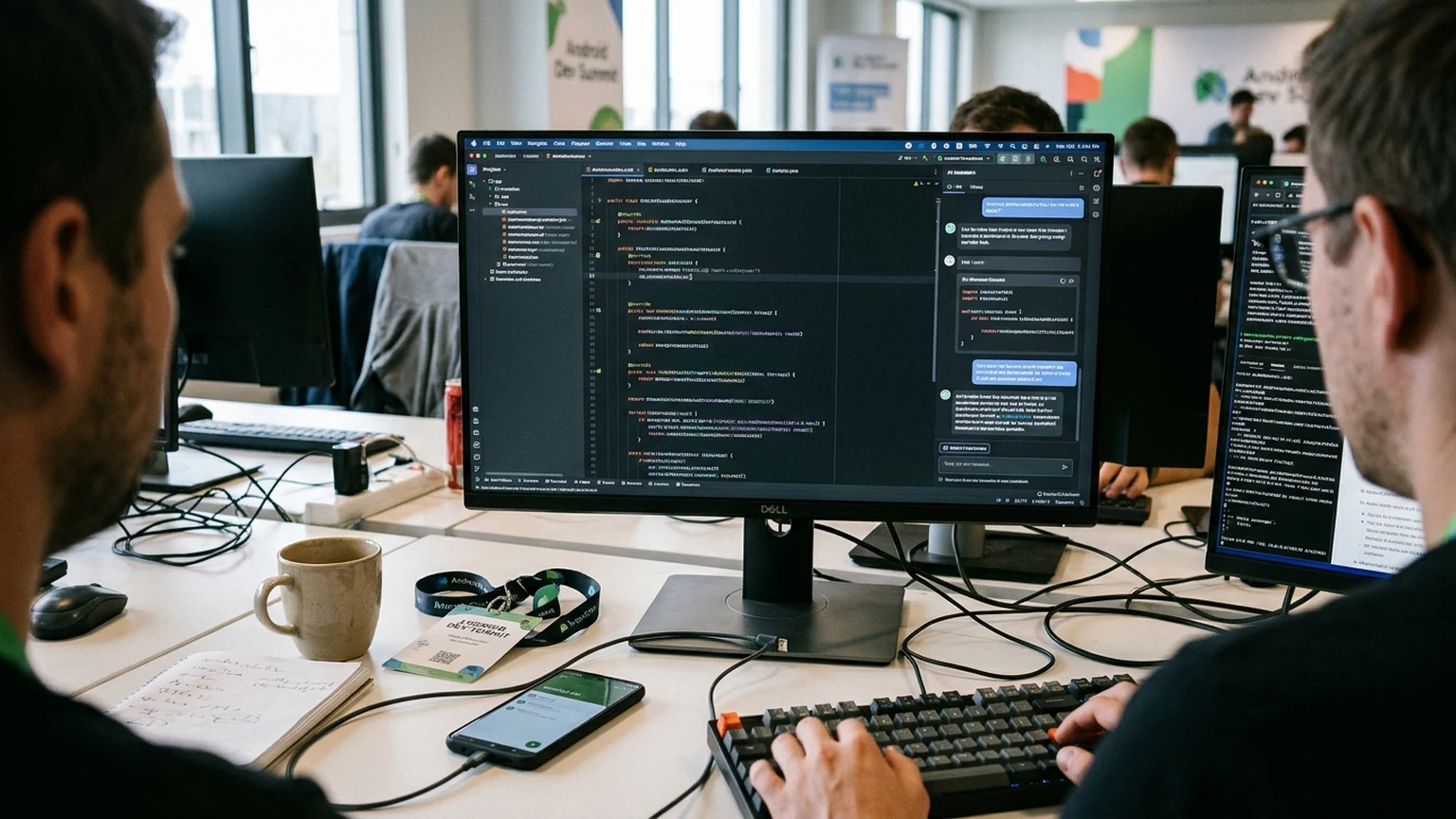
Written by Kristian Kostov with AI assistance and checked against the linked sources. Company performance claims are attributed to the company. Analysis reflects AiLookout’s interpretation; we have not independently tested the products discussed. The cover is an AI-generated editorial illustration, not a photograph or evidence of an actual event.
Our editorial standards