Announced 14 Oct 2026 · Sources checked
What did Google release?
Google Research scientists Rajesh Jayaram and Vincent Cohen-Addad announced the public release of Deep Review on 14 October 2026. Google describes it as an agentic AI system built to give rigorous feedback and technical verification on complex documents. It started as a tool for computer-science papers and now targets other long, claim-heavy documents too, including legal and financial material, design documents and presentations.
The pitch is aimed at what the post calls a validation bottleneck. Generative AI has sped up the writing of papers, proposals and code, but the human capacity to verify that work has stayed largely fixed. Reviewing a long manuscript or a complex contract needs specialist knowledge and time, so information is being produced faster than it can be checked. Deep Review is Google’s attempt to automate the most tedious parts of that checking while leaving final judgment to people.
Google positions it as useful in two moments: during drafting, as an iterative improvement tool, and during review, to check claims, evaluations and the scientific process. The tool lives at research.google/deepreview.
Where Deep Review came from: the Paper Assistant Tool
Deep Review is the renamed, expanded version of the Paper Assistant Tool, or PAT, an experimental project that helped researchers stress-test manuscripts before conference deadlines. Over the past year Google partnered with four flagship computer-science conferences, STOC 2026, ICML 2026, NeurIPS 2026 and ICLR 2027, to give private, pre-submission feedback to authors of more than 16,000 manuscripts who opted in. Conference organizers wrote up the program themselves, including an ICML retrospective and a NeurIPS announcement.
Google stresses that the pilots were separate from official peer review. Authors chose to receive feedback in the weeks before the deadline, the analysis never fed into accept or reject decisions, PAT collected no data for training, and papers were deleted from Google systems after each program ended. Google says author reactions were extremely positive, though the post summarizes satisfaction in a chart rather than publishing a full survey.
The method is described in a June 2026 preprint, “Towards Automating Scientific Review with Google’s Paper Assistant Tool”. Its abstract reports that inference scaling let PAT find deeper issues than a single model call, with a 34 percent improvement over zero-shot recall on mathematical errors in the SPOT benchmark. Google adds that Deep Review now runs on Gemini 4 Argon, so current capability should exceed the older PAT versions described there.
How the four-stage review pipeline works
Google’s explanation of why it needed a pipeline is candid: single-prompt model calls often fail on long, complex documents because they exhaust their reasoning budget, miss dependencies between distant sections, or accept nuanced claims without checking them. Deep Review splits the job into four stages.
First, a segmenter agent breaks the document into logical, possibly overlapping segments that must together cover all of the content, such as introduction, methods and experiments. Second, adaptive budgeting inspects how dense each segment is and allocates compute accordingly, so a section full of proofs can get far more reasoning than a related-work section. Third, specialized reasoning agents review the segments in parallel; each sees the whole document for cross-references but focuses on its own section.
Fourth, a synthesis agent merges the segment reports, checks consistency across sections, reruns logical checks if needed, and performs external grounding and tool calls as a final guard against hallucinations. Google says the result checks logical consistency and mathematical statements, suggests improvements, grounds facts and compares the work with existing literature, while leaving higher-level judgments to humans.
Access, pricing and privacy terms
Access is tiered. Every user gets two complimentary document reviews per week. People with heavier workloads can connect a Gemini API key for higher usage limits and programmatic access through the Deep Review API, which Google suggests wiring into continuous-integration and drafting workflows. The post does not list per-review prices; usage beyond the free tier is tied to the user’s Gemini API account.
Inputs are limited for now to PDFs and plain text, with multi-file support coming soon. Google says that will let users run consistency checks across whole sets of related documents, spreadsheets and exhibits at once, which matters for contracts with schedules or papers with supplements.
The data terms are specific. Google says documents uploaded to Deep Review are never used to train, fine-tune or improve Google models, and are stored for one year solely so they can be shown back to the user in the Deep Review interface. That is a longer retention window than the PAT pilots, where papers were deleted after each program, and anyone uploading unpublished or confidential work should weigh it.
Beyond papers: legal, finance and Antigravity
Google argues that the reasoning used to check whether a proof holds up also applies to other documents where claims must be backed by evidence. Its examples are design documents, where Deep Review can catch unstated architectural assumptions and edge cases; presentations, where it checks that slides flow and that bullet takeaways match the charts; and legal and financial documents, where it checks internal consistency across clauses and data tables, flags ambiguous terms and grounds claims against evidence.
Developers get a second route. Google is introducing a Teamwork Deep Document Review Pattern in Antigravity, its agentic coding environment, built on the Teamwork multi-agent orchestration framework. It uses a hierarchy of agents with self-correction and segment-based rubrics to evaluate papers, drafts and proposals, and can be invoked with the /teamwork-preview command. That puts the same idea next to the coding agents Google is pushing with Gemini 4 Argon.
Why automated review is arriving now
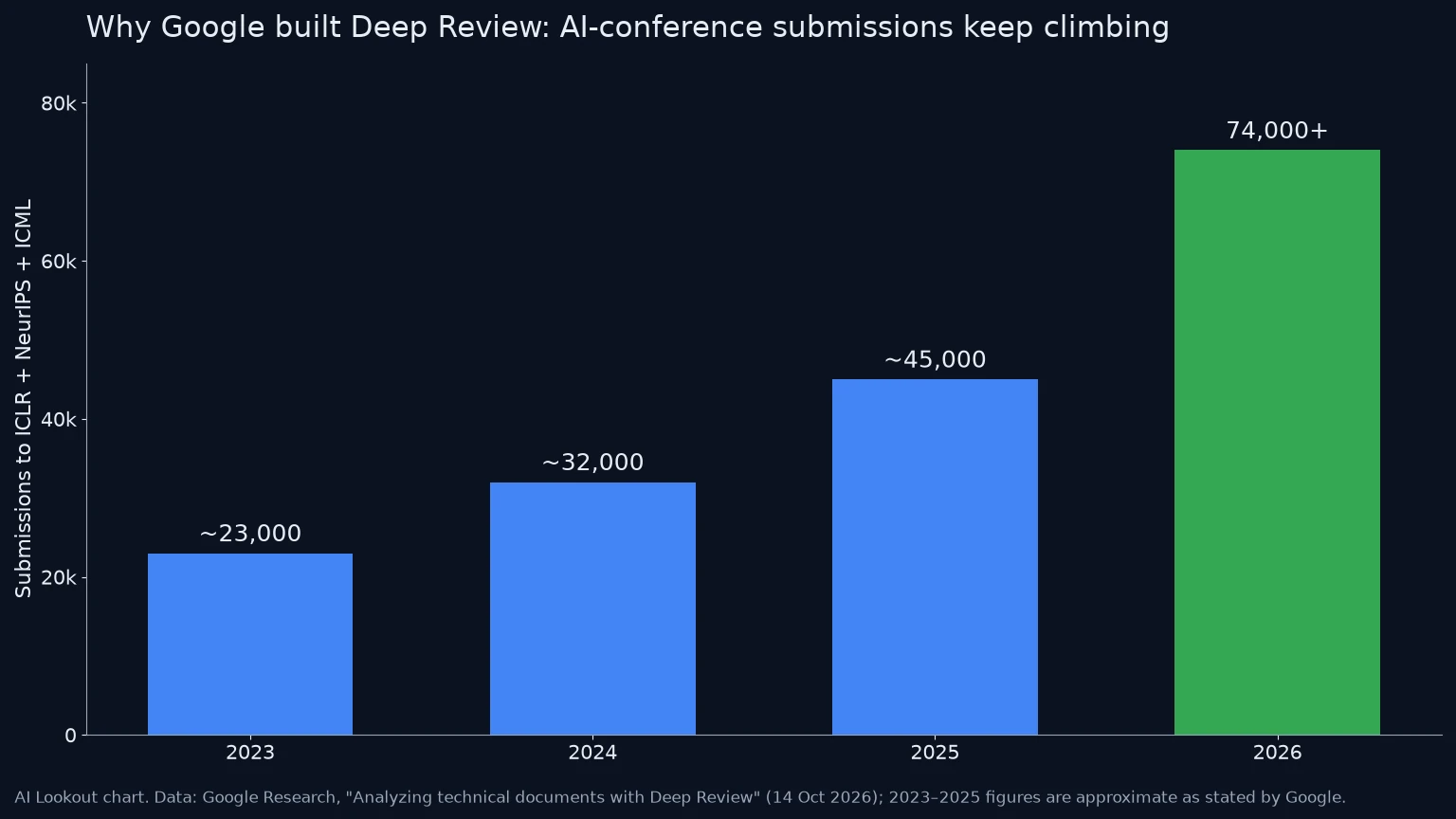
Google’s strongest argument is a number. It says three major AI conferences, ICLR, NeurIPS and ICML, received more than 74,000 submissions this year, up from about 45,000 in 2025, 32,000 in 2024 and 23,000 in 2023. Each paper needs several careful reviews, and the pool of qualified reviewers has not tripled.
At the same time, AI is producing more of the work that needs checking. OpenAI recently released hundreds of AI-written math manuscripts with Lean proofs, and Meta published ten health manuscripts drafted with its Muse models. Tools that can stress-test such output before it reaches human referees are becoming part of the research stack, not a novelty.
Google also frames access as an equity issue. Thorough pre-submission critique has usually depended on senior faculty, well-funded labs or strong peer networks. Free automated checks could give researchers outside those circles a way to catch avoidable flaws before submission.
What Google has not shown yet
The announcement does not publish error rates, false-positive rates or head-to-head comparisons with human reviewers for the public version. The SPOT result in the preprint is for an earlier PAT build and a specific benchmark of mathematical errors, not a general accuracy figure. Domain claims for legal and financial review are described as capabilities, without published evaluations in those fields.
There are also open questions about use in formal peer review. Google designed PAT as an author-side tool separate from conference decisions; how conferences will treat reviewers who run submissions through Deep Review, given confidentiality rules, is not addressed in the post. We have not used the tool ourselves, so we cannot yet report on output quality, speed or how often it flags real errors versus noise.
Common questions
Is Google Deep Review free?
Every user gets two complimentary document reviews per week. For more, Google says you can connect a Gemini API key for higher limits and API access; usage beyond the free tier runs through your Gemini API account.
Does Google train on documents uploaded to Deep Review?
Google says no: uploads are never used to train, fine-tune or improve Google models. They are stored for one year so they can be displayed to you in the Deep Review interface.
What file types does Deep Review accept?
PDFs and plain text at launch. Google says multi-file inputs are coming soon.
Sources & further reading
How this story was made
Written by Kristian Kostov with AI assistance and checked against the linked sources. Company performance claims are attributed to the company. Analysis reflects AiLookout’s interpretation; we have not independently tested the products discussed. The cover places the companies’ own logos, taken from public-domain or openly licensed files credited in the caption, on a plain background. It is not a product photograph, a screenshot, or an endorsement.
Our editorial standards