Announced 21 Oct 2026 · Sources checked
What Getty Images filed
Getty Images Holdings announced on 21 October 2026 that it had started voluntary Chapter 11 proceedings for certain of its US entities in the US Bankruptcy Court for the District of Delaware. It is a prepackaged case: the company has already agreed a plan of reorganization with its main lenders and the people who will own it, and has begun asking creditors to vote on it.
Chief executive Craig Peters called the filing "a procedural step to implement the financial restructuring previously announced" and said Getty continues to operate normally. The company expects no impact on contributors, partners, customers, employees or vendors, and plans to finish the restructuring by the end of the year once customary regulatory approvals are obtained.
According to PPC Land's reading of the disclosure statement, the plan would remove more than $500 million of roughly $1.46 billion in funded debt. Only US entities are in court; operations in the UK, Ireland, Canada, Japan, India and other countries are not debtors and account for about 44 percent of revenue.
Who ends up owning Getty
The deal was first announced on 12 October. Members of the Getty family, through affiliated entities, and affiliates of Koch Equity Development committed up to $533 million of new equity. Holders of 83.5 percent of Getty's unsecured bonds agreed to retire $270 million of senior unsecured notes, and holders of about 89 percent of its secured bonds and term loans, plus all revolving lenders, agreed to lower interest and extend maturities.
When the process ends, the Getty family and Koch will own 100 percent of the reorganized company, and Getty Images will be private again. Koch is also lending up to $143 million to fund the company during the case. PPC Land reports that existing shares are cancelled with no recovery and that the stock last closed at two cents on 20 October, after the New York Stock Exchange delisted it.
PPC Land also flags a gap it could not reconcile: the press releases say up to $533 million of equity, while the plan documents give about $433 million, less outstanding debtor-in-possession loans.
Why the company says it got here
Getty's own story is that its business is fine and its balance sheet is not. In the releases, the company says the process addresses its capital structure and "certain non-operating liabilities". PPC Land reports that the disclosure statement names three non-operational causes: litigation over warrants from Getty's 2022 stock market listing, the collapse of its planned merger with Shutterstock, and the debt that merger left behind.
On the warrants, PPC Land reports that courts awarded investors who were blocked from exercising them more than $200 million in judgments and interest over about four years, and that the plan seeks to wipe out about $99.5 million of pending judgments and an estimated $275 million or more of possible future claims.
The Shutterstock deal, signed in January 2025, cleared the US Justice Department but ran into the UK Competition and Markets Authority, which in May 2026 required the sale of Shutterstock's whole editorial business. Getty walked away in July. The disclosure statement, as quoted by PPC Land, complains that "the CMA did not credit the competition created by generative AI" and says the attempt cost more than $100 million in fees.
What the filing says about generative AI
Generative AI is not the official cause of the filing, but it runs through the company's own account of its market. PPC Land reports that the disclosure statement attributes shifts in demand to "the emergence of generative AI and changes in media consumption and marketing strategies", and says AI tools "have put pressure on the budget-conscious microstock image market", the low-priced segment served by iStock, which Getty calls a small part of its business.
The same document describes AI as a revenue line. Getty says it has licensed images, video and metadata to AI companies for training foundation models and powers AI search and discovery tools, naming Perplexity and OpenAI's ChatGPT. Its press releases also pitch Getty and iStock image generators trained only on permissioned content, sold with indemnification and perpetual worldwide usage rights. The filing gives no breakdown of how much any of this earns.
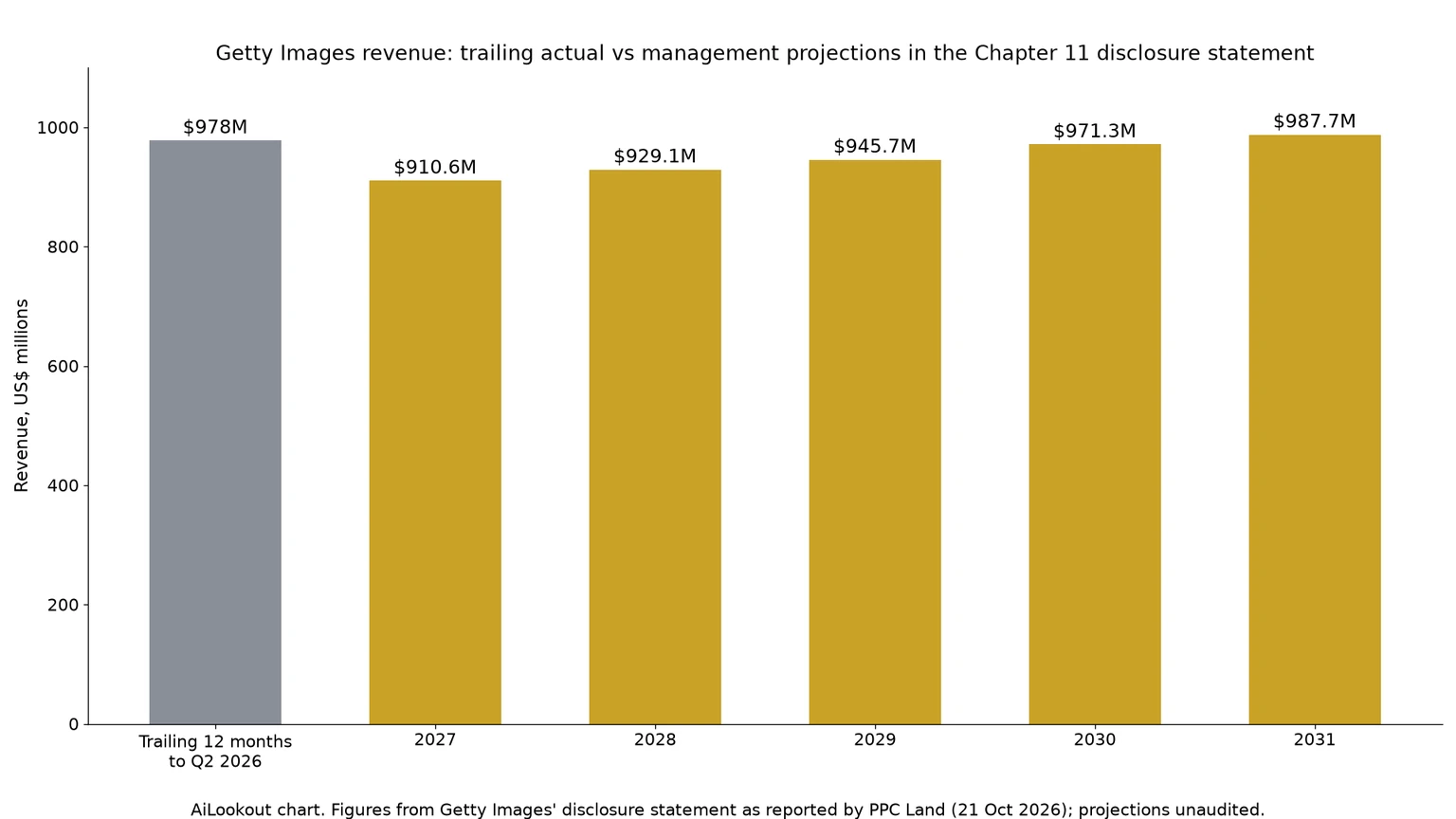
Getty's investment banker, Guggenheim Securities, valued the reorganized company at about $1.3 billion to $1.5 billion and said it took into account "the impact of artificial intelligence". Management projects revenue of about $910.6 million in 2027, below the roughly $978 million earned in the twelve months to mid-2026, rising back to about $987.7 million by 2031.
For the AI industry, Getty is one of the few large, rights-cleared image libraries that can license training data at scale. It is the second AI-adjacent company in the same Delaware court this month, after the chatbot maker Character.ai filed for Chapter 11 on 12 October, though Character.ai is selling its assets while Getty is keeping its business intact.
What changes for customers, photographers and AI licensees
Getty serves customers through its Getty Images, iStock and Unsplash brands and works with more than 600,000 content creators. The company says payments to vendors and contributors continue in the ordinary course, and it has asked the court for permission to keep paying wages, vendors and contributors as usual.
PPC Land reports that the plan assumes every licence agreement as it stands and states that the ownership change is not an assignment or a change of control under those licences. Counterparties who object must do so by 30 November; those who stay silent are treated as consenting. That matters to any AI company with a data or display licence from Getty, as well as to agencies and brands with enterprise subscriptions.
The case also lands as rights holders press AI companies in court elsewhere, from Canadian newspapers suing Anthropic to authors' groups rethinking AI deals. A privately held Getty, owned by its founding family and Koch, will keep negotiating those licences, but it will stop filing public reports with the SEC, so outsiders will see far less of how that business performs.
What we could not verify
AI Lookout read Getty's two press releases directly. Most of the detail on debt, warrants, AI licensing and projections comes from PPC Land's report on the 8-K and disclosure statement; the court documents are posted on the Kroll case website, which we could not open in a form we could read. Treat those figures as reported, not independently checked.
What happens next
According to PPC Land, voting and objections close on 30 November 2026, and a combined hearing on the disclosure statement and plan is set for 14 December. If the court confirms the plan, Getty aims to emerge as a private company around the end of the year. Points to watch include any objections from licence counterparties, what regulatory approvals the company still needs, and whether the new owners say more about AI licensing once the company no longer reports publicly.
Common questions
Is Getty Images shutting down?
No. Getty says it continues to operate normally during the Chapter 11 case and expects to emerge as a private company owned by the Getty family and Koch Equity Development by the end of 2026.
Did AI cause Getty Images' bankruptcy?
Not according to Getty. It names warrant litigation and the failed Shutterstock merger as the main causes, though its disclosure statement says generative AI has pressured the microstock market.
What happens to AI companies that license Getty images?
PPC Land reports that the plan keeps existing licence agreements in place and treats the ownership change as no change of control; counterparties have until 30 November to object.
Sources & further reading
How this story was made
Written by Kristian Kostov with AI assistance and checked against the linked sources. Company performance claims are attributed to the company. Analysis reflects AiLookout’s interpretation; we have not independently tested the products discussed. Cover photography is illustrative and does not depict the specific announcement or product.
Our editorial standards