Announced 19 Oct 2026 · Sources checked
What fal launched
Generative media platform fal has launched FLUX 3 Max, a video generation model it post-trained on top of Black Forest Labs' FLUX 3. In a 19 October press release and a launch post by fal Research, the company says the model reaches top-tier image-to-video quality while producing a 10-second clip in roughly 11 to 12 seconds, close to real time for a model in this quality band.
FLUX 3 Max takes a text prompt or a still image and returns video at 720p. It runs only on fal's own inference platform through its API, and fal describes this as the first iteration of the model, with more post-training already under way. The company is pairing the launch with a 75 percent discount for the first three weeks.
Black Forest Labs, the German lab behind the FLUX image models, supplied the base model. Its chief executive Robin Rombach said in the release that the company built FLUX 3 "as a foundation for others to build on", and that FLUX 3 Max is an example of that. It is the second FLUX 3 spin-off this month, after BFL's own open-weight FLUX 3 Image Klein model for still images.
How fal built it on FLUX 3
fal is best known as an inference host: developers call its API to run hundreds of image, video and audio models without managing GPUs. FLUX 3 Max is part of a newer push in which fal's research team takes an existing foundation model and keeps training it, then tunes how it runs on fal's own serving stack.
The product page describes three layers of work. Post-training, done with Black Forest Labs, aimed to improve visual fidelity, motion coherence, prompt adherence and image-to-video quality. The press release adds that this included reinforcement learning. Inference optimization changed how the model executes to cut latency and raise throughput. Systems engineering tuned the serving path around the model so the speed holds up under production load.
fal has done this once before. Its earlier H3 Max model was a post-trained version of MiniMax's open H3 video weights, and fal says FLUX 3 Max applies the same recipe to a different base model. The launch post frames the partnership as an example of what becomes possible when model developers give specialised teams access to their weights. fal has not said whether FLUX 3 Max's own weights will be released; as launched, it is a hosted model.
The speed claim, and why fal's numbers do not agree
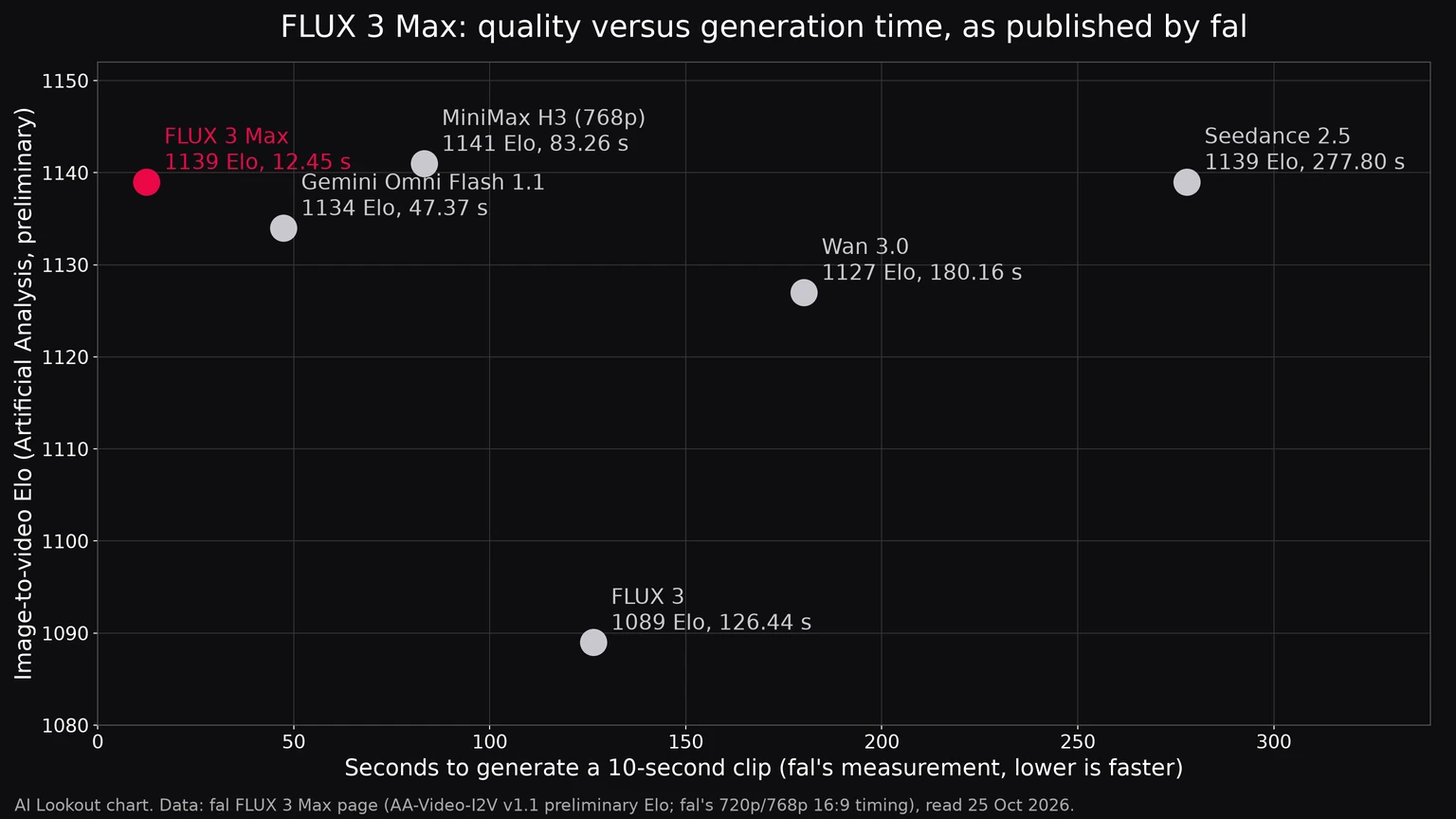
Speed is the headline claim, and fal's three launch documents do not quote the same figures. The press release says FLUX 3 Max generates a 10-second video in 10.95 seconds, against 277.80 seconds for ByteDance's Seedance 2.5 and 126.44 seconds for the original FLUX 3. It calls that more than 22 times faster than Seedance and 11.5 times faster than FLUX 3.
The product page and the launch post both give 12.45 seconds instead. The product page still says about 22 times faster than Seedance, which matches 12.45 seconds, and about 10 times faster than FLUX 3. The launch post uses 12.45 seconds too, but describes it as 26.5 times faster with 96.2 percent lower latency, ratios that would fit a time closer to 10.5 seconds. fal's materials do not explain the difference, so AI Lookout reports each figure as published.
The gap is small in practice. Any of these numbers puts FLUX 3 Max far ahead of most models fal compared it with. But it shows that the timings are fal's own benchmark runs, on its own hardware and serving stack, for a 16:9 clip at 720p, rather than a measurement anyone outside fal has reproduced. Generation time on fal will also depend on queueing and load, which a benchmark does not capture.
What the quality ranking does and does not say
For quality, fal leans on Artificial Analysis's video arena, where people vote blind between pairs of clips. According to the release, FLUX 3 Max scored 1,139 Elo in the image-to-video arena across 4,868 votes in a preliminary evaluation, 50 points above the original FLUX 3 at 1,089. The launch post describes the gain as 47 points, another small mismatch between the documents.
The product page's comparison table, charted below, lists MiniMax H3 at 1,141, FLUX 3 Max and Seedance 2.5 at 1,139, Google's Gemini Omni Flash 1.1 at 1,134 and Wan 3.0 at 1,127. fal says FLUX 3 Max is "tied for #1" because its confidence interval overlaps the leaders, while noting that MiniMax H3 is listed first on that board. That is a fair reading of overlapping intervals, but it is not the same as being the top-rated model.
Two caveats follow. The Elo figures are labelled preliminary, so they can move as more votes arrive. And they cover image-to-video only. fal's materials do not quote a text-to-video arena score for FLUX 3 Max, even though text-to-video is one of its launch endpoints.
Price, endpoints and how to use it
fal bills FLUX 3 Max per second of output video, with no minimums or subscription, and charges the same for text-to-video and image-to-video. The list price is $0.17 per second at 720p. Until 7 November the launch discount cuts that to $0.0425 per second, so a 10-second clip costs about 43 cents during the promotion and $1.70 afterwards, before any further changes fal makes.
Developers reach the model through fal's Python or JavaScript client, using model IDs such as blackforestlabs/flux-3-max/text-to-video and the image-to-video equivalent, which takes a prompt and an image URL. The API documentation lists the parameters. The press release and launch post also mention a keyframes-to-video mode, though the product page's FAQ, updated on 18 October, lists only the first two endpoints at launch.
fal says content generated through its API can be used in commercial projects, subject to its terms of service. Its product page also links each sample prompt to runs in ChatGPT and in fal's own agent, which suggests the model is reachable from those tools as well as the raw API.
Who it is for
The pitch is aimed at teams that generate a lot of clips and iterate on them. fal argues that a fast model at top-tier quality removes the usual split between a cheap draft model and a slow final model: "the take you iterate on is the take you ship." That matters for ad studios, app developers and creative tools that need many variations of a shot, a market where rivals such as Kling 4.0 with its 30-second clips and HeyGen's picture-and-sound video model are competing hard.
Because FLUX 3 Max and H3 Max sit on the same API, fal also suggests moving a shot between them by changing one model ID. H3 Max adds native audio, which FLUX 3 Max's materials do not mention, so teams that need sound may still pick it or pair FLUX 3 Max with a separate audio step.
Limits and open questions
Most of what is known about FLUX 3 Max comes from fal itself. The speed figures are internal, the quality ranking is preliminary, and the sample clips on the product page are fal's own selections, described as one pass per prompt with no editing. AI Lookout did not generate any videos with the model for this article.
The launch materials also leave out details buyers usually want: maximum clip length is not stated in the documents we read, there is no word on resolutions above 720p, and fal does not describe the training data used in post-training or any safety filtering beyond its general terms. The discount ending on 7 November means the real cost comparison with other hosted video models will only be clear after that date.
Why it matters
FLUX 3 Max is a sign of how the video model market is changing. Instead of every lab training from scratch, inference platforms are starting to take strong base models and make their own tuned versions, competing on speed and price as much as on raw quality. For Black Forest Labs, partnerships like this spread FLUX 3 to more developers without BFL running the service itself. AI video is also moving into longer productions, as Grok Imagine's AI-made Odyssey episode showed recently, which makes generation speed a real cost factor.
What to watch next is whether independent testers confirm fal's timings, whether the Artificial Analysis score holds once it is no longer preliminary, and what fal's next round of post-training changes. Until then, FLUX 3 Max is best read as a fast, competitively rated hosted video model with vendor-reported numbers, not a proven leader.
Common questions
What is FLUX 3 Max?
A video generation model from fal Research, post-trained in collaboration with Black Forest Labs on BFL's FLUX 3. It turns text or an image into 720p video and runs on fal's API.
How fast is FLUX 3 Max?
fal's press release says 10.95 seconds for a 10-second clip; its product page and launch post say 12.45 seconds. Both are fal's own benchmarks, compared with 277.80 seconds for Seedance 2.5.
How much does FLUX 3 Max cost?
$0.17 per second of output video at 720p, discounted to $0.0425 per second until 7 November 2026, billed per second with no subscription.
Sources & further reading
How this story was made
Written by Kristian Kostov with AI assistance and checked against the linked sources. Company performance claims are attributed to the company. Analysis reflects AiLookout’s interpretation; we have not independently tested the products discussed. The cover places the companies’ own logos, taken from public-domain or openly licensed files credited in the caption, on a plain background. It is not a product photograph, a screenshot, or an endorsement.
Our editorial standards