Announced 20 Oct 2026 · Sources checked
What ElevenLabs launched
ElevenLabs has launched Eleven Realtime, two speech-to-speech models for building voice agents: Eleven Realtime v1 Mini and Eleven Realtime v1 Max. The company announced them on 20 October 2026 in a launch post that pitches each model as "a complete voice agent" you pick from a single menu, instead of assembling speech recognition, turn detection, a language model and text-to-speech yourself.
Both models support more than 90 languages and can use any of the more than 17,000 voices in the ElevenLabs library. They are available inside ElevenAgents, the company's platform for running voice agents on the phone, the web and messaging channels, and through a new Realtime API that speaks the same protocol as OpenAI's Realtime API.
ElevenLabs' argument is that the hard part of a voice agent is not the voice but the timing: how long to wait after a pause, how to recover when a caller interrupts, and when an "mm-hm" means keep going. In ElevenAgents those are all adjustable settings. Eleven Realtime is the company's offer to tune them for you.
Mini or Max
ElevenLabs positions v1 Mini as the low-cost default for natural conversation. It recommends it for AI assistants, tutors and interactive characters and says it "will be sufficient for most use cases." The product documentation describes Mini as the default Realtime model, with the lowest latency and cost.
v1 Max is aimed at complex tasks such as customer support, lead qualification, scheduling and other multi-step workflows where an agent has to follow a process and call tools. According to the Realtime models documentation, Max "reasons before it responds" and costs more than Mini. The docs suggest starting with Mini and moving to Max when long instructions or multi-step tool calls are not handled well enough, or when the agent must run under Zero Retention Mode or HIPAA, which Mini does not support.
The benchmark numbers
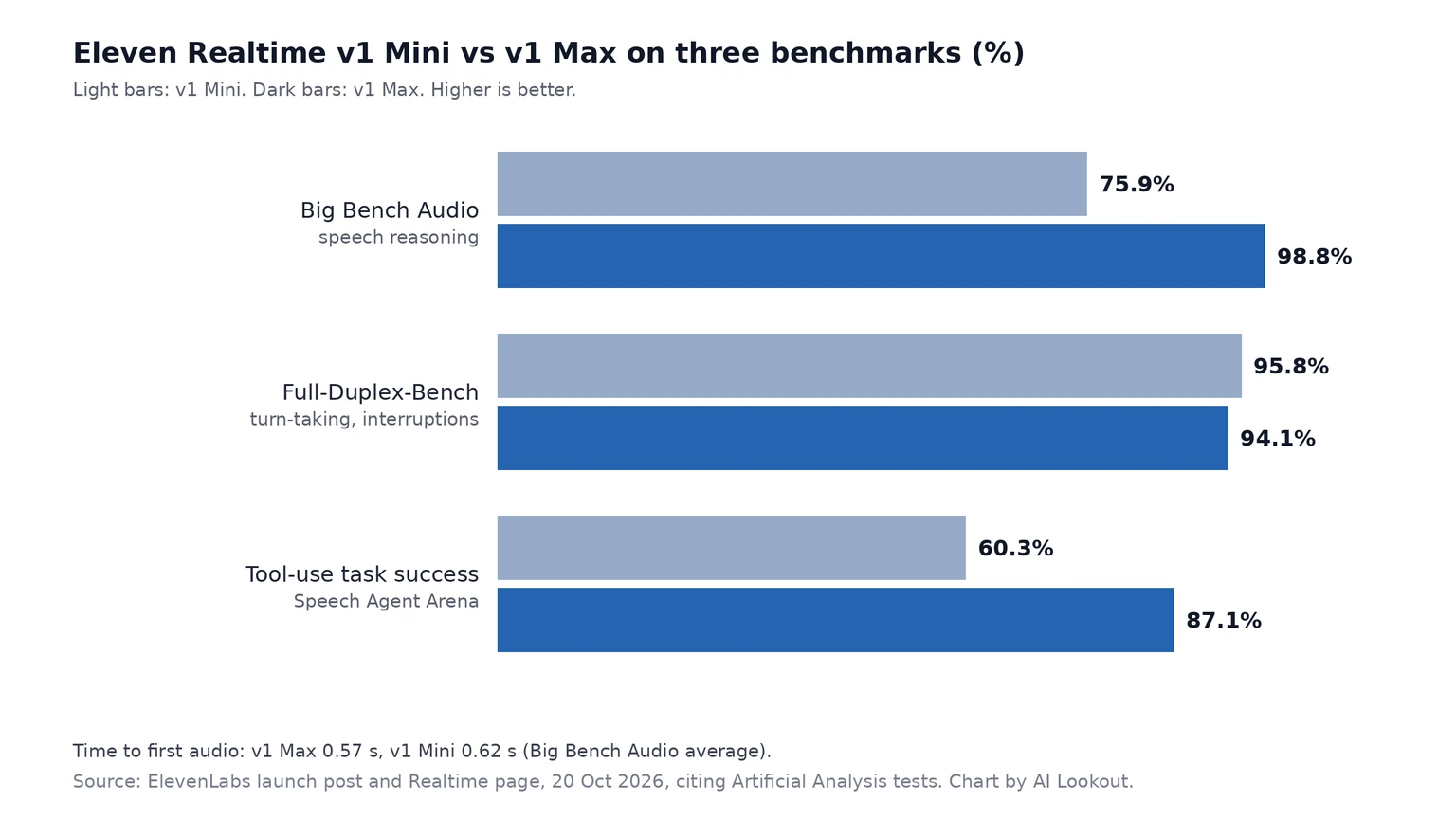
ElevenLabs says the analysis firm Artificial Analysis evaluated both models independently on three public benchmarks. On Big Bench Audio, which asks 1,000 reasoning questions by voice and scores the spoken answer, v1 Max answered 98.8% correctly and v1 Mini 75.9%. On the same test, Max started speaking after 0.57 seconds on average and Mini after 0.62 seconds.
On Full-Duplex-Bench, which measures pauses, turn-taking, interruptions and backchannels such as "mm-hmm", Mini scored 95.8% and Max 94.1%. In the Speech Agent Arena, where people compare two models in blind live conversations, Max scored 998 and Mini 988. On tool-use tasks Max completed 87.1% and Mini 60.3%, which is why ElevenLabs recommends Max for agents that call tools heavily.
The company claims Max sits on the frontier of accuracy and speed, since the most accurate models on Big Bench Audio are usually the slowest to answer. These figures come from ElevenLabs' announcement; AI Lookout has not run the models. Time to first audio measures how quickly speech starts, not how long an agent takes to finish a task.
Cascaded, not fused
Despite the speech-to-speech label, Eleven Realtime is not a single end-to-end audio model. The FAQ in ElevenLabs' OpenAI compatibility guide says both models "use a cascaded architecture" in which each component is a distinct model, optimised to work together as one system. Asked directly whether they are fused models, the guide answers no.
ElevenLabs also says the specifics of the underlying models are not public. Each component uses its latest research, but the company does not name the language model, transcription model or voice model inside Mini or Max. For buyers, that means the trade-off is control for convenience: you get a tuned package, but you cannot see or choose what is in it.
That matters when comparing results. The customer-experience publication CX Foundation points out that Artificial Analysis's leaderboard also lists ElevenLabs' existing default cascaded setup at 90.5% task success, against 87.1% for Max, with overlapping confidence intervals. In other words, the new package is not proven to beat a well-configured ElevenLabs agent on every measure.
How developers switch it on
In ElevenAgents, an agent now has a Voice mode setting: Custom, where you choose the language model, text-to-speech model and speech recognition yourself, or Realtime, where you pick Mini or Max and ElevenLabs manages those settings. The agent's system prompt, voice, tools, knowledge base and turn settings carry over unchanged, and switching back to Custom restores the stored configuration. The same switch is available through the CLI and the API with a realtime_model field.
Developers already using OpenAI's Realtime API can try the models by changing the endpoint and model name. ElevenLabs says its API uses the same client and server events over the same WebSocket transport, so OpenAI's own SDK works as is: a backend mints a short-lived client secret and the browser connects to ElevenLabs instead of OpenAI.
There are caveats. The Realtime API is WebSocket only, so apps built on WebRTC have to change transport first, and the guide covers browser connections only; documentation for server-side OpenAI Realtime SDKs is not published yet. The standalone API also runs separately from ElevenAgents, so phone channels, knowledge bases and other platform features require building on ElevenAgents.
Pricing and availability
ElevenLabs' API pricing page lists both models at $0.08 per minute of connected audio plus language-model usage. Token rates differ: the page shows $0.20 per million input tokens and $6.00 per million output tokens for one tier and $1.80 and $9.00 for the other, and the documentation confirms that Max costs more per token than Mini. Connected audio above a workspace's concurrency limit is billed at a burst rate of $0.16 per minute.
Availability is staggered. The documentation says Realtime models are rolling out gradually, and workspaces without access get an error saying Realtime models are not available. Mini is offered in the US, EU, India and Singapore data-residency environments; Max is available in the US and EU but not India or Singapore. Only Max can run under Zero Retention Mode or HIPAA, and only in the US and EU.
Rules and limits
Realtime mode comes with restrictions that ElevenLabs checks when an agent is published. It cannot be used with a custom language model or Amazon Bedrock, workflow nodes cannot override the managed settings, and Max needs a token limit of at least 1,024 or no limit. Text-only agents should stay in Custom mode.
Transfers are another trap. An agent in Realtime mode can only hand a call to, or receive one from, other Realtime agents, although transfers between Mini and Max work. If the Realtime model does not respond in time or returns an error, the agent falls back to backup language models under ElevenLabs' existing cascading rules.
How it compares
The launch lands in a crowded week for voice AI. SpaceXSI opened Grok Voice 3.0 in its Voice Agent API on 14 October at the same $0.08-per-minute list price. Mistral released Voxtral 3 and a voice agent SDK on 20 October, chaining separate transcription, language and speech models much as a Custom-mode agent does. OpenAI is rolling out GPT-Live-1.1 in ChatGPT Voice, and its Realtime protocol is the one ElevenLabs chose to copy.
For ElevenLabs, best known for voices and lately for tools such as Instant Soundtracks for video, the bet is that most teams would rather buy a tuned conversation engine than build one. Real deployments, such as Yelp's planned agent that phones restaurants, show why turn-taking and tool use matter. The open questions are cost per completed task, behaviour on real phone lines and how the hidden components change over time.
Common questions
What is Eleven Realtime?
A pair of ElevenLabs voice-agent models, v1 Mini and v1 Max, that bundle speech recognition, turn-taking, a language model and text-to-speech into one selectable model, launched on 20 October 2026.
Can I use Eleven Realtime with OpenAI's Realtime SDK?
Yes, for browser apps over WebSocket. ElevenLabs says its API uses the same events and transport, so you change the endpoint and model name; WebRTC apps must switch to WebSocket first.
How much does Eleven Realtime cost?
ElevenLabs lists $0.08 per minute of connected audio plus token charges, with v1 Max priced higher per token than v1 Mini and a $0.16 per minute burst rate above concurrency limits.
Sources & further reading
- Introducing Eleven Realtime: a simpler way to build natural voice agents ↗
- Eleven Realtime | Speech to Speech Voice Agents ↗
- Realtime models (ElevenAgents documentation) ↗
- OpenAI Realtime API compatibility (ElevenAgents documentation) ↗
- ElevenAPI pricing ↗
- ElevenLabs Wants to Take the Assembly Work Out of Voice AI ↗
How this story was made
Written by Kristian Kostov with AI assistance and checked against the linked sources. Company performance claims are attributed to the company. Analysis reflects AiLookout’s interpretation; we have not independently tested the products discussed. The cover places the companies’ own logos, taken from public-domain or openly licensed files credited in the caption, on a plain background. It is not a product photograph, a screenshot, or an endorsement.
Our editorial standards