Announced 14 Oct 2026 · Sources checked
What Colossal announced
Colossal Biosciences, the Dallas company trying to bring back the woolly mammoth, the thylacine and the dodo, announced an internal AI platform called GenoMorph on 14 October 2026. In its press release, Colossal says the system has identified an estimated 2,300 candidate regulatory DNA elements linked to the size and shape of a bird's beak, the first step toward deciding which edits might give a living pigeon the dodo's heavy, hooked bill and skull.
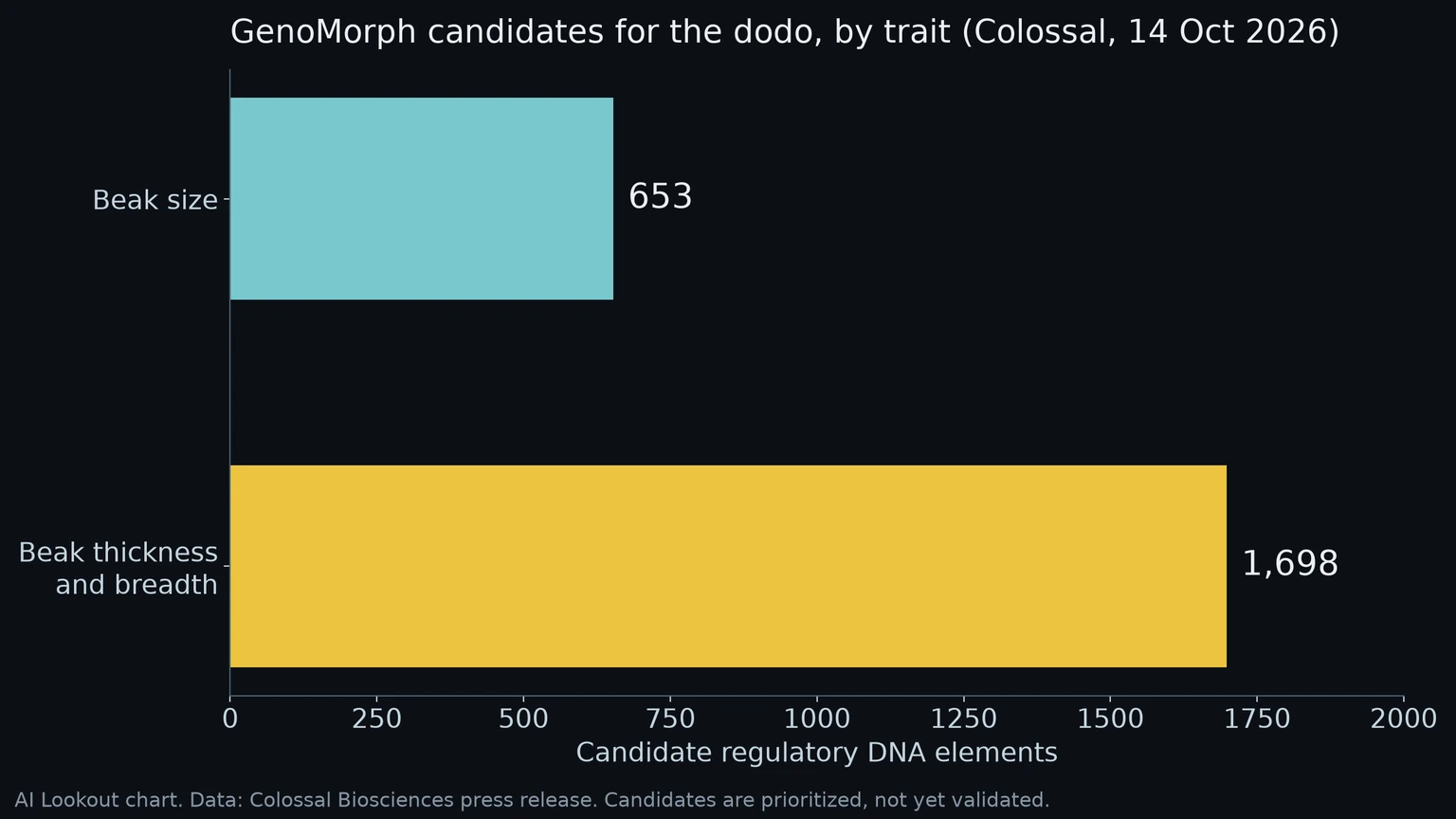
The breakdown is 653 candidates associated with beak size and 1,698 associated with beak thickness and breadth. Colossal is explicit that these are prioritized targets for experiments, not proven causes. The same announcement bundled several lab advances: a more complete dodo genome, a larger colony of Nicobar pigeons, new pigeon germ cells, chicken stem-cell chimeras and a lipid-nanoparticle system for editing genes inside bird embryos.
Colossal did not give a date for hatching a dodo or a dodo-like bird. A paper on the embryo-editing platform has been submitted to the bioRxiv preprint server, and the company says more dodo genome results will follow peer review.
Why the dodo needed a different approach
Most attempts to link genes to traits rely on comparing many individuals of the same species. That is impossible for the dodo. Colossal's own summary on its website says the company has assembled one high-quality dodo genome, compared with 104 for the woolly mammoth, because DNA degrades quickly in the hot, wet climate of Mauritius where the bird lived until the late 1600s.
Chief executive Ben Lamm put it this way in the release: de-extinction is as much a data problem as a biology problem, and with so few dodo genomes the company cannot use population-level comparisons. A single genome tells you what the dodo's DNA said, but not which of the hundreds of thousands of differences from a pigeon actually mattered for its appearance.
The target is also not ordinary genes. Protein-coding genes are the instructions for building an animal. Regulatory DNA decides when, where and how strongly those instructions are switched on during development. Those switches are thought to drive much of the difference in skull and beak shape between bird species, but they are much harder to spot by reading sequence alone.
How GenoMorph works
GenoMorph sidesteps the single-genome problem by learning from living birds. Colossal's avian team built what it calls an avian regulatory atlas from hundreds of samples taken from chickens, quail, ducks and pigeons. The samples cover six stages of embryonic development and three regions of the developing face, so the atlas records which stretches of DNA are active while a beak is forming.
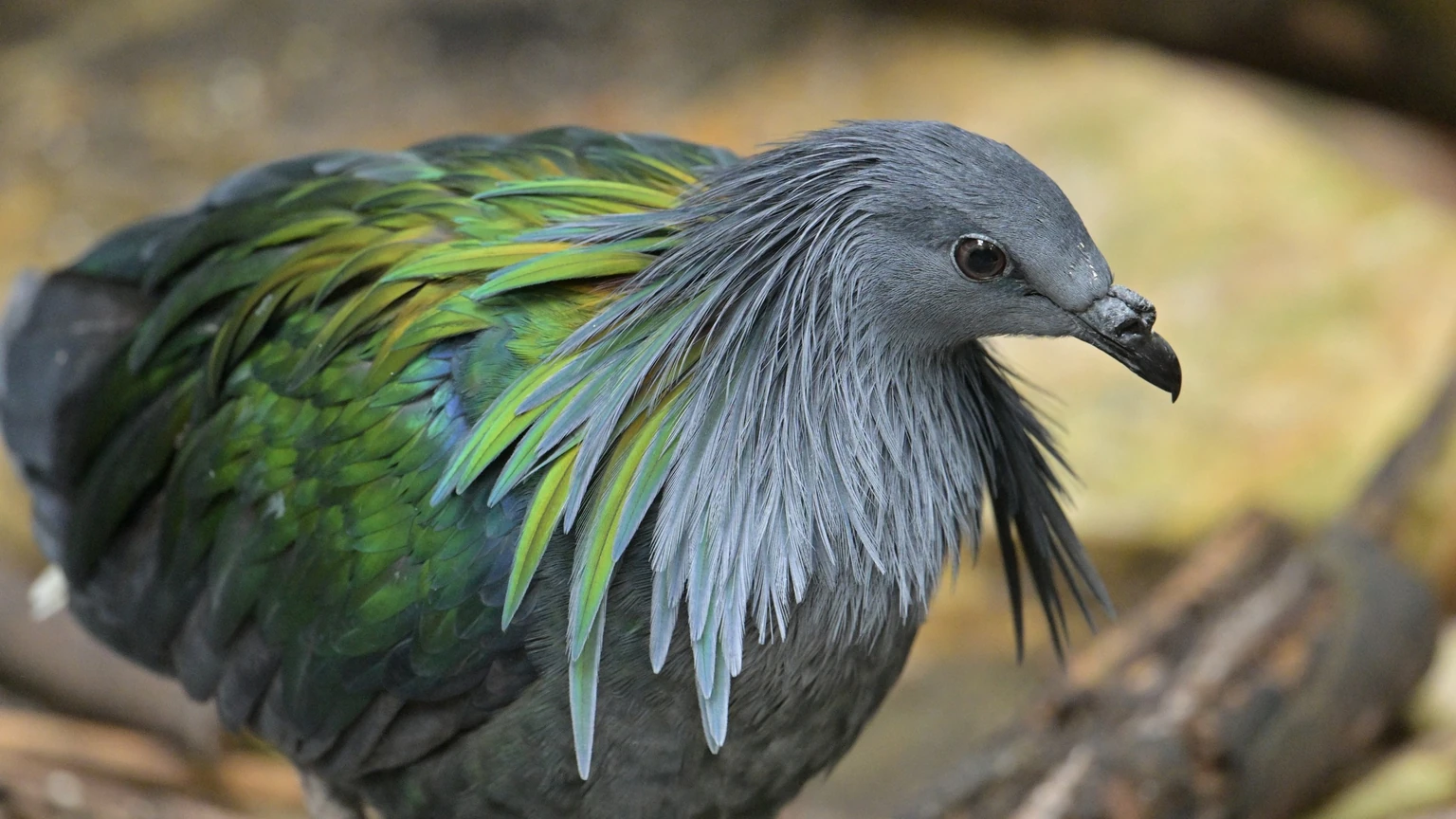
The team then combined that atlas with genomes and CT-derived skull measurements from more than 70 bird species, including the Nicobar pigeon, the dodo's closest living relative. Each skull was described with 541 anatomical landmarks. The platform uses comparative genomics, developmental biology and this 3D shape data to predict which regulatory elements are likely to be active during development and which are most strongly associated with differences in physical form.
Chief science officer Beth Shapiro described the result as comparative: use the breadth of living bird diversity, combined with AI, to find candidate loci in the dodo genome worth testing. Avian species director Anna Keyte said generic data would not have worked and that building the developmental dataset took more than a year of experimental work. Colossal has not published the model architecture, training details or code, and describes GenoMorph as an internal platform.
What the 2,300 candidates are, and are not
The 2,300 figure is a rounded total. The two published counts, 653 and 1,698, add up to 2,351, and the release itself calls the total an estimate. Some elements could plausibly be linked to more than one trait, which would explain the rounding, but Colossal has not said.
More importantly, the candidates are statistical associations. The release states that the findings do not yet establish that the elements cause beak traits. They are a shortlist that narrows hundreds of thousands of possible differences to a number a lab can test, which is useful, but it is a long way from a recipe for a dodo's head.
Colossal says preliminary findings were presented at the Craniofacial Gordon Research Conference and at the annual meeting of the Society for Molecular Biology and Evolution. A peer-reviewed paper describing GenoMorph itself was not linked in the announcement, so the method cannot yet be independently checked.
The rest of the pipeline
The release spends as much space on lab work as on AI. A computational method first built for the company's dire wolf project lets new dodo DNA fragments progressively update the reference genome, so fragments that were too different from the Nicobar pigeon to align on the first pass can fill gaps in later rounds. Colossal reports that 95% of the dodo genome's bases are now covered at least five times, with average coverage of 65-fold.
The Texas colony of Nicobar pigeons has grown to 36 birds, and eggs from the latest breeding season were used to derive new primordial germ cells, the cells that become sperm and eggs. Editing those cells is how Colossal hopes to make heritable changes. It is also working on a telomere-to-telomere Nicobar pigeon genome, which would improve the reference for the dodo and for its extinct relative, the Rodrigues solitaire.
Two new tools are meant to speed up testing. Chimeric chickens made from embryonic stem cells have hatched, and the approach is being extended to pigeons so edits can be screened before germ cells are touched. A lipid-nanoparticle system delivers DNA, RNA and CRISPR tools into developing bird embryos; editing the bone regulator Runx2 produced a clear craniofacial change. Colossal says it is now using that system to check GenoMorph's candidates in near real time, and that the strongest are being engineered into Nicobar pigeon germ cells.
Where AI fits in de-extinction
GenoMorph fits a broader pattern of AI being used to read the parts of the genome that do not code for proteins. Google DeepMind's AlphaGenome predicts how DNA changes affect gene regulation, and its AlphaGenome Atlas made billions of those predictions searchable this month. Hugging Face's Carbon-A gene finder applies a similar idea to annotating genes across eukaryotes.
The difference here is that the output is meant to drive physical edits in living animals, and the loop runs through a wet lab. That makes it closer in spirit to the Google Research agents that ran wet-lab experiments to find cancer-target binders than to a pure prediction tool: the model proposes, and experiments decide.
Lamm argues the approach is repeatable for any extinct species with a thin genomic record. Colossal also pitches it for endangered birds, where large population datasets may never exist. If GenoMorph's candidates hold up in embryos, that conservation use may matter more than the dodo itself.
Limits and open questions
All of the numbers in this story come from Colossal. The company is privately funded and has strong reasons to announce progress, and its earlier claims, such as calling gene-edited grey wolves dire wolves, drew criticism from scientists who argued the animals were edited modern species rather than revived ones. A dodo built this way would likewise be a Nicobar pigeon carrying selected dodo-like edits, and Colossal's own release talks about reconstructing key aspects of the dodo's anatomy rather than the whole bird.
Beak and skull shape are only part of what made a dodo. Its size, flightlessness, behaviour and the island ecosystem it lived in are not addressed by this work. Even within the skull, a few thousand regulatory candidates will need to be tested, combined and checked for side effects in developing embryos, which is slow even with faster delivery tools.
The questions to watch are whether Colossal publishes GenoMorph's method and validation results, how many of the 2,300 candidates actually change craniofacial development when edited, and whether the approach is used for an endangered species, where the benefit would be easier to measure.
Common questions
What is GenoMorph?
An internal AI platform at Colossal Biosciences that predicts which regulatory DNA elements are active during bird development and which are most associated with skull and beak shape, so the company can choose gene-editing targets for species with very little genomic data.
Has Colossal brought back the dodo?
No. GenoMorph produced a shortlist of candidate DNA switches that now need lab testing. Colossal plans to edit confirmed ones into Nicobar pigeon germ cells and has not given a hatch date.
Why use AI instead of comparing dodo genomes?
Colossal has only one high-quality dodo genome, so it cannot compare many dodos to find which differences matter. GenoMorph instead learns how regulatory DNA shapes beaks across more than 70 living bird species and applies that to the dodo genome.
Sources & further reading
How this story was made
Written by Kristian Kostov with AI assistance and checked against the linked sources. Company performance claims are attributed to the company. Analysis reflects AiLookout’s interpretation; we have not independently tested the products discussed. Cover photography is illustrative and does not depict the specific announcement or product.
Our editorial standards