Announced 15 Oct 2026 · Sources checked
What CERN and Mistral signed
CERN, the European particle physics laboratory near Geneva, announced on 15 October that it and Mistral had signed a statement of intent to establish a long-term strategic partnership on foundation models for scientific discovery. CERN brings its physics expertise, scientific data and large-scale computing; Mistral brings experience training large AI models.
The centrepiece is an ambition rather than a product: a single pretrained Large Physics Model, which CERN describes as the first foundation model for collider physics. It would be trained on billions of simulated proton-proton collisions at the Large Hadron Collider and designed for several jobs at once.
Reuters, in a report carried by KELO, said the model is called “Flare” and that a CERN spokesperson described it as using the same idea as the language models behind generative AI, but trained on collision data rather than text. CERN's own release does not use that name.
What a Large Physics Model would actually do
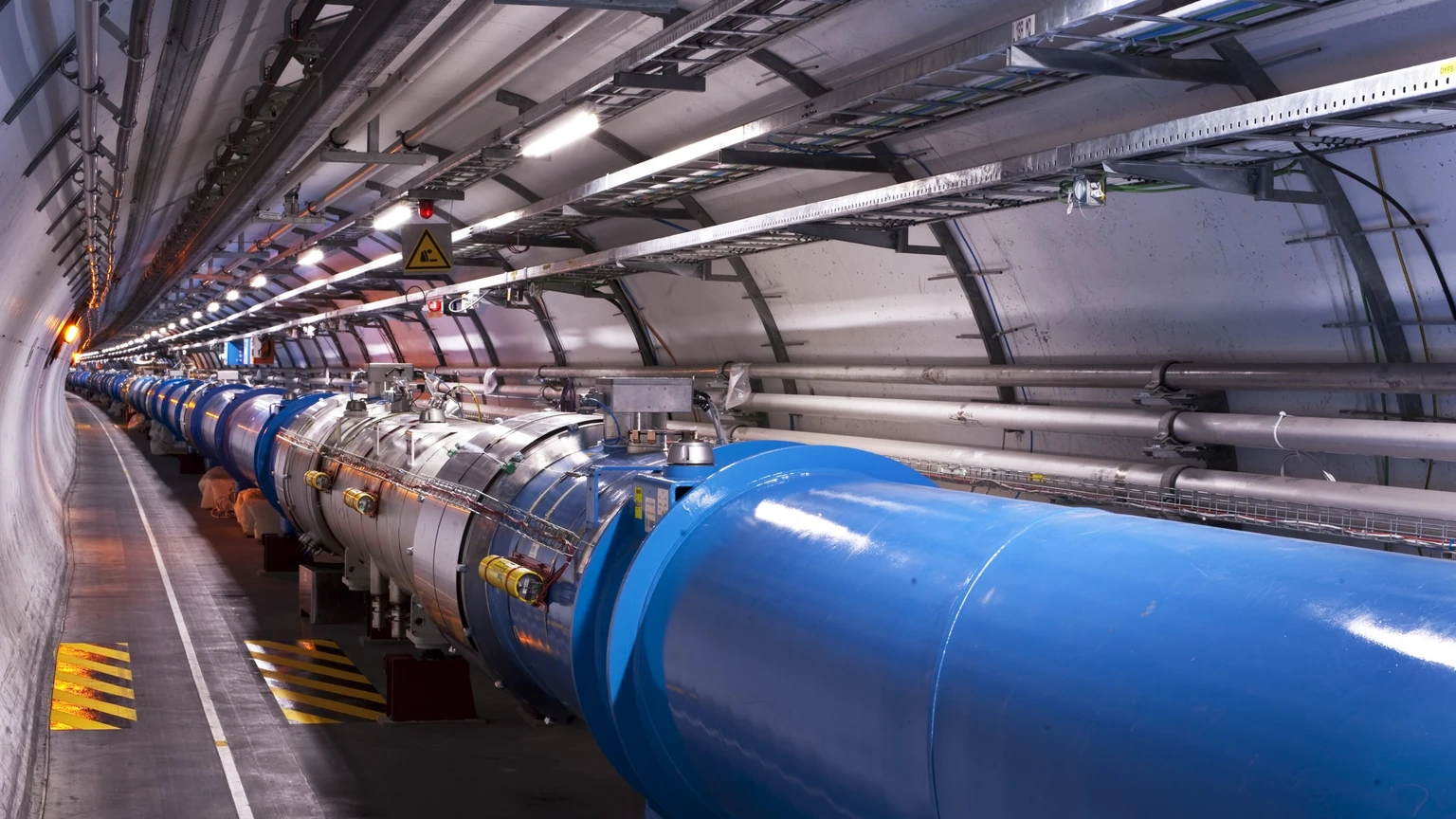
When protons collide in the LHC, detectors record electrical signals from thousands of sensors. Turning those signals into a list of particles, with their energies and paths, is called reconstruction. Today it runs through a chain of specialised algorithms, each transforming the data a step further until physicists have objects they can analyse.
Machine learning is already part of that chain, and CERN says it has improved performance on many individual tasks. The CERN spokesperson told Reuters the lab has used AI to turn raw data into pictures of events for a decade, but with multiple tools for each step. A foundation model would instead learn across the whole chain and support several tasks inside one network.
CERN lists four target uses: reconstructing particle collisions, identifying particles, flagging unexpected signals that might point to new physics, and evaluating designs for future detectors. These are proposed applications; none is described as running yet. The idea mirrors how large language models replaced many narrow text tools: pretrain once on huge data, then adapt to many tasks.
Training on simulation rather than only real data matters. Physicists can generate collisions where the true particles are known, which gives the model labelled examples at a scale real experiments cannot. The open question, as with any simulator-trained system, is how well it carries over to messy real detector data.
Why one model instead of many? Each specialised algorithm today is tuned, validated and maintained on its own. A shared model could, in principle, learn features common to every step, be adapted to new tasks with less data, and be improved once rather than tool by tool. The risk mirrors the benefit: a single model that is wrong in a subtle way could bias several downstream measurements at once, so validation will matter as much as raw accuracy.
Why CERN's data is the draw
CERN says it holds around one exabyte, or one million terabytes, of experimental data from the LHC. It expects the number of collisions to rise tenfold with the High-Luminosity LHC upgrade, due to start operating around 2030. More collisions per second means more overlapping events to untangle, which is exactly where faster, more general reconstruction would help.
“High-energy physics provides a unique environment in which artificial intelligence can be developed and tested with exceptional rigour,” said Enrica Porcari, CERN's Chief Information Officer. Unlike many AI tasks, particle physics comes with precise simulations and well-understood physical laws, so a model's mistakes can be measured rather than guessed at.
Reuters framed the deal as giving Mistral access to one of the world's largest scientific datasets. CERN's release says the training data will be simulated collisions; it does not say which experiments or how much real data Mistral will see.
What Mistral brings
Mistral is best known for language models, including the trillion-parameter Mistral Large 4, announced on 6 October; Reuters says the lab's new open-weight model goes public on 27 October. Mistral has also been building a physics side. In May it introduced physics AI at Mistral after bringing Emmi AI into the company, pitching models that replace slow engineering solvers for partners such as ASML, Airbus and Safran.
“We are proud to work with CERN to explore what large-scale AI models can bring to the growing complexity of particle physics,” said Johannes Brandstetter, Mistral's Vice-President of AI for Engineering. According to Reuters, chief executive Arthur Mensch wrote in Le Monde the same day that frontier models are “now indispensable to scientific progress” and criticised companies that keep their advantages to themselves.
For Mistral, the partnership is also a statement about European AI. Both sides present it as strengthening Europe's scientific and technological capabilities, a theme that runs through Mistral's other recent work such as its Timestral forecasting models.
What the deal does not say
The announcement leaves most practical questions open. Reuters reported that no budget or timeline was disclosed. Neither side gave a model size, compute plan, training schedule or any early results. A statement of intent signals direction; it is not a signed contract with deliverables.
Access is also unclear. Porcari said the goal is AI capabilities “that can serve the whole physics community and be shared,” and Mistral calls itself an open-weight lab, but the release does not say whether the Large Physics Model's weights, code or training data will be public, or on what licence. Nor does it say who owns the result.
Both organisations say models from the partnership could later serve other sciences, but the initial focus is high-energy physics only.
Part of a wider AI-for-science push
The deal lands in a busy week for AI in science. Google.org this week named 17 AI-for-science grantees, and a team of physicists showed GPT-6 Astra solving 49 of 50 unpublished physics problems in the TheoPhysEval benchmark.
The CERN plan is different in kind. Those projects use language models to reason about science. A Large Physics Model would be trained directly on detector-level physics data, closer to how weather and protein models learn from measurements than to a chatbot. If it works, the same approach could spread to other fields with big simulations and instruments.
What to watch next
The signs of real progress will be a formal agreement with funding, a named team, a first technical paper or benchmark against existing reconstruction software, and a decision on whether the model will be open. Physics collaborations are cautious about new tools, so any model will have to match today's algorithms on precision before experiments rely on it.
For readers outside physics, the useful test is simple. Does the model reconstruct real LHC events at least as precisely as current software, at lower cost or higher speed, and can independent physicists inspect it? If the answer is yes on all three, the approach could become a template for other big-instrument sciences, from astronomy surveys to fusion experiments. If the weights stay private, it would be a strong Mistral capability but a weaker shared scientific resource.
Until then, this is a promising plan between Europe's largest physics lab and its best-known AI company, with a clear technical goal and few commitments on paper.
Common questions
What is CERN's Large Physics Model?
A planned foundation model for collider physics, to be trained on billions of simulated proton-proton collisions at the Large Hadron Collider. It would reconstruct collisions, identify particles, flag unexpected signals and help evaluate detector designs in one network. Reuters reports it is called Flare.
When will the CERN and Mistral model be ready?
No date was given. The two organisations signed a statement of intent on 15 October 2026 and disclosed no timeline, budget or model size.
Will the Large Physics Model be open?
Not stated. CERN says it wants capabilities that serve the whole physics community and can be shared, but the announcement does not say whether weights, code or data will be released.
Sources & further reading
How this story was made
Written by Kristian Kostov with AI assistance and checked against the linked sources. Company performance claims are attributed to the company. Analysis reflects AiLookout’s interpretation; we have not independently tested the products discussed. The cover places the companies’ own logos, taken from public-domain or openly licensed files credited in the caption, on a plain background. It is not a product photograph, a screenshot, or an endorsement.
Our editorial standards