Announced 24 Oct 2026 · Sources checked
Apollo says the payoff stops at big tech
Torsten Slok, partner and chief economist at Apollo Global Management, used his Daily Spark note on 24 October 2026 to make one of the bluntest claims yet from a major investment firm about the AI boom. Despite heavy investment and the hype around the technology, he wrote, AI has delivered "zero financial payoff to corporate America outside of tech."
His argument rests on a split that investors use all the time. The Magnificent 7, the largest US tech companies, sit on one side. The S&P 493, the other companies in the S&P 500 index, sit on the other. Slok says the tech giants are seeing revenue per worker and profit margins rise. The rest of the index is not. His bottom line is that "the AI story will be decided in the S&P 493, not the Mag 7," and that so far there is no evidence that revenue growth or margins are improving outside the tech sector.
The note lands in a week when other big names have been weighing in on what AI is doing to companies. Goldman Sachs economists estimated that AI could displace up to 9 percent of US workers, with job losses likely to arrive in a recession, while Amazon chief executive Andy Jassy said AWS capacity is sold out for 2026. Slok is looking at the other end of that chain: the companies buying AI, and whether it shows up in their results.
Revenue per worker and margins
The first chart in the note tracks revenue per employee, adjusted for inflation to the fourth quarter of 2019. By AI Lookout's reading of the chart, the Magnificent 7 sit at roughly $780,000 per worker after a dip to around $565,000 in early 2023, while the S&P 493 line hovers near $525,000 with little movement. Those values are read from the image, not from a published table, so treat them as approximate.
The second chart shows profit margins. The Magnificent 7 line climbs to roughly 30 percent, while the S&P 493 stays near 10 percent. Slok's point is not that the rest of corporate America is doing badly, but that it is not doing any better, despite spending on AI tools for more than two years.
He made a similar point in a 9 August note titled "The Buyers of AI Are Still Waiting for the Payoff." There he wrote that the S&P 493 is spending heavily on AI but it is not showing up in profit margins. Health care margins have halved since 2015, consumer staples are stuck near 6 percent and consumer discretionary near 8 percent. He concluded then that the AI capex boom "is so far only showing up in the sellers' margins, not the buyers'."
Productivity still shows no AI effect
The third piece of evidence is productivity. Slok points to utilization-adjusted total factor productivity, a series from the San Francisco Fed based on work by economist John Fernald. Total factor productivity measures how much output the economy gets from a given amount of labor and capital, which makes it the closest proxy for real technological progress.
In a 5 October note, Slok wrote that this measure is sitting slightly below zero with no sign of acceleration since the AI spending cycle began. Output per hour, the more familiar labor productivity number, is running near 2.5 percent, above its post-2005 average. That gap matters. Pouring money into data centers and chips lifts output per hour mechanically, because each worker has more equipment. Slok calls strong output per hour with flat total factor productivity "the signature of capital deepening, not of a technology shock."
In other words, the economy is producing more partly because it has more machines, not yet because those machines make firms fundamentally more efficient.
Where the token money actually goes
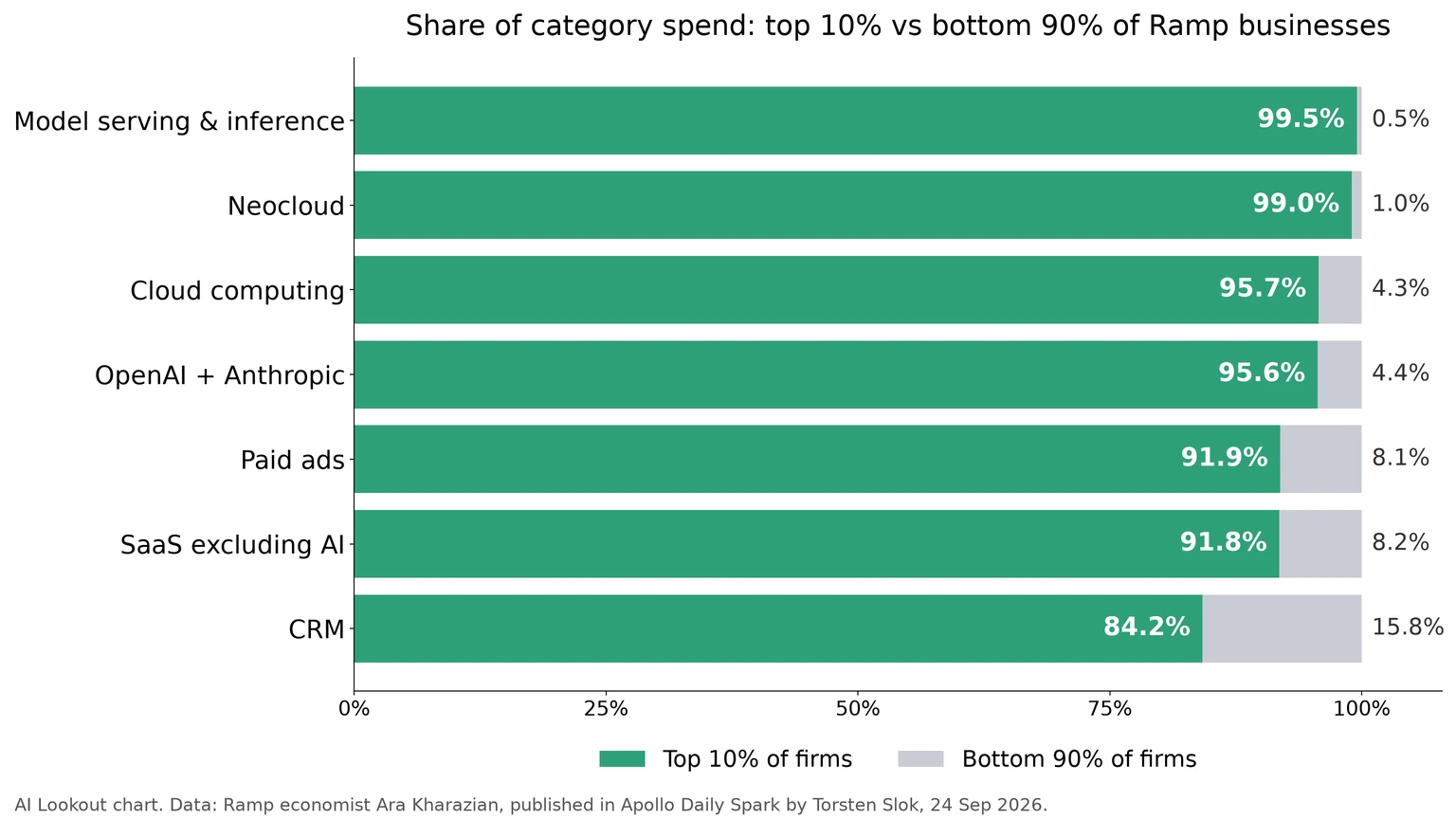
The last two charts in the 24 October note use data from Ramp, the corporate card and spend management company, whose economist Ara Kharazian tracks how US businesses pay for AI. One chart shows that venture-backed companies make up 80.4 percent of the top 1 percent of AI spenders on Ramp, compared with 13.1 percent of the median spender. The other compares how concentrated spending is across categories.
That second table first ran in a 24 September Daily Spark. The top 10 percent of Ramp customers account for 99.5 percent of model serving and inference spend and 99 percent of neocloud spend. They pay 95.6 percent of spend on OpenAI and Anthropic and 95.7 percent of cloud spend. For comparison, the long tail still accounts for 15.8 percent of CRM spend and 8.2 percent of non-AI software.
The same note said roughly 10 percent of software-spending businesses on Ramp now pay a GPU vendor, up from under 4 percent two years ago, mostly through model serving and inference. Slok's explanation is that AI spending tracks how much a company runs, not how many people it has. That echoes Vercel's AI Gateway data, which showed how differently token volume and dollar spend can be distributed.
Slok's conclusion is that as long as agentic AI and token spending stay confined to a small part of the economy, the macroeconomic effects of AI will be very limited.
Why mainstream firms are pulling back
The newest claim in the note is about behavior. Slok wrote that with no impact on the bottom line, mainstream corporate America is pulling back and starting to view token spending as a cost center that weighs on margins, rather than a source of growth. He added that these firms do not need the latest model and are unwilling to pay for it.
Ramp's own October AI Index, published on 14 October, gives some context. Kharazian reported that 55.9 percent of Ramp businesses paid for AI in September, with 43.8 percent paying Anthropic and 40.6 percent paying OpenAI. But he also reported two straight months of virtually no growth in token spend, even as token volumes rose. The top 1 percent of firms spent $9,568 per employee per month in September, down 3.1 percent from a July high of $9,873.
Kharazian's view is that the main driver is falling prices at the frontier, plus efficiency gains across models, which push down the blended price per million tokens. He also said enterprise contracts with the big labs are rarely restrictive and often come with discounts. That points to a market where buyers are getting more for less, not necessarily one where they are giving up on AI.
The case for patience
Slok's own notes include the strongest counterpoint. In the 5 October piece he wrote that total factor productivity has swung between roughly minus 3 and plus 4 percent over the past 40 years with no clear trend, so a sub-zero reading is not unusual. Electricity and information technology both took a decade or more to show up in aggregate numbers.
His argument also uses a narrow lens. Revenue per worker and margins for 493 companies are averages, and early gains at a few firms could be invisible in them. Some companies are already acting on their AI plans in other ways, such as American Express cutting 5 percent of jobs as it prepares for AI. And the Ramp data covers businesses that use Ramp, not the whole economy.
Still, Slok frames the open question carefully. As models become commoditized, can mainstream firms turn cheap intelligence into faster revenue growth and wider margins? He thinks that may be harder than it sounds. In business, he wrote, intelligence is mostly judgment, which depends on context, and AI does not understand accountability, trust, culture, unwritten rules, ethical trade-offs or fairness.
What it means for AI buyers and builders
For the companies selling AI infrastructure, Apollo's argument is a warning about concentration. If a small group of venture-backed firms drives almost all of the spending, demand rests on a narrow base. Gartner made a related point when it warned that $3.5 trillion of AI infrastructure spending could face impairment, and the debate over GPU rental prices turns on the same question of who keeps paying.
For businesses buying AI, the note is a reminder that adoption alone is not a result. The useful test is whether a project moves revenue or margins, which is the same question our guide to measuring the ROI of an AI pilot starts from.
Slok will likely keep returning to this theme in the Daily Spark. AI Lookout will watch the next Ramp AI Index and the coming earnings season for signs that the S&P 493 lines start to move.
Common questions
What did Apollo say about AI payoff?
Chief economist Torsten Slok wrote that AI has delivered zero financial payoff to corporate America outside tech, with revenue per worker and margins flat for the S&P 493.
What is the S&P 493?
It is shorthand for the S&P 500 minus the Magnificent 7 largest tech companies, used to see how the rest of corporate America is doing.
Is AI spending falling?
Ramp reported two months of virtually no growth in token spend in August and September, which its economist ties mainly to falling model prices, while adoption kept rising to 55.9 percent.
Sources & further reading
How this story was made
Written by Kristian Kostov with AI assistance and checked against the linked sources. Company performance claims are attributed to the company. Analysis reflects AiLookout’s interpretation; we have not independently tested the products discussed. The cover places the companies’ own logos, taken from public-domain or openly licensed files credited in the caption, on a plain background. It is not a product photograph, a screenshot, or an endorsement.
Our editorial standards