Announced 8 Oct 2026 · Sources checked
What did Zhejiang University publish?
Researchers led by Sida Peng at Zhejiang University’s 3DV group posted SuperNav: An Agentic Navigation System for Any Task in Any Scene to arXiv on 8 October 2026 (cs.RO / cs.CV, 2610.12126v1). The same day they published the project page and opened github.com/zju3dv/SuperNav. Co-authors span Zhejiang University, Shenzhen University and Causa Robotics.
The pitch is task and scene generality without navigation-specific fine-tuning of the multimodal model. End-to-end vision-language-action navigators, the authors argue, inherit the coverage of their navigation trajectories. Modular pipelines hard-code when the model may explore, confirm, or stop. SuperNav instead treats the MLLM as a decision-maker that calls tools, reads optional Markdown “Navigation Skills,” and keeps a textual task-progress ledger across steps.
That framing sits next to other October robot-learning drops we covered, including Arc’s action-grounded robot traces and DreamTrue’s robot world-model preprint, which also emphasise scaffolds around pretrained models rather than training a new policy from scratch.
How does the agent harness actually work?
At each step the model receives four direction-labelled RGB views (front, right, back, left). To move, it calls a visual-point tool with a view id and normalised image coordinates. The tool executes motion and returns fresh views plus short diagnostics. The agent may also turn in place, update pending/found goals, load a Skill, or close the session as achieved or blocked.
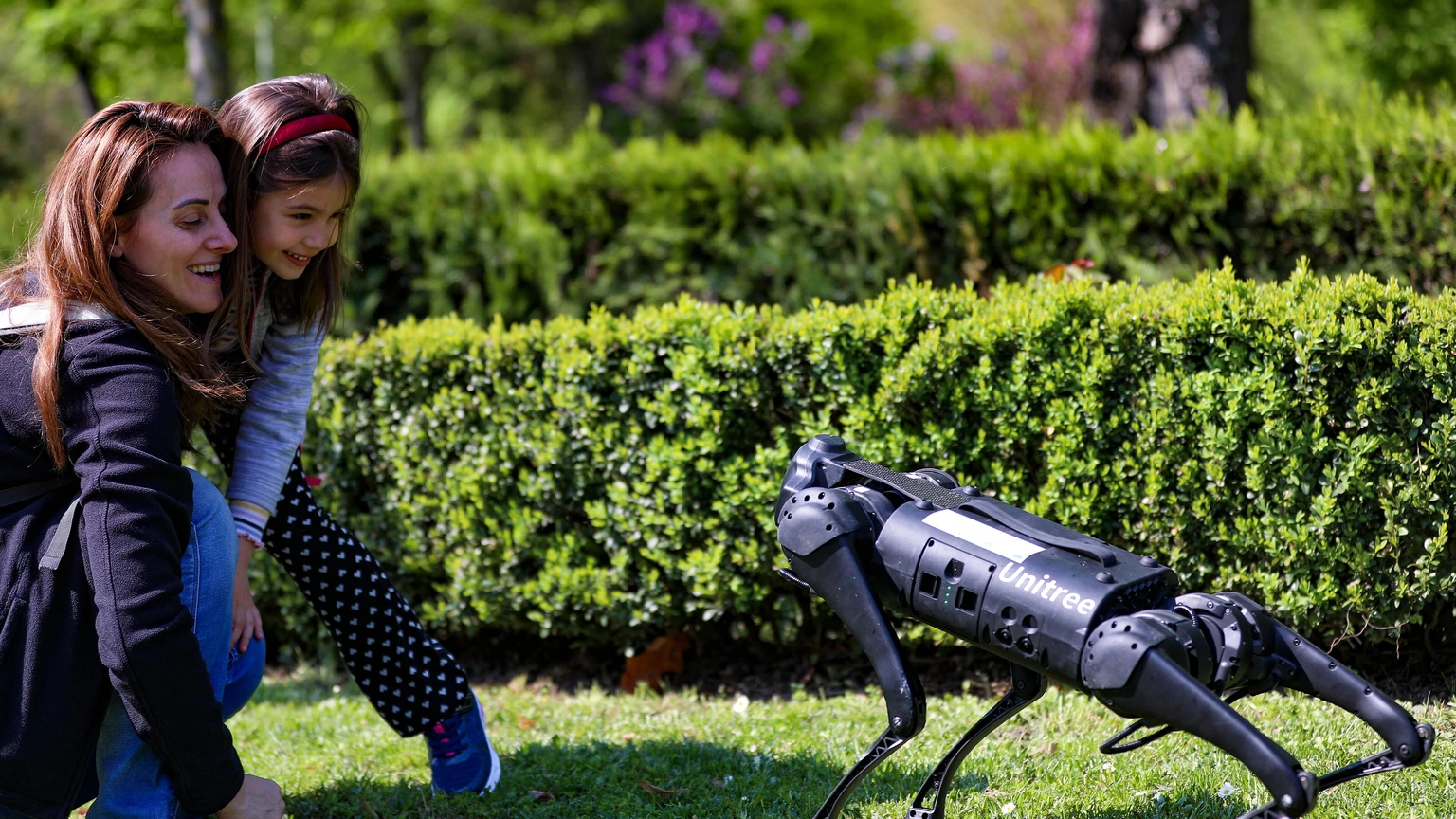
Two motion backends share the same point interface. The Geo-based Executor back-projects the selected pixel with depth and follows a path on a navigation mesh (or LiDAR height map on the Unitree Go2). The Learned Executor is a NoMaD-inspired flow policy that predicts local displacement increments and a stop signal from a marked reference image and a short RGB history, without depth grounding. Ablations in the paper credit Navigation Skills and the four-view tool design for large drops in success when removed.
The agent loop is implemented with Codex CLI and Model Context Protocol tools. Bundled recipes default to gpt-6-astra with medium reasoning; an ablation swapping in GPT-5.6 Terra still runs the same harness. Skills are Markdown packages the model discovers by name—search, recovery, entrance finding, completion checks—rather than hard-coded finite-state machines.
What can you download today, and under what licence?
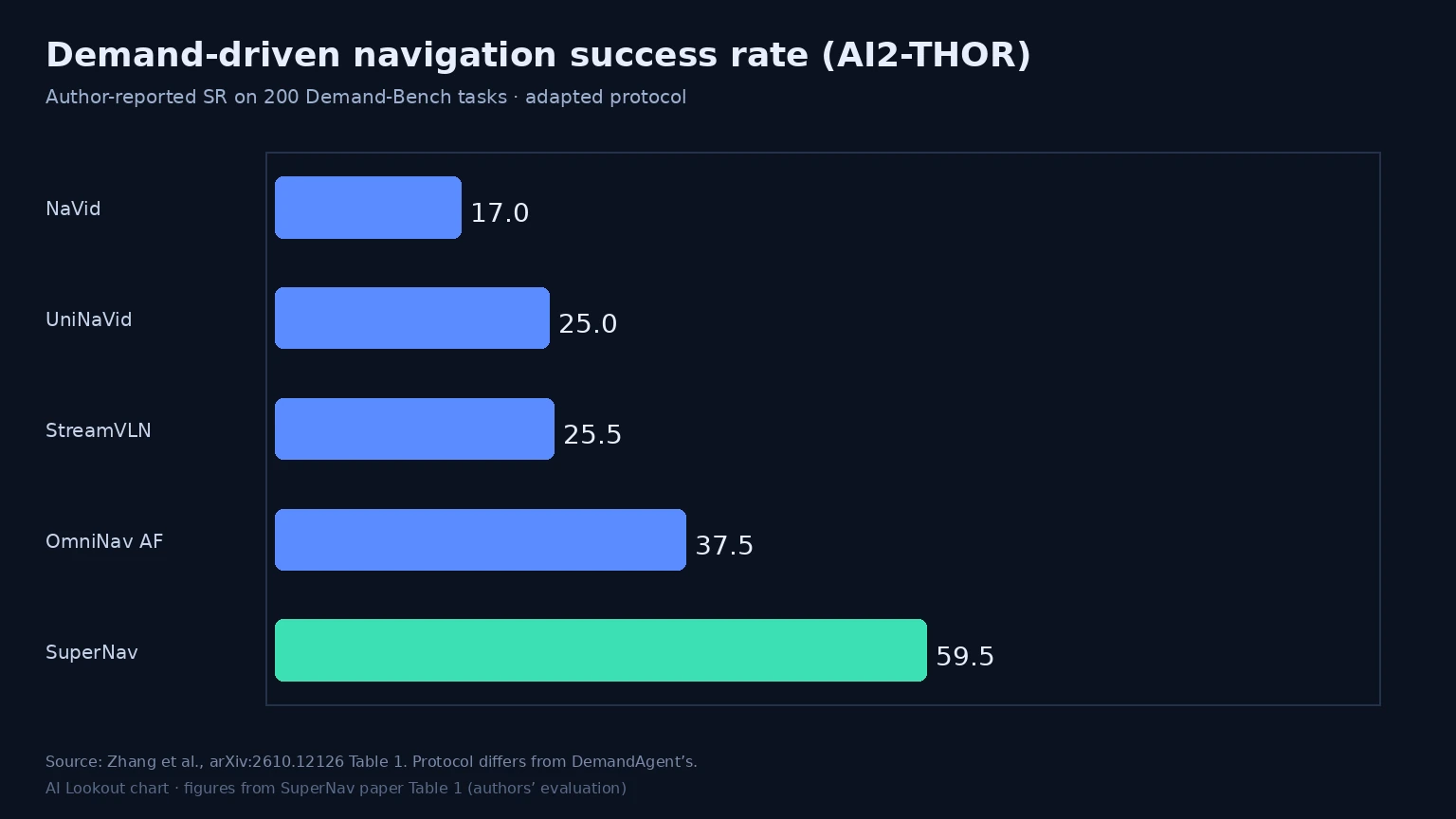
The GitHub tree includes the agent runtime, tools, Skills, experiment configs, tests and evaluation utilities for Habitat-GS and AI2-THOR. Installation targets Python 3.12 with optional extras for agents, evaluation, AI2-THOR and a Rerun viewer. Learned Executor weights are on Hugging Face under the0xka1/SuperNav-Learned-Executor (created 9 October, last modified 10 October 2026). The README still marks the InteriorGS single/multi-object packs, the AI2-THOR demand-driven pack, and real-robot Go2 drivers as not yet released.
The licence is Project Registration License (PRL) v1.0, not Apache or MIT. Academic, educational, evaluation and personal use are free without registration. Any company or organisation that uses the software in an internal or external project must register that project through a Google Form before use; registration is free and said to grant permission automatically. That is a material difference from permissive OSS for product teams planning a fork.
We did not run the Habitat stack or the Go2 stack in this newsroom. Claims about live robot behaviour rest on the authors’ videos and paper text.

What did we not verify, and what should teams watch?
We inspected the arXiv abstract and HTML, the GitHub README and LICENSE, the project page, and the Hugging Face model card metadata on 12 October 2026. We did not re-run Habitat-GS, AI2-THOR, HM3D, or the Unitree demos. Baseline checkpoints and camera settings follow the paper’s Appendix; small protocol mismatches can move SR by more than a few points.
Watch for the missing evaluation packs and Go2 drivers, any third-party reproductions on public HM3D splits, and whether organisational users actually register under PRL. If the authors later open an Apache-licensed subset of the tools, that would change the adoption story. Until then, treat the headline numbers as author-reported on author-defined suites, and the open code as a research harness with a registration gate for company projects.
Common questions
Do I need to fine-tune GPT or Gemini to use SuperNav?
No. The paper’s design keeps the multimodal model frozen for navigation and trains or configures only the harness and optional Learned Executor. You still need API or local access to a capable MLLM that can call the MCP tools.
Is SuperNav free for a startup product?
Research and personal use are free. Organisational project use requires free registration under the Project Registration License before you start. Read LICENSE in the repository; it is not Apache-2.0.
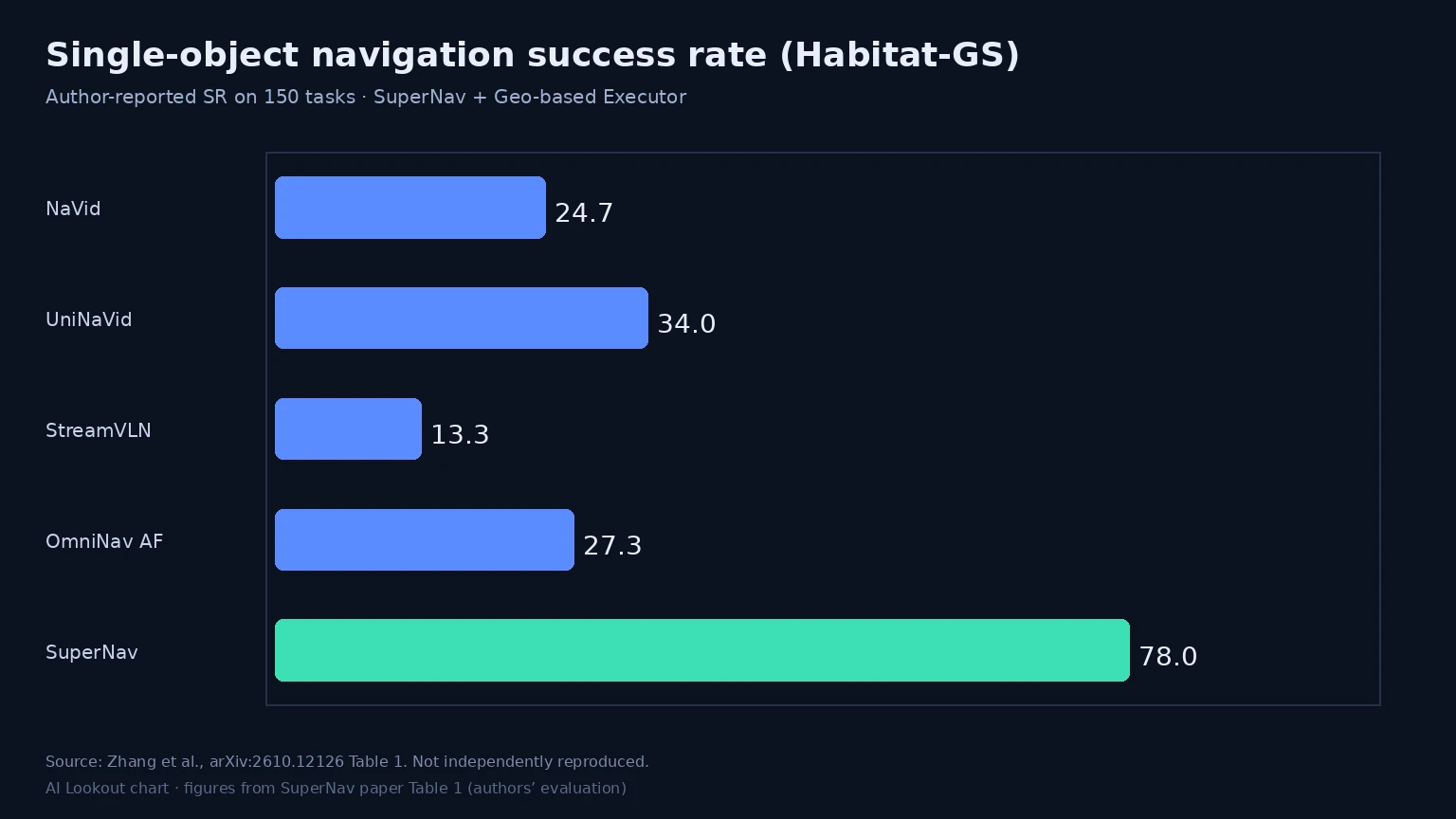
Can I reproduce the 78% single-object number today?
Not from the public tree alone. The InteriorGS instance-navigation benchmark pack is still unchecked in the release status list. You can run the agent stack and Learned Executor, but the exact 150-task suite is not listed as published yet.
What to remember
SuperNav is a credible open research harness for MLLM-directed robot navigation: strong author-reported gains, real Go2 videos, and downloadable weights—tempered by a non-permissive registration licence and unfinished eval packs.
Sources & further reading
How this story was made
Written by Kristian Kostov with AI assistance and checked against the linked sources. Company performance claims are attributed to the company. Analysis reflects AiLookout’s interpretation; we have not independently tested the products discussed. Cover photography is illustrative and does not depict the specific announcement or product.
Our editorial standards