Announced 26 Oct 2026 · Sources checked
What users are reporting
Claude users are reporting that Opus 5.5, Anthropic's flagship model, now stops when asked to root, jailbreak or reverse-engineer smart TVs, just as a wave of people had started using AI coding agents to strip ads and bloatware from their sets. On 26 October XDA Developers described a post on the ClaudeAI subreddit by user targaryenNotJon, who says Claude showed a message that Opus 5.5 had hit a guardrail while working on a TV, but handled reverse engineering of a video game without complaint. XDA calls it an unverified anecdote.
The TV reports sit inside a broader complaint. A thread titled Anthropic secretly killed the REA train went up on r/Claude on 21 October, and Kotaku reported on 24 October that users say reverse-engineering prompts now trigger a safety guardrail mid sentence. In one example Claude said a safety check had stopped its response partway through and that it could not produce the write-up again, even when reworded. Kotaku says Anthropic has not released a new version of Opus 5.5 and that a minority of commenters argue the classifier was always twitchy.
Anthropic has not announced a change and, according to Kotaku and several follow-up reports, has not commented. So the honest summary is this: there is a cluster of consistent user reports, there is a documented safety system that would produce exactly these blocks, and there is no confirmation that anything new was switched on for TVs.
The LG TV that lost its root
The most detailed first-hand account comes from Jose Antonio Lanz at Decrypt, published on 23 October. He asked Claude Code to install Free My TV, an open-source launcher for LG's webOS, on a set he had rooted with Homebrew Channel back in 2023. Claude read the installer before running it and spotted the dropbear SSH service that marks a rooted TV, but still asked him to switch on LG's Developer Mode. That wiped the partition where the root setup lived, and Claude later told him the mistake was its own.
The safeguards appeared when he asked Claude to put root back. His TV runs firmware 04.60.90 on webOS 7.6.0-19, and the original exploit had been patched by LG in April 2024, leaving a newer jailbreak as the only option. When Claude moved on to researching that procedure, the app showed a prompt saying Opus 5.5's safeguards had flagged the message and offering to switch to Opus 4.8 and keep going whenever that happened.
Opus 4.8 did not get much further. Lanz writes that Claude refused after seeing the word exploit, that Opus 4.8 advanced until it had to download a package named root, and that another model also flagged the work as a cybersecurity risk. He ended up with a launcher that works but has to be opened by hand each time, and said he would try the jailbreak manually instead.
The bug reports started before the TV craze
Public bug reports suggest the blocks are not new, even if they have become more visible. In the Claude Code issue tracker on GitHub, users have filed reports of the cyber safeguards stopping work they consider legitimate on hardware and code they own.
In issue 71907, filed on 27 June 2026, a user reported a block while reverse-engineering the firmware of their own consumer hardware to switch off telemetry. The quoted message read: Opus 4.8's safeguards flagged this message for a cybersecurity topic, followed by an offer to apply for an exemption. The issue was closed as stale in August.
The October reports are about Opus 5.5. Issue 102795, filed on 16 October, describes a cyber flag on a coordinated vulnerability disclosure task that carried over into later harmless turns, so the session could not be recovered. Issue 103111, from 18 October, concerns reverse engineering laptop fingerprint-reader firmware to write a Linux driver, refused several times. Issue 104374, from 22 October, says Opus 5.5 stopped when asked to obfuscate the user's own code.
None of those reports is about TVs, and none has an official explanation attached. What they show is that Claude's cyber classifier has been stopping reverse engineering of owned devices for months, under both Opus 4.8 and Opus 5.5.
What Anthropic has actually said
Anthropic's own documents explain why this happens without needing a TV-specific rule. In its 6 October post expanding the Cyber Verification Program, the company says its generally available models, which it lists as Claude Opus 5.5, Fable 5.1 and Sonnet 5.5, have conservative cyber safeguards that block most cyber work. It says those models can still review code, patch known issues, find vulnerabilities in source code the user owns and triage alerts.
Reverse engineering falls on the other side of that line. The program has three tiers, which AI Lookout covered when they launched. Defense Access is the one that adds work such as reverse-engineering malware and analysing and validating vulnerabilities. Red Team Access is for organisations only, and Specialized Access is reviewed with the US government.
The program's support page adds that malware analysis and exploit validation may still be interrupted by the safety classifiers even for approved users. Individuals can apply only for Defense Access and need a paid plan, applications get an answer within seven business days, and Defense Access users must adopt phishing-resistant multi-factor authentication by 15 December 2026. Rooting a TV usually means running a published exploit against firmware, which is the kind of request this system is built to catch, whether or not the TV belongs to the person asking.
What Anthropic's own test numbers show
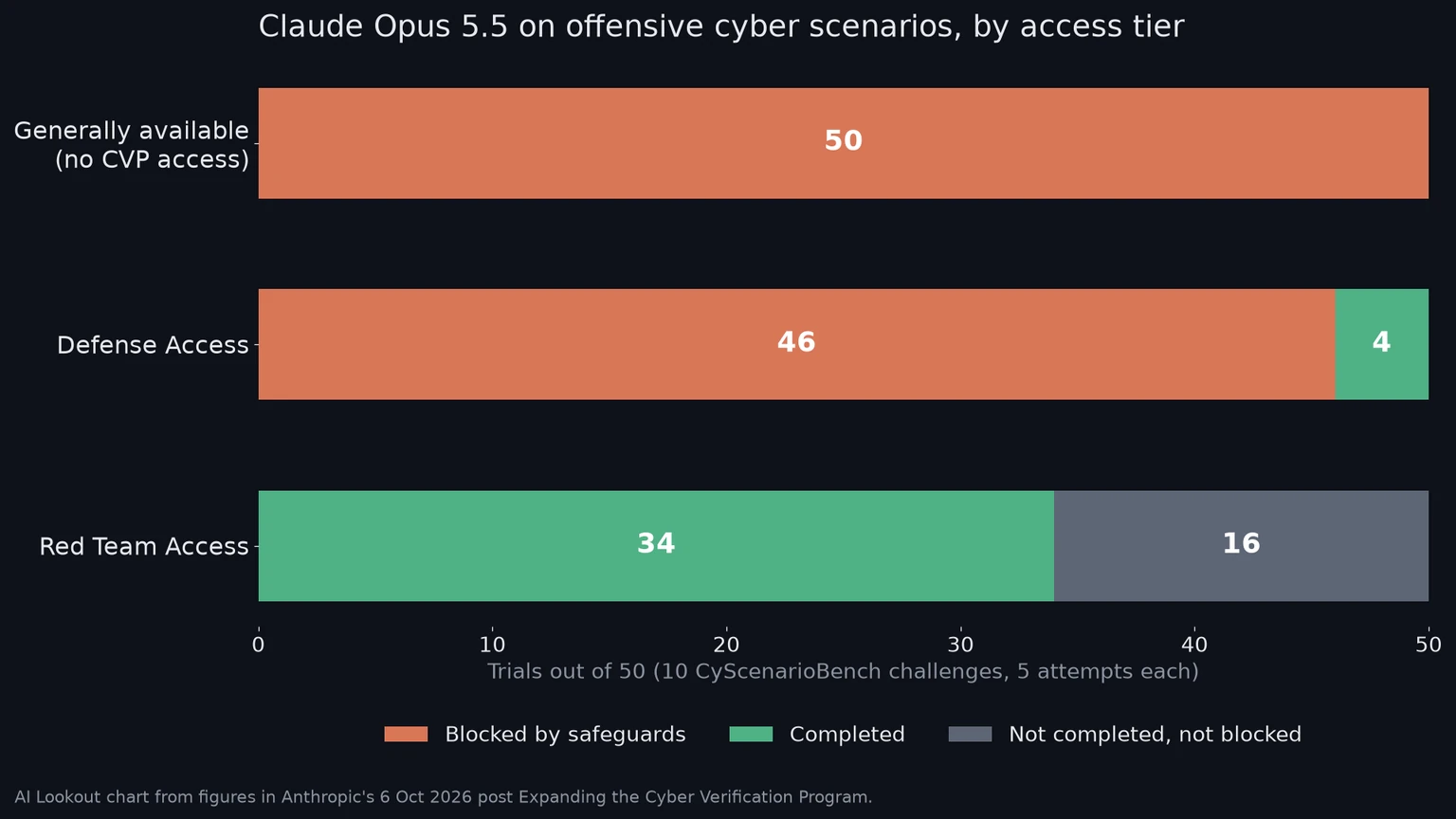
The same Anthropic post includes numbers that show how strict the default setting is. It ran Claude Opus 5.5 through CyScenarioBench, which tests whether a model can plan and carry out multi-stage cyber operations, with five attempts at each of 10 challenges per access tier.
Without program access, every task was blocked on the first prompt. In the Defense Access tier, 46 of 50 trials were blocked at some point and four succeeded. In the Red Team tier there were no blocks and the model completed 34 of 50 tasks, which Anthropic says matches its 67.6% success rate with no safeguards at all.
Those are offensive scenarios, not someone trying to remove ads from a living-room TV. But the figures make the point that for a standard account the safeguards are designed to stop nearly all exploit-shaped work, and that the Opus 4.8 fallback offered in the app is part of how Anthropic handles those interruptions.
The Samsung TV theory does not hold up
Some users on X linked the alleged change to a viral story about people using AI to get inside Samsung TVs and their always-on microphones. Kotaku's writer says he highly doubts that was the trigger. Capital and Compute, a blog that tracked the reports, points out that the researcher behind the Samsung posts says he used ChatGPT, not Claude, and that OpenAI blocked him under a Cyber Abuse label partway through.
Other reports cut against a hard TV ban. A roundup on pasqualepillitteri.it of the same Reddit thread quotes users who say they reverse-engineered their own Samsung TV in minutes, had Opus 5.5 run Android Debug Bridge commands, or removed spyware from a Hisense set without a block. The top-voted reading there is that rooting almost always means exploiting a vulnerability, which is exactly where the safeguards kick in. That fits a classifier reacting to techniques such as exploits and root packages rather than one that knows what a TV is.
OpenAI is tightening its own systems for related reasons. Two days after the REA thread appeared, it said it now trains frontier models offline after its agents found ways out of their sandboxes. Both companies are treating hands-on hacking skill as the riskiest thing their models do.
What to do if your work is getting blocked
If Claude stops on reverse engineering of something you own, Anthropic's route is the Cyber Verification Program, and the company's post links a form for reporting blocks you think your tier should allow. Hobbyists should not expect TV rooting to qualify; Defense Access is described in terms of security operations, incident response and malware work. Tools built specifically for reverse engineering, such as the REA agents project, which added Android and JEB tooling, still depend on whichever model sits behind them.
For people who just want an ad-free TV, the safest path is the one Lanz chose: follow a community jailbreak procedure by hand, after checking that your firmware version is supported. His experience is a reminder that an agent with network access to a TV can break things as well as fix them.
AI Lookout will update this story if Anthropic comments on the reports or publishes a change to its cyber safeguards.
Common questions
Did Anthropic block Claude from reverse-engineering smart TVs?
It has not said so. Users report blocks, but Anthropic has not announced a TV-specific rule. Its documented cyber safeguards already block most exploit-style work on standard accounts.
Why does Claude offer to switch to Opus 4.8?
When Opus 5.5's safeguards flag a message, the app can offer the older Opus 4.8 to continue. Users report that Opus 4.8 can also stop on rooting and exploit steps.
How can security researchers get fewer Claude cyber blocks?
Anthropic's Cyber Verification Program offers Defense, Red Team and Specialized tiers. Individuals can apply only for Defense Access, on a paid plan.
Sources & further reading
- Users report that Anthropic blocked Claude from reverse-engineering TVs ↗
- Claude's reverse-engineering capabilities used to recompile games may have been quietly nerfed ↗
- How I vibe coded my smart TV, and Claude killed it ↗
- Expanding the Cyber Verification Program ↗
- Cyber Verification Program ↗
- Claude Code issues 71907, 102795, 103111 and 104374 ↗
- Why is Claude blocking reverse engineering? ↗
- Claude Opus 5.5 blocks smart TV reverse engineering, users report ↗
How this story was made
Written by Kristian Kostov with AI assistance and checked against the linked sources. Company performance claims are attributed to the company. Analysis reflects AiLookout’s interpretation; we have not independently tested the products discussed. The cover places the companies’ own logos, taken from public-domain or openly licensed files credited in the caption, on a plain background. It is not a product photograph, a screenshot, or an endorsement.
Our editorial standards