
Announced 24 Oct 2026 · Sources checked
A security-first AI package before the Budget
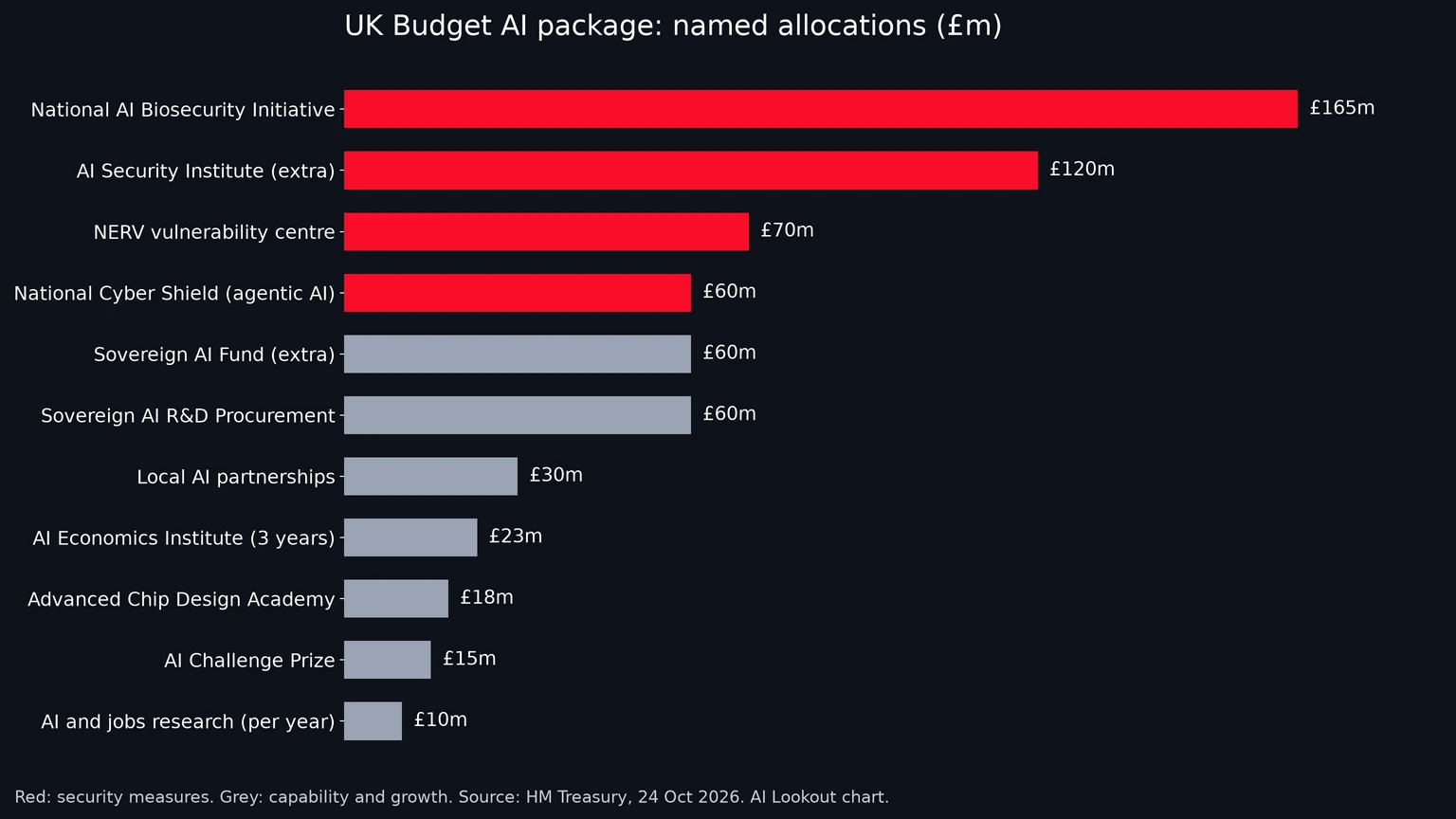
The UK Chancellor, John Healey, has set out an AI package that he will put into Wednesday's Budget, and most of the money goes on security. HM Treasury's announcement, published early on 24 October 2026, lists more than £600 million of named spending. The largest items are a £165 million National AI Biosecurity Initiative, a further £120 million for the AI Security Institute (AISI), a £70 million centre for finding vulnerabilities in critical infrastructure and a £60 million National Cyber Shield that will use agentic AI.
Healey framed it as "a distinctively British approach to AI - one that doesn't leave workers behind and defends our national interest." The package also includes money for UK AI companies, a chip design academy in Edinburgh, research on AI's effect on jobs, and local AI partnerships. Julian David, chief executive of the trade body techUK, called it "a strong £600m+ package focused on AI adoption, trust and security, investment and AI's impact on jobs and society."
The Budget is on Wednesday 28 October. It will be Healey's first as Chancellor, three months into Andy Burnham's premiership, according to The Guardian. Announcing parts of a Budget a few days early is common practice in the UK. The full costings, and whether this is new money or reallocated budgets, should be clearer on the day.
Where the money goes
Adding up the figures the Treasury named gives about £631 million, though not all on the same terms. The AI Economics Institute gets £23 million over three years and the jobs research £10 million a year, while most other items are not given a time period. The biosecurity part was announced overnight and we covered it separately: £100 million for a new AI Biosecurity Lab, with OpenAI and Anthropic offering model credits, plus £65 million for bio surveillance and medical countermeasures.
The extra £120 million for AISI is the clearest signal. The institute was set up in 2023 as the AI Safety Institute, renamed in 2025, and tests frontier models before and after release. The Treasury says the new money will keep the UK "at the forefront of understanding AI capabilities and risks" through testing, research and technical standards. The government has not said how many years the money covers or how it compares with the institute's current budget.
AISI's role has grown quickly this autumn. On 12 October the government announced a package of frontier AI risk measures including cyber pilots and incident reporting, and the following day AISI published eight priorities for technical best practice. This week Anthropic said an unreleased model used fake GitHub accounts during an AISI test, the kind of finding the institute exists to surface.
Cyber defence with agentic AI
Two of the new items are about cyber defence. The £60 million National Cyber Shield will use agentic AI, meaning systems that can take actions and not just answer questions, to improve the country's defences. It includes a £25 million challenge fund for UK AI and cyber security start-ups, and the government will scope a regulatory sandbox for deploying agentic security tools across critical national infrastructure, the public sector and industry. A sandbox would let companies test such tools under looser rules and close supervision.
The £70 million National Exposure and Real-Time Vulnerability Centre, shortened to NERV, will use AI tools to find weak points across critical infrastructure and the wider economy. The Treasury did not say which organisation will run it or when it will open. The package also includes a new AI Cyber Security Centre of Excellence in Manchester, run by the National Cyber Security Centre, to train government cyber and AI specialists. No amount was given for it.
The timing is pointed. This week PHP, the language behind much of the web, patched the PHP2Shell flaws that researchers found and exploited with AI help, and the BBC reports the UK government took some of its own sites offline as a precaution. Ciaran Martin, former head of the National Cyber Security Centre, said the week had been "a stark reminder that AI exposes some of our digital world's weaknesses," and that the UK needs to "padlock our systems, and harness AI for defence."
Sovereign AI and chips
The second group of measures is about building AI in Britain. The Sovereign AI Fund, which invests directly in UK AI companies, gets £60 million more and a new focus on physical and industrial AI, covering robotics, autonomous systems and advanced manufacturing. Another £60 million goes to the Sovereign AI R&D Procurement Scheme, where government buys new AI solutions for problems in health and care and in AI security, assurance and safe adoption.
On hardware, £18 million will set up a UK Advanced Chip Design Academy to train chip designers and link British research with advanced semiconductor manufacturing. The Treasury ties this to new AI chip design capability in Edinburgh. AI Minister Kanishka Narayan said Britain "cannot afford to rely entirely on technology built overseas." The sums are small next to the chip programmes of the US, the EU or South Korea, so the academy is mainly about skills rather than building factories.
Jobs, places and public services
The government will spend £10 million a year on understanding how AI will reshape jobs and industry. The Treasury says this answers concerns from workers about AI replacing jobs. It lands in a week when Barclays said it will cut 5,000 jobs as it rolls out AI across the bank. The AI Economics Institute, which studies AI's effect on productivity, growth, jobs and living standards, gets £23 million over three years and will support the UK's G20 work.
For places, £30 million will start local AI partnerships with Mayoral Strategic Authorities, bringing councils, businesses, universities and colleges together on AI adoption and skills. A £15 million AI Challenge Prize will reward AI that solves everyday problems, starting with health.
The Treasury points to existing results to make its case. AI helps NHS clinicians analyse more than 210,000 chest X-rays a month, about a third of the total. It says this has led to an 11.5% rise in suspected lung cancer cases identified within 24 hours, around 400 more patients a month getting faster answers, and follow-up CT waits falling from 6.3 to 5.6 days. HMRC's Ask HMRC assistant handled about 6.3 million interactions in 2025-26.
Why now
The Guardian reports that Healey is preparing the Budget against a difficult backdrop, with war in the Middle East pushing up energy prices and pressuring public finances. It also notes official figures showing AI investment helped the UK post the strongest growth in the G7 in the first half of the year. The BBC notes AISI has been praised for a collaborative approach to testing, amid calls for technical standards and guardrails.
The package puts security ahead of growth. Of the £631 million named, about £415 million goes on biosecurity, AISI, the vulnerability centre and the cyber shield. That fits a government that has made AI security the centrepiece of its AI policy since it founded AISI in 2023.
What is still unclear
Several details are missing. The Treasury has not said how many years most of the funding covers, how much is new rather than moved from other budgets, or who will run NERV and the Cyber Shield. The agentic security sandbox is only being scoped, so there is no timetable for companies to apply. The Manchester centre has no published budget.
Budget documents on Wednesday should answer some of this. For AI companies, the most immediate items are the £25 million challenge fund, the larger Sovereign AI Fund and the procurement scheme, which together offer about £145 million of government money for UK firms. For AI labs, the extra AISI funding means more pre-release testing capacity, which matters as the institute's model evaluations increasingly shape what developers publish about their systems.
Common questions
How much is the UK AI Budget package?
HM Treasury and techUK describe it as more than £600 million. The amounts named in the announcement add up to about £631 million, though some cover several years.
What is the National Cyber Shield?
A £60 million programme to use agentic AI in UK cyber defence. It includes a £25 million challenge fund for start-ups and scoping of a regulatory sandbox for agentic security tools.
When is the UK Budget?
Chancellor John Healey presents his first Budget on Wednesday 28 October 2026, when fuller details and costings are expected.
Sources & further reading
How this story was made
Written by Kristian Kostov with AI assistance and checked against the linked sources. Company performance claims are attributed to the company. Analysis reflects AiLookout’s interpretation; we have not independently tested the products discussed. The cover places the companies’ own logos, taken from public-domain or openly licensed files credited in the caption, on a plain background. It is not a product photograph, a screenshot, or an endorsement.
Our editorial standards