Announced 20 Oct 2026 · Sources checked
What Synaptics announced
Synaptics has launched a family of microcontroller chips built around Google Research's open-source Coral NPU, and put a Coral developer board on general sale. The company introduced the Astra SR200 Series on 20 October 2026, calling it the first in a new class it names the xMCU: a microcontroller that can run multimodal AI, meaning vision, voice and sensing, on the device itself.
In a second announcement the same day, Synaptics said its Coralboard SL, a development board built with Google Research, is now generally available from the distributor DigiKey after a limited first run, and that a new Coralboard SR based on the SR200 chips joins it.
The two launches matter for the same reason. Google designed Coral NPU as an accelerator that any chip maker can drop into a design for free. Synaptics says its SL2619 processor holds the first implementation of Coral NPU, and the SR200 now carries a second-generation version in a new chip family.
What the Coral NPU is
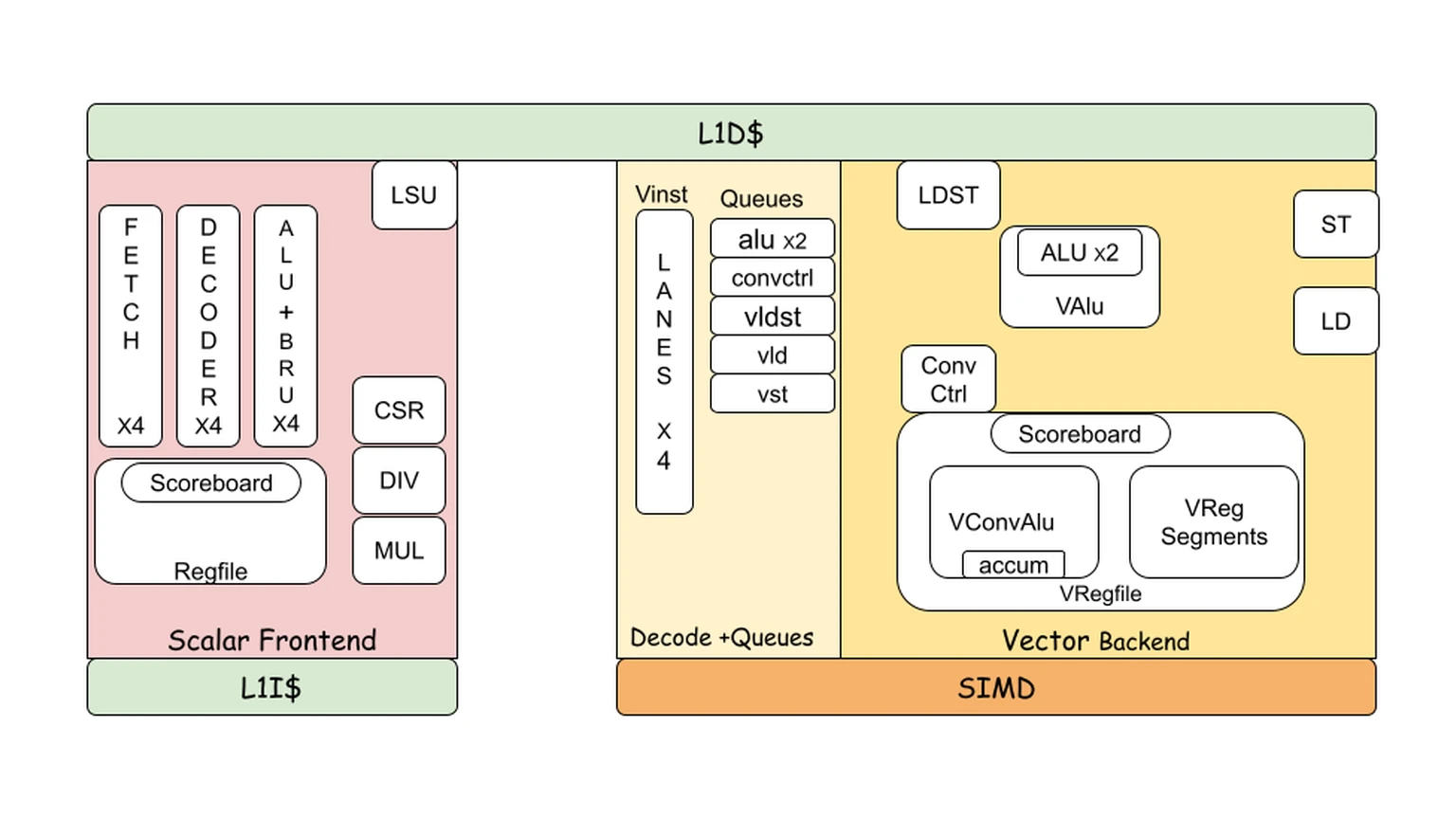
Coral NPU is a neural processing unit, a small processor specialised for running machine learning models. Its GitHub repository describes it as open-source hardware IP designed by Google Research and freely available for ultra-low-power chips in wearables such as earbuds, augmented reality glasses and smart watches. It is based on the 32-bit RISC-V instruction set and combines scalar, vector and matrix processing units.
The Coral name goes back to Google's earlier Edge TPU accelerators and boards. The new NPU is a different kind of project: a design that chip makers can license at no cost and build into their own silicon, with an open software stack, rather than a Google-made part.
RISC-V itself is gaining ground in AI hardware because anyone can implement it without paying for an instruction set licence; Jim Keller's Tenstorrent builds its AI processors on the same architecture. Billy Rutledge, a director at Google Research, said the SR200 brings “the second generation of the Coral NPU IP with RISC-V vector core support into silicon”.
Three SR200 chips
The SR200 Series launches with three pin-compatible chips that share a software development kit, so a product can move up or down the range without a new board design. Synaptics gives each one an AI performance figure in GOPS, billions of operations per second.
The SR210 is rated at 200 GOPS for power-optimised, always-on voice and sensing. The SR230 adds vision, display and optional audio at 300 GOPS for mainstream multimodal devices. The SR250 reaches 400 GOPS, with dual vision and display paths for more demanding products.
All three pair an Arm Cortex-M85 core running at up to 800MHz with a Cortex-M52 efficiency core, a combination Synaptics and Arm say is the first of its kind. An always-on domain handles voice activity detection and wake-up, and an optional Cadence Tensilica HiFi 5 DSP adds audio processing. Industrial versions add gigabit Ethernet with time-sensitive networking and two CAN-FD interfaces for factory equipment and robots. The chips run the Zephyr real-time operating system.
Memory is the selling point
Synaptics' main argument for the xMCU label is memory. Ordinary microcontrollers have a few megabytes of on-chip memory at most, which limits the AI models they can hold. The SR200 pairs up to 8MB of SRAM with integrated high-bandwidth custom DRAM that Synaptics says scales to hundreds of megabytes; the Coralboard SR specification lists up to 256MB.
Synaptics says this memory runs AI workloads at one-third the power of typical system DRAM and removes the need for external memory in most designs. Vikram Gupta, who runs its edge compute division, said the chips run multimodal AI workloads “that traditionally require Linux and discrete DRAM”. That is the pitch in one line: applications-processor tasks at microcontroller power and cost.
Security is built in as well. Synaptics lists hardware isolation, cryptographic acceleration, anti-tamper detection and secure boot, and says the design targets PSA Level 3 and Common Criteria EAL4+ certification. Those are targets, not certifications already granted.
Coralboard SL goes on sale
The Coralboard SL is the board developers can buy now. It uses the Synaptics Astra SL2619 processor, which Synaptics says contains the first implementation of the Coral NPU inside its 1 TOPS (trillion operations per second) Torq NPU, plus two Arm Cortex-A55 cores at 2GHz and a Cortex-M52.
The board has 2GB of DDR4 memory, a microSD slot, camera and display connectors, Qwiic and mikroBUS headers for sensors, add-on boards for HDMI, power, camera and microphones, and Wi-Fi and Bluetooth through an M.2 slot. DigiKey is the exclusive distributor, and orders opened on 20 October.
The Coralboard SR uses the top SR250 chip, with its 400 GOPS NPU, up to 8MB of SRAM and up to 256MB of DRAM, dual image signal processors, multiple cameras and digital microphones. Synaptics did not give prices for either board or a shipping date for the SR in its release.
An open compiler for the NPU
Both boards and all SR200 chips use Torq, Synaptics' compiler and runtime for its NPUs, which is built on the open MLIR and IREE compiler projects and published on GitHub as open source under Apache 2.0. Synaptics says Torq supports common machine learning frameworks and gives developers one path from optimising a model to deploying it, in place of the closed vendor toolchains most NPUs ship with.
Synaptics names three model families with day-one support: Google's Gemma 3 270M, which it says runs at up to 12 tokens per second with INT8 quantisation and 16 with 4-bit, Liquid AI's LFM2.5, and Ultralytics' YOLO26 vision models. Liquid AI has been pushing hard on small models, including its LFM2.5 agent model for laptops and desktops.
Daniel Chang, chief executive of the edge AI company ENERZAi and a Torq contributor, said NPU compilers “have largely been closed, black-box toolchains”. Synaptics also suggests that the open source code lets developers point AI coding agents at the compiler to add features and debug performance.
Who it is for
Synaptics aims the SR200 at AI wearables, battery-powered sensors, connected cameras, streaming devices and industrial vision and voice systems. Its release carries supportive quotes from Sonos, the home security company Verisure, which said it runs its own vision, voice and audio models on Astra processors, the smart glasses maker Jorjin and the network equipment company Accton. None of them announced an SR200 product.
On-device AI is having a moment at the small end. Model makers are shrinking models to fit phones and sensors, as with PrismML's ternary Bonsai 2 models, and Google DeepMind has built an on-device Gemma scam detector for Android. Chips like the SR200 are the other half: hardware cheap and frugal enough to run those models without a phone or a cloud connection.
Synaptics is also in the middle of a sale. Onsemi agreed in June to acquire the company, in a deal Synaptics said then was expected to close in mid-2027, subject to shareholder and regulatory approval.
What is missing
The announcements leave practical gaps. Synaptics gave no SR200 sampling or volume production dates, no chip or board prices, and no power figures for real workloads beyond the one-third DRAM power claim.
The performance numbers are Synaptics' own and come without benchmark details. GOPS ratings say little about how fast a given model runs, and the Gemma 3 270M token rates are for a very small model. Independent measurements will have to wait for the boards to reach developers.
The bigger test is whether other chip makers follow. Google's case for Coral NPU is a common, open accelerator that ends the fragmentation of edge AI hardware. One vendor with two boards is a start; a second licensee would show the idea is spreading.
Common questions
What is the Coral NPU?
An open-source neural processing unit design from Google Research, based on RISC-V, that chip makers can build into low-power chips for wearables and sensors at no licence cost.
What is the Synaptics Astra SR200 Series?
A family of three AI microcontrollers, the SR210, SR230 and SR250, that combine Arm cores, a Coral-based Torq NPU rated at 200 to 400 GOPS and integrated DRAM for running vision and voice models on the device.
Where can I buy a Coralboard?
Synaptics says the Coralboard SL is available to order from DigiKey from 20 October 2026. It did not give a price or a shipping date for the new Coralboard SR.
Sources & further reading
How this story was made
Written by Kristian Kostov with AI assistance and checked against the linked sources. Company performance claims are attributed to the company. Analysis reflects AiLookout’s interpretation; we have not independently tested the products discussed. The cover places the companies’ own logos, taken from public-domain or openly licensed files credited in the caption, on a plain background. It is not a product photograph, a screenshot, or an endorsement.
Our editorial standards